Nanna: The Norse Goddess Who Died of Grief for Baldr
Nanna was a Norse goddess known as the wife of Baldr and the mother of Forseti, the god associated with justice and reconciliation. In Snorri Sturluson’s Gylfaginning, she dies of grief at Baldr’s funeral and is cremated alongside him. Her story continues in the realm of Hel, where she sends gifts to Frigg and Fulla through the messenger Hermóðr.
A different version survives in Saxo Grammaticus’s Gesta Danorum. Rather than Baldr’s grieving wife, Nanna is portrayed as the mortal daughter of King Gewar, who rejects Balderus and marries his rival, Hotherus. The contrast reveals how differently medieval writers portrayed her identity and fate.
Who Was Nanna in Norse Mythology?
Nanna belonged to the Ásynjur, the goddesses associated with the Æsir. In Skáldskaparmál, Snorri Sturluson lists her among the goddesses attending a banquet welcoming Ægir to Asgard, alongside Frigg, Freyja, Iðunn, and others. Although she is absent from the separate catalogue of goddesses in Gylfaginning, chapter 35, her inclusion in the banquet establishes her place among the divine figures recognized by Snorri.
In Gylfaginning, chapter 32, Nanna is called Nepsdóttir, meaning “daughter of Nep” (Old Norse Nepr). Her father is otherwise an obscure figure, and nothing is recorded about her mother or early life. The same passage identifies Baldr as her husband and Forseti as their son.
Unlike Frigg or Freyja, Nanna has no clearly defined sphere of divine authority in the Eddic sources. Snorri assigns her no separate dwelling or particular powers, and the surviving accounts offer little information about her life before Baldr’s death.
How Did Nanna Die at Baldr’s Funeral?
In Gylfaginning, chapter 49, Snorri Sturluson describes how the Æsir prepare Baldr’s funeral aboard his ship, Hringhorni. The vessel is so large that the gods cannot launch it without the help of the giantess Hyrrokkin. When Baldr’s body is carried onto the ship, Nanna sees her dead husband and dies from grief.
Snorri uses the Old Norse words sprakk hon af harmi ok dó, meaning “she burst from grief and died.” Her body is placed on Baldr’s funeral pyre, which is then set alight. Thor consecrates the pyre with his hammer Mjölnir.
Nothing in the account suggests that Nanna took her own life or deliberately chose to die alongside Baldr. Her death is described as an overwhelming response to grief, not a ritual sacrifice or an obligation imposed on widows in Norse society.
Nanna in Hel: The Gifts She Sent to Asgard
Nanna’s story continues in Gylfaginning, chapter 49, when Hermóðr travels to Hel to seek Baldr’s release. He finds Baldr seated in the hall of the dead and stays overnight. Hel agrees to let Baldr return to Asgard only if everything in the world, living and dead, weeps for him.
Before Hermóðr departs, Baldr gives him the ring Draupnir to return to Odin as a keepsake. Nanna sends a linen garment and other gifts to Frigg, Baldr’s mother, and a gold finger-ring to Fulla, Frigg’s attendant.
These are Nanna’s last recorded actions in Snorri’s account. Although she remains in Hel, she can still send gifts to the gods in Asgard. Snorri offers no explanation for her choice of gifts or any particular symbolic meaning they might carry.
Nanna and Her Son Forseti
In Gylfaginning, chapter 32, Snorri Sturluson identifies Forseti as the son of Baldr and Nanna Nepsdóttir. Forseti presides over Glitnir, a hall where gods and humans bring their disputes and leave reconciled. Snorri calls it the finest place of judgment among gods and humans.
In Grímnismál, stanza 15, Glitnir is described as a hall supported by golden pillars and roofed with silver, where Forseti settles disputes. The poem does not name his parents, making Snorri’s account the explicit surviving source for his relationship with Nanna. No preserved myth describes her role in Forseti’s upbringing or his judicial activities.
Nanna in Saxo Grammaticus: A Different Story
Nanna, Hotherus, and Balderus
In Book III of Gesta Danorum, composed around 1200, Saxo Grammaticus portrays Nanna as the mortal daughter of King Gewar (Gevarus), rather than Baldr’s divine wife. She falls in love with Hotherus, a young warrior raised in her father’s household, whose courage and accomplishments in hunting, combat, and music have won her admiration.
Balderus, the son of Odin, becomes infatuated with Nanna after seeing her bathing. Recognizing Hotherus as a rival, he resolves to kill him. When Balderus later seeks Nanna’s hand in marriage, she refuses. She argues that the gulf between gods and mortals makes a lasting union impossible, adding that divine promises cannot always be trusted and that differences in status threaten such relationships.
After Hotherus defeats Balderus in battle, he marries Nanna and takes her to Sweden as his queen. The conflict continues, however, and Balderus eventually dies from a wound inflicted by Hotherus. Unlike Snorri’s account, Saxo’s narrative does not describe Nanna dying from grief at Baldr’s funeral.
Why Does Saxo’s Account Differ from the Edda?
Saxo’s narrative changes both the characters and their relationships. Hotherus, corresponding to the Norse Höðr, is a skilled human warrior rather than the blind god who unwittingly kills Baldr in Snorri’s account. Balderus becomes a rejected suitor whose rivalry with Hotherus leads to warfare. Nanna’s own wishes influence the conflict, and Saxo gives her a direct response to the god seeking her hand.
These differences belong to the wider literary approach of Gesta Danorum. Writing a Latin history for a Christian audience, Saxo adapted Scandinavian legendary material into narratives of rulers, warriors, and dynastic struggles. His treatment of the old gods also reflects medieval historical interpretation and the influence of classical literature.
Saxo’s Nanna cannot simply be combined with Snorri’s grieving goddess into a single biography. The accounts preserve substantially different versions of the tradition, and the surviving evidence does not establish which portrayal, if either, more closely reflects pre-Christian belief.
Nanna in the Old Norse Poems
In Hyndluljóð, stanza 20, a woman identified in modern editions as Nanna is named as the daughter of Nökkvi. The surviving manuscript, Flateyjarbók, actually reads Manna, which editors commonly amend to Nanna. The passage belongs to a genealogy recited by the giantess Hyndla for Óttarr and mentions a marriage connection between the woman’s son and Óttarr’s family. Neither Baldr nor Forseti appears in this passage, leaving the identification with Baldr’s wife uncertain.
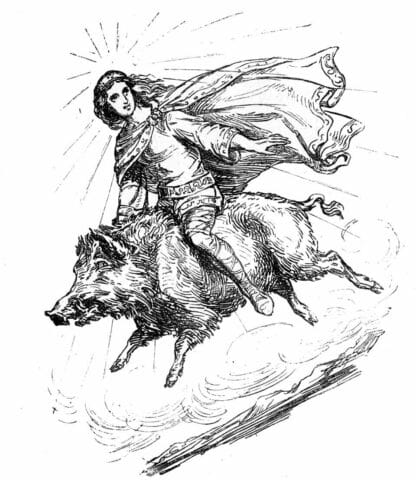
Another important poetic source is Húsdrápa, composed by Úlfr Uggason in late tenth-century Iceland. The poem describes mythological scenes carved in the hall of Óláfr pái at Hjarðarholt. Its surviving verses depict the gods approaching Baldr’s funeral pyre, including Freyr riding his golden-bristled boar and Heimdallr on horseback. A giantess also appears, helping to launch the funeral ship.
Nanna is not named in these surviving verses. Húsdrápa provides early evidence for the funeral tradition, but the account of Nanna dying from grief is preserved explicitly in Snorri’s Gylfaginning, not in the surviving poetry.
Read Also
What Does the Name Nanna Mean?
The origin of Nanna’s name is uncertain. One traditional explanation connects it with the Germanic root nanþ-, associated with courage or daring and related to the Old Norse verb nenna (“to strive”). Another treats it as a nursery-word formation, comparable to words for “mother” or “woman” in other languages.
In a 2023 study, linguist Riccardo Ginevra examined how the name may have been understood in Old Norse poetry. He argued that nanna meant “maiden,” citing Völuspá, stanza 30, where the plural nǫnnur Herjans (“Odin’s maidens”) refers to the valkyries. This poetic usage provides evidence for the name’s meaning in Old Norse, although it does not settle its earlier etymology.
Ginevra also reconsidered Nanna’s patronymic, Nepsdóttir, meaning “daughter of Nepr” or Nefr. He proposed tracing her father’s name to an Indo-European word for “sky” or “cloud,” interpreting the full name as “Maiden, Sky’s Daughter.” He compared this combination with the Vedic dawn goddess Uṣas and related imagery in Greek and Baltic traditions.
These comparisons suggest a possible connection with older Indo-European mythological traditions, but they do not establish that Nanna was worshipped as a dawn goddess in Scandinavia.
Was Nanna Worshipped in the Viking Age?
There is no secure evidence of an organized cult dedicated to Nanna in pre-Christian Scandinavia. No known sanctuary, offering, or place-name can be confidently associated with her worship. Although Snorri includes her among the Ásynjur, the surviving literary sources reveal little about her place in religious practice.
A possible clue comes from the Setre comb, discovered on the island of Bømlo in western Norway in 1932. The bone comb dates to approximately the late sixth or seventh century, before the Viking Age, and bears a disputed runic inscription. One interpretation reads part of the text as alu Nanna, alu Nanna, possibly invoking the goddess through a repeated formula.
In Runic Amulets and Magic Objects, Mindy MacLeod and Bernard Mees discuss the possibility that the inscription addresses Nanna and seeks her favour. Other scholars interpret the text as a love poem or personal charm, without any reference to a deity. The inscription therefore remains uncertain evidence for religious devotion to Nanna, and cannot establish that she received organized worship or had a particular divine responsibility.
Conclusion
Nanna’s surviving stories preserve two very different portrayals. In Snorri Sturluson’s Edda, her fate is closely tied to Baldr’s death, although her gifts from Hel show that her role does not end at his funeral. Saxo Grammaticus instead presents a mortal woman whose rejection of Balderus shapes the conflict with Hotherus.
Neither account establishes how Nanna was understood in pre-Christian Norse religion. The limited poetic evidence and disputed Setre inscription leave her earlier religious significance and possible worship uncertain. Nor can we determine which medieval portrayal more closely reflects the traditions that preceded them.
Academic Sources & Primary Texts
- Sturluson, Snorri.
Edda: Prologue and Gylfaginning.
Edited by Anthony Faulkes, 2nd ed.
Viking Society for Northern Research, 2005.
Chapters 32, 35, and 49.
Read source. - Sturluson, Snorri.
Edda: Skáldskaparmál.
Edited by Anthony Faulkes.
Viking Society for Northern Research, 1998.
Includes references to Nanna and verses from
Úlfr Uggason’s Húsdrápa.
Read source. - Saxo Grammaticus.
Gesta Danorum: The History of the Danes.
Edited by Karsten Friis-Jensen and translated
by Peter Fisher. Oxford University Press, 2015.
Book III, the account of Nanna, Hotherus,
and Balderus.
View academic edition. - Pettit, Edward, ed. and trans. (2023).
The Poetic Edda: A Dual-Language Edition.
Open Book Publishers.
Hyndluljóð, stanza 20;
Grímnismál, stanza 15; and
Völuspá, stanza 30.
Read source. - Marold, Edith, ed. (2017).
“Úlfr Uggason, Húsdrápa.”
In Poetry from Treatises on Poetics,
edited by Kari Ellen Gade and Edith Marold.
Skaldic Poetry of the Scandinavian Middle Ages,
vol. 3. Brepols.
Read critical edition. - Ginevra, Riccardo (2023).
“The Myth of Baldr’s Death and the Vedic
Wounded Sun: The Old Norse Theonyms
Nanna Neps-dóttir and Hǫðr in Germanic
and Indo-European Perspective.”
In Castalia: Studies in Indo-European
Linguistics, Mythology, and Poetics.
Brill, pp. 80-105.
View study. - MacLeod, Mindy, and Bernard Mees (2006).
Runic Amulets and Magic Objects.
Boydell Press, pp. 23-24.
Discussion of the Setre comb inscription
and its possible reference to Nanna.
View publication. - RuneS: Runic Writing in the Germanic Languages.
“Setre, Comb (N KJ40).”
Academic database of runic inscriptions,
including archaeological information,
transliteration, and dating.
View inscription record.
Copyright & Content Notice
© 2026 History & Myths.
All rights reserved.
Written by H. Moses.
This article presents original historical and
mythological analysis based on primary texts
and academic research. Reproduction or
redistribution of the original article without
permission is prohibited.
Ancient myths remain in the public domain.
Referenced works and images retain their
respective copyright and licensing terms.