Völundarkviða: The Smith’s Revenge in Norse Mythology
Völundarkviða (The Lay of Völundr) is an Old Norse poem preserved in the Poetic Edda. It tells the story of Völundr, a legendary master smith known in Old English tradition as Wayland the Smith. After his swan-maiden wife leaves, King Níðuðr captures him, seizes his possessions, and holds him prisoner. His leg tendons are severed to prevent his escape, and he is forced to work for the king.
Völundr takes a brutal revenge. He murders the king’s sons, turns their remains into valuable objects, and sexually assaults Níðuðr’s daughter, Böðvildr, before flying away. The poem combines supernatural figures and events with a grim tale of captivity and revenge drawn from Germanic heroic tradition.
What Is Völundarkviða?
Völundarkviða means “The Lay of Völundr.” The poem survives chiefly in Codex Regius (GKS 2365 4to), an Icelandic manuscript copied around 1270, where it appears between Þrymskviða and Alvíssmál. Its author is unknown, and the surviving manuscript does not establish when the poem was originally composed.
The text combines poetic stanzas with prose passages that introduce characters and connect events. The prose introduction identifies the swan maidens as valkyries, while the verses give Völundr titles associated with the álfar (elves). One of these, vísi álfa, is often translated as “prince of the elves,” although scholars disagree about its precise meaning. The poem does not identify Völundr as one of the Æsir, the principal Norse gods.
Völundr and the Three Swan Maidens
The story begins in Úlfdalir (Wolf-Dales), where Völundr and his brothers, Egill and Slagfiðr, settle near Lake Úlfsjár. The prose introduction describes the three brothers as sons of a king of the Finnar, a term commonly used for the Sámi in Old Norse sources. They travel on skis and hunt wild animals.
One morning, they find three women spinning flax beside the lake, with swan-feather garments lying nearby. The prose identifies them as valkyries: Hlaðguðr Svanhvít (Swan-White), Hervör Alvitr, and Ölrún. Egill takes Ölrún as his wife, Slagfiðr takes Svanhvít, and Völundr marries Hervör Alvitr.
The couples live together for seven winters. According to the prose introduction, the women then fly away in search of battles and never return. The verses give a different sequence: longing draws the women away in the eighth year, and separation comes in the ninth. They yearn for the dark forest and the destiny awaiting them.
Egill travels east in search of Ölrún, while Slagfiðr heads south after Svanhvít. Völundr remains in Úlfdalir, crafting gold rings and threading them onto strips of bark. He continues his work while waiting for Alvitr, hoping she will return.
How King Níðuðr Captured and Maimed Völundr
King Níðuðr, lord of the Njárar, learns that Völundr is living alone in Úlfdalir and sends armed men to his home at night. While the smith is away hunting, they enter his hall and find seven hundred gold rings strung on strips of bark. They take the rings down but replace all except one.
Völundr returns, prepares a meal of bear meat, and sits down to count his rings. Finding one missing, he believes Hervör Alvitr has returned. He falls asleep, only to awaken with his hands bound and his feet shackled. Níðuðr demands to know how he obtained the gold, claiming the treasure belongs to him.
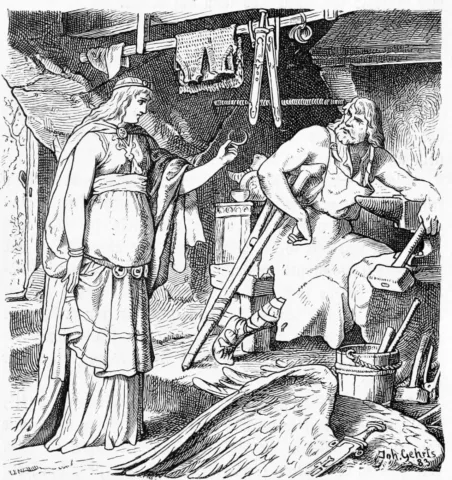
The king takes Völundr’s sword and gives the stolen ring to his daughter, Böðvildr. When the queen sees the smith’s anger at recognizing his possessions, she compares his eyes to those of a glittering serpent. She orders the tendons behind his knees to be cut so he cannot escape.
Völundr is then imprisoned on Sævarstaðr, a small island off the coast, where he must forge precious objects for Níðuðr. The accompanying prose states that no one dares approach him except the king himself.
The Murder of Níðuðr’s Sons
Níðuðr’s two young sons visit Völundr at his forge on Sævarstaðr. They find a chest filled with gold and precious stones and ask for the keys. Völundr promises them some of the treasure if they return alone the next day, warning them not to mention their visit to anyone in the royal household.
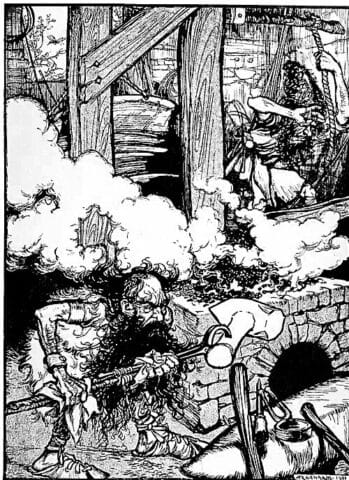
The brothers return as instructed. When they open the chest, Völundr cuts off their heads and conceals their remains beneath the bellows of his forge. He then uses parts of their bodies to make gifts for the royal family.
He mounts their skulls in silver and sends them to Níðuðr, apparently as drinking vessels. From their eyes he fashions precious stones for the queen, and from their teeth, brooches for Böðvildr. The recipients remain unaware of what they have received.
Völundr has turned the craftsmanship Níðuðr sought to exploit into an instrument of revenge, making the king accept objects fashioned from his own sons’ remains.
Vali: The Norse God Born to Avenge Baldr
Böðvildr, the Broken Ring, and Völundr’s Revenge
Böðvildr visits Völundr after damaging the gold ring her father had taken from him. Afraid to reveal what happened, she asks the smith to repair it. Völundr promises to make the ring so beautiful that her parents will consider it better than before.
He gives her beer until she falls asleep, then sexually assaults her. The poem does not describe the assault directly, but Völundr later tells Níðuðr that his daughter is pregnant. When questioned by her father, Böðvildr confirms that she was unable to resist him.
Unlike Níðuðr and his queen, Böðvildr played no part in Völundr’s imprisonment or mutilation. Yet she becomes a victim of his revenge, drawn into his plans through the very ring her father had stolen.
Völundr’s Escape and the End of the Poem
Völundr rises into the air, laughing as he escapes his island prison. Böðvildr leaves in tears, distressed by his departure and fearing her father’s anger. Although the smith’s leg tendons have been severed, the poem never explains how he manages to fly.
Níðuðr, grieving for his sons, demands to know what happened to them. Before answering, Völundr insists that the king swear not to harm his wife or any child of his, even if they are within the royal household.
He then directs Níðuðr to the bloodstained bellows in his workshop and reveals that he murdered the princes. He explains how he fashioned their remains into gifts for the royal family and announces that Böðvildr is pregnant.
Níðuðr wishes to punish him but admits that no one can reach him or shoot him down. Völundr flies away, leaving the king behind in grief.
The poem ends with Níðuðr questioning Böðvildr about her time on the island. She confirms what happened and tells her father that she had neither the knowledge nor the power to resist Völundr. Her testimony closes the story, leaving her future and that of her unborn child unknown.
Völundr and Wayland the Smith in Germanic Tradition
Völundr also appears in other Germanic traditions. He is known as Weland in Old English literature and as Velent in Þiðreks saga. These accounts preserve familiar elements of his story, although their details and endings differ.
Wayland in Old English Literature: Deor
The Old English poem Deor, preserved in the tenth-century Exeter Book, recalls Weland’s suffering under King Nithhad, who held him captive in sinew bonds. It then turns to Beadohild, whose distress over her pregnancy exceeds even her grief at her brothers’ deaths.
Unlike Völundarkviða, Deor does not narrate the revenge. Instead, it uses Weland and Beadohild as examples of suffering within a poem whose recurring refrain expresses the hope that hardship will pass. Its brief references suggest that the poet expected his audience to recognize the characters and their story.
The Franks Casket and the Ardre Picture Stone
The legend also appears in early medieval carvings, centuries before the surviving manuscript of Völundarkviða.
The Franks Casket, an Anglo-Saxon whalebone chest dating to the early eighth century, depicts Weland at his forge, holding what is generally interpreted as a human skull in his tongs. A headless body lies nearby. The scene shares the front panel with the Christian Adoration of the Magi, placing Germanic legend and biblical imagery side by side.
The Viking Age Ardre VIII picture stone from Gotland, Sweden, contains another probable depiction of the legend. Its carvings show a smithy, two headless figures, and a large bird interpreted as Völundr escaping. Although some details remain disputed, the combination of these images strongly supports their identification with the smith’s story.
Wayland in Þiðreks saga
A fuller version survives in the thirteenth-century Þiðreks saga, an Old Norse work drawing on Germanic heroic traditions. Here the smith is called Velent, and his brother Egill helps him escape by collecting feathers for a flying garment.
Velent prepares for the possibility that the king will order Egill to shoot him down. He fastens a bladder filled with blood beneath his arm and instructs his brother to aim at it. Egill’s arrow strikes the bladder, convincing the king that the escaping smith has been wounded.
The saga gives Velent a different ending. After the king’s death, his successor Otvin makes peace with the smith and arranges his marriage to the princess, who has borne Velent a son named Viðga. Neither this reconciliation nor the marriage appears in Völundarkviða, which ends with Böðvildr’s testimony.
Hodr: The Blind Norse God Who Killed Baldr
When and Where Was Völundarkviða Composed?
Neither the date nor the place of composition of Völundarkviða can be established with certainty. Certain words and features of its metre suggest Old English influence, although this may reflect how the poem was transmitted rather than where it was first composed.
John McKinnell argues that the poem originated in a Norse-speaking community in northern England, possibly Yorkshire, during the tenth or early eleventh century. Ursula Dronke, while acknowledging its Old English elements, proposed a Norwegian origin, drawing on an earlier English poem about Weland that has not survived. Both interpretations remain hypotheses, since the surviving evidence cannot establish a definite place or date of composition.
Why Völundarkviða Combines Myth and Heroic Legend
Although Völundarkviða appears among the mythological poems of the Poetic Edda, no Norse gods take part in its story. Its supernatural elements come from the swan maidens, Völundr’s association with elves, and his unexplained ability to fly. The central conflict belongs more closely to Germanic heroic legend, involving a powerful king, an imprisoned craftsman, and a violent struggle for revenge.
Scholars have identified two traditional narrative patterns within the poem: the supernatural bride who leaves her husband and the captive smith who takes revenge on his oppressor. These stories may have developed separately, but the surviving poem connects them through recurring details. The swan maidens’ flight finds an echo in Völundr’s escape through the air. The gold ring he makes while awaiting his wife later passes to Böðvildr, whose attempt to have it repaired brings her to his forge. Both details link the opening story of separation to the later events of captivity and revenge.
Conclusion
Völundr escapes the king who imprisoned and mutilated him, but Völundarkviða offers no simple restoration of justice. His revenge claims the lives of Níðuðr’s sons and leaves Böðvildr to face the consequences of an assault she could not resist. The poem closes with her testimony rather than a celebration of the smith’s freedom, leaving a troubling contrast between his extraordinary abilities and the suffering he inflicted.
Sources & Primary Texts
This article draws on the Old Norse text of Völundarkviða, comparative Germanic literature, and archaeological evidence. The following sources distinguish the surviving medieval accounts from modern scholarly interpretations.
Primary Texts and Editions
- Pettit, Edward (2023). Völundarkviða, in The Poetic Edda: A Dual-Language Edition, pp. 341–364. Open Book Publishers. Old Norse text, English translation, and scholarly commentary. Read the edition.
- Marsden, Richard (2004). Deor, in The Cambridge Old English Reader, pp. 317–321. Cambridge University Press. An edition of the Old English poem referring to Weland and Beadohild. View the edition.
Academic Studies
- McKinnell, John (1990). “The Context of Völundarkviða.” Saga-Book, Vol. XXIII, pp. 1–27. Viking Society for Northern Research. Examines the poem’s linguistic features, possible origins, and literary structure. Read the study.
- Robertson, Isobel Rennie (2020). Wayland Smith: A Cultural-Historical Biography. PhD thesis, University of Leeds. A comparative study of Wayland’s appearances in literature and art, including violence, captivity, and cultural transmission. Read the thesis.
- Hall, Alaric (2007). Elves in Anglo-Saxon England: Matters of Belief, Health, Gender and Identity. Boydell Press. Provides linguistic and religious context for early Germanic elf traditions. View the book.
Archaeological Evidence
- British Museum. The Franks Casket. An early eighth-century Anglo-Saxon carved whalebone chest featuring scenes associated with Wayland the Smith. Museum documentation.
- Gotlandic Picture Stones, Gotlands Museum. GP 21 Ardre kyrka VIII. Archaeological documentation and interpretation of the picture stone, including scenes associated with Völundr. Explore the archaeological record.
Copyright & Image Credits
© 2026 History & Myths. Original article text and historical analysis by History & Myths. Medieval texts and historical artifacts discussed in this article belong to the cultural and historical record. Images, where used, are credited to their respective creators or institutions according to their applicable licenses. Modern illustrations are identified as artistic interpretations rather than historical evidence.