The Banshee (Bean Sí): A Wailing Death Omen in Irish Folklore
In Irish folklore, the banshee (bean sí) is a supernatural woman whose mournful cry is believed to warn of an approaching death in a family. Her Irish name means “woman of the fairy mound,” linking her to the Aos Sí, the supernatural beings associated with Ireland’s fairy mounds. Despite her frightening reputation, the banshee traditionally announces death rather than causing it.
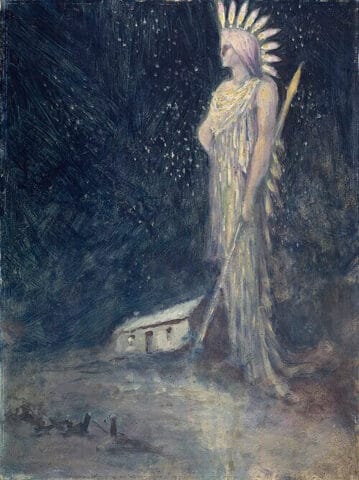
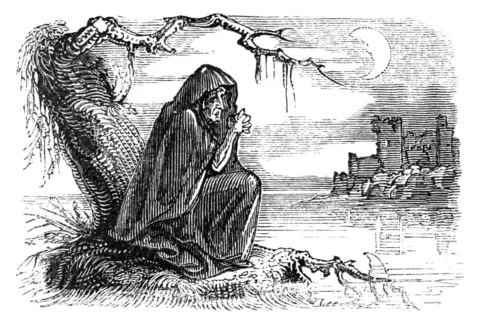
In some accounts, only her wailing is heard. Others describe her as a young woman or an elderly figure, often with long, loose hair. Her lament resembles keening, the traditional Irish practice of mourning the dead, and many local traditions associate her with particular families whose deaths she is believed to foretell.
What Is a Banshee? The Meaning of Bean Sí
The English word banshee derives from the Irish bean sí, formerly written bean sidhe, and the Old Irish ben síde. The name combines bean (woman) with sí, a term associated with the ancient mounds believed to house supernatural beings. It is commonly translated as “fairy woman” or “woman of the fairy mound.”
These beings were known collectively as the Aos Sí, inhabitants of a supernatural realm closely connected to the Irish landscape. The word fairy here refers to figures from traditional belief, not the small, winged creatures of modern children’s stories.
The banshee is not a single named character with a fixed biography. Patricia Lysaght’s research identifies her primarily as a solitary female being of the Otherworld. Some local traditions associate her with the spirits of deceased women or female ancestors, but no single explanation of her identity accounts for every recorded belief.
The Banshee’s Cry: Keening and the Warning of Death
The banshee’s cry was not always described as a scream. In Irish folklore, it could sound like quiet sobbing, a prolonged lament, or a piercing shriek heard at night near a house or along a road. Some accounts describe repeated cries over several nights, while others tell of a single warning shortly before news of a death arrived.
These descriptions closely resemble caoineadh, the traditional Irish practice of keening at wakes and funerals. Women known as mná caointe, sometimes professional mourners, expressed grief through vocal cries and rhythmic or improvised verses, often praising the deceased. Unlike human mourners lamenting someone already dead, the banshee was believed to keen before or around the time of death.
In parts of Counties Limerick, Kilkenny, and Tipperary, she was also called bean chaointe, meaning “keening woman.” The shared language reflects the close relationship between supernatural death warnings and traditional Irish mourning, although it does not establish that one practice originated directly from the other.
What Does the Banshee Look Like?
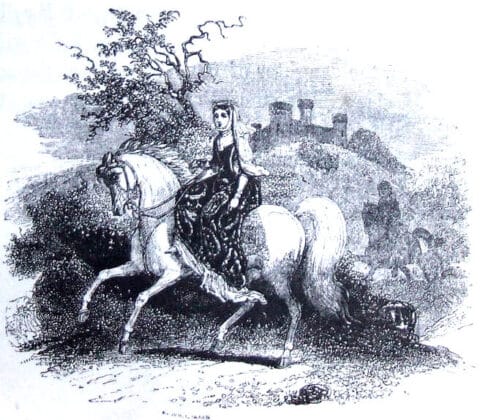
Irish folklore gives the banshee no single appearance. Many accounts describe a small, elderly woman with long white or grey hair, dressed in black, white, or a pale cloak. Others portray her as young and beautiful, with flowing hair and clothing in white, grey, or red.
A markedly different description appears in the Irish Schools’ Collection from Gleann Draoi in County Clare. There the banshee is a tall, thin woman with long brown hair, wearing a red dress and cloak. She is sometimes seen beside a river, mourning and combing her hair.
The comb itself became a recurring feature in some banshee traditions. Stories from different parts of Ireland warn against picking up a comb found outdoors, as it may belong to the supernatural woman who will come back for it. Patricia Lysaght’s research, however, shows that this motif was not universal and appears more strongly in some regions than in others.
Which Irish Families Were Associated with the Banshee?
In many Irish traditions, the banshee was believed to follow a particular family across generations, mourning when one of its members was approaching death. Some accounts even describe her announcing the death of someone living abroad to relatives who remained in Ireland.
The belief was especially associated with old Gaelic families, including the O’Briens and O’Connors. Some traditions held that the banshee followed only families whose surnames began with Ó or Mac, but recorded accounts show a more complicated picture. The FitzGeralds, a family of Anglo-Norman origin long established in Ireland, were also associated with her. Having a banshee could be regarded as a sign of ancestral standing, although there was no universally accepted list of families entitled to one.
Nor was the tradition restricted to noble households. An account in the Irish Schools’ Collection from County Limerick names the Sheedys, described as humble working people, alongside the wealthy Lyons family, whose English ancestry the narrator specifically mentions. Such examples show that local beliefs did not always conform to rules about Gaelic surnames or noble descent.
Where Did the Banshee Tradition Come From?
The banshee’s origins cannot be traced to a single event or figure. Medieval Irish literature contains supernatural women who mourn dead heroes or foretell their deaths. Folklorist Patricia Lysaght distinguishes two related traditions: ben síde texts, featuring women of the fairy mounds who lament fallen or doomed heroes, and badb texts, associated more closely with death in battle. Some relevant texts may date to the eighth century, although their precise relationship to the later banshee remains open to interpretation.
A recognizable account of the family death-messenger appears in the memoirs of Ann Fanshawe. Recalling a visit to Lady Honora O’Brien in the mid-seventeenth century, Fanshawe described hearing a cry and seeing a female apparition at her window, followed by news of a death in the household. She wrote her memoirs in 1676, although they were not published until 1829.
Most detailed evidence for regional banshee beliefs comes from oral traditions collected during the nineteenth and twentieth centuries. These accounts suggest a long association between supernatural women, family identity, and mourning, but do not establish that the banshee descended from a particular pagan goddess or developed directly from funeral keening.
Banshee Stories Recorded in Irish Folklore
The Irish Schools’ Collection, compiled in the late 1930s, preserves accounts of banshee encounters passed down through families and local communities. Some describe warnings believed to have preceded a death, while others tell of dangerous encounters with the supernatural woman.
One account from Kilcash, County Tipperary, was collected by James Halpin from Mrs. Halpin of Boolagh. While a man named O’Brien lay ill, neighbours keeping watch with his family heard what sounded like a child crying in the yard. One of them, a man named Meany, went outside and saw a woman beside a stile, weeping and combing her hair. O’Brien died the following day.
Another story concerns the Kavanagh family of Ballyvourney in County Cork. A married woman living in Bandon heard a lonely cry that she recognized as the banshee’s. Although she knew of no recent death among her relatives, the sound troubled her. The following day, she learned that her father had died. The story was related by one of her daughters, who also believed in the banshee.
A tale recorded by Joe McGann at Coolbock, County Sligo, follows an elderly man returning home late from a card game. As he crosses a stile, he sees an old woman sitting on a stone and combing her hair. She runs away, leaving behind a golden comb, which he takes home. Later that night, his wife wakes him, believing a cat is making noise outside their window. Looking out, the man finds the banshee demanding her comb. He throws it back, and she warns him that he was fortunate not to put his hand outside.
The Banshee, the Badb, and the Washer at the Ford
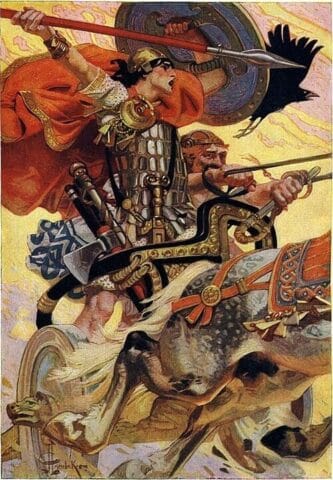
In medieval Irish literature, the Badb is associated with warfare and prophecies of death. In Togail Bruidne Da Choca (The Destruction of Da Choca’s Hostel), she appears as a woman dressed in red, washing a chariot, its cushions, and its harness at a river crossing. When Cormac Conloinges questions her, she reveals that the chariot belongs to him and foretells his death. Her warning concerns a warrior facing destruction, rather than a family’s approaching loss.
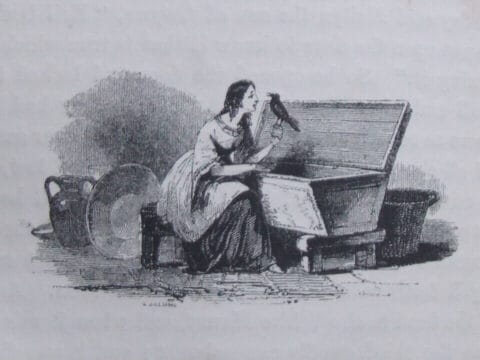
Scottish Gaelic folklore preserves a related figure called the bean nighe, meaning “washing woman.” She appears beside streams or fords, washing the clothing or burial shrouds of people destined to die. John Gregorson Campbell recorded Highland traditions in which someone who approached her without being noticed could learn whose death she was foretelling. In some accounts, the washing women were believed to be spirits of women who had died in childbirth.
Campbell also describes the bean nighe as a form of the bean shìth, the Scottish Gaelic counterpart of the banshee. The traditions therefore overlap, particularly in their association with impending death. Their similarities, however, do not establish that the Irish family banshee descended directly from the medieval Badb.
How the Banshee Changed in Modern Culture
Modern films, fantasy literature, and games have often transformed the banshee from a supernatural mourner into a frightening ghost or dangerous creature. Her distinctive cry remains, but its meaning has changed in many portrayals.
In Disney’s Darby O’Gill and the Little People (1959), the banshee appears as a ghostly apparition associated with approaching death. In the 2014 fifth-edition rules of Dungeons & Dragons, she becomes an undead spirit whose wail can reduce those who hear it to zero hit points if they fail a saving throw. What traditionally warned a family of death has become a potentially deadly supernatural attack.
Conclusion
The banshee’s cry was feared because it warned of a death that could not be prevented. In Irish folklore, her connection to particular families made her part of their remembered losses and inherited traditions. Accounts collected across Ireland place her near familiar homes, roads, and waterways, where an unexplained sound or appearance could become a warning of approaching death. These stories preserve not only a belief in the supernatural, but also the ways Irish communities understood mourning and family ties.
Sources & Primary Texts
This article draws on academic studies of Irish folklore, historical accounts, and oral traditions preserved in the National Folklore Collection. Recorded encounters are treated as evidence of traditional beliefs, not as verified supernatural events.
Academic Studies
- Lysaght, Patricia (1986). The Banshee: The Irish Supernatural Death-Messenger. Dublin: Glendale Press. The foundational study of banshee beliefs, including their origins, regional variations, family associations, and oral traditions. National Library of Ireland.
- Darwin, Gregory R. “The Mermaid and the Banshee in Gaelic Folk Tradition.” BABEL: Civilisations et sociétés, Vol. 21. Examines supernatural female figures in Irish and Scottish traditions, their relationships with families, and parallels with medieval Irish literature. Read the academic study.
- Mc Laughlin, Mary (2019). “Keening the Dead: Ancient History or a Ritual for Today?” Religions, 10(4), 235. Explores traditional Irish funeral lamentation, professional keeners, and the changing role of keening in Irish society. Read the study.
Historical and Literary Sources
- Fanshawe, Ann (1676). The Memoirs of Ann, Lady Fanshawe. First published in 1829. Contains a seventeenth-century account of a supernatural death warning associated with the O’Brien family. Folger Shakespeare Library, manuscript record.
- Stokes, Whitley (1900). “Da Choca’s Hostel.” Revue Celtique, Vol. 21. Edition and translation of the medieval Irish tale describing the Badb and her warning of Cormac Conloinges’ death. University College Cork, text references.
- Campbell, John Gregorson (1900). Superstitions of the Highlands and Islands of Scotland. Glasgow: James MacLehose and Sons. See “The Bean Nighe, or Washing Woman” for Scottish Gaelic traditions concerning supernatural death omens. Read the historical collection.
Irish Folklore Archive: Original Recorded Accounts
The following accounts come from The Schools’ Collection, compiled in Ireland during the late 1930s and preserved by the National Folklore Collection, University College Dublin.
- The Banshee, County Tipperary. Collected by James Halpin from Mrs. Halpin of Boolagh. Describes a reported banshee encounter preceding the death of a man named O’Brien. Volume 0557, page 558. Read the original account.
- The Banshee, County Cork. Collected by Sr. H. J. A family account involving the Kavanaghs of Ballyvourney and a death warning heard in Bandon. Volume 0378, page 118. Read the original account.
- The Banshee, County Sligo. Collected by Joe McGann at Coolbock. Records a traditional story about a man who takes a supernatural woman’s golden comb. Volume 0179, page 541. Read the original account.
- The Banshee, County Limerick. Collected by Mary Devaney. Documents local beliefs associating the banshee with the Sheedy and Lyons families. Volume 0507, page 518. Read the archival record.
- The Banshee, County Clare. Recorded at Gleann Draoi. Describes a tall woman with brown hair and red clothing, sometimes seen combing her hair beside a river. Volume 0590, page 167. Read the archival record.
Irish Language Reference
- Ó Dónaill, Niall (1977). Foclóir Gaeilge–Béarla. Irish-English dictionary, consulted for the meaning of bean sí and related terminology. Consult the dictionary.
Copyright
© 2026 History & Myths. Original article text and historical analysis by History & Myths. Traditional Irish folklore and historical accounts discussed in this article form part of the cultural record. Archival materials are attributed to their respective collections and sources. Images are credited to their creators or institutions according to their applicable licenses. Modern illustrations, where used, are artistic interpretations rather than historical evidence.