Magni and Móði: Thor’s Sons Who Inherit Mjölnir
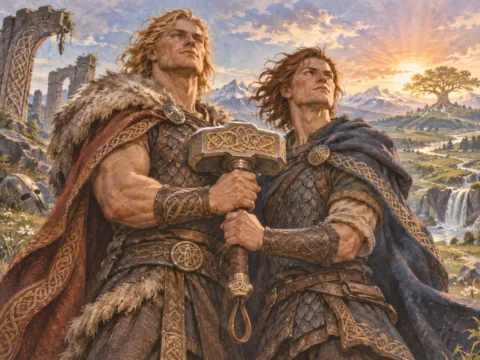
Magni and Móði (Modi) are Thor’s sons in Norse mythology. Both survive Ragnarök and inherit his hammer, Mjölnir, after his death. Their names appear in the Poetic Edda and Prose Edda, although the surviving texts reveal far more about Magni than his brother.
Magni, the son of Thor and the giantess Járnsaxa, is remembered for his extraordinary strength. He rescued his father after the giant Hrungnir fell upon him during their battle. Móði has no comparable surviving adventure, and the medieval sources do not identify his mother.
Who Were Magni and Móði in Norse Mythology?
In Skáldskaparmál, Snorri Sturluson names Magni and Móði among Thor’s children, alongside his daughter Þrúðr (Thrud). All three belong to the divine family of the Æsir, although their mothers are not necessarily the same.
Magni’s mother was Járnsaxa, a jötunn (giantess), while Þrúðr was the daughter of Thor’s wife, Sif. The surviving texts do not identify Móði’s mother. Some modern accounts name Sif or describe Magni and Móði as full brothers, but neither claim can be confirmed from the medieval sources.
Their Old Norse names suggest qualities associated with Thor. Magni is related to magn, meaning strength or might, while Móði derives from móðr, a word associated with courage, spirit, and anger. Scholars have interpreted the brothers as personifications of their father’s strength and fighting spirit, although the names alone do not establish separate divine powers or responsibilities.
Where Are Magni and Móði Mentioned in the Norse Sources?
The surviving references to Magni and Móði come from Old Norse poetry and Snorri Sturluson’s Prose Edda. In the poems, their names frequently serve to identify Thor rather than introduce stories about the brothers themselves.
In Hárbarðsljóð, stanzas 9 and 53, Thor calls himself Magni’s father during an argument with the ferryman Hárbarðr. Hymiskviða, stanza 34, similarly refers to Thor as Móði’s father while describing his struggle to lift the giant Hymir’s enormous cauldron.
An earlier poetic reference to Magni appears in Þórsdrápa, composed by the tenth-century skald Eilífr Goðrúnarson. The poem uses “father of Magni” as a poetic designation for Thor. Although preserved in later manuscripts of Snorri’s Edda, this verse provides evidence that Magni’s name was known in Scandinavian poetry before Snorri wrote his mythological accounts.
The brothers appear together in Vafþrúðnismál, stanza 51, which foretells their possession of Mjölnir after Ragnarök. Snorri develops their stories further in two parts of the Prose Edda: Skáldskaparmál preserves the account of Magni rescuing Thor from Hrungnir, while Gylfaginning, chapter 53, describes both brothers in the renewed world.
These sources provide a clear picture of the brothers’ place in Norse mythology, even though they preserve few details of their individual lives.
How Did Magni Save Thor from Hrungnir?
Magni’s rescue of Thor is told in Skáldskaparmál. The story begins with a dispute between Odin and the giant Hrungnir over their horses, Sleipnir and Gullfaxi. Hrungnir pursued Odin into Asgard, where the gods offered him drink. Once intoxicated, he began threatening them. Thor confronted the giant, but Hrungnir insisted that he was an unarmed guest under Odin’s protection. They agreed to settle their dispute in a formal duel.
The fight took place at Grjótúnagarðar. Hrungnir carried a massive whetstone and a stone shield, while the giants had prepared a second fighter, Mökkurkálfi, a clay figure with a mare’s heart. Thor’s servant Þjálfi arrived ahead of him and warned Hrungnir that Thor intended to attack from underground. Deceived, the giant placed his shield beneath his feet, leaving himself exposed.
Thor approached amid thunder and lightning and hurled Mjölnir at Hrungnir. The giant threw his whetstone in return. The weapons collided in midair, shattering the stone. One fragment struck Thor’s head, causing him to fall, while Mjölnir smashed Hrungnir’s skull. The dying giant collapsed over Thor, trapping his neck beneath an enormous leg. Meanwhile, Þjálfi defeated Mökkurkálfi.
Neither Þjálfi nor the assembled Æsir could lift Hrungnir’s leg. Magni then arrived and threw it off his father. His age differs between manuscripts: the Codex Regius gives three years, while other versions describe him as only three nights old. Magni even declared that he could have killed Hrungnir with his fist had he reached the battlefield earlier.
Thor welcomed his son and predicted that he would grow mighty. As a reward, he gave Magni Gullfaxi, Hrungnir’s golden-maned horse. Odin objected, arguing that Thor should have given such a valuable animal to his own father rather than to the son of a giantess.
What Do We Know About Móði?
Unlike Magni, Móði has no surviving myth centered on his own actions. Although Old Norse poems identify him as Thor’s son, they tell us little about his activities or character before Ragnarök.
His name nevertheless appears in skaldic poetry beyond these mythological references. John Lindow notes that poets used Móði as the base word in kennings for men, suggesting that the name was familiar enough for audiences to recognize it in figurative expressions.
This poetic evidence gives Móði a presence beyond the few surviving narratives, but it cannot tell us whether he once had stories of his own. No reliable account describes his individual adventures, abilities, or responsibilities among the Æsir.
What Happens to Magni and Móði After Ragnarök?
At Ragnarök, Thor kills the world-serpent Jörmungandr but dies from its venom after taking nine steps. Neither Magni nor Móði is described fighting in the final battle. Instead, both survive the destruction and appear in the world that follows.
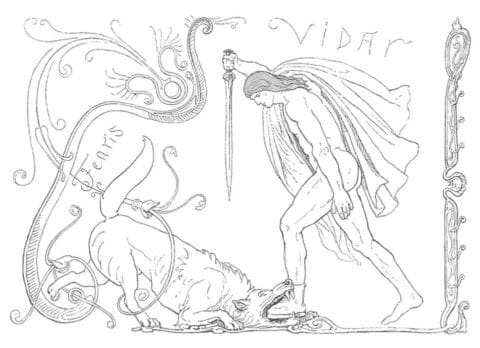
In Vafþrúðnismál, stanza 51, the giant Vafþrúðnir tells Odin that Víðarr and Váli will inhabit the gods’ sacred dwellings after Surtr’s fires have died down. Magni and Móði will possess Mjölnir when Vingnir, another name for Thor, has fallen in battle. The prophecy names both brothers but does not explain how they acquire the hammer.
Snorri Sturluson expands on their fate in Gylfaginning, chapter 53. When the earth rises again from the sea, Víðarr and Váli settle at Iðavöllr, where Asgard once stood. Magni and Móði join them, bringing Mjölnir. Baldr and Höðr later return from Hel, and the gods gather to recall the former world. They also discover the golden playing pieces once owned by the Æsir.
Who Inherits Thor’s Hammer Mjölnir?
The medieval sources name Magni and Móði together as the hammer’s inheritors, without assigning it exclusively to either brother. They do not describe the sons wielding Mjölnir or taking over Thor’s responsibilities as the god of thunder. Their possession of the weapon is established, but their subsequent deeds remain unknown.
Read Also
Ragnarök Explained: How the Norse World Ends and What Comes After
Discover how Ragnarök brings the Norse gods’ world to an end, which gods survive, and how a new world emerges after the destruction.
What Do Magni and Móði Represent in Norse Mythology?
Magni and Móði are often interpreted as personifications of Thor’s strength and courage. Magni’s rescue of his father supports this reading, while Móði’s connection to courage or wrath rests chiefly on the meaning of his name. The surviving myths do not establish that either brother was worshipped as the embodiment of a particular quality.
John McKinnell offers a broader interpretation of their survival in Vafþrúðnismál. He argues that the poem presents courage and strength as qualities that endure beyond Ragnarök, alongside the determination to avenge fallen relatives. Thor himself cannot escape death, but the qualities associated with him survive through his sons. In this reading, their inheritance of Mjölnir reinforces the continuity between the fallen god and the next generation.
Whether the brothers had independent religious roles remains uncertain. No secure evidence establishes dedicated sanctuaries, rituals, or organized worship associated with either of them. Their significance is preserved chiefly in mythological poetry and prose, although the absence of such evidence cannot rule out religious practices that left no surviving record.
Conclusion
Magni and Móði have very different places in the surviving Norse myths. Magni is remembered for an extraordinary act of strength, while much of Móði’s story remains unknown. Yet both survive their father and enter the renewed world with Mjölnir. The medieval sources leave their future open, offering no account of how Thor’s sons use the hammer they inherit.
Sources & Primary Texts
This article draws on edited Old Norse texts, scholarly translations, and academic studies of Thor’s sons, their appearances in skaldic poetry, and their place in the myths surrounding Ragnarök.
- Pettit, Edward (ed. and trans.). The Poetic Edda: A Dual-Language Edition. Open Book Publishers, 2023. See Vafþrúðnismál 51, Hárbarðsljóð 9 and 53, and Hymiskviða 34.
Read the academic edition. - Sturluson, Snorri. Edda: Skáldskaparmál. Edited by Anthony Faulkes. Viking Society for Northern Research, 1998. The primary prose account of Magni rescuing Thor after the battle with Hrungnir.
Read the edited text. - Sturluson, Snorri. Edda: Prologue and Gylfaginning. 2nd ed., edited by Anthony Faulkes. Viking Society for Northern Research, 2005. See chapter 53 for the gods who survive Ragnarök.
Read the edited text. - Marold, Edith (ed.). “Eilífr Goðrúnarson: Þórsdrápa.” In Poetry from Treatises on Poetics, edited by Kari Ellen Gade and Edith Marold, pp. 68–129. Skaldic Poetry of the Scandinavian Middle Ages, vol. 3. Brepols, 2017.
Publisher information. - Lindow, John. Norse Mythology: A Guide to the Gods, Heroes, Rituals, and Beliefs. Oxford University Press, 2002. See the entries on Magni, Móði, and Hrungnir.
Academic reference. - Lindow, John. “Thor’s Duel with Hrungnir.” Alvíssmál, vol. 6, 1996, pp. 3–20. A scholarly examination of the battle narrative and its earlier poetic traditions.
Read the study. - McKinnell, John. “The Paradox of Vafþrúðnismál.” In Essays on Eddic Poetry, edited by Donata Kick and John D. Shafer, pp. 153–171. University of Toronto Press, 2014. Discusses the poem’s interpretation and the significance of the gods who survive Ragnarök.
Book information.
Copyright & Editorial Notice
© 2026 History & Myths. All rights reserved. This article presents original historical and literary analysis based on Old Norse mythological texts and academic scholarship. The underlying medieval narratives are part of the historical literary record, while the article’s original wording, organization, and commentary are protected by copyright. Reproduction without permission is prohibited, except where permitted by applicable law.