Ullr: The Mysterious Norse God of Skiing and Archery
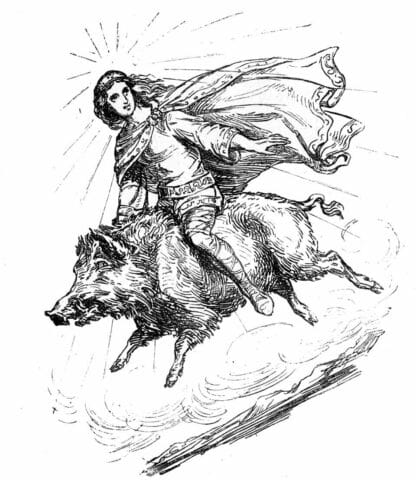
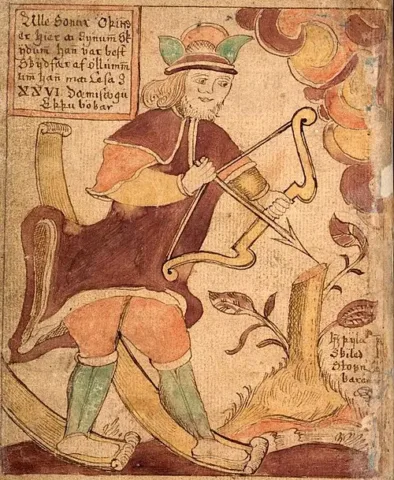
Ullr was a Norse god associated with skiing, archery, and hunting. The son of Sif and stepson of Thor, he was praised for his skill with a bow and his ability to travel on skis. The Poetic Edda places his home at Ýdalir, meaning “Yew Dales,” but preserves almost no stories about his deeds. Although often described as a god of winter, no surviving Old Norse text explicitly gives him authority over the season.
Ullr’s limited presence in mythology contrasts with evidence suggesting that he once held considerable religious importance. Scandinavian place names preserve his name, while archaeological discoveries at Lilla Ullevi in Sweden point to ritual activity at a site associated with him. An ancient reference to “Ullr’s ring” also raises questions about his connection with sacred oaths. Together, these clues reveal a god whose historical significance may have been greater than his surviving myths suggest.
Who Was Ullr in Norse Mythology?
In Gylfaginning, Snorri Sturluson places Ullr among the Æsir and identifies him as Sif’s son and Thor’s stepson. His biological father is never named, and the surviving sources provide no account of his birth, marriage, or children. Snorri describes him as handsome and possessing the qualities of a skilled warrior, but offers little else about his personal history.
Ullr’s name is generally connected with a Germanic word meaning “glory” or “splendour,” related to Gothic wulþus and Old English wuldor. This linguistic connection has encouraged interpretations of Ullr as an ancient god associated with radiance or the sky. Neither interpretation is confirmed by the surviving myths, and the meaning of his name alone cannot establish his religious functions.
Ullr: The God of Skiing, Archery and Hunting
In Gylfaginning, Snorri Sturluson describes Ullr as an unmatched archer and skier, adding that he is a god worth invoking in single combat. This places his abilities in a martial context, where skill with a bow and movement across difficult terrain could be valuable. However, Snorri recounts no battle or hunting expedition involving Ullr himself.
Skáldskaparmál preserves four titles for the god: “ski-god,” “bow-god,” “hunting-god,” and “shield-god.” These names establish his association with weapons, hunting, and travel on skis, although they offer no details about how he exercised these roles.
The same work records the poetic expression “Ullr’s ship” as a name for a shield. Its origin is uncertain. Some have suggested that it reflects a lost tradition in which Ullr travelled using a shield, but no surviving myth describes such an event. The expression confirms his association with shields without revealing the story behind it.
Ýdalir and the Hall of Ullr
Ullr’s dwelling is named in Grímnismál, stanza 5, where Odin describes the homes of the gods. The poem calls it Ýdalir, meaning “Yew Dales,” and states that Ullr has built halls there. It appears alongside other divine residences, including Thor’s Þrúðheimr and Freyr’s Álfheimr.
The name may reflect Ullr’s connection with archery. Yew wood was valued for making bows, making a landscape named after the tree appropriate for an accomplished archer. The poem itself, however, offers no explanation for the name.
Unlike Valhalla, which receives detailed descriptions elsewhere in Grímnismál, Ýdalir is mentioned only briefly. No surviving myth describes its appearance, inhabitants, or events taking place there. Its precise role in Norse cosmology therefore remains unknown.
Ullr’s Ring and the Sacred Oaths
In Atlakviða, a speech usually attributed to Guðrún recalls the oaths Atli swore to Gunnar before betraying him. The speaker invokes several witnesses to those promises, including the sun, Sigtyr’s mountain, and “Ullr’s ring.” The passage appears as stanza 30 in some editions and stanza 32 in Henry Adams Bellows’s translation. The poem does not describe the ring or explain how it was used.
Rings were associated with sworn agreements elsewhere in Old Norse literature, leading scholars to suggest that Ullr may have helped guarantee oaths. Yet Atlakviða never explicitly identifies him as a god of oaths or describes a ceremony performed in his honour.
Another reference appears in Grímnismál, stanza 42, where Odin invokes the favour of Ullr and all the gods for whoever first reaches into the flames surrounding him. The passage confirms Ullr’s place among the divine powers named in the poem, but reveals nothing about rituals dedicated to him.
Ollerus: The God Who Replaced Odin
In Book III of Gesta Danorum, the Danish historian Saxo Grammaticus tells an unusual story about Ollerus, a figure generally identified with Ullr. After Odin uses deception and magic to assault the princess Rinda, the other gods condemn his behaviour and banish him. They appoint Ollerus in his place, granting him Odin’s authority and even his name. According to Saxo, Ollerus holds this position for nearly ten years.
When Odin regains his former status, Ollerus is forced into exile in Sweden, where he is eventually killed by the Danes. Saxo also describes him as a powerful magician who could cross the sea using an inscribed bone instead of a boat.
This account differs sharply from the Poetic Edda and Prose Edda, where Ullr never replaces Odin. Saxo wrote around 1200 CE and portrayed the old gods as rulers and magicians. His story may preserve elements of a lost tradition, but it cannot establish that Ullr once ruled the gods or displaced Odin’s worship.
Ullr’s Worship and Archaeological Evidence
Ullr’s name survives in numerous Scandinavian place names, suggesting that his worship was once more widespread than the surviving myths imply. In Sweden, names such as Ullevi combine his name with vé, meaning a sacred place, while Ulleråker refers to a field associated with him. These names are particularly concentrated in central Sweden, with related evidence in southeastern Norway.
One of the strongest archaeological examples comes from Lilla Ullevi, near Stockholm. Excavations in 2007 uncovered a stone platform, postholes, and 65 iron amulet rings associated with ritual activity during the Vendel Period, particularly the seventh and eighth centuries. The site’s name and unusual concentration of deposited objects support its interpretation as a place of worship connected with Ullr.
Some researchers have suggested that the rings were deposited during oath-taking ceremonies or other solemn agreements. Their precise function remains uncertain, however, and no inscription identifies the rituals performed there. Together, the archaeological remains and place names provide evidence of Ullr’s regional religious importance, even though they reveal little about the ceremonies conducted in his honour.
Was Ullr Really a God of Winter?
Ullr is often called the Norse god of winter, but this title is not found in the surviving Old Norse sources. His reputation as a skier and hunter has encouraged an association with snowy landscapes, yet no medieval text describes him controlling snow, frost, or the changing seasons.
Later retellings developed this association further, sometimes portraying Ullr as a winter ruler who governed while Odin was absent. Saxo Grammaticus does describe Ollerus temporarily replacing Odin, but he does not present this episode as a seasonal change.
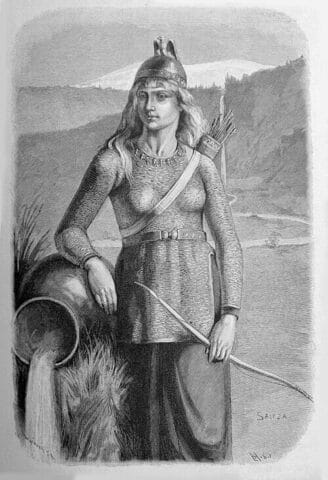
Ullr also shares several characteristics with Skadi, who travels on skis and hunts with a bow. These similarities suggest an overlapping connection with outdoor activities in northern landscapes, not necessarily identical religious functions. Ullr’s association with winter is therefore understandable, but his authority over the season remains a modern interpretation rather than an established feature of Norse mythology.
Why Did Ullr Disappear from Norse Mythology?
Matthew Edwards has proposed that Ullr’s cult became less prominent after the seventh century, which may help explain his limited role in later mythological literature. However, archaeological evidence from Lilla Ullevi shows ritual activity continuing into the seventh and eighth centuries. The surviving evidence cannot establish when his worship declined across different regions.
Geography may also explain the gap. Most surviving Norse myths were preserved in medieval Iceland, while place-name evidence for Ullr is strongest in central Sweden and southeastern Norway. Stories familiar in those regions may never have entered the Icelandic written tradition.
Ullr’s obscurity may therefore reflect changes in regional worship, the uneven preservation of mythology, or both. None of these explanations establishes why so few stories about him survive.
Read Also
- Sif: Thor’s Wife and the Mystery of Her Golden Hair
, discover Ullr’s mother, her relationship with Thor, and the Norse myth of her golden hair. - Skadi: Norse Goddess of Winter and the Hunt
, explore another Norse deity associated with skiing, archery, and hunting. - Thor: Norse God of Thunder, Mjölnir and Viking-Age Worship
, learn about Ullr’s stepfather and his importance in Norse mythology and religion. - Odin: All-Father, Chief of the Norse Gods and God of Wisdom
, discover the god whom Ollerus temporarily replaces in Saxo Grammaticus’s account.
Conclusion
Ullr occupies an unusual place in Norse mythology. Medieval texts preserve his reputation as a skilled archer and skier, but tell almost nothing about his deeds. Scandinavian place names and archaeological discoveries suggest that his religious importance was once greater than his limited appearances in the surviving stories might indicate.
Whether Ullr’s worship declined or his traditions simply went unrecorded remains uncertain. The evidence reveals a deity with recognizable attributes and traces of an established cult, even though much of what his worshippers believed about him has been lost.
Academic Sources & Primary Texts
This article draws on medieval Old Norse literature, historical place-name evidence, archaeological research, and modern scholarship. It distinguishes Ullr’s documented attributes from theories concerning his worship, sacred oaths, and possible decline in religious importance.
Primary Norse Sources
- Snorri Sturluson. Edda: Prologue and Gylfaginning.
Edited by Anthony Faulkes. 2nd edition. Viking Society for Northern Research, 2005.
Chapter 31 identifies Ullr as Sif’s son and Thor’s stepson, describing his exceptional abilities in archery, skiing, and single combat.
Academic Edition - Snorri Sturluson. Edda: Skáldskaparmál.
Edited by Anthony Faulkes. Viking Society for Northern Research, 1998.
Preserves poetic titles associated with Ullr, including references to skiing, archery, hunting, and shields, together with expressions such as “Ullr’s ship.”
Academic Edition - The Poetic Edda: A Dual-Language Edition.
Edited and translated by Edward Pettit. Open Book Publishers, 2023.
Includes Grímnismál, which names Ullr’s dwelling at Ýdalir and invokes his favour, and Atlakviða, which preserves the reference to “Ullr’s ring” in an oath.
Read the Scholarly Edition - Saxo Grammaticus. Gesta Danorum, Book III.
English translation by Oliver Elton, 1894.
Preserves the story of Ollerus replacing Odin during his exile, ruling for nearly ten years, and eventually being driven from power.
Read Book III
Modern Academic Research
- Edwards, Matthew (2022).
“Understanding a Forgotten God: The Role of Ullr.”
Scandia: Journal of Medieval Norse Studies, 5(5).
Examines Ullr’s possible religious functions, evidence from Scandinavian place names, sacred oaths, and the hypothesis that his cult declined in importance before the Viking Age.
Read the Research Article - Molin, John Julian (2015).
Ullr: A God on the Edge of Memory.
Master’s thesis, University of Iceland.
Reviews the literary, linguistic, and place-name evidence for Ullr, including debates concerning his relationship with other gods and his possible earlier prominence.
Thesis Information and Access - Riisøy, Anne Irene (2016).
“Performing Oaths in Eddic Poetry: Viking Age Fact or Medieval Fiction?”
Journal of the North Atlantic, Special Volume 8, pp. 141–156.
Investigates oath-taking in Old Norse texts, including Ullr’s ring, and discusses archaeological finds at Lilla Ullevi and the difficulties of identifying historical oath rituals.
Journal Article - Ögren, Anders, Charlotte Hedenstierna-Jonson, John Ljungkvist, Ben Raffield, and Neil Price (2022).
“New Institutional Economics in Viking Studies: Visualising Immaterial Culture.”
Archaeological Dialogues, 29(2), 172–187.
Examines the relationship between archaeological material, social institutions, and oath-taking, including the possible interpretation of amulet rings deposited at Scandinavian ritual sites such as Lilla Ullevi.
Read the Research Article
Research Note: Ullr’s association with skiing, archery, and hunting is documented in medieval sources. His possible responsibilities concerning oaths, the significance of the rings discovered at Lilla Ullevi, and the proposed decline of his cult remain subjects of scholarly interpretation. No surviving Old Norse text explicitly identifies Ullr as a ruler of winter.
Copyright & Content Notice
© 2026 History & Myths. All rights reserved.
The original editorial content of this article is published by History & Myths. Reproduction or redistribution of substantial portions requires permission, except where permitted by applicable copyright law. Brief quotations should include clear attribution and a link to the original article.
Ancient texts, scholarly publications, archaeological objects, and third-party images remain subject to their respective rights and licenses. Image credits and licensing information are provided separately where applicable.