Gefjon: The Norse Goddess Who Created Zealand
Gefjon, also known as Gefjun, was a Norse goddess credited with creating Zealand (Sjælland), Denmark’s largest island. In Snorri Sturluson’s Gylfaginning, King Gylfi of Sweden rewarded her with as much land as four oxen could plough in a day and a night. Gefjon harnessed four oxen, identified as her sons by a giant, and used their extraordinary strength to tear a vast stretch of land from Sweden and drag it into the sea, forming Zealand.
In Ynglinga saga, Gefjon is also linked to Denmark’s legendary royal past through her marriage to Skjöldr and their settlement at Lejre. Other sources describe her as a maiden attended by women who died as maidens, while Lokasenna credits her with knowledge of human destinies. These accounts preserve different aspects of Gefjon’s identity, although her precise role in pre-Christian Norse religion remains uncertain.
Who Was Gefjon in Norse Mythology?
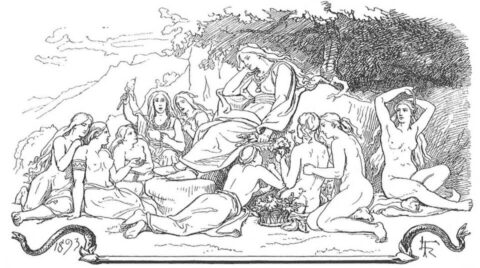
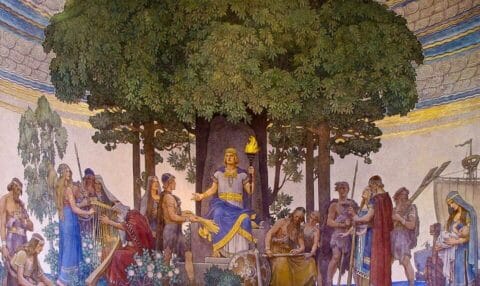
Gefjon, known in Old Norse as Gefjun and also written Gefion, belonged to the Ásynjur, the goddesses associated with the Æsir. In Gylfaginning, chapter 35, Snorri Sturluson lists her fourth, after Frigg, Sága, and Eir. He calls her a mær (maiden) and states that women who die as maidens serve her, without explaining the nature of this service.
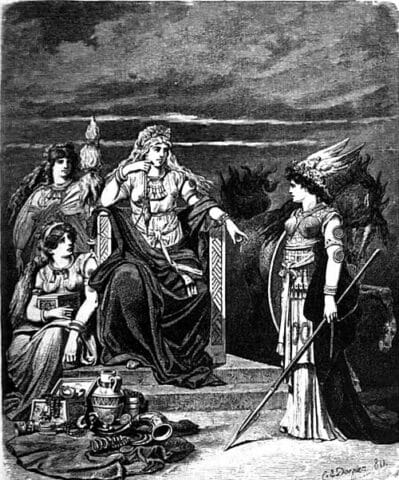
In Skáldskaparmál, Gefjon appears among the goddesses attending Ægir’s feast in Asgard. She also speaks in Lokasenna, attempting to calm the quarrel between Loki and the gods. Odin subsequently credits her with knowledge of human destinies comparable to his own.
The surviving sources identify neither Gefjon’s parents nor a separate divine residence. Her association with ploughing and the acquisition of land has encouraged interpretations of her as an agricultural or fertility goddess, but no Old Norse text explicitly assigns her authority over either domain.
How Did Gefjon Create the Island of Zealand?
In Gylfaginning, chapter 1, King Gylfi of Sweden rewards a travelling woman for entertaining him with as much land as four oxen can plough in a day and a night. The woman is Gefjon, who travels north to Jötunheimr to obtain the oxen needed to claim her reward.
The four oxen are her sons by a giant. Gefjon harnesses them to a plough, which cuts so deeply into the ground that an entire stretch of land breaks loose. They drag it westward into the sea, stopping in a strait where Gefjon fixes the land in place and names it Selund, the island of Zealand.
The land’s removal leaves behind a lake called Lögrinn, traditionally identified with Lake Mälaren in Sweden. Snorri describes its bays as corresponding to Zealand’s headlands. Some scholars have questioned this identification, suggesting that Lake Vänern offers a closer geographical match.
The account is an etiological myth, explaining the origins of Zealand and the lake through a single supernatural event rather than describing their actual geological formation.
Gefjon in Gylfaginning and Ynglinga Saga
The accounts in Gylfaginning, chapter 1, and Ynglinga saga, chapter 5, differ chiefly in their narrative setting and the details they provide about Gefjon’s oxen. In Gylfaginning, the animals are identified as her sons by a giant, but their transformation is not explicitly described. Ynglinga saga places Gefjon’s journey within Odin’s migration to Scandinavia. He sends her from Óðinsey (Odense), on the island of Funen, to seek land. This version states that she bears four sons by a giant and transforms them into oxen before using them to acquire Zealand.
Both accounts quote a stanza attributed to Bragi Boddason, known as Bragi the Old, a skald traditionally associated with the ninth century. The verse describes Gefjon drawing land away from Gylfi to enlarge Denmark, with steam rising from the oxen as they pull. It also describes their eight ennitungl, literally “forehead moons,” a poetic expression for their eyes, and four heads. The stanza preserves the central image of Gefjon’s extraordinary ploughing without explaining the oxen’s parentage or supernatural transformation.
The manuscript evidence complicates the relationship between the two prose accounts. The Gefjon episode is absent from the Uppsala manuscript of Gylfaginning. In a 2021 study, Mikael Males argued that the opening chapter was probably added to another branch of the manuscript tradition, citing its close verbal agreement with Ynglinga saga and its limited connection to the surrounding narrative. His analysis suggests that the prose versions should not be treated as two fully independent witnesses to the myth.
Gefjon, Skjöldr, and the Danish Royal Tradition
In Ynglinga saga, chapter 5, Gefjon settles on Zealand and marries Skjöldr, a son of Odin. They live at Hleiðra (Lejre), a place associated with the legendary Danish royal dynasty known as the Skjöldungar, or descendants of Skjöldr. Their marriage links Gefjon’s acquisition of Zealand to the traditional origins of Danish kingship.
Lejre was also an important centre of power during the late Iron Age and Viking Age. Archaeological excavations have uncovered successive monumental halls and aristocratic residential complexes dating broadly from the sixth to the tenth centuries. These discoveries support Lejre’s historical importance, although they cannot establish that Gefjon or Skjöldr were historical figures.
In her 2018 study Gefjon, Gylfi and Skjöldr: Kingship and Land, Karen Bek-Pedersen compares the myth with early Irish narratives in which a female figure embodies both the land and royal sovereignty. She argues that Gefjon may represent a Norse version of this tradition, linking the acquisition of territory with political authority. The comparison offers a possible interpretation of the myth’s relationship to kingship, but does not establish that Gefjon received worship as a goddess of sovereignty or participated in royal inauguration rituals.
Was Gefjon a Virgin Goddess?
In Gylfaginning, chapter 35, Snorri Sturluson describes Gefjon with the words Hon er mær, ok henni þjóna þær, er meyjar andask, meaning that she is a maiden and that women who die as maidens serve her. The Old Norse word mær can mean a young unmarried woman or a virgin. Although the passage associates Gefjon with women who die as maidens, Snorri does not explain what their service involves.
Other accounts complicate this description. In Gylfaginning, chapter 1, the four oxen that create Zealand are identified as Gefjon’s sons by a giant. Ynglinga saga, chapter 5, explicitly describes her bearing these sons and transforming them into oxen before recording her marriage to Skjöldr.
The different portrayals may reflect separate traditions preserved in Snorri’s works. Neither text explains how Gefjon’s motherhood and marriage relate to her status as a mær. The surviving evidence therefore does not support treating her as a permanently virginal goddess with a clearly defined religious responsibility for chastity.
Gefjon in Lokasenna: Loki’s Accusation and Odin’s Defence
During Ægir’s feast in Lokasenna, Gefjon intervenes in the quarrel between Loki and the other gods. In stanza 19, she questions why they are exchanging bitter words. Loki immediately turns his insults against her.
In stanza 20, Loki claims that a handsome young man gave Gefjon an ornament, described by the Old Norse word sigli, and that she had a sexual encounter with him. Neither the young man nor the alleged incident is identified elsewhere in the surviving myths. Some commentators have compared the ornament with Freyja’s necklace Brísingamen, but the poem does not establish that they are the same object.
Odin rebukes Loki in stanza 21, declaring that Gefjon knows aldar örlög, the destinies of humankind, as thoroughly as he does. This is a striking claim, since no other surviving account portrays Gefjon foretelling events or revealing human fates.
The exchange must be read in the context of Lokasenna, a poem built around insults and accusations. Loki’s allegation cannot be treated as an independently established event in Gefjon’s life. Odin’s reply, however, associates her with knowledge of fate, a quality not explained in the other surviving accounts of the goddess.
What Does the Name Gefjon Mean?
The name Gefjon, or Gefjun in Old Norse, is commonly interpreted as “the giving one,” from the verb gefa, meaning “to give.” This interpretation has encouraged associations with fertility and abundance, although the name alone cannot establish Gefjon’s religious responsibilities.
The traditional etymology presents linguistic difficulties. In his 1952 study, Albert Morey Sturtevant questioned its phonological basis, particularly the vowel changes expected in the historical development of Gefjun. Kevin French revisited the problem in 2014, examining possible connections with Gothic gabei (“riches”) and Old Norse gǫfugr (“noble”). He proposed that the name may derive from an older Germanic formation associated with wealth or high status, rather than directly from gefa. Its precise origin remains disputed.
Gefjon has also been compared with Gefn, a poetic name for Freyja associated with giving. The similarity has led some scholars to consider a possible historical connection between the two goddesses. However, the surviving sources distinguish their mythological appearances, and the resemblance between their names does not establish that they were originally the same deity.
Was Gefjon Worshipped in Viking Age Scandinavia?
There is no secure archaeological evidence of a cult dedicated to Gefjon in pre-Christian Scandinavia. No known sanctuary, offering, or runic dedication can be confidently associated with her worship. Her appearances in Norse literature establish her mythological importance, but reveal little about the religious practices directed toward her.
A possible clue appears in Völsa þáttr, a medieval Icelandic tale preserved in the late fourteenth-century manuscript Flateyjarbók. The story describes a household passing around a preserved horse phallus called Völsi during a ceremonial gathering. When the farmer’s daughter reluctantly receives it, she swears við Gefjun ok við goðin önnur, meaning “by Gefjon and the other gods.” However, the repeated refrain invokes mǫrnir, whose identity is disputed, as recipients of the offering rather than explicitly naming Gefjon.
The episode has traditionally been interpreted as evidence of pre-Christian fertility rituals. In The Paganesque and The Tale of Vǫlsi (2024), Merrill Kaplan challenges this approach, examining how the tale constructs a satirical image of pagan religion for a medieval Christian audience. Gefjon’s invocation is therefore a literary reference to the goddess, not sufficient evidence that she received offerings or presided over fertility ceremonies during the Viking Age.
Read Also
- Odin: All-Father, Chief of the Norse Gods and God of Wisdom
- Frigg: Norse Goddess, Queen of Æsir, Wife of Odin, Mother of Baldr
- Norse Creation Myth: Ginnungagap, Ymir and the Birth of the World
Gefjon’s Legacy in Denmark
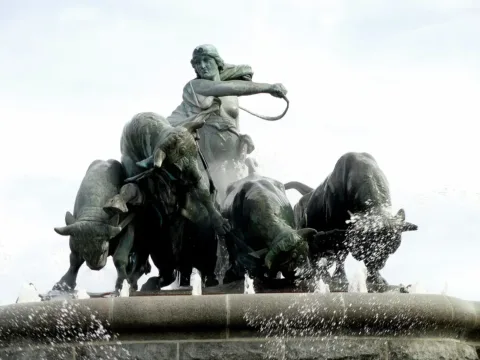
Gefjon’s association with Zealand became part of Denmark’s cultural heritage, most visibly through the Gefion Fountain (Gefionspringvandet) in Copenhagen. Created by Danish sculptor Anders Bundgaard and unveiled in 1908, the monument stands near Kastellet and Langelinie. Its bronze figures depict Gefjon driving four powerful oxen, while water cascades over the surrounding stone terraces.
The project originated in 1897, when the Carlsberg Foundation pledged 50,000 kroner for a public fountain to commemorate the brewery’s fiftieth anniversary. Copenhagen’s municipal art fund later contributed additional financing, and Bundgaard won the design competition held in 1898. By bringing Gefjon’s legendary ploughing into a prominent public space, the fountain gave the medieval story of Zealand’s origins a lasting presence in Denmark’s capital.
Conclusion
Gefjon’s creation of Zealand connects the island’s mythical origins with Denmark’s legendary royal past. Her marriage to Skjöldr places the story within the traditions of Lejre, while the verse attributed to Bragi the Old preserves an early poetic account of her extraordinary ploughing.
Other sources associate Gefjon with maidens, motherhood, and knowledge of human destinies, without presenting a consistent picture of her divine responsibilities. These differing traditions leave much of her religious identity uncertain, even as her connection to Zealand remains firmly established in Danish cultural memory.
Academic Sources & Primary Texts
- Sturluson, Snorri.
Edda: Prologue and Gylfaginning.
Edited by Anthony Faulkes, 2nd ed.
Viking Society for Northern Research, 2005.
Chapters 1 and 35, Gefjon’s creation of Zealand
and her place among the goddesses.
Read source. - Sturluson, Snorri.
Heimskringla I: The Beginnings to Óláfr Tryggvason.
Translated by Alison Finlay and Anthony Faulkes,
2nd ed. Viking Society for Northern Research, 2016.
Ynglinga saga, chapter 5.
Read source. - Sturluson, Snorri.
Edda: Skáldskaparmál.
Edited by Anthony Faulkes.
Viking Society for Northern Research, 1998.
Includes Gefjon among the goddesses attending
Ægir’s feast.
Read source. - Bragi Boddason the Old.
Fragments.
Edited by Margaret Clunies Ross in
Skaldic Poetry of the Scandinavian Middle Ages,
vol. 3. Brepols, 2017.
The stanza describing Gefjon’s ploughing
and the enlargement of Denmark.
View poetic witness. - Pettit, Edward, ed. and trans. (2023).
The Poetic Edda: A Dual-Language Edition.
Open Book Publishers.
Lokasenna, stanzas 19-21,
concerning Gefjon, Loki, and Odin.
Read source. - Bek-Pedersen, Karen (2018).
“Gefjon, Gylfi and Skjöldr: Kingship and Land.”
Quaestiones Medii Aevi Novae,
vol. 23, pp. 7-25.
A comparative study of land, divine femininity,
and royal sovereignty in Norse and Irish traditions.
View study. - Males, Mikael (2021).
“Gylfaginning: Poetic Sources and the Structure
of the Archetype.”
Saga-Book, vol. 45, pp. 119-150.
Discusses the manuscript evidence and the
possible later addition of the Gefjon episode.
Read study. - French, Kevin (2014).
We Need to Talk about Gefjun: Toward a New
Etymology of an Old Icelandic Theonym.
Master’s thesis, University of Iceland.
Examines the traditional interpretation of
Gefjun’s name and alternative Germanic etymologies.
View research. - Völsa þáttr.
In Stories from Sagas of Kings.
Introduction, notes, and glossary by
Anthony Faulkes, 2nd ed.
Viking Society for Northern Research, 2007.
Contains an invocation naming Gefjon.
Read source. - Kaplan, Merrill (2024).
The Paganesque and The Tale of Vǫlsi.
Studies in Old Norse Literature, vol. 14.
D. S. Brewer.
Examines the medieval literary portrayal
of pagan ritual and its historical limitations.
View publication. - Jensen, Inge Mørch, and Thomas Eske Rasmussen.
“Gefionspringvandet.”
Lex: Danmarks Nationalleksikon.
Historical reference for Anders Bundgaard’s
Gefion Fountain, unveiled in Copenhagen in 1908.
Read reference.
Copyright & Content Notice
© 2026 History & Myths. Original article content by H. Moses. All rights reserved. This article draws on historical texts and academic scholarship to examine Gefjon in Norse mythology. Ancient sources and modern research are acknowledged in the references above. Images and third-party materials remain subject to their respective copyrights and licenses. Unauthorized reproduction of original content is prohibited except as permitted by applicable law.