Rán: The Norse Sea Goddess Who Claimed the Drowned
In Norse mythology, Rán was a sea goddess associated with drowning and the dangers of the ocean. Snorri Sturluson describes her as the wife of Ægir, mother of nine daughters linked to the waves, and owner of a net used to catch people at sea. Her name became closely associated with those who never returned from their voyages.
In Sonatorrek, a poem attributed to Egill Skallagrímsson, a grieving father blames Rán and Ægir for the drowning of his son. Such accounts portray the sea as a power capable of claiming human lives, but they leave an important question unresolved: did the Norse believe that everyone who drowned entered Rán’s realm?
Who Was Rán in Norse Mythology?
Rán’s name corresponds to the Old Norse word rán, meaning “robbery” or “plunder.” The association suits a figure linked to the sea’s power to take human lives, although her surviving mythology is known chiefly through poetry and medieval Icelandic texts.
In Skáldskaparmál, Rán belongs to a family of supernatural beings associated with the ocean. Her husband Ægir personifies the sea, while their nine daughters represent its waves. Snorri names them Himinglæva, Dúfa, Blóðughadda, Hefring, Uðr, Hrönn, Bylgja, Bára, and Kólga. Another passage substitutes Dröfn for Bára. Several names, including Bylgja and Hrönn, are also words used for waves.
These family relationships served a practical purpose in Old Norse poetry. Skalds could describe the sea as “Rán’s land” or refer to its waves through the names of Ægir’s daughters. The family provided poets with a vocabulary for depicting the ocean rather than a developed cycle of stories about their lives.
Rán’s name also appears in poetic expressions for gold. In Skáldskaparmál, Snorri recounts how Ægir illuminated his hall with shining gold during a feast for the gods. The story explains why poets could call gold “Ægir’s fire” or “Rán’s light,” extending the imagery to their daughters as well. These expressions belong to the language of skaldic poetry, not to a myth in which Rán possesses or guards a treasure.
Rán’s classification is less straightforward. A medieval list of the ásynjur, or goddesses, includes her name, while her association with Ægir places her among beings often connected with the giants. Literary scholar Judy Quinn therefore treats Rán as a sea-deity whose identity cannot be neatly confined to the categories of goddess or giantess. Her importance lies above all in how Norse poets gave the sea a recognizable, sometimes threatening, human form.
Rán’s Net and the Dangers of the Sea
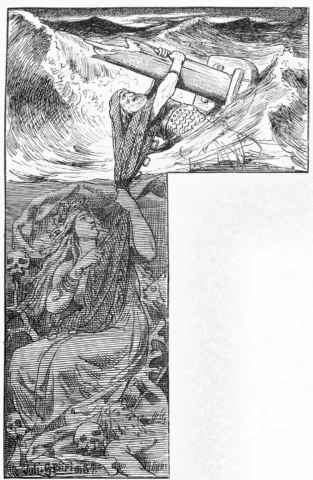
Rán’s most distinctive possession was a fishing net. In Skáldskaparmál, Snorri describes it as a means of catching people who venture onto the sea. He gives no account of Rán personally casting the net at sailors, leaving its use to the imagination.
The net appears more directly in the prose introduction to Reginsmál. Loki borrows it from Rán to catch Andvari, a dwarf hiding in a waterfall in the form of a pike. Once captured, Andvari is forced to surrender his gold. The same borrowing appears in Völsunga saga, chapter 14. Snorri’s separate account of Andvari’s capture, however, describes Loki catching him with his hands rather than using Rán’s net.
Judy Quinn points out that no surviving skaldic kenning draws on the image of Rán’s net. Poets instead portray the sea through her body or actions. In Helgakviða Hundingsbana I, stanzas 28 to 30, violent waves threaten Helgi’s fleet. An Ægir-daughter attempts to overturn the ships, but the Valkyrie Sigrún protects them. The king’s vessel escapes from Rán’s grasp, with no net mentioned.
Another example appears in Helgakviða Hjörvarðssonar, stanza 18. The warrior Atli accuses the giantess Hrímgerðr of attempting to give the prince’s men to Rán by attacking their ships. The expression describes the threat of drowning rather than an encounter with Rán herself.
The distinction between these accounts is significant. In prose, Rán possesses an object that other mythical figures can borrow. In poetry, the sea itself can become her grasp, requiring no separate weapon or fishing net.
Rán in Skaldic Poetry: Grief, Drowning, and the Sea
One of the most personal portrayals of Rán appears in Sonatorrek, a lament attributed to the tenth-century Icelandic poet Egill Skallagrímsson and preserved in the later Egils saga. According to the saga, Egill composed the poem after his son Bǫðvarr drowned during a storm. Rather than describe the drowning itself, he addresses the supernatural powers he holds responsible for his loss.
The accusation unfolds across several stanzas. In stanza 6, Egill describes Hrönn, one of Ægir and Rán’s daughters, as having torn an irreparable breach in his family. Stanza 7 turns directly against Rán, whom he blames for depriving him of someone he loved. In stanza 8, his anger reaches Ægir, the sea-being he imagines attacking with a weapon if revenge were possible. The ocean has become an adversary against whom the grieving father has no means of retaliation.
Matthias Egeler draws attention to Egill’s description of Ægir as a brewer of ale. Elsewhere in Norse literature, Ægir entertains the gods at elaborate feasts. In Sonatorrek, however, that familiar image of hospitality belongs to the same supernatural power associated with the destruction of Egill’s family. The contrast gives the accusation particular force: a figure known for welcoming guests has become the object of a father’s resentment.
Read Also:
Hel: The Norse Ruler of the Dead and Her Underworld
The poem also raises questions about what Egill believed happened to his son after death. Some scholars have interpreted expressions in stanzas 10, 18, and 21 as suggesting that Bǫðvarr reached Óðinn’s realm despite having drowned. Jón Hnefill Aðalsteinsson challenges this interpretation. He argues that munvegar in stanza 10 need not mean a path to Valhalla, and that stanza 21 concerns another son rather than Bǫðvarr. The disagreement depends partly on difficult poetic language and the relationship between different parts of the lament. Rán’s involvement in the drowning is clear, but the poem’s account of the son’s ultimate destination remains open to interpretation.
Rán also appears in the poetry of Hofgarða-Refr Gestsson, an eleventh-century skald who describes the dangers of a sea voyage. In one verse, a ship struggles out of Rán’s white mouth, its red-stained hull battered by the waves. In another, a figure called Gymir’s spray-cold völva, or seeress, draws ships into Ægir’s jaws. Scholars generally identify this figure with Rán.
Judy Quinn observes that the second expression connects Rán with the language of prophecy and supernatural women associated with human fate. It does not establish that she was worshipped as a seeress, but it shows how skaldic imagery could combine the dangers of the ocean with ideas about the timing of death.
Where Hofgarða-Refr depicts the immediate struggle to survive at sea, Sonatorrek gives those same destructive forces a role in the grief that follows a drowning. Rán could serve both as an image of threatening waves and as a supernatural figure against whom a bereaved father directed his anger.
What Happened to Those Who Drowned at Sea?
The clearest account of Rán receiving the drowned appears in Eyrbyggja saga, chapter 54. After Þóroddr and his companions perish at sea, their bodies are never recovered. During their funeral feast, the dead men return to the farmhouse, still dripping wet. Their appearance is initially welcomed as a good omen: people believed that drowned men who attended their own funeral had been well received by Rán. The saga places this belief in a community that had accepted Christianity but retained elements of older traditions.
Yet the same saga offers a different picture of what followed death at sea. In chapter 11, the fisherman Þorsteinn þorskabítr dies at sea with his companions. Around the time of his death, a shepherd sees the mountain Helgafell open and hears the dead men being welcomed inside. Rán is never mentioned. The two episodes preserve contrasting portrayals within a medieval Icelandic narrative, but cannot by themselves establish the beliefs of Viking Age Scandinavians as a whole.
Another tradition appears in Friðþjófs saga ins frœkna. During a dangerous storm, Friðþjófr fears that his men may soon enter Rán’s dwelling. He divides a gold ring among them so that, if they drown, they will arrive wearing gold appropriate to honored guests. His verses also imagine entering Rán’s bed, using the language of intimacy to describe the prospect of drowning. Her underwater dwelling appears as a place where the dead might receive hospitality rather than simply suffer punishment.
The gold episode is sometimes cited as evidence that Viking sailors paid Rán for safe passage or favorable treatment after death. The saga, however, describes a particular decision by a legendary hero. It neither establishes a widespread historical custom nor explicitly presents the gold as a compulsory payment.
Read Also:
Poetic Edda vs. Prose Edda: How Norse Myths Survived
A more unusual picture of Rán’s dwelling appears in Sneglu-Halla þáttr. Hoping to secure passage on an already crowded ship, the poet Sneglu-Halli claims to have dreamed of a drowned man living with Rán. In the comic verse he invents, the dead man describes an underwater existence among lobsters, fish, and seaweed. Halli hopes the frightening story will persuade other passengers to abandon their places. The episode treats Rán’s household with humor, but it is a fictional trick rather than testimony about what the dead experienced.
Fóstbrœðra saga uses similar imagery in a different way. After Þorgeirr and Þormóðr survive a dangerous voyage, the waves are described as Rán’s daughters attempting to embrace them. Here the embrace represents the threat of drowning, not an account of the men’s destination after death.
The surviving texts therefore distinguish between being seized by the sea and being received into Rán’s dwelling. Some imagine her welcoming drowned people, while others use her name and family simply to describe the dangers of a voyage. None establishes an exclusive afterlife for everyone who died at sea.
Was Rán Worshipped in the Viking Age?
Rán’s presence in Old Norse poetry shows that her association with the sea and drowning was well established. Whether she received religious worship is less certain. No surviving evidence securely identifies a temple, shrine, priesthood, or recurring sacrificial ritual dedicated specifically to her.
Viking Age Scandinavians made offerings of weapons, jewelry, and other valuables, sometimes depositing them in lakes and waterways. Such finds confirm that water could play a role in religious ceremonies, but they cannot be attributed to Rán without evidence identifying the intended recipient.
The gold episode in Friðþjófs saga likewise provides no evidence of a regular ritual dedicated to Rán.
Informal prayers or local practices may have existed, but the surviving literary and archaeological evidence does not allow us to reconstruct a distinct cult devoted to Rán.
Conclusion
Rán’s place in Norse mythology is clearest in the poetry that portrays the sea as a force capable of taking human lives. For sailors, she represented the danger of drowning; for grieving families, she gave that loss a name. Later sagas imagined her receiving the drowned, but the surviving evidence does not establish that everyone lost at sea belonged to her. Her literary presence is well documented, while the extent of her worship remains uncertain.
Sources & Primary Texts
Academic Studies
- Quinn, Judy (2014).
“Mythologizing the Sea: The Nordic Sea-Deity Rán.”
In Nordic Mythologies: Interpretations, Institutions, Intersections, edited by Tim Tangherlini, pp. 71–97. - Egeler, Matthias (2018).
“The Mythological Landscape of Sonatorrek: An Experiment in Contextualising Poetic Experience.”
Quaestiones Medii Aevi Novae, vol. 23, pp. 47–65. - Aðalsteinsson, Jón Hnefill (1999).
“Religious Ideas in Sonatorrek.”
Saga-Book of the Viking Society, vol. 25, pp. 159–178.
Primary Texts and Scholarly Editions
- Snorri Sturluson.
Edda: Skáldskaparmál.
Edited by Anthony Faulkes. Viking Society for Northern Research, 1998. - Egils saga.
Scholarly edition edited by Bjarni Einarsson.
Viking Society for Northern Research, 2003. Includes Sonatorrek. - Eyrbyggja saga.
The Saga of the Ere-Dwellers.
Translated by William Morris and Eiríkr Magnússon, 1892. Icelandic Saga Database. See chapters 11 and 54.
These sources distinguish medieval literary portrayals of Rán from interpretations of Viking Age religious belief.
Copyright & Attribution
© 2026 History & Myths. Original research synthesis, analysis, and article text by H. Moses. All rights reserved. Unauthorized reproduction or republication of this original content is prohibited.
Ancient myths and historical source materials remain subject to their own public-domain status or applicable rights. Third-party images and quoted material retain their respective copyrights and licenses.