Jörð: The Norse Earth Goddess and Mother of Thor
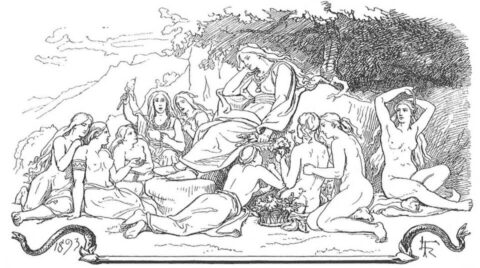
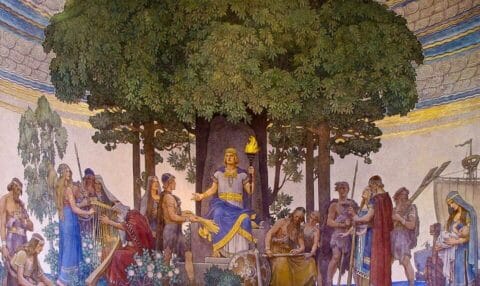
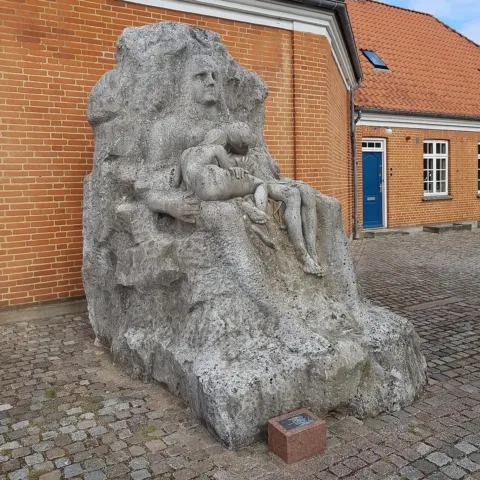
Jörð is the personification of the earth in Norse mythology and the mother of Thor by Odin. Her name means “earth” in Old Norse, while Fjörgyn and Hlóðyn also appear as names associated with Thor’s mother in Eddic poetry. Although Snorri Sturluson includes Jörð among the ásynjur, the goddesses of the Æsir, her ancestry connects her to the giants, making her classification less straightforward.
No surviving myth centers on Jörð herself. She is known chiefly through divine genealogies and poetic descriptions of the earth, leaving much of her personal identity and possible role in pre-Christian worship uncertain.
Who Is Jörð in Norse Mythology?
The Old Norse word jörð can refer to the physical earth or to its personification as a mythological figure. This distinction matters when interpreting Norse texts, since not every reference to the earth describes Jörð as a goddess. For example, when Völuspá describes the earth rising green from the sea after Ragnarök, it refers to the land rather than explicitly depicting the goddess’s return.
Snorri Sturluson’s Prose Edda preserves both meanings. In Gylfaginning, Jörð appears in divine genealogies, while Skáldskaparmál explains how poets could describe the earth as “Ymir’s flesh,” “Thor’s mother,” or “Odin’s bride.” These expressions reflect two ways of imagining the world: as land formed from the giant Ymir’s body and as a female figure connected to the gods through family relationships. Neither tradition establishes Jörð as the creator of the earth or assigns her specific powers over nature.
Jörð as the Mother of Thor
In Gylfaginning, chapter 9, Snorri Sturluson identifies Jörð as the mother of Ása-Þórr, whom Odin fathered with her. Thor’s mother is therefore Jörð, not Frigg, despite Frigg’s marriage to Odin.
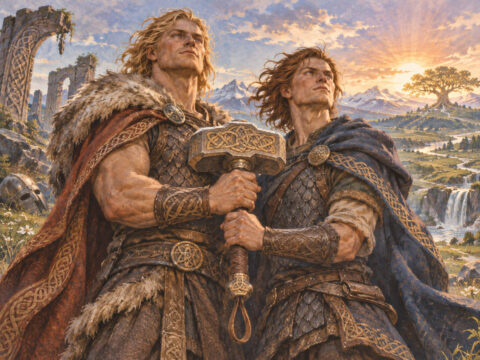
Eddic poetry also preserves this relationship. In Þrymskviða, stanza 1, Thor is called Jarðar burr (“son of Jörð”) when he awakens to discover that his hammer is missing. Loki uses the same designation in Lokasenna, stanza 58, during their confrontation at Ægir’s feast. The expression appears without explanation in both poems, suggesting that Thor’s maternal ancestry was already familiar to their audiences.
Jörð’s Parents: Nótt and Annarr
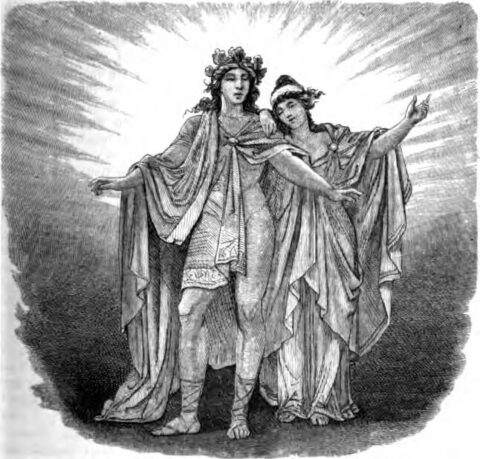
In Gylfaginning, chapter 10, Snorri Sturluson identifies Jörð as the daughter of Nótt (Night) and Annarr. Nótt is herself the daughter of Nörfi, a giant from Jötunheimr. She first married Naglfari and bore a son, Auðr, before having Jörð with Annarr. Her third husband, Dellingr, was the father of Dagr (Day). This genealogy places the personified earth within a family connecting Night and Day.
The account conflicts with the preceding chapter, where Snorri describes the earth as both Odin’s daughter and his partner, with whom he fathered Thor. Chapter 10 instead names Annarr as Jörð’s father, creating an inconsistency in her ancestry.
The father’s name also appears in forms such as Ánarr and Ónarr, which occur among the dwarf names in different manuscript versions of Völuspá. John McKinnell suggests that Snorri may have confused these names with Annarr, meaning “second,” and interpreted it as another name for Odin, by analogy with Þriði (“third”), an established Odin-name. This could explain the conflicting genealogies, but neither the identification with Odin nor the suggestion that Jörð’s father was the dwarf named in the poem can be established with certainty.
Fjörgyn and Hlóðyn: Other Names of Jörð?
Fjörgyn and Hlóðyn are poetic names for Jörð, not separate mothers of Thor. In Völuspá, Thor is called mögr Hlóðynjar (“son of Hlóðyn”) and Fjörgynjar burr (“son of Fjörgyn”) during his final battle with Jörmungandr. Hárbarðsljóð, stanza 56, also describes Fjörgyn as Thor’s mother, who will meet him in Verland and guide him toward Odin’s lands.
Snorri Sturluson lists both names among the poetic terms for the earth in Skáldskaparmál. Their etymologies remain debated. Fjörgyn has traditionally been linked to words associated with mountains, but Riccardo Ginevra (2021) proposes a connection with an Indo-European root meaning “colourful, spotted, dark,” possibly describing the earth’s appearance. He interprets Hlóðyn as reflecting the ancient image of the earth as the bearer of the cosmos.
The feminine Fjörgyn should not be confused with Fjörgynn, also written Fjörgvinn, the masculine name of Frigg’s father in Gylfaginning. Despite their linguistic similarity, the surviving myths do not establish that they were the same figure.
Was Jörð a Goddess or a Giantess?
In Gylfaginning, chapter 36, Snorri Sturluson counts Jörð among the ásynjur, the goddesses of the Æsir, alongside Rindr, the mother of Váli. Yet her ancestry connects her to the jötnar (giants). Her maternal grandfather, Nörfi, is identified as a giant from Jötunheimr.
John McKinnell offers a more specific interpretation in Meeting the Other in Norse Myth and Legend. He argues that Snorri included Jörð and Rindr among the ásynjur because they bore sons to Odin, although their identities belong more closely to the giantesses who became partners of the gods. Their inclusion in Snorri’s list therefore need not reflect their original mythological classification.
The distinction between gods and giants was not always determined by ancestry alone. The Æsir and jötnar frequently formed family relationships despite their conflicts. Jörð’s designation as a goddess and her association with the giants can therefore coexist, although the surviving evidence does not establish precisely how she was classified in pre-Christian belief.
Jörð in Skaldic Poetry
Skaldic poets used Jörð’s name and family relationships in kennings, condensed metaphors that drew on familiar mythology. In Haustlöng, attributed to the ninth-century poet Þjóðólfr of Hvinir, Thor is identified as Jörð’s son during his battle with the giant Hrungnir.
Her identity also appears in descriptions of wealth. In a verse attributed to Eyvindr skáldaspillir, gold lies hidden within the body of Thor’s mother, turning the earth into a living figure whose body contains precious metal.
Hallfreðr Óttarsson’s Hákonardrápa, composed in praise of Jarl Hákon Sigurðarson, develops this imagery further. Norway is portrayed as Odin’s bride and the forest-covered daughter of Ónarr. Hákon’s acquisition of territory becomes a figurative marriage to the land, using Jörð’s mythological relationships to express political conquest.
Read Also
Thor: Norse God of Thunder, Mjölnir and Viking-Age Worship
Explore the myths, family relationships, and religious importance of Jörð’s son, Thor.
Was Jörð Worshipped as an Earth Goddess?
There is no clear surviving evidence of a cult devoted specifically to Jörð. Eddic and skaldic poetry preserve her mythological identity but do not describe temples, sacrifices, festivals, or prayers dedicated to her. This does not rule out her worship, although it leaves no basis for reconstructing distinct religious practices.
A possible Germanic parallel appears in Tacitus’ Germania, chapter 40, written around 98 CE. Tacitus describes several tribes worshipping Nerthus, whom he identifies as Mother Earth. Her sacred wagon was carried in procession during a period of peace, then ritually washed in a secluded lake. The account documents an earth-associated religious tradition, but it does not establish a cult of Jörð. Linguistically, Nerthus is more closely connected with the Old Norse god Njörðr, and identifying her with Jörð remains speculative.
Snorri Sturluson’s Prose Edda also describes ancient people imagining the earth as a living being capable of producing and sustaining life. However, this passage belongs to the work’s Christian-era prologue, which seeks to explain the origins of pagan beliefs. It cannot serve as direct evidence that Jörð received worship in pre-Christian Scandinavia.
Conclusion
Jörð’s identity as Thor’s mother and the personified earth is well attested, but her place in Norse mythology remains difficult to define. The names Fjörgyn and Hlóðyn preserve her presence in Eddic poetry, while conflicting genealogies complicate her relationship with the gods and giants.
Her importance extends into skaldic poetry, where the earth becomes a living figure associated with divine ancestry, wealth, and political power. Yet no surviving myth centers on Jörð, and no distinct cult can be securely identified. Much of what we know about her comes from the ways Old Norse poets imagined and described the land.
Sources & Primary Texts
This article draws on medieval Old Norse texts and modern scholarship to distinguish Jörð’s documented mythological roles from uncertain genealogical traditions and evidence of pre-Christian worship.
Primary Sources
- Snorri Sturluson. Edda: Prologue and Gylfaginning. Edited by Anthony Faulkes. Viking Society for Northern Research, 2005. Especially chapters 9, 10, and 36, concerning Jörð’s ancestry, Thor’s parentage, and her classification among the goddesses.
Academic edition. - Snorri Sturluson. Edda: Skáldskaparmál. Edited by Anthony Faulkes. Viking Society for Northern Research, 1998. Preserves poetic names and kennings for the earth, including references to Jörð’s mythological relationships.
Academic edition. - Pettit, Edward, ed. and trans. The Poetic Edda: A Dual-Language Edition. Open Book Publishers, 2023. Consulted for Völuspá, Þrymskviða, Lokasenna, and Hárbarðsljóð, including references to Thor as the son of Jörð, Fjörgyn, and Hlóðyn.
Open-access edition. - Tacitus. Germania, chapter 40, c. 98 CE. Describes the worship of Nerthus, identified as Mother Earth, providing comparative evidence for Germanic religious traditions rather than direct evidence of Jörð’s worship.
Latin text and English translation.
Academic Studies
- McKinnell, John. “The Earth as Body in Old Norse.” Religionsvidenskabeligt Tidsskrift 74 (2022): 534–550. Examines Jörð, the creation of the earth from Ymir’s body, and the mythological language used to describe the land.
Journal article. - McKinnell, John. Meeting the Other in Norse Myth and Legend. D. S. Brewer, 2005. Especially pp. 155–156, discussing Jörð, Rindr, and Odin’s relationships with giantesses.
Publisher’s edition. - Ginevra, Riccardo. “Old Norse -yn (Proto-Germanic *-unjō-) and the Re-analysis and Spread of Derivational Morphology through Semantic Association.” In Dérivation nominale et innovations dans les langues indo-européennes anciennes, 61–71. MOM Éditions, 2021. Investigates the linguistic histories of Fjörgyn and Hlóðyn and their possible Indo-European connections.
Academic publication record. - Osborne, Emily. “Grund gulls [Ground of Gold]: The Trope of Woman as ‘Land’ in Skaldic Poetry from the Tenth to Fourteenth Centuries.” Scandinavian-Canadian Studies 22 (2015): 26–51. Examines the literary and political significance of representing land as a woman in skaldic poetry.
Full academic article.
Copyright & Content Rights
© 2026 History & Myths. Original editorial content by H. Moses. All rights reserved. Historical texts, scholarly quotations, and third-party images remain subject to their respective rights and licenses. Reproduction of substantial portions of the original article requires permission, except where permitted by applicable law.