Did Ancient Egyptians Practice Human Sacrifice? New Evidence
Did ancient Egyptians practice human sacrifice? The evidence suggests that they sometimes did, but the practice was limited, early, and very different from the idea of human sacrifice as a normal feature of Egyptian religion.
The strongest case comes from the First Dynasty royal cemeteries at Abydos, where subsidiary graves surrounded the tombs and funerary complexes of early rulers. Archaeologists have long debated whether some of the people buried there died naturally or were deliberately killed to accompany the ruler into the afterlife.
A 2026 forensic study strengthened the case for deliberate killing. Researchers re-examined 46 skulls from burials associated with Djer, Djet, and Merneith and found potentially lethal injuries around the time of death in 18 individuals. That does not prove that everyone in the subsidiary graves was sacrificed, but it adds direct physical evidence of violent death to a debate that had previously relied heavily on burial patterns.
The question is therefore not whether human sacrifice was common throughout Egyptian history. It was not. The more useful questions are why retainer sacrifice appeared during the earliest period of kingship, who the victims were, how some of them died, and why the practice disappeared.
Did Ancient Egyptians Really Practice Human Sacrifice?
Yes, in some early royal funerary contexts.
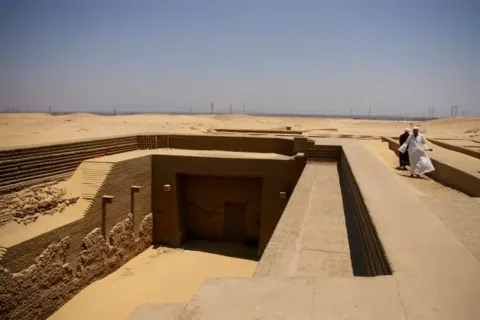
The evidence is strongest at First Dynasty Abydos, where groups of people were buried in subsidiary graves closely tied to royal tombs and funerary enclosures. In some cases, the timing and organization of those burials suggest that the dead may have been part of the ruler’s funeral rather than people buried there gradually over many years.
There is no good evidence that this remained a normal feature of Egyptian religion for centuries. The practice appears to belong mainly to a short, formative phase of early kingship.
What Is Retainer Sacrifice?
Retainer sacrifice is a form of human sacrifice in which people connected with a ruler are killed and buried with or near that ruler after death.
It differs from sacrificing a victim to a god. The purpose, as usually understood, was to allow attendants, officials, or other members of the royal household to continue serving the ruler in the afterlife.
At Abydos, the central question is therefore not simply why courtiers were buried near kings, but whether some of them died specifically because the ruler had died.
Evidence for retainer sacrifice can include organized burial groups, closely related burial dates, their position around the royal tomb, and signs of violent death.
In early Egypt, this narrower practice is the main form of human sacrifice under discussion.
The First Dynasty Burials at Abydos
The most important evidence comes from the royal cemetery at Abydos, especially Umm el-Qaab and the nearby funerary enclosures used by First Dynasty rulers.
Subsidiary graves surrounded several royal complexes, including those associated with Aha, Djer, Djet, Merneith, Den, and later First Dynasty rulers. Their number varied greatly from one reign to another.
Some complexes contained dozens or even hundreds of burials. Djer’s funerary landscape was among the largest, while the number of subsidiary graves generally declined later in the dynasty.
The graves were arranged in planned groups closely connected to royal monuments, showing that they formed part of the funerary landscape rather than an ordinary cemetery that developed independently over time.
By themselves, these burials do not prove that every person was sacrificed. They establish the archaeological setting in which the retainer-sacrifice debate developed.
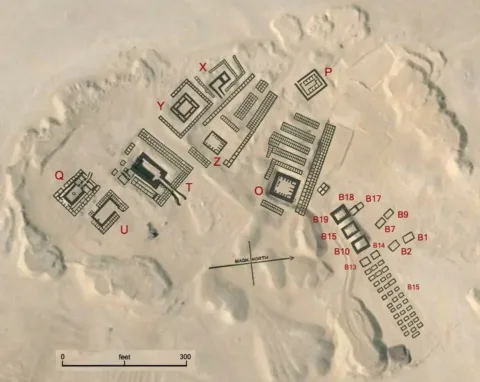
Map Key: Royal Tombs at Umm el-Qa’ab
Iry-Hor — B1–B2
King Ka — B7–B9
Narmer — B17–B18
Aha — B19–B15–B10
Djer — O
Djet — Z
Merneith — Y
Den — T
Anedjib — X
Semerkhet — U
Qa’a — Q
Peribsen — P
Read Also
First Dynasty of Ancient Egypt: Pharaohs, Timeline, and Legacy
Why Did Archaeologists Suspect Sacrifice in the First Place?
The suspicion began with the layout and timing of the burials.
Many subsidiary graves were arranged in ordered groups around royal tombs and funerary enclosures rather than added gradually over generations. That raised the possibility that groups of people died within the same narrow period as the ruler.
Early excavators, including Flinders Petrie, also noted the unusually large number of graves around some royal complexes. Their close relationship to the king’s burial made them difficult to explain simply as prestigious cemetery plots for courtiers who died naturally at different times.
Some burials also belonged to people connected with the royal household, administration, or specialist work. If they were buried as part of the same funerary event, their presence would fit the idea of a court intended to accompany the ruler into the afterlife.
For more than a century, however, the argument rested mainly on burial layout, chronology, and royal context. Those clues suggested retainer sacrifice, but they could not show how the individuals actually died.
What the 2026 Forensic Study Found
In 2026, bioarchaeologist Roselyn Campbell re-examined 46 human skulls from First Dynasty subsidiary burials at Abydos. The remains, held in the Duckworth Laboratory collection at the University of Cambridge, came from funerary complexes associated with Djer, Djet, and Merneith.
Eighteen of the 46 individuals, about 39 percent of the sample, showed potentially lethal cranial trauma that occurred around the time of death.
This changed the nature of the evidence. The case for retainer sacrifice no longer rested only on the arrangement and timing of the graves. Some of the surviving remains themselves preserved signs of violent death.
The sample is still limited. These skulls represent only a fraction of the people originally buried around the royal complexes, and much of the rest of their skeletons is no longer available for examination.
The study therefore does not prove that every subsidiary burial contained a sacrificed retainer. It does, however, provide direct physical evidence that violent death affected a substantial portion of the individuals who could be re-examined.
How Were Some of the Retainers Killed?
The injuries suggest that at least some individuals suffered direct blows to the head around the time of death.
The 2026 study identified perimortem cranial trauma, meaning the damage occurred before healing could begin. Most of the injuries were consistent with blunt-force impact, while a smaller number of skulls also showed sharp-force trauma.
Some fractures were severe and potentially lethal. In several cases, their location and severity make accidental trauma a less convincing explanation. In several cases, the location and severity of the injuries make accidental trauma a less convincing explanation.
The surviving remains do not reveal the exact weapon or circumstances of death. They cannot show whether the individuals were restrained, killed during a formal ritual, or executed in some other setting.
What the bones do show is that a significant number of people buried around these royal complexes suffered potentially lethal head injuries at or near the time of death.
What About the Other 28 Individuals?
The absence of lethal cranial trauma in the other 28 individuals does not mean they all died naturally.
Some methods of killing can leave little or no evidence on the skull, especially when the rest of the skeleton is missing. Injuries elsewhere on the body would also be impossible to assess in many of these cases.
That limitation matters because the 2026 study examined surviving skulls from an old collection rather than complete skeletons from newly excavated burials.
The group may therefore have included people who died in different ways. Some could have been killed without leaving cranial trauma, while others may have died from illness, accident, or unrelated causes.
The evidence confirms violent death in part of the sample, but it does not allow the remaining individuals to be classified confidently as either sacrificed or naturally deceased.
Who Were the People Buried Around the Kings?
They were not simply anonymous slaves.
Labels, grave goods, and the wider cemetery context suggest that at least some of those buried in the subsidiary graves belonged to the royal household or administration. Identified roles include officials, seal-bearers, inspectors, artisans, and other people connected with the court.
If some of them were deliberately killed, their presence may reflect the idea that the ruler would continue to need a functioning household and skilled personnel in the afterlife.
The evidence does not allow every individual to be identified. Many names and titles are lost, and some graves were poorly documented during early excavations.
It is therefore more accurate to describe the group as royal retainers and court personnel than to assume they were all slaves, servants, or prisoners.
Were the Retainers Willing Sacrifices?
We do not know.
The graves and skeletal injuries may show that some people died in connection with the ruler’s funeral, but they cannot reveal whether those individuals agreed to die, were forced, or even understood what was going to happen.
Service to the king may have carried religious and social meanings that are difficult to reconstruct today, but there is no secure evidence that the retainers volunteered for death.
At the same time, the archaeological record does not preserve their intentions, and no surviving First Dynasty text explains how these deaths were arranged.
The evidence can tell us that some individuals were probably deliberately killed. It cannot tell us whether they accepted, resisted, or anticipated their fate.
Was Human Sacrifice Practiced Before the First Dynasty?
Possibly, but the evidence is less secure than at First Dynasty Abydos.
Predynastic cemeteries at sites such as Hierakonpolis and Adaima have produced unusual burials that some researchers have interpreted as possible evidence of ritual killing or human sacrifice. Some individuals were buried in exceptional contexts or show signs of violence and unusual treatment of the body.
None of those features proves sacrifice by itself. Violent death could reflect execution, conflict, punishment, or other practices that are difficult to distinguish archaeologically.
The evidence at Abydos is stronger because the subsidiary graves form part of an organized royal funerary system. Their location, timing, and relationship to royal monuments create a clearer context for interpreting some deaths as retainer sacrifice.
Human sacrifice may therefore have existed before the First Dynasty, but the case becomes much stronger with the royal burial complexes of early dynastic Abydos.
Was Human Sacrifice Common Throughout Ancient Egyptian History?
No. The strongest evidence is concentrated in the earliest dynastic period, especially the First Dynasty royal cemeteries at Abydos.
After that, the pattern changes sharply. Large groups of subsidiary burials around royal tombs become much less common, and the archaeological record does not show retainer sacrifice continuing as a standard part of royal funerary practice.
Later Egyptian texts and imagery could depict violence against enemies, but this is not evidence of retainers being killed to accompany a ruler into the afterlife.
The evidence from Abydos therefore belongs to a specific early context rather than to Egyptian religion as a whole.
Retainer sacrifice appears to have been a short-lived feature of early kingship that declined as royal burial practices changed.
Why Did Retainer Sacrifice Disappear?
There is no single proven explanation for its disappearance.
One possibility is that the practice was closely tied to the formative period of Egyptian kingship, when royal power and funerary traditions were still being established. As those institutions became more stable, the need for large groups of subsidiary burials may have diminished.
Practical considerations may also have played a role. Officials, artisans, and other court personnel were valuable to the functioning of the state, making the repeated loss of skilled people increasingly difficult to sustain.
At the same time, royal funerary customs were changing. Later rulers continued to prepare extensively for the afterlife, but they did so through different kinds of tombs, objects, rituals, and representations of service.
The archaeological evidence points to a gradual decline rather than a clear moment of abolition. Retainer sacrifice seems to have faded as early Egyptian kingship and funerary ideology developed in new directions.
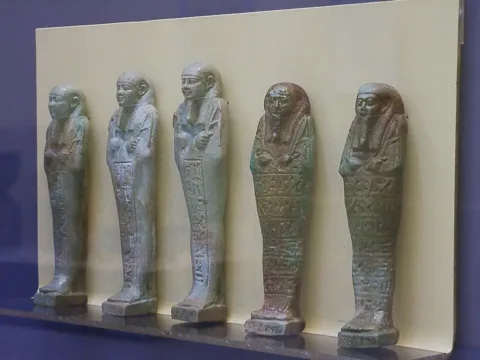
Did Shabti Figures Replace Human Sacrifice?
Not directly.
Shabti figures were intended to perform required labor for the deceased in the afterlife, but they became common much later than the First Dynasty subsidiary burials at Abydos.
The chronological gap makes a direct replacement unlikely. Egyptians did not simply stop burying retainers and begin using shabtis instead. The two practices belong to different stages of Egyptian funerary tradition.
After subsidiary burials declined, ideas about provisioning and serving the dead continued to develop through tomb equipment, representations, models, and eventually shabti figures.
Shabtis therefore reflect a broader concern with providing service in the afterlife, but there is no evidence that they were introduced specifically to replace sacrificed retainers.
What the Evidence Proves, and What It Does Not
The evidence now makes deliberate killing at First Dynasty Abydos difficult to dismiss.
The organization of the subsidiary graves had long suggested that some retainers died in connection with royal funerals. The 2026 forensic study adds physical evidence, with potentially lethal perimortem trauma identified in a substantial part of the examined sample.
It does not prove that everyone in the subsidiary graves was sacrificed, that all victims died in the same way, or that every royal complex followed the same practice. Nor can the evidence reveal whether those who were killed were willing participants.
Most importantly, the findings do not support the idea that human sacrifice was normal throughout Egyptian history.
What they support is more specific: some individuals buried around First Dynasty rulers at Abydos were probably deliberately killed as part of early royal funerary practice, while the scale and precise nature of that practice remain uncertain.
Conclusion
Human sacrifice was not a normal feature of ancient Egyptian religion, but the evidence indicates that some early rulers were accompanied in death by retainers who may have been deliberately killed.
The strongest case comes from First Dynasty Abydos, where burial patterns and the 2026 forensic evidence point to a short-lived practice tied to the formative stages of Egyptian kingship. Its exact scale remains uncertain, but it appears to have declined as royal funerary traditions changed.
Academic & Primary Sources
- Roselyn Campbell (2026).
“New Data from Old Bones: Using Bioarchaeology and Forensics to Reassess Legacy Data from Ancient Abydos, Egypt.”
Frontiers in Environmental Archaeology.
View study - Laurel Bestock (2008).
“The Early Dynastic Funerary Enclosures of Abydos.”
Archéo-Nil, 18, pp. 42–59.
View article - Emily Teeter, ed. (2011).
Before the Pyramids: The Origins of Egyptian Civilization.
Oriental Institute Museum Publications 33, University of Chicago.
View publication - Toby A. H. Wilkinson (1999).
Early Dynastic Egypt.
Routledge.
Publisher page - David O’Connor (2009).
Abydos: Egypt’s First Pharaohs and the Cult of Osiris.
Thames & Hudson.
Smithsonian record - W. M. Flinders Petrie (1900–1901).
The Royal Tombs of the First Dynasty.
Egypt Exploration Fund.
Primary excavation report