What If Medusa Had Defeated Perseus? Greek Mythology Scenario
In the traditional myth, Perseus kills Medusa, escapes with her head, rescues Andromeda, defeats Polydectes, and eventually fulfills the prophecy that haunted his grandfather Acrisius. But what if his story had ended inside Medusa’s lair?
If Medusa had detected Perseus before he struck and turned him to stone, the consequences would reach far beyond the death of a single hero. Andromeda would never be rescued by Perseus, Polydectes would remain a threat to Danaë, and Medusa’s head would never become the weapon that shapes several later episodes of the myth.
Even Pegasus and Chrysaor would lose the moment of birth described in the surviving tradition, since both emerge after Medusa is beheaded.
The effects would continue into later generations. Without Perseus returning alive and marrying Andromeda, the family line that eventually leads to Heracles would no longer develop in the same way.
The Alternate Scenario: Medusa Defeats Perseus
In Apollodorus’s account, Perseus reaches the Gorgons while they are asleep.
Athena guides his hand as he watches Medusa through the reflection in his bronze shield,
allowing him to strike without meeting her gaze. He kills her before she can react
and escapes with her head.
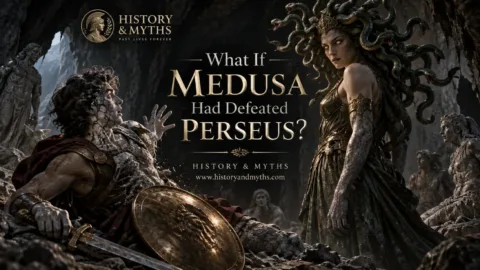
Our alternate scenario changes one moment: Medusa wakes before Perseus can strike.
Once he loses the advantage of surprise, the mission becomes far more dangerous.
His weapons may have brought him this far, but they cannot protect him if he looks
directly at Medusa. The most immediate outcome is that she turns Perseus to stone
before he can use the sickle.
From that moment, the familiar myth breaks apart. Perseus never leaves with Medusa’s
head, and every event that depends on his survival takes a different course.
Medusa survives, but her victory does not automatically turn her into a conqueror.
The decisive change is simply that Perseus is removed from the story before his later
adventures can begin.
What Happens Immediately After Perseus Falls?
If Medusa turns Perseus to stone before he can strike, her head is never taken.
That changes the story immediately. In the traditional myth, Medusa’s severed head becomes one of Perseus’s most powerful weapons, used against several later enemies. Without the beheading, that weapon never enters the story.
Stheno and Euryale also have no fleeing Perseus to pursue. The attack ends at the Gorgons’ home instead of becoming the beginning of a wider journey.
Pegasus and Chrysaor are affected as well. In Hesiod and later mythographers, both emerge only after Medusa is beheaded. If Perseus fails, that traditional birth does not take place at this moment.
Medusa’s victory therefore stops several later events before they can begin, not because she does anything new, but because Perseus never completes the act that sets them in motion.
Medusa Survives, But What Would She Do Next?
Defeating Perseus would not automatically turn Medusa into a conqueror seeking revenge across Greece.
The surviving myths give no reason to think she would leave the Gorgons’ home after his death. Hesiod places Medusa and her sisters far beyond Ocean, near the edge of the mythical world, while Apollodorus presents Perseus as the intruder who comes to them while they sleep. Neither account describes Medusa hunting Greek heroes or trying to expand her power.
The most plausible outcome is that she remains with Stheno and Euryale.
What could change is her reputation. A hero aided by the gods has entered her territory and failed. If news of Perseus’s fate reached the Greek world, Medusa would become an even more feared figure, and another attempt against her might eventually follow.
A campaign against Athena, Poseidon, or Greek cities would require an entirely new assumption. Nothing in the surviving tradition makes that a necessary consequence of her victory.
Danaë and Polydectes Without Perseus
Perseus’s failure would leave his mother, Danaë, in a far more dangerous position.
In Apollodorus, Polydectes wants Danaë but cannot reach her while Perseus is present. Sending Perseus after Medusa is therefore more than a heroic challenge, it removes the main obstacle between Polydectes and Danaë.
In the traditional story, Perseus eventually returns to Seriphos and finds Danaë and Dictys seeking refuge from Polydectes. He ends the threat by showing the king Medusa’s severed head, turning Polydectes and his supporters to stone. Dictys then becomes king.
If Medusa defeats Perseus, that rescue never happens.
Polydectes remains in power, Danaë loses the son who had protected her, and Dictys has no clear path to the throne. The myth does not tell us exactly what Polydectes would do next, so Danaë’s final fate cannot be fixed with certainty. What does disappear is the event that removes Polydectes from power.
Medusa’s victory would therefore leave Seriphos under a very different balance of power.
Andromeda Would Never Meet Perseus
Andromeda’s story changes for one simple reason: Perseus never reaches her.
In Apollodorus, Perseus encounters Andromeda only after killing Medusa and leaving with her head. He finds her bound as a sacrifice to a sea monster, agrees to rescue her in return for marriage, kills the creature, and frees her.
If Medusa defeats Perseus, that rescue never happens.
Andromeda remains exposed to the monster, and the crisis created by Poseidon is left unresolved in the form preserved by the myth. It would be too strong to say that she certainly dies, because another intervention is possible in an alternate scenario. What disappears completely is the traditional outcome in which Perseus saves her and becomes her husband.
Without that marriage, the family line that follows Perseus and Andromeda also changes, with consequences that reach much further into Greek mythology.
What Happens to Pegasus and Chrysaor?
Pegasus and Chrysaor create one of the biggest complications in this alternate timeline.
In both Hesiod and Apollodorus, they emerge only after Perseus cuts off Medusa’s head. Pegasus appears as the winged horse, while Chrysaor later becomes the father of Geryon. Their traditional births are therefore tied directly to Medusa’s death.
If Medusa defeats Perseus, that moment never occurs.
This does not prove that Pegasus and Chrysaor could never exist in any version of the myth. It means only that the birth described by the surviving tradition no longer takes place. No alternate account explains how they would emerge while Medusa remained alive.
The consequences could spread much further. Pegasus later becomes central to the story of Bellerophon and the defeat of the Chimera, while Chrysaor’s line leads to Geryon.
Medusa’s survival would therefore affect myths far beyond the story of Perseus himself.
Would the Prophecy of Acrisius Still Come True?
Acrisius was told that his daughter Danaë would bear a son who would eventually kill him. In the traditional myth, every attempt to escape that fate fails. Perseus survives, grows up, and later kills Acrisius accidentally with a discus during athletic games, fulfilling the prophecy exactly as feared.
If Medusa turns Perseus to stone before he returns, that path to the prophecy disappears.
Acrisius would likely survive longer because the grandson named in the prophecy never reaches the moment in which it is fulfilled. Yet Greek mythology often treats attempts to escape fate as part of the very process that brings it about.
That creates two possible outcomes. Perseus’s death could cause the prophecy to fail entirely, or fate could find another route that eventually leads to Acrisius’s death.
The surviving myth gives us no answer. What changes for certain is that Perseus no longer fulfills the prophecy in the way preserved by Apollodorus and Pausanias.
The Perseid Bloodline Changes Completely
If Perseus dies before meeting Andromeda, one of the largest long-term changes is the fate of his descendants.
In Apollodorus, Perseus and Andromeda become the parents of Perses, Alcaeus, Sthenelus, Mestor, Electryon, and Gorgophone. Their descendants become part of major royal lines associated with Mycenae and Tiryns.
The most important connection leads to Heracles. Electryon becomes the father of Alcmene, while Alcaeus becomes the father of Amphitryon. Heracles is later born to Alcmene and raised in Amphitryon’s household, placing him within the wider family descended from Perseus.
If Perseus never marries Andromeda, that genealogy cannot develop in the form preserved by Apollodorus. This does not prove that Heracles could never exist in every possible version of Greek mythology, but the traditional Perseid line leading to him would be broken.
Medusa’s victory would therefore reshape a family line that reaches far beyond Perseus himself.
Read More
Would Athena or Hermes Intervene Again?
Perseus does not face Medusa alone in the traditional story. Hermes gives him the sickle used to kill her, while Athena guides his hand as he looks at Medusa through the reflection in his shield. Their help is central to his success.
If Medusa defeats him, the surviving myths do not tell us what Athena or Hermes would do next.
They might support another attempt, but there is no surviving account in which either god returns to kill Medusa personally after Perseus fails, nor is there a second named hero sent in his place.
For this alternate scenario, the cleanest outcome is to leave that question open. Perseus dies, Medusa survives, and no immediate divine intervention reverses the result.
The Most Likely Outcome
The most plausible version of this alternate myth is not one in which Medusa conquers Greece or declares war on the gods.
Perseus simply fails to kill her and never returns.
From there, the consequences follow from his absence. Polydectes remains in power on Seriphos, Andromeda loses the rescuer she has in the traditional myth, Pegasus and Chrysaor lose their traditional moment of birth, and Acrisius’s prophecy no longer reaches its familiar fulfillment. The Perseid family line that later leads to Heracles would also be broken.
Medusa would not need to do anything else to transform the mythology. Her survival alone is enough to prevent several later stories from unfolding as they do in the surviving tradition.
Academic Sources
- Apollodorus.
The Library, Book 2, Chapter 4.
This is the principal ancient source used for Perseus’s mission,
Athena and Hermes’s assistance, Medusa’s death, Andromeda,
Polydectes, Acrisius, and the later Perseid family line.
Perseus Digital Library, Tufts University.
- Hesiod.
Theogony, lines 270–294.
An early Greek source for the Gorgons, Medusa’s mortality,
and the emergence of Pegasus and Chrysaor after her beheading.
Perseus Digital Library, Tufts University.
- Pausanias.
Description of Greece, Book 2, 16.2–3.
Preserves the tradition in which Perseus accidentally kills Acrisius
with the discus, fulfilling the prophecy despite attempts to avoid it.
Perseus Digital Library, Tufts University.
- Bremmer, J. N.
“Gorgo/Medusa.”
Oxford Classical Dictionary.
A modern scholarly overview of Medusa, the Gorgons,
Perseus’s mission, and the development of the myth in Greek tradition.
Oxford University Press.
- “Perseus.”
Oxford Classical Dictionary.
A modern academic summary of Perseus’s encounter with Medusa,
rescue of Andromeda, defeat of Polydectes,
fulfillment of Acrisius’s prophecy, and the Perseid dynasty.
Oxford University Press.
The alternate scenario in this article is speculative, but its point of divergence
and consequences are based on events, genealogies, and relationships preserved
in ancient Greek sources and modern classical scholarship.
© 2026 History & Myths. All rights reserved.
This article is original content and may not be copied, republished, adapted, or redistributed without prior written permission.