What If Spartacus Had Defeated Rome? Alternate History
In 71 BCE, Spartacus had already defeated several Roman forces, and the Republic had turned to Marcus Licinius Crassus to end the revolt.
But what if Spartacus had defeated Crassus instead?
That would not automatically mean the fall of Rome. The Republic still had other armies, Pompey was returning from Spain, and Spartacus left no clear political program for ruling Italy or abolishing slavery across Roman territory.
A decisive victory could nevertheless have transformed the war. Spartacus might have gained time to escape across the Alps, reach Sicily, attract more followers, or threaten Rome itself.
The real question is not whether Spartacus could have ruled Rome, but how much damage one more major Roman defeat might have done to the Republic.
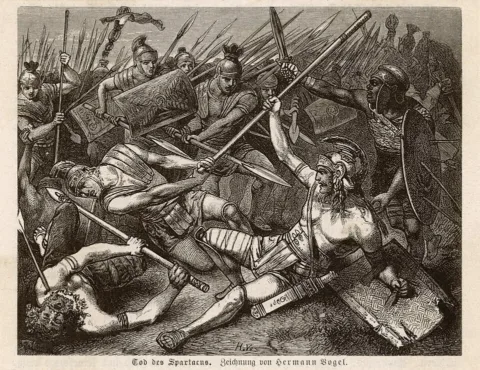
The Historical Turning Point: Spartacus Faces Crassus
By 71 BCE, the revolt had become a serious military crisis. After earlier Roman failures, the Senate gave Marcus Licinius Crassus command of the campaign.
Crassus imposed tighter discipline on his forces and pursued Spartacus more systematically than previous commanders had done. The rebels were gradually pushed into a more dangerous position in southern Italy.
That made Crassus the immediate obstacle between Spartacus and any chance of prolonging the revolt. Defeating his army before further Roman forces arrived would create the opening on which this alternate-history scenario depends.
Alternate-History Scenario: Spartacus Defeats Crassus
The point of divergence is simple: Spartacus wins a decisive battle against Crassus in 71 BCE before Pompey can return from Spain.
This would be a major reversal, but not an entirely implausible one. Spartacus had already defeated several Roman forces before Crassus took command, although Crassus brought greater discipline and resources to the campaign.
For the victory to matter, Crassus would need to lose enough men and officers that his army could no longer continue effectively, while Spartacus preserved most of his own force.
That would not give the rebels control of Italy. It would, however, remove the army Rome expected to end the revolt and give Spartacus room to move before the Republic could recover.
What happened next would depend on how he used that brief advantage.
What Did Spartacus Actually Want?
The ancient sources do not give Spartacus a clear political program, so claims that he intended to overthrow the Roman Republic or abolish slavery across Italy go beyond the evidence.
Plutarch says Spartacus tried to lead his followers toward the Alps, hoping they could leave Italy and return to places such as Gaul and Thrace. That suggests escape was one of his aims during at least part of the revolt.
Appian preserves a different episode in which Spartacus moved toward Rome after defeating Roman forces, then abandoned the plan because his army was not properly equipped for such an attack and no city had joined him.
Spartacus appears to have adapted his aims as the war changed. The surviving evidence supports escape, survival, and opportunistic military action more clearly than a fixed plan to govern Rome or create a new political order.
The Alps, Sicily, or Rome: What Options Did Spartacus Have?
After defeating Crassus, Spartacus would have faced three realistic choices.
Crossing the Alps offered the clearest route out of Italy. Plutarch says Spartacus had considered this earlier, suggesting that escape rather than conquest remained a serious possibility.
Sicily offered another path. Spartacus had already tried to arrange transport there through Cilician pirates, and the island had a recent history of major slave revolts. Reaching it with a large force could have opened a new front against Rome.
Marching on Rome promised the greatest symbolic victory but carried the highest risk. Spartacus commanded a mobile field army, not a force designed to capture and hold a major city.
Of the three options, the Alps or Sicily offered the best chance of preserving the revolt. A direct move on Rome would be the boldest choice, but also the one most likely to destroy the advantage gained by defeating Crassus.
Pompey Would Still Be Coming Home
A defeated Crassus would not leave the Republic without another major commander.
Pompey was returning from Spain, and Plutarch says Crassus had already asked the Senate to summon him as reinforcement. Crassus later regretted that request because he feared Pompey would arrive in time to share the credit for ending the war.
In this alternate timeline, Pompey becomes the immediate threat. He would return with military prestige, experienced troops, and a strong political incentive to finish a revolt that had just humiliated Crassus.
Spartacus might gain a brief advantage, but Pompey’s arrival would sharply reduce the time available to turn that victory into something larger.
Could the Revolt Spread Across Italy?
A major victory over Crassus could have drawn more people into Spartacus’ army, especially enslaved laborers on rural estates and others willing to exploit Rome’s temporary weakness.
The revolt had already grown far beyond the gladiators who escaped from Capua by absorbing fugitives and other recruits as it moved through Italy. Appian describes large numbers joining Spartacus as his early victories continued.
But expansion would bring its own problems. A larger force needed more food, weapons, discipline, and coordination, while the rebels did not always act as a single body. Plutarch records groups separating from Spartacus on more than one occasion, sometimes operating independently before being attacked by Roman forces.
A victory over Crassus could therefore produce a larger and more dangerous uprising, but not necessarily a unified movement capable of acting across Italy as one army.
Could Spartacus Reignite Revolt in Sicily?
Sicily was more than another escape route. The island had already experienced major slave uprisings, making it a potentially dangerous place for Rome if Spartacus could reach it with a large armed force.
Plutarch says Spartacus had tried to arrange passage through Cilician pirates, but the plan failed when they took payment and abandoned the agreement.
After defeating Crassus, another attempt could have become more attractive. Reaching Sicily might place thousands of rebels among large enslaved populations with a recent memory of servile war.
That would not guarantee a new uprising, but it could open a second major front that Rome would have to suppress separately.
Would Roman Slavery Collapse?
No. Even a major victory by Spartacus would not have ended slavery across the Roman Republic.
Slavery was deeply embedded in Roman agriculture, households, mining, and commerce. Spartacus could free people who joined him and encourage further escapes or revolts, but the surviving sources do not show that he had a political program to abolish slavery throughout Roman territory.
What could change is the stability of the system. A victory over Crassus might encourage new uprisings, make large estates harder to control, and force Roman elites to spend more troops and money suppressing unrest.
The result would be greater disruption and insecurity, not immediate abolition.
Could Spartacus Build a State of His Own?
Spartacus showed that he could organize a large fighting force, manage supplies, and keep a rebellion moving across Italy. Appian even describes him restricting private possession of gold and silver at Thurii while encouraging the purchase of iron and bronze for weapons.
That shows practical military leadership, but not a clear plan for permanent government.
A lasting state would require territory, food production, administration, alliances, and a leadership structure strong enough to hold together followers with different backgrounds and aims.
The more plausible outcome would be a temporary rebel-held territory or refuge, perhaps in southern Italy or Sicily, rather than a durable kingdom ruled by Spartacus.
What Happens to Crassus and Pompey?
A decisive defeat could have changed Crassus’ political career as well as the course of the revolt.
If he survived after losing much of his army, the victory he historically gained over Spartacus would disappear from his record. If he were killed, Rome would also lose one of its wealthiest and most influential political figures years before his later alliance with Pompey and Caesar.
Pompey, meanwhile, was returning from Spain with his army. Historically, his troops killed thousands of fugitives after Spartacus’ final defeat, allowing Pompey to claim a share of the credit for ending the revolt.
If Crassus had already been defeated, Pompey could instead have returned to find the war still unresolved.
That would change the political circumstances surrounding their consulship in 70 BCE and could also alter the relationship that later connected Pompey, Crassus, and Caesar. How far those changes would extend is much harder to establish.
Would Spartacus Have Destroyed the Roman Republic?
Defeating Crassus alone would not have been enough to destroy the Roman Republic.
Rome still had other armies, commanders, allies, and the ability to continue the war. Pompey’s return from Spain is the clearest example: even after losing a major army, Spartacus would still face another experienced Roman force entering Italy.
A victory could prolong the revolt, increase unrest, and expose how difficult it had become for Rome to restore control. But the collapse of the Republic would require further Roman defeats and a much broader breakdown of political and military authority.
Spartacus could create a far deeper crisis without actually bringing down the Roman state.
Why a Spartacus Victory Would Still Matter
Spartacus would not need to conquer Rome for a victory over Crassus to matter.
Defeating the army sent to end the revolt could prolong the war, encourage further resistance, and force Rome to commit more men and resources to restoring control across Italy.
It would also expose something the Republic had already discovered repeatedly during the revolt: Spartacus was no longer leading a band of escaped gladiators, but a military threat capable of defeating Roman armies in the field.
His victory would not have guaranteed the fall of Rome. But it could have turned an uprising Rome was close to suppressing into a much longer and more disruptive crisis.
Academic Sources
The historical sections of this article are based on surviving ancient accounts of the Spartacus revolt and modern scholarship on Roman slavery, rebellion, and the political context of the late Republic.
Appian, The Civil Wars, Book I, Chapter 14.
One of the principal ancient accounts of the Spartacus revolt, including his victories over Roman forces, the appointment of Crassus, the final campaign, and the later rivalry between Crassus and Pompey.
Perseus Digital Library
Plutarch, Life of Crassus.
A major ancient source for Spartacus, including the growth of the revolt, divisions among the rebels, Crassus’ command, the attempted passage to Sicily, and Pompey’s return to Italy.
Perseus Digital Library
Keith R. Bradley, Slavery and Rebellion in the Roman World, 140 B.C.-70 B.C.
Indiana University Press, 1989. A major scholarly study of Roman slave resistance, including the Sicilian slave wars and the revolt led by Spartacus.
Google Books
Brent D. Shaw, Spartacus and the Slave Wars: A Brief History with Documents.
Bedford Series in History and Culture, 2001. Combines modern historical analysis with a large collection of translated Greek and Latin sources on slavery and rebellion in Rome, Italy, and Sicily.
Springer Nature
Theresa Urbainczyk, Spartacus.
Bristol Classical Press, 2004. A focused scholarly examination of the historical Spartacus, the limitations of the surviving evidence, and the later development of his reputation.
Bloomsbury Publishing
Aldo Schiavone, Spartacus.
Harvard University Press, 2013. A modern interpretation of Spartacus’ military strategy, political ambitions, and the wider significance of the revolt within Roman Italy.
Google Books
Copyright Notice
© 2026 History & Myths. All rights reserved.
This article is original editorial content created for HistoryAndMyths.com.
Unauthorized reproduction, republication, or substantial copying of the text,
structure, or original analysis is prohibited without prior written permission.
Brief quotations are permitted for commentary, research, or educational use
when accompanied by clear attribution and a link to the original article.