Sif: Thor’s Wife and the Mystery of Her Golden Hair
Sif was a Norse goddess best known as Thor’s wife and for the golden hair that became her defining feature. In Snorri Sturluson’s Prose Edda, Loki cuts off her hair, provoking Thor’s anger and forcing Loki to seek help from the dwarves. They create a replacement made of gold that grows like natural hair, setting in motion the events that also lead to the creation of Thor’s hammer, Mjölnir.
Beyond this famous story, the surviving sources reveal relatively little about Sif. She is the mother of Ullr and Þrúðr and appears in poems involving Loki and Thor, but her own powers and religious responsibilities remain unclear. Her golden hair has often been interpreted as a symbol of ripening grain, leading to descriptions of Sif as a goddess of fertility or harvest. Yet the Old Norse texts never explicitly assign her that role, leaving the meaning of her most recognizable feature open to debate.

Who Was Sif in Norse Mythology?
Sif belonged to the Ásynjur, the goddesses associated with the Æsir. The surviving texts reveal little about her background. Neither her parents nor her birthplace are identified, and no account assigns her a particular dwelling or independent sphere of authority. Most of what we know comes from the Poetic Edda and Snorri Sturluson’s Prose Edda, where she appears in a small number of episodes rather than as the central figure of a lengthy myth.
Her name provides another clue to her identity. It is related to the Old Norse word sifjar, meaning kinship or relationships established through marriage. The term shares a Germanic root with Old English sibb, meaning kinship or peace, from which the modern English word sibling developed. This connection has led scholars to associate Sif with family bonds and marriage. However, the surviving myths do not explicitly identify her as a goddess responsible for protecting either.
Sif’s Family: Thor, Ullr and Þrúðr
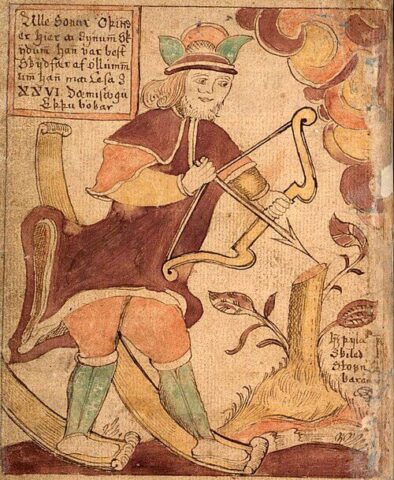
Sif was married to Thor, but the surviving myths provide few details about their life together. In Skáldskaparmál, Snorri Sturluson identifies her as the mother of Ullr and Þrúðr. The two children have different paternal relationships: Þrúðr is Thor’s daughter, while Ullr is explicitly described as his stepson in Gylfaginning. Ullr’s biological father is never named.
Snorri also describes Sif as elja Járnsöxu, a term commonly translated as “rival wife” or “co-wife” of Járnsaxa. Járnsaxa is identified elsewhere as the mother of Thor’s son Magni, but no surviving story describes a rivalry between the two women. Thor’s other son, Móði, is also mentioned in the sources, although his mother is not identified. Sif therefore cannot be assumed to be the mother of every child attributed to Thor.
How Loki Cut Sif’s Hair
The story appears in Skáldskaparmál, where Snorri Sturluson explains why gold could be called “Sif’s hair” in Norse poetry. Loki cuts off all her hair as an act of mischief, although the text gives no further motive. When Thor discovers what happened, he seizes Loki and threatens to break every bone in his body unless he makes amends.
Loki promises to obtain replacement hair from the dwarves and visits the sons of Ívaldi, renowned craftsmen who fashion it from gold. Their creation is no ordinary ornament. According to Snorri, the golden strands take root when placed on Sif’s head and grow like natural hair.
The dwarves also produce Odin’s spear Gungnir and the ship Skíðblaðnir. Loki then enters a wager with another dwarf, Brokkr, setting in motion the contest that produces Thor’s hammer Mjölnir. Sif’s lost hair is thus the event that begins the creation of several famous treasures of the gods.
The Meaning of Sif’s Golden Hair
Sif’s golden hair had a specific meaning in Old Norse poetry. In Skáldskaparmál, Snorri introduces the story to explain why poets could use “Sif’s hair” as an expression for gold. It belonged to a wider tradition of poetic descriptions that also called gold “Freyja’s tears” and “Ægir’s fire,” drawing on familiar myths instead of naming the metal directly.
Snorri also quotes a verse from Bjarkamál that uses a related expression involving Sif’s hair to describe gold distributed by a generous ruler. This provides a literary example of her name being used in poetry about wealth, rather than evidence that she possessed authority over gold itself.
The replacement of Sif’s shorn hair with golden strands that could grow like natural hair has encouraged comparisons with ripening grain and seasonal renewal.
These interpretations offer possible symbolic meanings, but Snorri never connects Sif’s hair with agriculture or the changing seasons.
Sif and the Accusations of Infidelity
Sif speaks directly in Lokasenna, where Loki insults the gods gathered at Ægir’s feast. She approaches him with a cup of mead and asks him to acknowledge that she, at least, is innocent of wrongdoing. Loki accepts the drink but responds by claiming that he once had an affair with her behind Thor’s back. The poem provides no account of such an encounter beyond Loki’s accusation.
A similar insult appears in Hárbarðsljóð, where Thor quarrels with a ferryman named Hárbarðr, generally understood to be Odin in disguise. Hárbarðr claims that Sif has a lover at home and suggests Thor should confront him instead. Thor rejects the accusation as a lie.
Both poems use personal insults to provoke their opponents. Neither supplies independent evidence of Sif’s infidelity. The accusations reveal how her marriage could become a target in contests of honour and verbal aggression, rather than establishing an otherwise unknown episode in her mythology.
Was Sif a Goddess of Fertility and Harvest?
Sif is frequently described as a goddess of fertility, grain, or harvest, but none of these roles is explicitly assigned to her in surviving Old Norse texts. The interpretation developed through later scholarship, particularly during the nineteenth century, when researchers sought connections between Norse myths and the agricultural cycle.
According to this reading, Sif’s golden hair represents ripe grain. Its removal resembles harvesting, while its replacement suggests the return of vegetation. Her marriage to Thor, a god associated with thunder and rain, has also been interpreted as a symbolic union between the fertile earth and the weather that sustains crops.
Not all scholars accept this explanation. Rudolf Simek argues that the agricultural interpretation rests on insufficient evidence, noting that the Old Norse expression haddr Sifjar, meaning “Sif’s hair,” was also used for a kind of moss. No surviving source describes Sif protecting crops, granting successful harvests, or receiving agricultural offerings.
Sif may have carried associations with fertility that the surviving texts no longer preserve. However, identifying her specifically as a harvest goddess remains a modern interpretation rather than an established feature of her ancient worship.
Was Sif Worshipped by the Norse?
There is no secure evidence of a cult dedicated specifically to Sif in pre-Christian Scandinavia. Unlike Thor, whose worship is reflected in place names and historical accounts, Sif has no reliably identified sanctuary, votive inscription, or archaeological offering associated with her. The Poetic Edda and Prose Edda mention her in mythological narratives but describe no prayers, sacrifices, or festivals performed in her honour.
This absence of evidence has limits. Much of what survives about Norse religion was written down in medieval Iceland, after the conversion to Christianity, and does not provide a complete record of earlier religious practices. Sif may have received private devotion or been honoured alongside Thor, but neither possibility can be demonstrated from the surviving sources. Her presence in mythology is certain; the nature and extent of her historical worship remain unknown.
Read Also
- Thor: Norse God of Thunder, Mjölnir and Viking-Age Worship
, explore Sif’s husband, his family, legendary battles, and importance in Norse religion. - How Thor Got Mjölnir: Loki’s Wager and the Six Treasures
, discover how the cutting of Sif’s hair led to a contest between dwarven craftsmen and the creation of the gods’ famous treasures. - Loki in Norse Mythology: Trickster, Shapeshifter, Enemy of the Gods
, learn more about the unpredictable figure responsible for Sif’s lost hair and many other crises among the Æsir. - Ullr: The Mysterious Norse God of Skiing and Archery
Conclusion
Sif’s surviving myths reveal a goddess closely connected to Thor’s family but offer little insight into her independent role. Her golden hair became both the subject of a famous story involving Loki and a poetic expression for gold.
Whether that hair once carried associations with fertility or seasonal renewal remains uncertain. The available evidence establishes Sif’s place in Norse mythology without revealing the full extent of her religious significance.
Academic Sources & Primary Texts
This article draws on medieval Old Norse texts and modern scholarship concerning Sif, her golden hair, her family, and her possible religious significance. It distinguishes what the surviving sources explicitly record from later interpretations connecting Sif with fertility and agriculture.
Primary Norse Sources
- Snorri Sturluson. Edda: Prologue and Gylfaginning.
Edited by Anthony Faulkes. 2nd edition. Viking Society for Northern Research, 2005.
Identifies Sif as Thor’s wife and Ullr as her son, establishing Ullr’s relationship to Thor as his stepson.
Academic Edition - Snorri Sturluson. Edda: Skáldskaparmál.
Edited by Anthony Faulkes. Viking Society for Northern Research, 1998.
The principal source for Loki cutting Sif’s hair, the dwarves’ golden replacement, her family relationships, and poetic expressions using her name.
Academic Edition - The Poetic Edda: A Dual-Language Edition.
Edited and translated by Edward Pettit. Open Book Publishers, 2023.
Includes Lokasenna and Hárbarðsljóð, which preserve accusations about Sif within exchanges of insults involving Loki and Thor.
Read the Scholarly Edition
Modern Academic Scholarship
- Arwill-Nordbladh, Elisabeth (2016).
“Viking Age Hair.” Internet Archaeology, 42.
Examines the social and symbolic importance of hair in Viking-Age Scandinavia, including the myth of Sif’s golden hair.
Read the Research Article - Simek, Rudolf (1993).
Dictionary of Northern Mythology. Translated by Angela Hall. D. S. Brewer.
A scholarly reference for Sif’s identity, Old Norse terminology, and the problems surrounding her interpretation as a fertility or harvest goddess.
Bibliographic Record, WorldCat - Lindow, John (2002).
Norse Mythology: A Guide to the Gods, Heroes, Rituals, and Beliefs. Oxford University Press.
Provides historical and mythological context for Sif, Thor, Loki, and the limitations of the surviving medieval sources.
Oxford Academic - Clunies Ross, Margaret (1994).
Prolonged Echoes: Old Norse Myths in Medieval Northern Society, Volume 1: The Myths. Odense University Press.
Examines family relationships, social expectations, and the symbolic meanings of conflicts within Norse mythological narratives.
Bibliographic Record, WorldCat
Research Note: The surviving Norse texts establish Sif’s marriage to Thor, her family relationships, and the story of her golden hair. Her identification as a goddess of grain or harvest is a later scholarly interpretation rather than an explicitly documented religious role. Evidence for a separate historical cult of Sif also remains limited.
Copyright & Content Notice
© 2026 History & Myths. All rights reserved.
The original editorial content of this article is published by History & Myths. Reproduction or redistribution of substantial portions requires permission, except where permitted by applicable copyright law. Brief quotations should include clear attribution and a link to the original article.
Ancient texts, scholarly publications, archaeological objects, and third-party images remain subject to their respective rights and licenses. Image credits and licensing information are provided separately where applicable.