The Pursuit of Diarmuid and Gráinne: A Tragic Irish Love Legend
The Pursuit of Diarmuid and Gráinne is an Irish legend from the Fenian Cycle about love, loyalty, and a conflict that divided the warriors of the Fianna. Gráinne, daughter of King Cormac mac Airt, was promised in marriage to Fionn mac Cumhaill, but she chose Diarmuid, one of his own warriors. When Diarmuid refused to betray his leader, she placed him under a geis, a binding obligation that compelled him to flee with her.
Their escape from Tara began a pursuit across Ireland. Fionn sought to capture the pair, while Aonghus and several members of the Fianna helped them survive. Although peace was eventually arranged, Diarmuid later suffered a fatal wound during a wild boar hunt, and Fionn failed to save him despite possessing the power to heal.
Known in Irish as Tóruigheacht Dhiarmada agus Ghráinne, the tale survives in a written tradition that developed from older stories.
Why Was Gráinne Promised to Fionn?
The story begins at Almhuin in Leinster, where Fionn mac Cumhaill, leader of the Fianna, had been living without a wife since the death of Maighneis, daughter of Garadh Glundubh. Troubled by his loneliness, he spoke with his son Oisín and the warrior Diorraing, who suggested Gráinne, daughter of High King Cormac mac Airt, as a suitable bride.
Fionn accepted the suggestion and sent Oisín and Diorraing to Tara to seek her hand in marriage. Cormac welcomed the messengers but did not settle the matter without speaking to his daughter. He explained Fionn’s proposal and asked for her answer.
Gráinne replied that if Fionn was a suitable son-in-law for her father, he should also be a suitable husband for her. She raised no objection, and arrangements were made for Fionn and the Fianna to attend a marriage feast at Tara two weeks later.
The agreement placed Gráinne within reach of marriage to one of Ireland’s most celebrated warriors, but she had yet to meet the man who would change her decision.
The Feast at Tara and Gráinne’s Geis
Fionn arrived at Tara with the leading warriors of the Fianna for the marriage feast. As the guests took their places, Gráinne saw how much older her intended husband was than she had expected. She questioned her father’s druid about the warriors present, paying particular attention to a young man with dark, curling hair and ruddy cheeks. The druid identified him as Diarmuid Ó Duibhne, renowned for his beauty and charm.
Gráinne prepared a sleeping draught and had it served to Fionn, her father Cormac, and many of the assembled guests. Once they had fallen asleep, she approached Oisín, Fionn’s son, and offered him her affection. He refused because she was promised to his father.
She then turned to Diarmuid, who also rejected her proposal. He would not take a woman promised to Fionn, even if she had no connection to Oisín.
Gráinne responded by placing Diarmuid under a geis, a binding obligation that threatened misfortune if disobeyed. She commanded him to take her away from Tara that very night, before Fionn and Cormac awoke.
Diarmuid’s Choice Between Love and Loyalty
Gráinne’s geis placed Diarmuid in a difficult position. Leaving with her meant betraying Fionn, his leader and a man to whom he owed loyalty. Refusing her demand, however, meant breaking a binding obligation. Diarmuid sought advice from Oisín, Oscar, Caílte, and the druid Diorraing. They urged him to obey the geis, although Diorraing warned that Gráinne would eventually bring about his death.
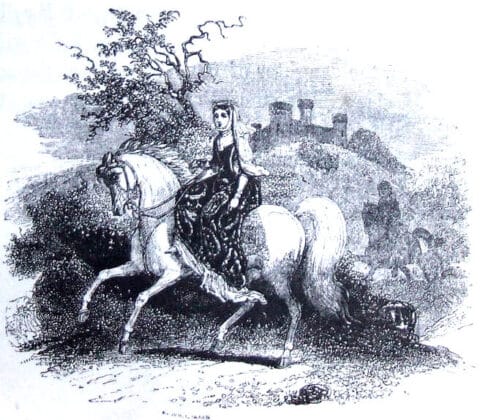
Diarmuid still faced the problem of escaping Tara. He told Gráinne that Fionn kept the keys to the fortress at night, making an ordinary departure impossible. She offered to lead him through a small gate from her chamber, but Diarmuid explained that another geis forbade him from passing through such an entrance. Gráinne suggested that he leap over the rampart using his spears instead.
Before leaving, Diarmuid said farewell to Oisín and the leaders of the Fianna, weeping as he parted from his companions. He climbed the rampart, used his two spears to vault over the wall, and landed on the grass outside, where Gráinne met him.
The Pursuit Across Ireland
After escaping from Tara, Diarmuid and Gráinne crossed the River Shannon at Athlone and travelled to an oak grove near Loughrea, in western Ireland. There, Diarmuid built a fortified enclosure with seven entrances to defend against an attack. Fionn’s trackers followed the fugitives as far as Athlone, and Fionn correctly guessed where they were hiding. He gathered the Fianna and surrounded the grove.
Aonghus an Bhrogha, Diarmuid’s foster father and a figure of the Tuatha Dé Danann, intervened without Fionn noticing. He took Gráinne to Limerick, leaving Diarmuid to escape on his own. Diarmuid leaped over the enclosure and made his way to Limerick, where he rejoined them.
During the early stages of their flight, Diarmuid avoided sleeping with Gráinne out of loyalty to Fionn. He left uncooked food at their resting places as a sign that their relationship had not become intimate. Eventually, when water splashed against Gráinne’s leg, she remarked that it had come closer to her than Diarmuid dared. Her teasing brought an end to his resistance, and they began living together as husband and wife.
The couple continued southwest to a cave near Rossbehy, overlooking Dingle Bay. They remained there until messengers sent by Fionn discovered their hiding place, forcing them to move again.
Retracing their route toward Limerick, Diarmuid and Gráinne crossed the Slieve Aughty mountains into southern Galway. Their journey brought them to a forest containing an enchanted rowan tree, where they faced another dangerous encounter.
The Trials of Diarmuid and Gráinne in Exile
In the forest of Dubhros stood an enchanted rowan tree whose berries could cure illness and restore youth. The tree had grown from a berry dropped by the Tuatha Dé Danann and was guarded by a giant named Searbhán Lochlannach. Diarmuid had obtained permission to hunt in the forest on the condition that he never touched its fruit.
Meanwhile, two warriors of Clann Morna sought peace with Fionn over their fathers’ involvement in the death of his father, Cumhall. Fionn demanded either Diarmuid’s head or a handful of the rowan berries as compensation. The warriors found Diarmuid in the forest and chose to fight him, but he overpowered and bound them.
Gráinne, who was pregnant, became determined to taste the berries. Despite his agreement with Searbhán, Diarmuid approached the giant and asked for some. Searbhán refused, and a fight followed. Diarmuid seized the giant’s iron club and killed him with his own weapon.
Diarmuid freed the two warriors and sent them back to Fionn with the berries, instructing them to claim they had killed Searbhán. Fionn recognised the scent of Diarmuid’s hand on the fruit and led the Fianna to Dubhros.
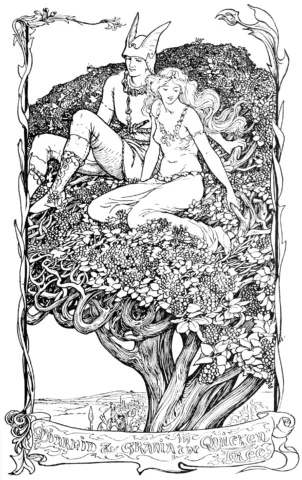
By then, Diarmuid and Gráinne were hiding in the branches of the tree, where Searbhán had kept his bed. Fionn played fidchell, an Irish board game, with Oisín beneath it. Watching from above, Diarmuid helped Oisín win by dropping berries onto the pieces he should move. Fionn realised who was hiding overhead and ordered his warriors to surround the tree.
Aonghus intervened once more, carrying Gráinne away unseen to Brugh na Bóinne. Diarmuid escaped by leaping from the tree beyond the surrounding warriors and later rejoined her there.
Aonghus’s Peace Agreement with Fionn
After Diarmuid and Gráinne reached Brugh na Bóinne, Aonghus sought an end to the pursuit. He approached Fionn and asked whether he would make peace with Diarmuid. Fionn agreed, and Aonghus obtained a similar promise from Cormac mac Airt, Gráinne’s father.
Diarmuid was willing to accept peace, but only under specific conditions. He demanded the restoration of his father’s territory, Uí Dhuibhne, where Fionn would be forbidden to hunt and the High King could collect no tribute. He also requested Beann Damhuis in Leinster from Fionn and Ceis Corainn from Cormac as Gráinne’s dowry.
Aonghus presented these demands to both men, and they accepted them. Diarmuid was pardoned for his actions during sixteen years as an outlaw. Cormac also gave another of his daughters in marriage to Fionn, helping to settle the dispute.
With the pursuit over, Diarmuid and Gráinne established their home at Rath Gráinne in Ceis Corainn, far from Fionn and Cormac. They prospered there, and Gráinne bore four sons and a daughter.
The Fatal Boar Hunt at Beann Gulban
Years after the peace agreement, Gráinne persuaded Diarmuid to invite Fionn and Cormac to their home, hoping to strengthen their friendship. During the visit, Diarmuid awoke at night to the sound of a hound. He heard it three times, despite Gráinne’s attempts to keep him from investigating.
At daybreak, Gráinne advised him to take his strongest sword, Moralltach, and his red spear, Gá Dearg. Diarmuid instead chose the smaller sword Beagalltach and the yellow spear, Gá Buidhe, taking his hunting dog with him.
He travelled to Beann Gulban, now known as Ben Bulben in County Sligo, and found Fionn alone on the mountain. Fionn explained that his warriors had pursued a dangerous wild boar, which had already killed several members of the Fianna. He warned Diarmuid that a geis forbade him from hunting pigs.
The prohibition came from an incident in Diarmuid’s childhood. His father, Donn, had killed the young son of Aonghus’s steward. Seeking revenge, the steward transformed the dead boy into an enchanted boar destined to cause Diarmuid’s death. Aonghus therefore placed Diarmuid under a geis never to hunt pigs. The beast now approaching Beann Gulban was that same creature.
Diarmuid suspected that Fionn had arranged the hunt to bring about his death. Fionn denied organising the pursuit, but Diarmuid refused to leave the mountain despite knowing the danger.
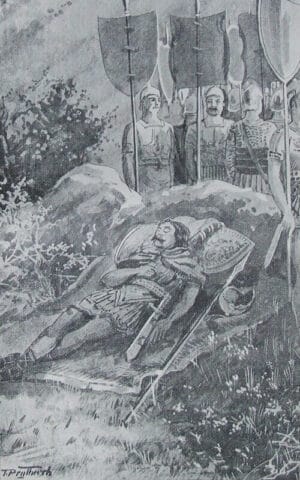
When the boar appeared, Diarmuid released his dog, but the animal fled. His spear failed to wound the beast, and his sword broke against its hide. The boar knocked him down and eventually tore open his abdomen. As it moved away, Diarmuid hurled the broken sword’s hilt at its head, killing it.
The boar lay dead, but Diarmuid was mortally wounded.
Why Did Fionn Refuse to Save Diarmuid?
When Fionn and the Fianna reached Diarmuid, Fionn mocked his wounded appearance rather than offering help. Diarmuid reminded him that he possessed a healing power: anyone who drank water from Fionn’s cupped hands could recover from illness or injury. Fionn replied that Diarmuid had done nothing to deserve such a favour.
Diarmuid begged him to use that power. Fionn initially claimed that he knew of no well on the mountain, but Diarmuid pointed out one only nine paces away.
Fionn eventually fetched water, yet allowed it to escape through his fingers before reaching Diarmuid. The wounded warrior accused him of doing so deliberately. On his second attempt, Fionn again lost the water, this time while thinking of Gráinne.
Oscar, Fionn’s grandson, could no longer tolerate the delay. He threatened to fight Fionn unless he brought the water immediately. Fionn returned to the well a third time and managed to carry the water back, but Diarmuid died just as he approached.
Fionn had possessed the means to save him. His resentment had prevented him from acting in time.
What Happened to Gráinne After Diarmuid’s Death?
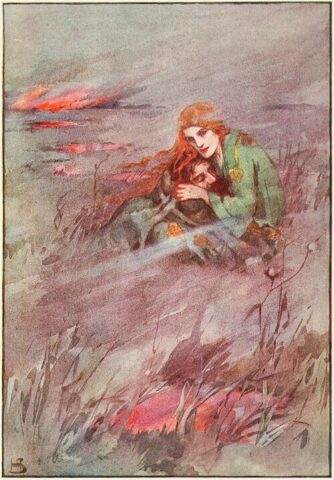
Gráinne learned of Diarmuid’s death when Fionn returned to Rath Gráinne leading her husband’s hound, Mac an Cuill. Overcome by grief, she fell from the ramparts. In the account translated by Standish Hayes O’Grady, she was pregnant and gave birth to three stillborn sons. When Fionn refused to surrender Diarmuid’s hound, Oisín took it from him and gave it to her.
Gráinne sent her household to recover Diarmuid’s body, but Aonghus had already reached the mountain. Mourning his foster son, he carried the body to Brugh na Bóinne. Although he could not restore Diarmuid to life, Aonghus declared that he would place a soul in his body so they could speak to each other every day.
Gráinne then summoned her surviving children, told them how Fionn had failed their father, and urged them to prepare for revenge.
The surviving versions disagree about what happened next. The oldest surviving manuscript, dated 1651, ends with Gráinne calling on her children to avenge Diarmuid. In the longer version published by O’Grady, Fionn eventually persuades her to marry him, and she negotiates peace between him and her sons. Other traditions leave her mourning Diarmuid or continue the conflict through their children.
The Story’s Origins in Irish Literary Tradition
The Pursuit of Diarmuid and Gráinne belongs to the Fenian Cycle, the body of Irish literature centred on Fionn mac Cumhaill and the Fianna. Although its surviving prose narrative is relatively late, the story was known much earlier. References to Gráinne’s elopement with Diarmuid appear in Irish literary tradition by the tenth century, while Acallam na Senórach, composed around the late twelfth or early thirteenth century, preserves further references to the characters.
The extended prose narrative may have taken shape in the fourteenth century, although its precise date of composition remains uncertain. Its earliest surviving manuscript copy was written in 1651 by Dáibhídh Ó Duibhgeannáin. This manuscript became the principal source for Nessa Ní Shéaghdha’s scholarly edition, published in 1967. An earlier edition and English translation appeared in 1857 under Standish Hayes O’Grady.
The legend also circulated through oral storytelling in Ireland and Gaelic-speaking Scotland, producing variations in its episodes and ending. Across Ireland, numerous ancient stone monuments acquired the name Leaba Dhiarmada agus Ghráinne, meaning “Diarmuid and Gráinne’s Bed,” reflecting local traditions about the lovers’ hiding places.
These associations demonstrate the story’s lasting place in Irish folklore, but they do not establish Diarmuid and Gráinne as historical individuals.
Academic Sources & Primary Texts
This article draws on Irish literary texts, scholarly editions, and academic research into the Fenian Cycle and the development of the Diarmuid and Gráinne tradition.
Primary Texts
- Ní Shéaghdha, Nessa, ed. and trans. Tóruigheacht Dhiarmada agus Ghráinne: The Pursuit of Diarmaid and Gráinne. Irish Texts Society 48. Dublin: Irish Texts Society, 1967.
National Library of Ireland catalogue. - O’Grady, Standish Hayes, ed. and trans. Toruigheacht Dhiarmuda agus Ghrainne; or, The Pursuit after Diarmuid O’Duibhne, and Grainne. Transactions of the Ossianic Society 3. Dublin: John O’Daly, 1857.
Irish Sagas, University College Cork.
Academic Studies
- Johnston, Elva. “Gráinne.” Dictionary of Irish Biography. Royal Irish Academy, 2009.
Read the biographical study. - Sumner, Natasha. “Diarmaid and Gráinne in Oral Tradition.” In Tóruigheacht Dhiarmada agus Ghráinne: Reassessments, edited by Kevin Murray, 107–158. London: Irish Texts Society, 2018.
Harvard University publication record. - Murray, Kevin. The Early Finn Cycle. Dublin: Four Courts Press, 2017.
Publisher’s book record.
Research Note: The surviving prose narrative developed from older Fenian traditions. Manuscript versions and oral accounts do not always agree, particularly about the ending of Gráinne’s story. These differences have been distinguished where relevant.
Copyright Notice
© 2026 History & Myths. Written by H. Moses. All rights reserved. Original article text may not be reproduced or republished without permission. Ancient source texts, scholarly works, and images remain subject to their respective rights and licenses.