Greek Priesthood: Roles and Religious Power in Ancient Greece
Greek priesthood was not a religious authority in the way most people expect. There was no centralized clergy, no unified doctrine, and no class of priests controlling belief. Instead, priesthood in ancient Greece functioned as a civic office tied to specific cults, temples, and city-states, where individuals were responsible for performing rituals correctly rather than shaping religious thought.
This difference is structural, not superficial. In systems like Egypt, priests formed an organized hierarchy with economic and intellectual power. In Greece, that model simply did not exist. A priest was not “above” society—he or she was embedded within it, often holding the role temporarily, sometimes even selected by lot, and always accountable to the traditions of a particular sanctuary or polis.
Understanding Greek religion therefore requires shifting perspective. The question is not “what did priests believe or teach?” but “how did religious offices operate inside the civic system?” Once you look at it this way, the priesthood stops being a vague spiritual category and becomes something more precise: a mechanism that maintained ritual order, civic identity, and the relationship between the community and its gods.
Why Greek Priests Were Not Religious Authorities
The core mistake in most explanations is treating Greek priests as if they held interpretive authority over religion. They didn’t. There was no official doctrine to define, no sacred text to guard, and no institutional structure that allowed priests to impose belief on the population. Religion in Greece did not operate through “truth claims” managed by a clergy—it operated through recognized rituals performed in the correct way.
That distinction removes the priest from the center of power. What mattered was not who the priest was, but whether the ritual was executed properly. If a sacrifice followed the established form—right animal, right timing, right procedure—it was considered valid regardless of any personal belief or insight from the officiant. Authority, therefore, was procedural, not intellectual.
This is why Greek priests did not function as mediators of divine will in a broad sense. Outside of very specific contexts—most notably oracles—they were not expected to interpret messages from the gods or guide personal morality. Their role was narrower and more concrete: to maintain continuity between the community and its gods by preserving established practice. Innovation or personal interpretation had little place in that system.
The absence of a centralized religious authority reinforces this point. Each cult operated independently, tied to a specific sanctuary and deity, with its own traditions. There was no higher body overseeing all priests, no unified hierarchy connecting temples across regions. A priest of Athena in Athens had no authority over a sanctuary of Apollo elsewhere. Religious life was fragmented by design, and priesthood reflected that fragmentation.
As a result, influence did not come from theological control but from context—the importance of the sanctuary, the visibility of the rituals, and the civic role attached to the office. A priest serving a major public cult could hold social prestige, but that prestige came from the position within the community, not from any ability to define or reshape religion itself.
| Aspect | Greek Priesthood | Egyptian Priesthood |
|---|---|---|
| Structure | Decentralized, local cult-based | Centralized, hierarchical institution |
| Authority | Ritual execution only | Ritual + theological + administrative |
| Selection | Election, lot, or inheritance | Career-based priesthood |
| Duration | Often temporary or rotating | Long-term or lifelong |
| Religious Control | No unified control | Strong institutional control |
| Economic Power | Limited, sanctuary-based | Large-scale temple economy |
Priesthood as a Civic Office, Not a Profession
In Greek society, priesthood was not a lifelong religious career. It functioned as a defined office within the civic structure, similar in logic to other public roles tied to the functioning of the city-state. The key difference from modern expectations is that holding a priestly position did not separate an individual from society—it positioned them temporarily within a specific religious responsibility.
In many cases, priests were appointed for fixed terms, sometimes annually, depending on the cult and the city. Selection methods varied: some positions were filled by election, others by lot, and certain prestigious roles were restricted to specific families through hereditary rights. What matters is not the variation itself, but what it reveals: there was no single pathway into priesthood, because there was no unified institution controlling access.
This structure had direct consequences. Since priesthood was not a profession, it did not require formal theological training. Competence was measured by knowledge of ritual procedure, not by intellectual or spiritual authority. The role demanded precision and adherence to tradition, not interpretation or innovation. A priest needed to know what to do, not what it meant.
Equally important, priesthood did not monopolize religious participation. The broader community remained actively involved in rituals, festivals, and offerings. The priest facilitated and formalized these acts but did not replace the collective role of the citizens. Religion, in this sense, stayed public and shared, not delegated to a specialized class.
This civic nature also explains why priesthood could intersect with status without becoming a source of independent power. Holding a priestly office could enhance visibility and prestige, especially in major cults, but it did not create a separate authority structure outside the city. The office remained anchored to the polis, dependent on its traditions, and limited by its expectations.
Seen this way, Greek priesthood was less about religious leadership and more about administrative responsibility within a ritual system—a role defined by function, duration, and context rather than by belief or hierarchy.
How Priests Were Selected (Election, Lot, Inheritance)
There was no single, standardized method for becoming a priest in ancient Greece. Selection followed the logic of the polis, not the structure of a centralized religious institution. As a result, three main pathways appear across different city-states and cults: election, selection by lot, and hereditary assignment. Each reflects a different priority—political trust, civic equality, or continuity of tradition.
Election was typically used for positions connected to major public cults. These roles required visibility and a level of public confidence, especially during large festivals and state rituals. Choosing a priest through voting ensured that the individual represented the community in a formal and recognizable way. The office still did not grant theological authority, but it carried symbolic and civic importance.
Selection by lot (sortition) followed a different principle. It treated priesthood as a civic duty rather than a specialized or elite role. This method reflects a broader Greek idea: religious offices could be distributed in the same way as political responsibilities, emphasizing fairness and participation. If citizens could be entrusted with governance, they could also be entrusted with ritual duties, as long as they followed established procedures.
Hereditary priesthood existed in specific cults where continuity was essential. Certain families maintained long-standing connections with particular deities or sanctuaries, and their role was preserved across generations. Authority in this case came from tradition and lineage rather than from any centralized system. These positions were usually tied to a single cult context, not to a wider religious structure.
What unifies these methods is the absence of central regulation. There was no overarching authority controlling priestly appointments across the Greek world. Each city and each cult operated according to its own rules, shaped by local customs and political organization.
This decentralized approach ensured that priesthood remained accessible but context-dependent. It could be prestigious, routine, or hereditary depending on the setting, but it never formed a unified class with collective authority. The role was defined by how it functioned within the community, not by membership in a broader religious hierarchy.
What Priests Actually Did (Ritual, Not Theology)
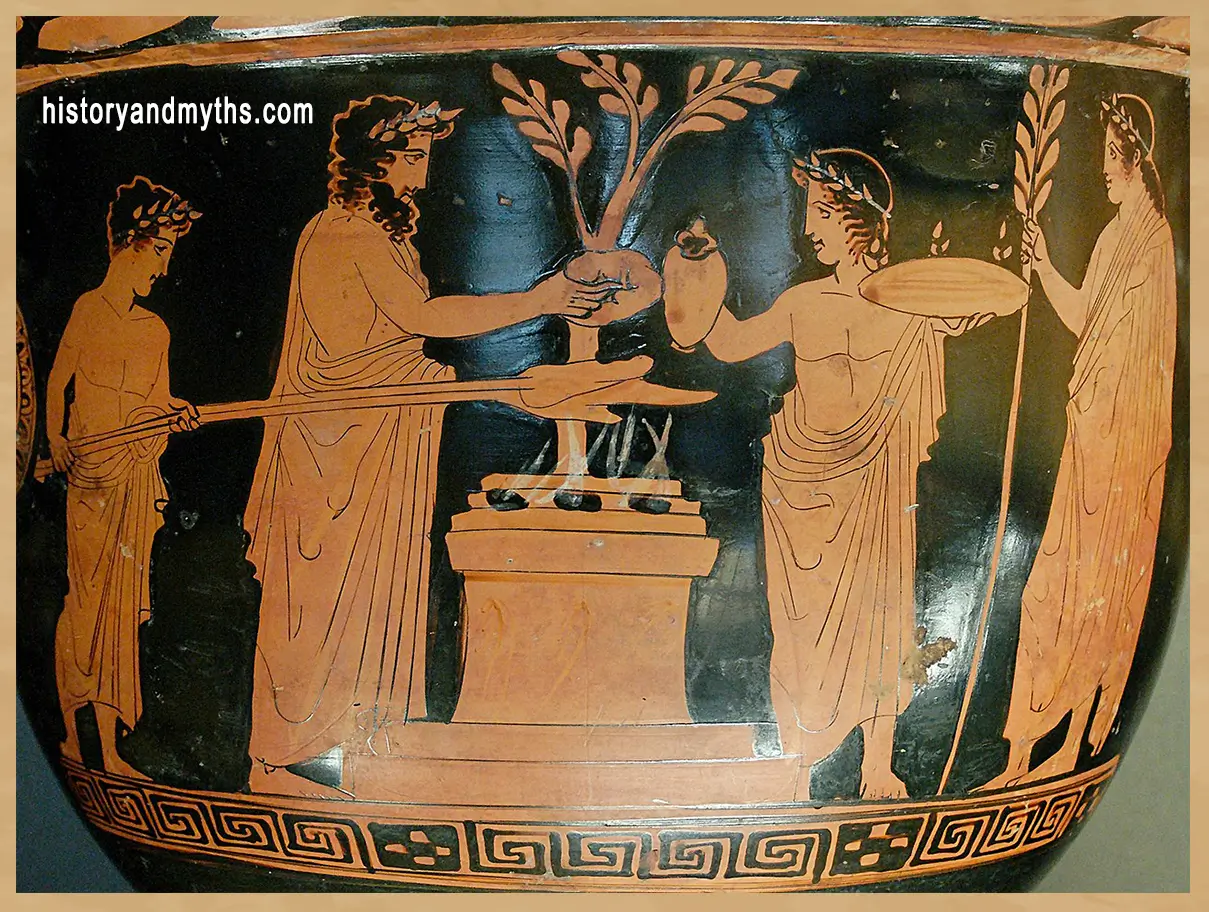
The practical role of Greek priests was defined by execution, not interpretation. Their responsibility was to ensure that rituals were carried out correctly according to established tradition. This included overseeing sacrifices, managing offerings, maintaining sacred spaces, and organizing festivals tied to specific deities. The emphasis was always on accuracy and continuity, not on explaining or redefining religious meaning.
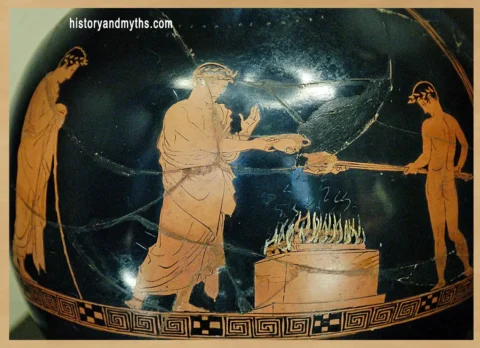
At the center of this role was the sacrificial system. Priests supervised animal sacrifices, which followed a precise sequence: preparation, procession, offering, and distribution. Each step had to align with recognized norms—choice of animal, timing, gestures, and spoken formulas. A successful ritual depended on correct performance, not on personal belief or insight. If the procedure was followed properly, the act was considered valid.
Beyond sacrifices, priests were responsible for the maintenance of the sanctuary. This included safeguarding temple property, managing dedications, and ensuring that sacred objects remained intact and properly displayed. Temples were not just symbolic spaces; they held valuable offerings and functioned as visible centers of civic identity. The priest’s role here was administrative as much as ritual.
Festivals added another layer of responsibility. Major events required coordination—preparing altars, organizing processions, and ensuring that public participation followed the expected structure. These occasions were not private acts of worship; they were collective performances of the community’s relationship with its gods. The priest acted as the official facilitator of that process.
What is notably absent from all these duties is theology. Priests did not teach doctrine, develop religious theory, or guide personal belief systems. Their authority did not extend into abstract interpretation. Instead, it remained grounded in doing things the right way at the right time, preserving a system where religion functioned through action rather than explanation.
System Insight — Greek Religion Worked Without a Central Priesthood
- Religion was based on correct ritual, not belief control
- Priests acted as civic officeholders, not spiritual authorities
- No central institution governed temples or cults
- Each sanctuary functioned as an independent system
- Religious authority remained local and limited
© historyandmyths.com — Educational use
Priestesses and Female Religious Power
One of the defining features of Greek priesthood is that it was not exclusively male. Women held some of the most visible and respected religious offices, not as exceptions, but as integral parts of the system. This is not a marginal detail—it reflects how Greek religion operated independently from strict political hierarchies.
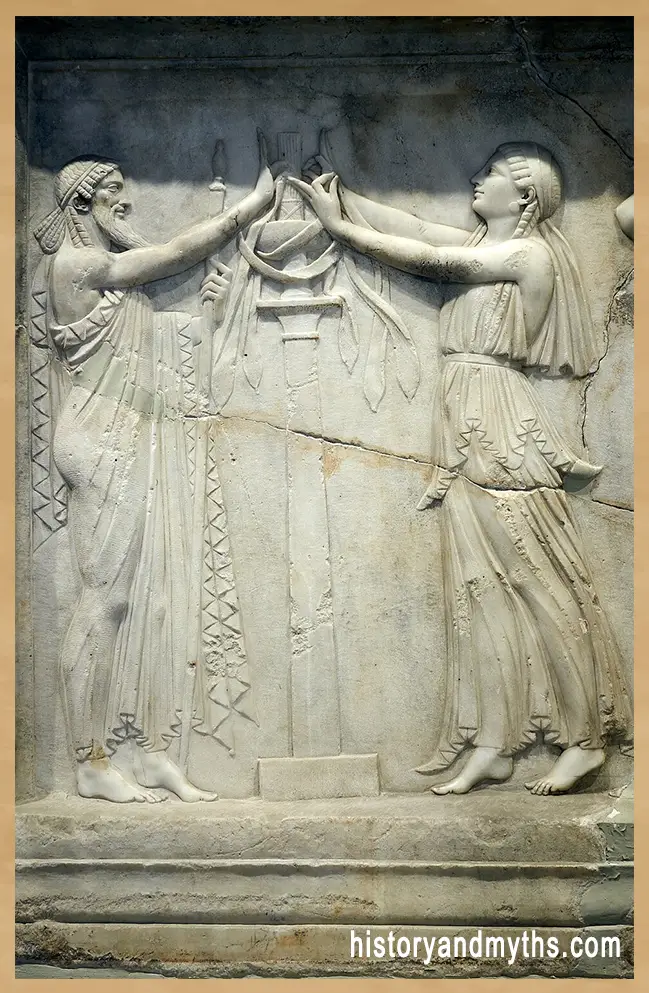
Priestesses were typically assigned to female deities or specific cults, but their importance depended less on gender and more on the status of the sanctuary they served. A priestess in a major cult could hold significant public recognition, especially during festivals and rituals that involved the wider community. Their presence was not symbolic—it was functional and necessary for the correct execution of certain rites.
In some cases, priestesses held long-term or even lifelong positions, particularly in prominent sanctuaries. This continuity provided stability in cult practice, especially where ritual precision and tradition were critical. Unlike many male priesthoods that rotated or were assigned temporarily, some female offices emphasized consistency over rotation, reinforcing their institutional importance.
The most well-known example is the oracle at Delphi, where the priestess—commonly referred to as the Pythia—served as the medium through which divine responses were delivered. This role stands out because it moves slightly beyond procedural ritual into controlled interpretation. However, even here, the authority of the priestess was context-specific, limited to the function of the oracle and supported by a broader ritual framework.
It is important not to overstate this influence. Priestesses did not form a unified class or gain broader control over religious or political systems. Their authority remained bounded by the same structural limits as male priests—defined by the cult, the sanctuary, and the expectations of the community.
What their presence clearly shows is that Greek religion did not centralize power in a single gender or institution. Instead, it distributed religious roles according to function and tradition, allowing women to occupy positions of visibility and importance within specific religious contexts without creating a separate or dominant hierarchy.
No Central Authority: A Fragmented Religious System
Greek priesthood only makes full sense when you accept that there was no unified religious system to belong to in the first place. What existed instead was a network of independent cults, each tied to a specific deity, location, and set of traditions. Priesthood reflected this structure: localized, self-contained, and disconnected from any overarching hierarchy.
There was no equivalent of a central temple authority, no institution coordinating religious life across regions, and no standardized rules governing all priests. Each sanctuary operated according to its own customs, often shaped by local history and civic priorities. A priest’s authority stopped at the boundaries of that specific cult. It did not extend outward, and it was not transferable.
This fragmentation had practical consequences. Ritual practices could vary from one city to another, even when directed toward the same deity. Titles, responsibilities, and selection methods differed depending on local systems. What mattered was not consistency across Greece, but consistency within each individual cult. As long as local traditions were preserved, the system functioned as intended.
The absence of central control also meant that religious power could not consolidate. No priestly class could expand its influence beyond its immediate context, and no sanctuary could claim universal authority. Even the most prominent religious centers remained influential, not dominant. Their importance came from reputation and tradition, not from institutional control.
This decentralized model aligns directly with the broader structure of Greek society. Just as political life was divided among independent city-states, religious life was divided among autonomous cult systems. Priesthood was not an exception to this pattern—it was one of its clearest expressions.
Case Study: The Pythia of Delphi
If there is one figure that seems to contradict the idea of limited priestly authority, it is the oracle at Delphi. The Pythia, the priestess serving Apollo, delivered responses that influenced decisions far beyond a single city. At first glance, this looks like centralized religious power. In reality, it reinforces the same system logic.
The Pythia’s role was highly specific and tightly controlled. She did not speak freely or define religious doctrine. Her function was limited to delivering oracular responses within a structured ritual process. Visitors—often individuals or state representatives—submitted questions, which were filtered, prepared, and presented through a formal procedure involving temple officials. The response attributed to Apollo emerged from this controlled setting, not from personal authority.
What made Delphi exceptional was not a different system, but the scale of its reputation. Unlike local cults tied to a single polis, Delphi operated as a panhellenic sanctuary, attracting visitors from across the Greek world. Its influence came from recognition and tradition, not from institutional control. No city-state was subordinate to Delphi, and no priesthood hierarchy extended outward from it.
Even the Pythia herself did not hold independent power. She served within a framework that included other officials who managed access, interpretation, and presentation of the oracle’s responses. The authority of the message depended on the sanctity of the process and the reputation of the sanctuary—not on the personal status of the priestess.
This example highlights a critical point: exceptional influence did not create centralized authority. Delphi became influential because multiple city-states chose to trust it, not because it governed religious life. The system remained decentralized, even at its most visible point.
Greek vs Egyptian Priesthood (System Comparison)
The contrast between Greek and Egyptian priesthood is not about degree—it is about structure. Both systems were deeply religious, but they organized religious authority in fundamentally different ways.
In Egypt, priesthood formed a centralized and professional institution. Temples functioned as economic and administrative centers, and priests operated within a clear hierarchy tied to the state. Their role extended beyond ritual into knowledge, administration, and control of temple resources. Religious authority was stable, continuous, and closely connected to political power.
In Greece, none of that structure existed. Priesthood was localized, temporary, and fragmented, tied to individual cults rather than a unified system. There was no professional clergy managing religion across regions, no centralized doctrine, and no institutional hierarchy linking sanctuaries together. Each office existed within its own context, defined by local tradition and civic structure.
This difference changes how religion functioned in practice. In Egypt, religion could be organized, accumulated, and controlled through institutions. In Greece, it could not. Religious life remained distributed across communities, with no mechanism for consolidation. Authority did not scale—it stayed bounded within each cult.
The economic dimension also highlights the divide. Egyptian temples controlled land, labor, and wealth on a large scale, reinforcing the power of the priesthood. Greek sanctuaries, while sometimes wealthy, did not create a unified economic network under priestly control. Their resources remained site-specific, not system-wide.
Even at the level of knowledge, the systems diverge. Egyptian priests preserved and transmitted religious texts, rituals, and cosmological frameworks within a structured tradition. Greek priests, by contrast, were not custodians of a formal theological body. Religious knowledge existed, but it was not centralized in a priestly class.
The result is clear:
- Egypt produced a religious institution.
- Greece produced a ritual system embedded in civic life.
This comparison doesn’t just highlight differences—it clarifies the Greek model itself. Priesthood in Greece was never meant to control religion. It was designed to operate it within a decentralized society.
- Greek priesthood was a civic role, not a religious profession
- Authority depended on ritual accuracy, not theology
- Priests were selected by election, lot, or inheritance
- No centralized priesthood existed across Greece
- Priestesses held important roles in specific cults
- Sanctuaries operated independently
- Religion functioned as a decentralized ritual system
Frequently Asked Questions
Did ancient Greek priests have religious authority?
No. Their role was limited to performing rituals correctly, not defining beliefs or doctrine.
How were Greek priests selected?
They were chosen through election, lot, or hereditary assignment depending on the cult and city.
Were Greek priests full-time professionals?
Usually not. Many priesthoods were temporary civic roles rather than lifelong careers.
Did Greek priestesses have important roles?
Yes. In major cults, priestesses held visible and respected positions.
Was there a central religious authority in ancient Greece?
No. Each cult operated independently without a unified system.
What was the main duty of a Greek priest?
To ensure rituals and sacrifices were performed correctly.
How does Greek priesthood differ from Egyptian priesthood?
Greek priesthood was decentralized, while Egyptian priesthood was centralized and institutional.
Sources & Rights
- Burkert, Walter. Greek Religion: Archaic and Classical. Cambridge, MA: Harvard University Press, 1985.
- Parker, Robert. On Greek Religion. Ithaca: Cornell University Press, 2011.
- Price, Simon. Religions of the Ancient Greeks. Cambridge: Cambridge University Press, 1999.
- Kindt, Julia. Rethinking Greek Religion. Cambridge: Cambridge University Press, 2012.
- Mikalson, Jon D. Ancient Greek Religion. Malden, MA: Wiley-Blackwell, 2005.
- Bremmer, Jan N. Greek Religion. Oxford: Oxford University Press, 1994.
- Hornblower, Simon, and Antony Spawforth, eds. The Oxford Classical Dictionary. 4th ed. Oxford: Oxford University Press, 2012.
- Ogden, Daniel, ed. A Companion to Greek Religion. Malden, MA: Blackwell Publishing, 2007.
- Rutherford, Ian. State Pilgrims and Sacred Observers in Ancient Greece. Cambridge: Cambridge University Press, 2013.
- Naiden, F. S. Smoke Signals for the Gods: Ancient Greek Sacrifice from the Archaic through Roman Periods. Oxford: Oxford University Press, 2013.
- Scullion, Scott. “Olympian and Chthonian.” Classical Antiquity 13, no. 1 (1994): 75–119.
- Versnel, H. S. Coping with the Gods: Wayward Readings in Greek Theology. Leiden: Brill, 2011.
- de Polignac, François. Cults, Territory, and the Origins of the Greek City-State. Chicago: University of Chicago Press, 1995.
- Gehrke, Hans-Joachim. History of the Archaic Greek World. Malden, MA: Wiley-Blackwell, 2010.
- Flower, Michael A. The Seer in Ancient Greece. Berkeley: University of California Press, 2008.
- Fontenrose, Joseph. The Delphic Oracle: Its Responses and Operations. Berkeley: University of California Press, 1978.
- Johnston, Sarah Iles. Ancient Greek Divination. Malden, MA: Wiley-Blackwell, 2008.
- Bowden, Hugh. Classical Athens and the Delphic Oracle: Divination and Democracy. Cambridge: Cambridge University Press, 2005.
- Blok, Josine H. Citizenship in Classical Athens. Cambridge: Cambridge University Press, 2017.
- Osborne, Robin. Greece in the Making: 1200–479 BC. London: Routledge, 1996.
- Cartledge, Paul. Ancient Greece: A Very Short Introduction. Oxford: Oxford University Press, 2011.
- Lewis, David M., et al., eds. The Cambridge Ancient History, Vol. 5: The Fifth Century BC. Cambridge: Cambridge University Press, 1992.
- Beard, Mary, John North, and Simon Price. Religions of Rome. Cambridge: Cambridge University Press, 1998.
- Assmann, Jan. The Search for God in Ancient Egypt. Ithaca: Cornell University Press, 2001.
- Teeter, Emily. Religion and Ritual in Ancient Egypt. Cambridge: Cambridge University Press, 2011.
- Baines, John, and Jaromír Málek. Atlas of Ancient Egypt. New York: Facts on File, 1980.
- Wilkinson, Richard H. The Complete Gods and Goddesses of Ancient Egypt. London: Thames & Hudson, 2003.
- Quirke, Stephen. Ancient Egyptian Religion. London: British Museum Press, 1992.
Written by H. Moses — All rights reserved © Mythology and History