Ancient Greek Festivals: Rituals, Games, and Public Life Explained
Greek festivals were not simple celebrations; they were organized religious events that combined ritual, community, and public display. At their core, they honored specific gods through sacrifices, processions, and competitions, bringing entire communities together under a shared structure of action.
This explains a key question: why were festivals so central in Greek life? They served multiple functions at once. They maintained relationships with the gods, reinforced civic identity, and demonstrated the strength and organization of the city-state. Participation was not optional in the cultural sense—it was part of belonging to the community.
Understanding Greek festivals requires looking at how they worked: structured rituals, coordinated public events, and repeated practices that linked religion with politics and daily life.
What Were Greek Festivals
Greek festivals were formal public events organized to honor specific gods through ritual activity. They were not casual gatherings. Each festival followed a defined structure that included sacrifices, processions, and communal participation, all performed according to established traditions.
They were also collective events managed by the city-state. Authorities determined timing, funding, and organization, ensuring that festivals operated as official expressions of the community rather than private celebrations. This made them part of civic life, not separate from it.
Importantly, festivals combined multiple elements in one event. Religious rituals were central, but they were often accompanied by competitions, performances, and public gatherings. This structure allowed festivals to function at several levels—honoring the gods while reinforcing social order and community identity.
| Festival Type | Main Function | Example |
|---|---|---|
| Local Festivals | Reinforce city identity and worship a specific deity | Panathenaia (Athens) |
| Pan-Hellenic Festivals | Connect different Greek communities | Olympic Games |
| Religious Festivals | Perform rituals and sacrifices | Dionysia |
| Athletic Festivals | Combine sport with religious honor | Olympic Games |
| Cultural Festivals | Include drama, music, and performance | City Dionysia |
Why Festivals Were Important
Greek festivals were important because they maintained the relationship between the community and the gods. Public sacrifices and rituals ensured that the city fulfilled its religious obligations, which were believed to secure protection, stability, and success.
They also reinforced civic identity and unity. By bringing citizens together in shared activity, festivals created a visible sense of belonging. Participation showed alignment with the values and structure of the city-state, making festivals part of how communities defined themselves.
At the same time, festivals displayed organization and power. Large-scale events required resources, planning, and coordination. Successful festivals demonstrated that a city was capable of managing both religious duties and public life effectively.
Their importance comes from this combination. Greek festivals were not isolated events; they were mechanisms that connected religion, society, and political structure in a single framework.
How Greek Festivals Worked
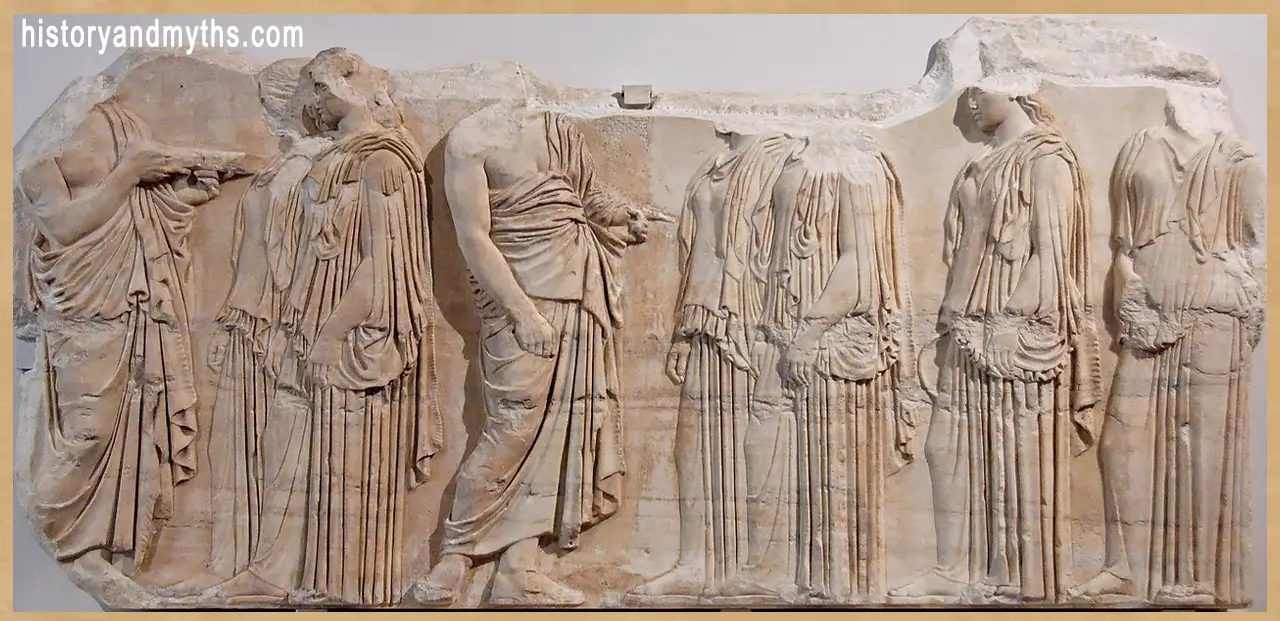
Greek festivals followed a structured sequence of actions, not spontaneous celebration. The process typically began with a procession (pompe), where participants moved through the city toward a sacred space, often carrying offerings and symbols associated with the deity.
At the center of the event was sacrifice, performed at an altar. This was the key ritual act, where offerings were made to the god. The act was public and collective, reinforcing both religious duty and community participation.
Festivals also included competitions and performances. Athletic contests, musical events, and dramatic performances were organized as part of the celebration, often dedicated to the same deity. These activities extended the festival beyond ritual into cultural expression.
The sequence was consistent: procession, sacrifice, and communal activity. Each part had a defined role, ensuring that the festival operated as a coordinated system rather than a loose gathering.
Types of Greek Festivals
Greek festivals can be understood through their scope and function, not just their names. The main distinction is between local festivals and pan-Hellenic festivals.
Local festivals were organized by individual city-states and reflected their specific identity. Events like the Panathenaia in Athens focused on a particular deity and reinforced the culture and priorities of that city. Participation was mainly limited to the local population, making these festivals central to civic life.
In contrast, pan-Hellenic festivals brought together participants from across the Greek world. The Olympic Games and other major events created shared spaces where different city-states interacted. These festivals operated beyond local identity, forming a broader cultural network.
Festivals can also be categorized by activity. Some emphasized religious ritual, others focused on athletic competition, and some combined multiple elements such as music, drama, and public ceremony. This variation shows that festivals were adaptable structures serving different purposes while maintaining a common framework.
How Greek Festivals Functioned
- Festivals combined ritual, community, and public organization.
- They followed a structured sequence: procession, sacrifice, and communal activity.
- City-states organized and funded major festivals.
- Events included religious, athletic, and cultural elements.
- Festivals reinforced both religious practice and civic identity.
Major Greek Festivals
Certain festivals illustrate how the system worked in practice, each combining ritual, public participation, and specific functions.
The Panathenaia in Athens was dedicated to Athena and organized by the city-state. It included a large procession, sacrifices, and competitions, reinforcing both religious devotion and civic identity.
The Olympic Games at Olympia functioned as a pan-Hellenic festival in honor of Zeus. While known for athletic competition, they were fundamentally religious events centered on ritual activity and shared participation across different Greek regions.
The Dionysia in Athens focused on Dionysus and incorporated dramatic performances alongside ritual practices. It demonstrates how festivals could integrate religious worship with cultural expression, particularly in theater and public performance.
These examples show variation within a common structure. Each festival followed the same framework—ritual, organization, and participation—while emphasizing different aspects such as politics, competition, or cultural activity.
Festivals and Political Power
Greek festivals were instruments of political organization and control, not just religious events. Since they were organized by the city-state, authorities used them to coordinate large groups of people and reinforce the structure of the polis.
Public participation was central. Citizens gathered in a controlled setting, followed a shared sequence of actions, and observed the roles of officials and elites. This made festivals a visible demonstration of hierarchy and order within the community.
Festivals also served to legitimize power. By linking political authority with religious activity, leaders presented their decisions and positions as aligned with divine approval. This connection strengthened trust in institutions and reduced resistance to authority.
In this way, festivals functioned as tools of governance. They organized collective behavior, displayed civic structure, and connected political power with religious practice in a single, coordinated event.
Festivals and Economy
Greek festivals also had a clear economic function. Large gatherings brought people from different regions into one place, creating opportunities for trade, exchange, and movement of goods. Markets often formed around festival sites, turning religious events into temporary economic centers.
This activity was not incidental. Cities benefited from hosting festivals by attracting visitors, increasing local consumption, and reinforcing their position within wider networks. Pan-Hellenic events in particular created regular points of contact between otherwise separate communities.
Festivals also redistributed resources internally. Public funding supported sacrifices, organization, and competitions, while participants contributed offerings and expenses. This circulation of wealth linked religious practice with economic activity at both local and regional levels.
The result was a system where festivals acted as periodic hubs of economic interaction, integrated into the broader structure of Greek society rather than separate from it.
Continue Reading
Why Festivals Sustained Greek Society
Greek festivals endured because they combined multiple essential functions into a single, repeatable system. They maintained religious obligations through ritual, reinforced civic identity through participation, and supported political structure through organized public activity. This integration made them necessary rather than optional.
Their regular repetition created stability. Festivals were held at fixed times, following established patterns, which ensured continuity across generations. This predictability allowed communities to organize social, political, and economic life around them.
They also adapted without losing structure. Different cities emphasized different festivals, and activities could vary, but the core elements—procession, sacrifice, and communal participation—remained consistent. This balance between consistency and flexibility helped the system function across diverse contexts.
For this reason, festivals were not just events. They were mechanisms that sustained Greek society, linking religion, community, and governance into a single, coordinated framework.
Greek Festivals in Context
Greek festivals were not separate from religion, politics, or daily life—they were the point where all three converged. Through structured rituals, public participation, and repeated organization, they translated belief into collective action and made the system visible at the scale of the entire community.
Their significance lies in function, not form. Festivals maintained relationships with the gods, reinforced civic identity, and supported political and economic structures at the same time. This explains why they remained stable across different regions and periods without centralized control.
Understanding Greek festivals therefore means understanding how Greek society worked. They were not occasional celebrations, but recurring frameworks that organized religion, power, and social life into a single, coordinated system.
Key Takeaways
- Greek festivals were structured religious events, not simple celebrations.
- They connected religion, politics, and society in a single system.
- Festivals reinforced civic identity and public order.
- They created economic and social interaction across regions.
- Their repeated structure sustained Greek society over time.
Frequently Asked Questions
What were Greek festivals?
Greek festivals were organized public events that combined religious rituals, sacrifices, and communal activities.
Why were Greek festivals important?
They maintained relationships with the gods and reinforced civic identity and social order.
What activities took place during Greek festivals?
Processions, sacrifices, athletic competitions, and cultural performances were common.
Were Greek festivals only religious?
No. They also had political, social, and economic functions.
What is the difference between local and pan-Hellenic festivals?
Local festivals were tied to a specific city, while pan-Hellenic festivals connected multiple regions.
Sources & Rights
- Burkert, Walter. Greek Religion. Harvard University Press.
- Parker, Robert. On Greek Religion. Cornell University Press.
- Mikalson, Jon D. Ancient Greek Religion. Wiley-Blackwell.
- Price, Simon. Religions of the Ancient Greeks. Cambridge University Press.
- Cartledge, Paul. Ancient Greece. Oxford University Press.
- Boardman, John. The Oxford History of Greece. Oxford University Press.
- Kindt, Julia. Rethinking Greek Religion. Cambridge University Press.
- Flower, Michael A. The Seer in Ancient Greece. University of California Press.
- Encyclopaedia Britannica. Ancient Greek Religion.
- World History Encyclopedia. Greek Religion.
Written by H. Moses — All rights reserved © Mythology and History