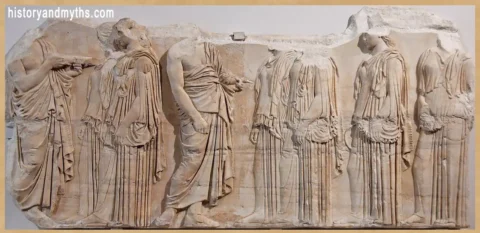
Ancient Greek Sacrifices and Offerings: Rituals, Meaning, and Process
Greek sacrifices were not just acts of worship—they were structured exchanges that linked gods, people, and resources within a single system. When an animal was sacrificed, only a portion was offered to the gods, while the rest was distributed and consumed by the community. This was not symbolic detail; it was the core of how the system worked.
In practice, sacrifice followed a recognizable pattern. An animal was selected, prepared, and ritually killed. Specific parts—typically bones wrapped in fat—were burned as an offering, while the meat was divided among participants. The ritual created a moment where religion, food distribution, and social participation overlapped. It was both a religious act and a controlled way of sharing resources.
People performed sacrifices not simply to “please the gods,” but to maintain a functioning relationship between divine expectation and human activity. The act confirmed order: the gods received their portion, and the community reinforced its unity through shared consumption. What mattered was not belief alone, but the correct execution of a process that produced both religious and social outcomes.
To understand Greek religion at a practical level, the key question is not “why did they sacrifice?” but “how did sacrifice organize relationships—between gods, individuals, and the wider community?”
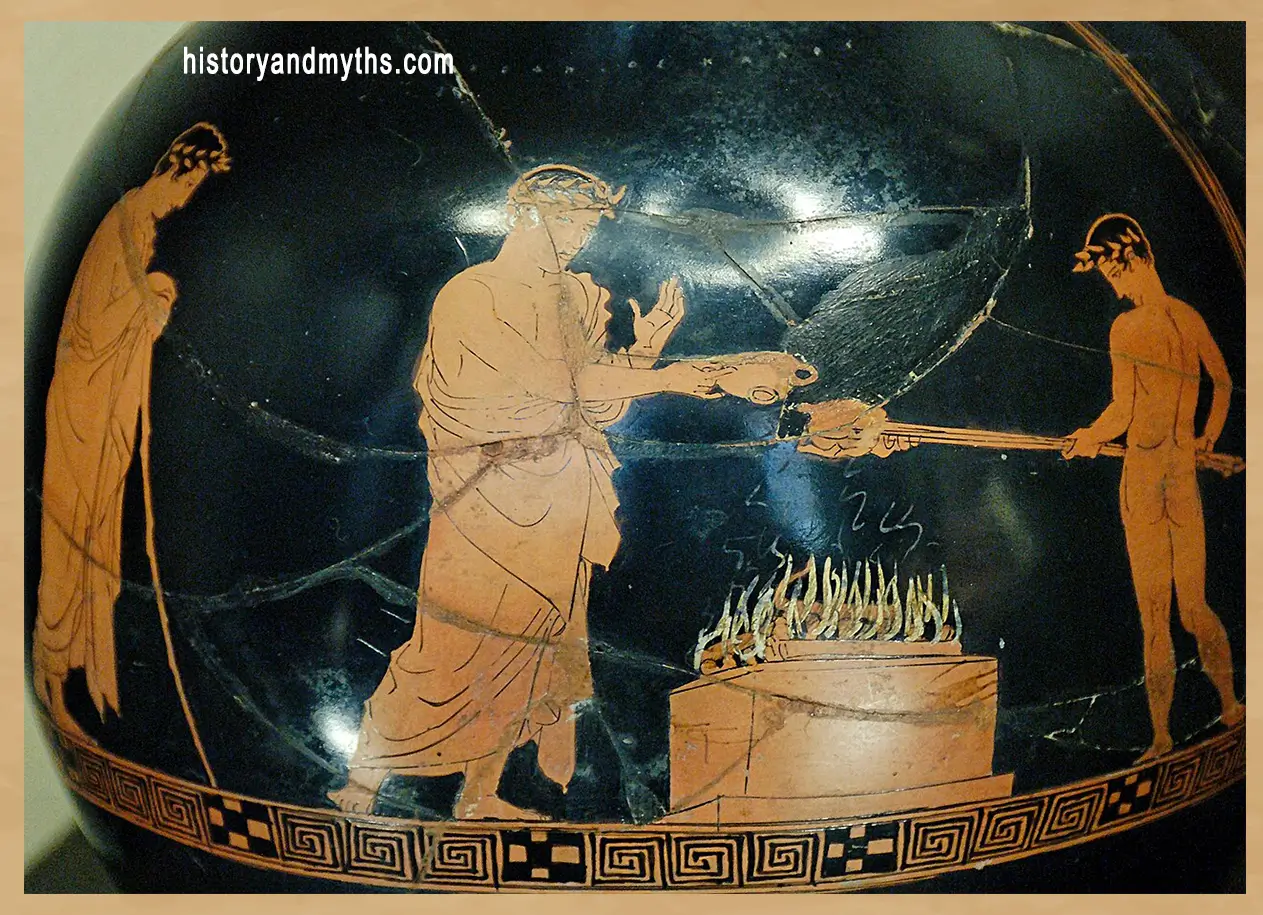
What Greek Sacrifice Really Was (Beyond Worship)
Reducing Greek sacrifice to “an offering to please the gods” misses how the system actually functioned. Sacrifice was a regulated exchange: a portion was formally given to the gods, while the rest was processed and distributed among people. The ritual did not remove resources from society—it reorganized them under religious rules.
This exchange had a fixed logic. The gods received what was symbolically appropriate—smoke, aroma, selected parts—while the community received what was materially valuable: meat. The split was not incidental. It created a stable pattern where divine recognition and human benefit coexisted in the same act. The ritual only worked because both sides were acknowledged.
Equally important, sacrifice was not a private gesture. It was publicly structured and socially visible. The value of the act depended on participation, witnesses, and adherence to form. A sacrifice performed correctly confirmed that relationships—between people and gods, and among people themselves—were being maintained as expected.
This is why precision mattered. The animal chosen, the sequence of actions, and the division of portions all followed recognized norms. The system did not rely on belief alone. It relied on repeatable procedures that produced consistent outcomes—religious legitimacy on one side, shared resources on the other.
Seen clearly, Greek sacrifice was not about giving something up. It was about transforming resources into a form that satisfied both religious obligation and social function, without separating the two.
| Aspect | Sacrifice | Offerings |
|---|---|---|
| Process | Structured ritual with killing and division | Direct giving without full ritual sequence |
| Outcome | Shared between gods and community | Fully dedicated to the gods |
| Material Use | Meat distributed and consumed | Removed from circulation |
| Function | Religious + social + economic | Primarily symbolic or devotional |
| Scale | Often public and communal | Often private or individual |
How the Sacrifice Process Worked Step by Step
Greek sacrifice followed a repeatable sequence. Each stage mattered because it controlled what the act produced—religious validity on one side, usable resources on the other.
1-Preparation and Selection
The process began with choosing the animal and setting the occasion. The selection was not random. Type, condition, and even appearance could be specified depending on the context. This step defined what kind of offering was being made and who was participating.
2-Public Setup and Participation
Sacrifice was organized as a visible event. Participants gathered, and the ritual space was prepared. This was not background detail—the presence of witnesses and participants turned the act into a shared, recognized procedure, not a private action.
3-Ritual Killing
The animal was killed according to established form. The act itself was controlled and framed by ritual gestures and words. What mattered here was not the physical act alone, but how it was performed within the accepted sequence.
4-Division of the Offering
This was the core of the system. Specific parts—typically bones wrapped in fat—were set aside and burned for the gods, while the remaining meat was processed for human consumption. The division was fixed enough to be recognizable but flexible enough to fit different contexts.
5-Burning and Consumption
The portion for the gods was burned, producing smoke that marked the offering as accepted. At the same time, the edible portion was distributed and consumed by participants. This stage completed the exchange: the gods received their share symbolically, and the community received its share materially.
The sequence matters because it shows that sacrifice was not a single act. It was a controlled process that moved resources through defined stages, ensuring that both religious obligation and social distribution were fulfilled within the same event.
Who Benefited from Sacrifices?
Sacrifice only makes sense when you track where the value goes. The ritual appears to give something to the gods, but in practice it distributes benefits across multiple layers—symbolic, social, and material.
The gods (symbolic share)
The divine portion—burned parts and smoke—fulfilled the obligation of offering. This did not transfer material value in a practical sense, but it validated the act within the religious framework. Without this step, the rest of the process lost legitimacy.
The community (primary material benefit)
The largest share of value remained with the participants. Meat from sacrificial animals was processed and distributed, often in quantities that would be difficult to access otherwise. For many, public sacrifices were one of the main occasions to consume meat. This made the ritual a reliable channel for resource distribution, not just a religious gesture.
Organizers and officials (limited but real gain)
Those responsible for the ritual—whether civic organizers or temple personnel—could receive portions or gain visibility through their role. The benefit here was bounded by the system; it did not create a separate class controlling resources, but it did attach modest advantages to participation in the process.
The important point is that sacrifice did not remove resources from society. It redirected them under a recognized structure, turning a religious obligation into a moment where symbolic offering and practical benefit aligned. The system worked because it produced value for participants while maintaining its religious form.
- The gods received a symbolic portion through burning
- The community received the material benefit through shared meat
- The ritual transformed resources without removing them from society
- Participation reinforced social bonds and collective identity
- The system linked religion with practical outcomes
© historyandmyths.com — Educational use
Sacrifice as a Social System
Sacrifice did more than move resources—it organized people. The ritual created a structured moment where individuals acted as a group, followed the same sequence, and shared the same outcome. This was not incidental. It was how the system reinforced cohesion.
The gathering itself mattered. Participants did not just observe; they took part in a coordinated process—from preparation to consumption. This turned the act into a collective performance, where each step was recognized and repeated across occasions. Consistency built familiarity, and familiarity reinforced belonging.
Shared consumption was central. Eating from the same sacrifice was not simply practical—it marked inclusion. Those present were part of the same event, receiving portions from the same source. This created a clear boundary between participants and non-participants, strengthening internal ties within the group.
The public nature of the ritual also established visibility. Sacrifice was performed in a way that could be seen, verified, and remembered. This visibility mattered for trust. A properly conducted sacrifice signaled that the community was maintaining its obligations and functioning as expected.
Finally, repetition across festivals and occasions gave the system durability. The same structure appeared again and again, linking separate events into a continuous pattern of shared action. Over time, this pattern did more than express belief—it maintained social order by embedding it in regular, visible practice.
Offerings vs Sacrifices (Clear Distinction)
Not everything given to the gods was a sacrifice. Greek religion used multiple forms of offering, and treating them as one category hides how the system actually worked. The key difference is process and outcome.
Sacrifice involved a structured sequence: an animal was killed, divided, and processed through ritual. The defining feature was the split between divine and human shares—part burned, part consumed. This made sacrifice both a religious act and a mechanism for distributing resources.
Offerings, by contrast, did not require that sequence. They were direct transfers to the gods without redistribution. These could take several forms:
- Liquid offerings (libations): wine, oil, or water poured onto the ground or altar.
- Food offerings: bread, fruits, or cakes left or burned without a shared meal.
- Votive objects: items dedicated permanently—statues, weapons, or personal objects—placed in sanctuaries.
The difference is functional. Offerings remove value from circulation by dedicating it fully to the gods, while sacrifices recycle value back into the community after fulfilling the ritual requirement. Both maintain the relationship with the divine, but they operate through different economic and social effects.
This distinction also reflects context. Large public events tended to rely on sacrifice because they supported participation and distribution. Smaller or personal acts more often used offerings, where the act of giving itself was the endpoint, not a shared outcome.
Why Burning Meat Mattered
Burning part of the animal was not a symbolic detail—it was the defining step that completed the exchange. Without it, the act remained incomplete. The division between what was burned and what was consumed is what turned a simple killing into a recognized sacrifice.
The portion burned was not random. Specific parts—often bones wrapped in fat—were selected and placed on the fire. This created a visible and controlled transformation: solid material turning into smoke. In the logic of the ritual, this marked the transfer to the divine side. The gods did not receive meat in a physical sense; they received the process of burning itself, framed as offering.
At the same time, burning established a clear boundary. Once the divine portion was set aside and consumed by fire, the remaining meat could be handled and distributed without ambiguity. The act legitimized human use of the rest, ensuring that consumption followed a recognized order rather than appearing as simple taking.
This step also stabilized the system. By fixing what belonged to the gods and what belonged to people, it prevented overlap or conflict. Everyone involved understood the division because it was visible, repeatable, and consistent across occasions.
What looks like a small ritual detail is actually structural. Burning meat was the moment where the system converted a shared resource into two distinct outcomes—one symbolic, one practical—while keeping both within a single, controlled act.
Public vs Private Sacrifice
Greek sacrifice did not operate at a single scale. It functioned on two distinct levels, each with its own structure and purpose: public (civic) and private (household). The difference is not just size—it is who organizes the ritual, who participates, and what the outcome achieves.
Public sacrifice (civic level)
These were organized by the community or the state, often tied to festivals or official occasions. Participation was broader, and the scale allowed for large gatherings and wider distribution of meat. The ritual reinforced collective identity: people took part as members of the same community, following a shared procedure and receiving from the same source. Visibility was high, and the outcome was both religious validation and social cohesion at scale.
Private sacrifice (household level)
At the household level, the structure was simpler and more contained. Families or small groups performed sacrifices for specific needs—protection, transition points, or routine observance. The scale limited distribution, and the audience was smaller, but the same core logic applied: a defined offering, a recognized division, and a controlled outcome. The focus here was not public cohesion but maintaining order within a smaller unit.
The key difference lies in function and reach. Public sacrifice integrated the wider community and redistributed resources broadly. Private sacrifice-maintained continuity at the level of the household, where needs were more immediate and participation more limited.
Together, these two layers ensured that sacrifice operated across the entire social structure—from individual households to the full community—using the same underlying system, adapted to different scales.
- Greek sacrifice was a structured exchange, not just an act of worship
- The ritual divided resources between gods and people
- Meat distribution made sacrifice economically important
- Public sacrifices reinforced social cohesion
- Offerings differed by removing value from circulation
- Burning defined the boundary between divine and human shares
- The system operated at both public and private levels
Frequently Asked Questions
What was the purpose of sacrifice in ancient Greece?
It functioned as a structured exchange, linking religious obligation with social and economic outcomes.
How did Greek sacrifices work?
An animal was selected, ritually killed, divided between gods and people, and the meat was distributed.
Did the gods receive the whole sacrifice?
No. Only a symbolic portion was burned, while the rest was consumed by the community.
What is the difference between sacrifice and offerings?
Sacrifice involved shared distribution, while offerings were fully dedicated to the gods.
Why was burning meat important?
It marked the transfer of the divine portion and legitimized human use of the rest.
Were sacrifices always public?
No. They could be public (state-level) or private (household-level).
Who benefited from sacrifices?
The gods symbolically, but the main material benefit went to the community.
Sources & Rights
- Burkert, Walter. Greek Religion: Archaic and Classical. Cambridge, MA: Harvard University Press, 1985.
- Naiden, F. S. Smoke Signals for the Gods: Ancient Greek Sacrifice from the Archaic through Roman Periods. Oxford: Oxford University Press, 2013.
- Detienne, Marcel, and Jean-Pierre Vernant, eds. The Cuisine of Sacrifice among the Greeks. Chicago: University of Chicago Press, 1989.
- Parker, Robert. On Greek Religion. Ithaca: Cornell University Press, 2011.
- Price, Simon. Religions of the Ancient Greeks. Cambridge: Cambridge University Press, 1999.
- Mikalson, Jon D. Ancient Greek Religion. Malden, MA: Wiley-Blackwell, 2005.
- Bremmer, Jan N. Greek Religion. Oxford: Oxford University Press, 1994.
- Kindt, Julia. Rethinking Greek Religion. Cambridge: Cambridge University Press, 2012.
- Versnel, H. S. Coping with the Gods: Wayward Readings in Greek Theology. Leiden: Brill, 2011.
- de Polignac, François. Cults, Territory, and the Origins of the Greek City-State. Chicago: University of Chicago Press, 1995.
- Rutherford, Ian. State Pilgrims and Sacred Observers in Ancient Greece. Cambridge: Cambridge University Press, 2013.
- Scullion, Scott. “Olympian and Chthonian Sacrifice.” Classical Antiquity 13, no. 1 (1994): 75–119.
- Jameson, Michael H. “Sacrifice and Animal Husbandry in Classical Greece.” In Pastoral Economies in Classical Antiquity. Cambridge: Cambridge University Press, 1988.
- Osborne, Robin. Greece in the Making: 1200–479 BC. London: Routledge, 1996.
- Cartledge, Paul. Ancient Greece: A Very Short Introduction. Oxford: Oxford University Press, 2011.
- Hornblower, Simon, and Antony Spawforth, eds. The Oxford Classical Dictionary. 4th ed. Oxford: Oxford University Press, 2012.
- Ogden, Daniel, ed. A Companion to Greek Religion. Malden, MA: Blackwell Publishing, 2007.
- Flower, Michael A. The Seer in Ancient Greece. Berkeley: University of California Press, 2008.
- Bowden, Hugh. Classical Athens and the Delphic Oracle: Divination and Democracy. Cambridge: Cambridge University Press, 2005.
- Johnston, Sarah Iles. Ancient Greek Divination. Malden, MA: Wiley-Blackwell, 2008.
- Gehrke, Hans-Joachim. History of the Archaic Greek World. Malden, MA: Wiley-Blackwell, 2010.
- Lewis, David M., et al., eds. The Cambridge Ancient History, Vol. 5: The Fifth Century BC. Cambridge: Cambridge University Press, 1992.
- Beard, Mary, John North, and Simon Price. Religions of Rome. Cambridge: Cambridge University Press, 1998.
- Assmann, Jan. The Search for God in Ancient Egypt. Ithaca: Cornell University Press, 2001.
- Teeter, Emily. Religion and Ritual in Ancient Egypt. Cambridge: Cambridge University Press, 2011.
- Quirke, Stephen. Ancient Egyptian Religion. London: British Museum Press, 1992.
Written by H. Moses — All rights reserved © Mythology and History