Ancient Greek Oracles and Prophecy: How Delphi Shaped Decisions
Greek oracles were not random prophecies or mystical guesses. They were structured systems through which people asked questions, received controlled responses, and used them to make decisions. An oracle did not simply “predict the future”—it translated uncertainty into guidance through ritual, interpretation, and authority tied to specific sanctuaries.
In practice, the process followed a clear pattern. A question was submitted, filtered by temple officials, and then delivered through a ritual setting—often involving a figure like the Pythia at Delphi. The response was typically short, symbolic, and deliberately ambiguous, allowing it to be interpreted in different ways depending on the situation. This ambiguity was not a flaw; it was part of how the system worked.
People trusted oracles not because they were always accurate, but because they were embedded in tradition, reinforced by reputation, and flexible enough to fit multiple outcomes. Cities consulted them before wars, rulers used them to justify decisions, and individuals turned to them when facing risk. What mattered was not absolute truth, but the ability of the oracle to provide direction that could be acted upon.
To understand Greek prophecy, then, the real question is not whether oracles were “right,” but how this system influenced decisions—and why it remained credible across the Greek world for centuries.
What an Oracle Actually Was (Not What People Think)
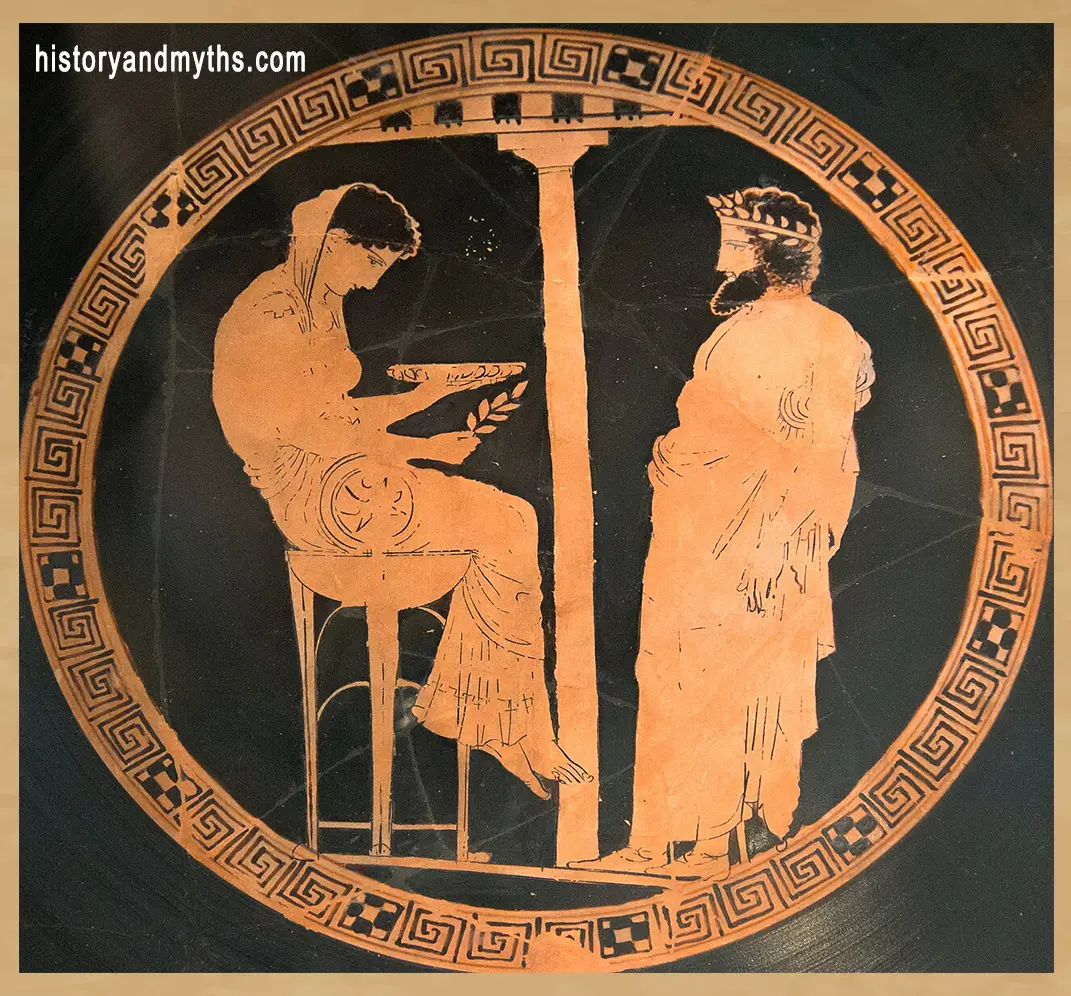
An oracle in ancient Greece was not simply a person delivering prophecies. It was a defined process tied to a specific sanctuary, combining ritual, controlled access, and interpretation. The individual speaking—such as the priestess at Delphi—was only one part of a larger system that determined how questions were asked, how responses were formed, and how they were understood.
This matters because most explanations reduce the oracle to a mystical figure receiving visions. In reality, the authority of an oracle did not come from spontaneous inspiration. It came from structure: recognized procedures, sacred space, and a long-standing reputation attached to the site itself. Without that framework, the response would carry no weight.
Each oracle was also location-bound. There was no universal oracle serving all of Greece. Different sanctuaries were associated with different deities and traditions, and their influence depended on how widely they were trusted. A response from a major center like Delphi carried far more weight than one from a local shrine, not because of a higher authority, but because of accumulated reputation.
Another key point is that oracles did not operate continuously. They functioned within specific times, rituals, and conditions. Access was limited, and not every question was accepted. This controlled availability reinforced their value—responses were not casual or frequent, but tied to formal occasions that gave them significance.
Seen clearly, an oracle was not a source of free-flowing prophecy. It was a regulated channel for decision-making, where uncertainty was processed through ritual and delivered in a form that could guide action without claiming absolute certainty.
| Aspect | Oracle System | Modern Expectation |
|---|---|---|
| Nature | Structured ritual process | Spontaneous prophecy |
| Control | Distributed across system layers | Single prophetic authority |
| Responses | Ambiguous and interpretable | Clear predictions |
| Purpose | Decision support | Future telling |
| Authority | Based on ritual and reputation | Based on supernatural certainty |
| Outcome | Flexible and adaptable | Fixed and testable |
How the Oracle System Worked Step by Step
The oracle did not produce answers randomly. It followed a controlled sequence, and each step shaped the final response. What people received was not a raw prophecy, but the result of a structured process.
1-Question Submission
The process began with a formal question. Individuals or city representatives did not walk in and ask freely. The question had to be prepared and framed in advance, often in a way that allowed a limited range of answers. This framing alone could influence the outcome before the ritual even began.
2-Access and Filtering
Not every question was accepted. Temple officials controlled access, deciding when consultations were allowed and which inquiries proceeded. This created a gatekeeping layer that filtered both the volume and the type of questions reaching the oracle.
3-Ritual Preparation
Before any response was given, rituals established the setting. Offerings, purification, and formal procedures were performed to legitimize the moment. This stage reinforced that the answer was not casual—it was produced under specific, recognized conditions.
4-Delivery of the Response
The answer was then delivered through the oracle figure—often a priestess in a controlled state. What mattered here was not personal authority, but the ritual context that framed the response as divine communication.
5-Interpretation
The final meaning did not exist at the moment of delivery. Responses were typically brief and ambiguous, requiring interpretation afterward. This is where the system extended beyond the sanctuary—those who received the answer had to decide how to apply it.
The key point is that the oracle’s power did not come from a single step. It came from the combination of all five. Control over the question, the process, and the interpretation ensured that the outcome was never entirely fixed, but always usable.
Who Controlled the Oracle? (Power Layer)
There was no single figure controlling the oracle. Power was distributed across the system, and that distribution is what made it effective. The priestess delivered the response, but she did not control access, question framing, or final interpretation. Those elements were handled elsewhere.
Temple officials managed entry into the process. They determined when consultations were allowed, organized the sequence of visitors, and handled the formal procedures around each inquiry. This gave them influence over which questions reached the oracle and in what form. Control at this stage shaped outcomes before any response was given.
The question itself was another layer of control. Those asking—whether individuals or city representatives—often framed their questions strategically. Instead of asking open-ended questions, they narrowed the options, sometimes forcing the oracle into limited or predictable responses. In practice, this meant that influence could begin outside the sanctuary, before the process even started.
The interpretation stage added a final layer. Responses were rarely explicit. Their meaning depended on how they were read and applied afterward. Political leaders, advisors, or communities could select the interpretation that aligned with their goals, giving them practical control over the result.
Even in highly visible centers like Delphi, this structure did not change. Influence came from reputation and procedure, not from centralized authority. The oracle did not impose decisions—it provided validated ambiguity that others could use.
The result is clear: control was never concentrated in one place. It was built into each stage of the system, making the oracle both influential and flexible without requiring a single controlling authority.
- Questions were controlled before reaching the oracle
- Access was limited and regulated by temple officials
- Responses were intentionally ambiguous
- Meaning was created through interpretation, not delivery
- The system produced guidance, not certainty
© historyandmyths.com — Educational use
Why Greeks Trusted Oracles
Trust in oracles did not depend on consistent accuracy. It depended on how the system was perceived and used. Even when outcomes were uncertain, the process itself carried enough weight to remain credible.
The first factor was tradition. Oracles had been consulted for generations, especially in major sanctuaries like Delphi. Repetition over time created legitimacy. People trusted the system because it had always been there, embedded in both personal decisions and public life.
The second factor was reputation reinforced by selective memory. Successful oracles were remembered and repeated; unclear or failed ones were ignored or reinterpreted. This created a feedback loop where the oracle appeared more reliable than it actually was, strengthening long-term trust.
The third factor was ambiguity. Responses were rarely precise. Instead, they were flexible enough to fit multiple outcomes. This made them difficult to disprove. Whatever happened, the response could be read as correct after the fact. Ambiguity was not a weakness—it was a built-in mechanism that protected the system from failure.
Another key element was risk management. Consulting an oracle shifted responsibility. A decision supported by prophecy carried more legitimacy, especially in uncertain situations like war or colonization. Even if the outcome failed, the decision itself remained justified because it followed a recognized process.
Finally, there was collective reinforcement. Oracles were not private beliefs—they were public actions. Cities, leaders, and communities all participated in the same system. This shared usage created a form of social validation: if everyone relies on it, it becomes rational to rely on it as well.
Trust, then, was not about proving that oracles were right. It was about maintaining a system that consistently produced usable guidance under uncertainty, backed by tradition, reinforced by interpretation, and supported by collective behavior.
Prophecy as a Political Tool
Oracles were not only consulted—they were used. In many cases, prophecy functioned as a tool to support decisions that had already been considered or desired. The value of the oracle was not in choosing a path from nothing, but in legitimizing a path in front of others.
One of the clearest uses was in war decisions. Before launching campaigns, leaders sought oracular approval. This did not mean the oracle dictated strategy. It meant the decision could be presented as aligned with divine will, reducing resistance and strengthening internal support. A military action backed by prophecy carried more weight than one based on human judgment alone.
The same logic applied to colonization. Establishing a new settlement involved risk, resources, and long-term commitment. Consulting an oracle provided a form of authorization that extended beyond practical reasoning. It transformed a strategic move into a sanctioned act, making it easier to justify to participants and investors in the venture.
Oracles also played a role in political authority. Leaders could invoke prophetic approval to reinforce their position or defend controversial actions. In this context, prophecy became a tool of persuasion, not because people were forced to believe it, but because it fit within an accepted system of validation.
A key detail is that oracles rarely gave direct commands. Their responses were interpretable, which allowed decision-makers to align the message with their objectives. This flexibility made prophecy adaptable. Instead of limiting action, it provided a framework that could support multiple directions while still appearing authoritative.
The result is a consistent pattern: prophecy did not replace decision-making—it strengthened it by adding legitimacy. In a system where public acceptance mattered, the oracle became a practical way to turn uncertain or contested choices into collectively accepted outcomes.
Ambiguity: The Hidden Mechanism
Ambiguity was not an accidental feature of Greek oracles—it was the mechanism that made the system durable. Responses were rarely direct or detailed. Instead, they were phrased in ways that allowed more than one interpretation, often using symbolic or conditional language.
This served a clear function. A precise prediction can be proven wrong. An ambiguous response cannot be easily falsified. If events unfolded in one direction, the answer could be read one way; if they unfolded differently, it could be read another. The system did not depend on being right in advance—it depended on remaining valid afterward.
Ambiguity also shifted responsibility. The oracle provided the response, but it did not fix its meaning. That task fell to the individual or community receiving it. This created a gap between message and decision, where interpretation became part of the process. In practical terms, people were not following orders—they were justifying choices through interpretation.
Another effect was flexibility under uncertainty. Greek society faced decisions that could not be solved with clear data—war, migration, political risk. An ambiguous response did not restrict action. It allowed decision-makers to adapt the meaning to changing conditions, while still maintaining the appearance of divine guidance.
This is why ambiguity did not weaken trust. It reinforced it. The oracle never needed to be consistently precise, because it was never designed to produce fixed outcomes. It was designed to produce usable statements that could survive different results.
At its core, ambiguity turned prophecy into something more stable than prediction. It ensured that the oracle remained relevant regardless of what happened, making it one of the most effective features of the entire system.
Case Study: Delphi (How the System Worked in Reality)
The oracle at Delphi is often treated as a unique phenomenon, but it actually shows the system at its most complete scale. Everything discussed earlier—controlled access, structured ritual, ambiguity, and interpretation—appears here in a more visible and organized form.
Consultation did not happen freely. Access to the sanctuary was regulated, and visitors followed a defined sequence before reaching the oracle. Questions were prepared in advance, and the process ensured that what reached the oracle was already shaped by context and intent. This alone limited randomness.
The response itself, delivered through the Pythia, was not a final answer in a modern sense. It was a statement embedded in ritual authority, often brief and open to interpretation. The meaning only became clear when applied outside the sanctuary, in the decisions that followed.
A well-known pattern illustrates this. When leaders consulted the oracle before major actions—such as war or expansion—they did not receive detailed instructions. They received phrases that could support more than one outcome. If the result was successful, the oracle was seen as correct. If it failed, the interpretation could shift, preserving the credibility of the system.
What made Delphi influential was not a different structure, but wider trust. It functioned as a panhellenic center, attracting individuals and city-states from across the Greek world. This shared recognition amplified its authority without turning it into a centralized power. No city was controlled by Delphi, but many chose to rely on it.
Even at this level, the same limits applied. The oracle did not enforce decisions, and it did not eliminate uncertainty. It provided a structured way to manage uncertainty, allowing actions to be framed as aligned with divine will.
Delphi, then, is not an exception to the system—it is its clearest example. It shows how oracles operated when reputation, ritual, and interpretation came together at full scale, producing influence without centralized control.
- Greek oracles functioned as structured decision-making systems
- The process included question control, ritual, and interpretation
- No single figure controlled the oracle entirely
- Ambiguity was a core feature, not a weakness
- Oracles were used to legitimize political and strategic decisions
- Trust came from tradition, reputation, and flexibility
- Delphi represents the system at its most influential scale
Frequently Asked Questions
What was a Greek oracle?
A structured system where questions were asked, processed through ritual, and answered in an interpretable form.
How did Greek oracles work?
They followed a process of question submission, filtering, ritual preparation, response delivery, and interpretation.
Were oracles always accurate?
No. Their responses were often ambiguous, allowing different interpretations depending on outcomes.
Who controlled the oracle?
Control was distributed across priests, officials, and those interpreting the response.
Why did people trust oracles?
Because of tradition, reputation, and their ability to provide usable guidance in uncertain situations.
What role did oracles play in politics?
They were used to legitimize decisions such as war, colonization, and leadership authority.
What made Delphi important?
Its reputation and panhellenic influence made it the most trusted oracle in the Greek world.
Sources & Rights
- Burkert, Walter. Greek Religion: Archaic and Classical. Cambridge, MA: Harvard University Press, 1985.
- Parke, H. W., and D. E. W. Wormell. The Delphic Oracle. 2 vols. Oxford: Basil Blackwell, 1956.
- Fontenrose, Joseph. The Delphic Oracle: Its Responses and Operations. Berkeley: University of California Press, 1978.
- Bowden, Hugh. Classical Athens and the Delphic Oracle: Divination and Democracy. Cambridge: Cambridge University Press, 2005.
- Johnston, Sarah Iles. Ancient Greek Divination. Malden, MA: Wiley-Blackwell, 2008.
- Flower, Michael A. The Seer in Ancient Greece. Berkeley: University of California Press, 2008.
- Kindt, Julia. Rethinking Greek Religion. Cambridge: Cambridge University Press, 2012.
- Parker, Robert. On Greek Religion. Ithaca: Cornell University Press, 2011.
- Price, Simon. Religions of the Ancient Greeks. Cambridge: Cambridge University Press, 1999.
- Mikalson, Jon D. Ancient Greek Religion. Malden, MA: Wiley-Blackwell, 2005.
- Bremmer, Jan N. Greek Religion. Oxford: Oxford University Press, 1994.
- Ogden, Daniel, ed. A Companion to Greek Religion. Malden, MA: Blackwell Publishing, 2007.
- Rutherford, Ian. State Pilgrims and Sacred Observers in Ancient Greece. Cambridge: Cambridge University Press, 2013.
- Naiden, F. S. Smoke Signals for the Gods: Ancient Greek Sacrifice from the Archaic through Roman Periods. Oxford: Oxford University Press, 2013.
- Versnel, H. S. Coping with the Gods: Wayward Readings in Greek Theology. Leiden: Brill, 2011.
- de Polignac, François. Cults, Territory, and the Origins of the Greek City-State. Chicago: University of Chicago Press, 1995.
- Gehrke, Hans-Joachim. History of the Archaic Greek World. Malden, MA: Wiley-Blackwell, 2010.
- Hornblower, Simon, and Antony Spawforth, eds. The Oxford Classical Dictionary. 4th ed. Oxford: Oxford University Press, 2012.
- Cartledge, Paul. Ancient Greece: A Very Short Introduction. Oxford: Oxford University Press, 2011.
- Osborne, Robin. Greece in the Making: 1200–479 BC. London: Routledge, 1996.
- Lewis, David M., et al., eds. The Cambridge Ancient History, Vol. 5: The Fifth Century BC. Cambridge: Cambridge University Press, 1992.
- Beard, Mary, John North, and Simon Price. Religions of Rome. Cambridge: Cambridge University Press, 1998.
- Assmann, Jan. The Search for God in Ancient Egypt. Ithaca: Cornell University Press, 2001.
- Teeter, Emily. Religion and Ritual in Ancient Egypt. Cambridge: Cambridge University Press, 2011.
- Quirke, Stephen. Ancient Egyptian Religion. London: British Museum Press, 1992.
Written by H. Moses — All rights reserved © Mythology and History