Greek Colonies in the Mediterranean: How Ancient Cities Expanded
Greek colonies in the Mediterranean were not random settlements—they were a structured response to pressure inside the Greek world. From the 8th to the 6th centuries BC, city-states began sending out groups of settlers to establish new communities across southern Italy, North Africa, Asia Minor, and the Black Sea. These were not military outposts or controlled provinces; they were new, self-governing cities built by Greeks, for Greeks, but outside the limits of the original polis.
Why did this happen? The answer is practical, not ideological. Population growth, limited farmland, and internal instability pushed people outward. At the same time, expanding trade created opportunities that could not be contained within the Aegean. Colonization solved both problems at once: it reduced pressure at home and extended economic reach abroad.
The key point is this: Greek colonization was a system of expansion without empire. Each colony maintained cultural and religious ties to its mother city, but it operated independently. This created a network of connected but autonomous cities that reshaped the Mediterranean—spreading Greek language, trade, and identity far beyond mainland Greece without centralized control.
This article breaks that system down: why colonies were founded, how they were established, and how they functioned as part of a wider Greek world.
What Were Greek Colonies?
Greek colonies were not extensions of empire—they were new, independent city-states established by groups of settlers from an original polis. Each colony (apoikia) had its own government, laws, and economic life from the moment it was founded. It was not ruled by the mother city; it started as a separate political entity.
This is the key distinction most summaries miss.
Unlike later imperial systems, Greek colonization did not create centralized control over distant territories. A colony maintained symbolic and cultural ties to its origin—shared gods, festivals, and identity—but it did not answer to it politically. There was no tax system, no administrative hierarchy, and no permanent military control linking colony to metropolis.
What connected them was origin, not authority.
Founding a colony meant relocating part of a population to a new location where they could reproduce the structure of a polis: urban center, farmland, religious sites, and a governing body. The goal was stability and self-sufficiency, not dependency. If a colony failed to sustain itself, it collapsed—there was no external system to support it.
This makes Greek colonies fundamentally different from trading posts or military bases. They were not temporary or specialized sites; they were full communities designed to survive long-term. Over time, many became more powerful than their founding cities, especially in regions like southern Italy and the Black Sea.
In practical terms, Greek colonization created a network of autonomous cities spread across the Mediterranean. They shared language and culture, but operated independently. That network—not an empire—is what expanded Greek influence.
| Aspect | Greek Colonies | Modern Empires |
|---|---|---|
| Political Control | Independent city-states | Direct rule from center |
| Relationship | Cultural and religious ties | Administrative hierarchy |
| Economic Role | Trade nodes and local production | Resource extraction |
| Military Presence | Limited / local defense | Permanent garrisons |
| Expansion Model | Decentralized network | Centralized expansion |
| Identity | Shared culture, separate politics | Unified imperial identity |
Why Did Greeks Establish Colonies?
Greek colonization was not driven by exploration—it was driven by constraint. Inside many city-states, the balance between population, land, and resources had started to break.
The first pressure was land. Most Greek poleis were limited by geography—mountains, poor soil, and small agricultural zones. As populations grew, available farmland did not. This created a structural problem: more citizens competing for the same fixed resource. Colonization offered a direct solution—move part of the population to a place where land was available.
The second pressure was economic. Local economies could not absorb everyone. Trade was expanding across the Mediterranean, but without access to new ports, raw materials, and routes, growth was limited. Establishing colonies along strategic coastlines allowed Greek cities to extend their commercial reach. Colonies became nodes in a wider trade system, not isolated settlements.
There was also a political dimension. Internal conflicts—especially between elites and lower classes—often led to instability. In some cases, sending out a group of settlers reduced tension at home. In others, individuals who lost power or faced exile used colonization as a way to rebuild status elsewhere. Founding a colony could be both a pressure release and a reset.
Opportunity mattered as well. Reports of fertile land, access to metals, or advantageous harbors made certain regions attractive. Colonization was not random movement—it followed known routes and targeted locations with clear economic value.
What ties these factors together is that colonization solved multiple problems simultaneously. It reduced population pressure, expanded economic access, and redistributed political risk. It was not a single-cause phenomenon—it was a coordinated response to overlapping constraints inside the Greek world.
How a Greek Colony Was Founded
Greek colonization followed a recognizable process. It was not spontaneous migration; it was organized, led, and structured from the outset.
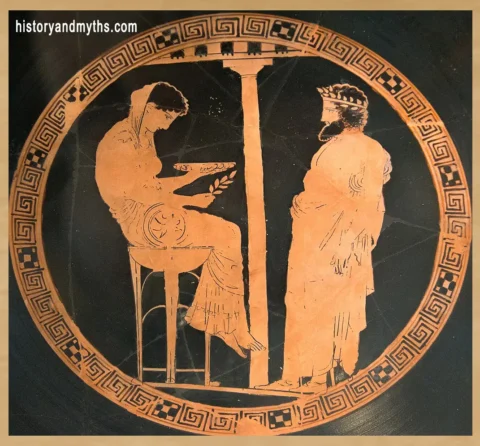
The first step was authorization. A polis did not send settlers arbitrarily. The decision was formal—often approved by political authorities and reinforced through consultation with religious institutions. Seeking guidance from places like Delphi was common, not as symbolism, but as a way to legitimize the venture and unify support behind it.
Next came leadership. Each expedition was placed under a single founder, the oikist. He was responsible for selecting settlers, organizing the journey, and establishing the new settlement. His authority was both practical and symbolic. After death, many oikists were honored as foundational figures of the new city, reinforcing continuity and legitimacy.
Site selection was strategic. Colonies were not placed randomly—they were positioned to maximize survival and advantage. Access to arable land, fresh water, and a defensible harbor were non-negotiable. Proximity to trade routes or valuable resources increased the colony’s long-term viability. Poor site choice usually meant failure.
The settlement itself followed a familiar pattern. Land was divided among settlers, creating an immediate economic base. A central urban space was established, along with religious sites that linked the colony culturally to its origin. This was not improvisation—it was replication of the polis model in a new location.
The relationship with local populations was variable. Some colonies integrated with existing communities through trade and coexistence. Others displaced or came into conflict with them, especially in regions where land was already occupied. There was no single model; outcomes depended on local conditions and the balance of power.
What defines the process is structure. Colonies were founded through planning, leadership, and clear objectives. They were designed to become self-sustaining cities from the outset—not dependent outposts, but new centers of Greek life.
Relationship Between Colony and Mother City
The relationship between a Greek colony and its mother city (metropolis) was defined by origin, not control. A colony did not function as a governed territory or subordinate unit. From its foundation, it operated as an independent polis with its own institutions and decision-making authority.
What persisted was connection, not hierarchy.
The strongest link was religious. Colonies carried the cults and rituals of their mother city, often establishing the same primary deities in their new environment. Founding ceremonies, sacred fire, and shared festivals reinforced a sense of continuity. This was not administrative dependence—it was cultural alignment.
There were also social and symbolic ties. The founder (oikist) embodied the connection between the two communities, and in many cases, early settlers maintained a shared identity rooted in their place of origin. This could influence alliances, marriage patterns, and mutual recognition, especially in the early stages of a colony’s development.
Economically, the relationship was flexible. Some colonies maintained strong trade links with their metropolis, particularly if the original purpose included access to specific goods or routes. Others diversified quickly and developed independent trade networks. There was no fixed economic dependency.
Politically, autonomy was the norm. Colonies made their own laws, conducted their own diplomacy, and managed their own conflicts. They could align with—or against—their mother city depending on circumstances. Shared origin did not guarantee shared interests.
This model distinguishes Greek colonization from later imperial systems. Instead of a centralized structure extending outward, it produced a network of self-governing cities connected by culture and memory. The influence of the metropolis was real, but it was not enforced—it was sustained through continuity, not authority.
- Driven by land shortage, population pressure, and trade expansion
- Colonies were founded as independent poleis, not controlled territories
- The oikist organized settlement and ensured initial structure
- Strategic coastal locations enabled long-distance trade networks
- Shared language and religion connected colonies culturally
- The system expanded Greek influence without creating an empire
Major Regions of Greek Colonization
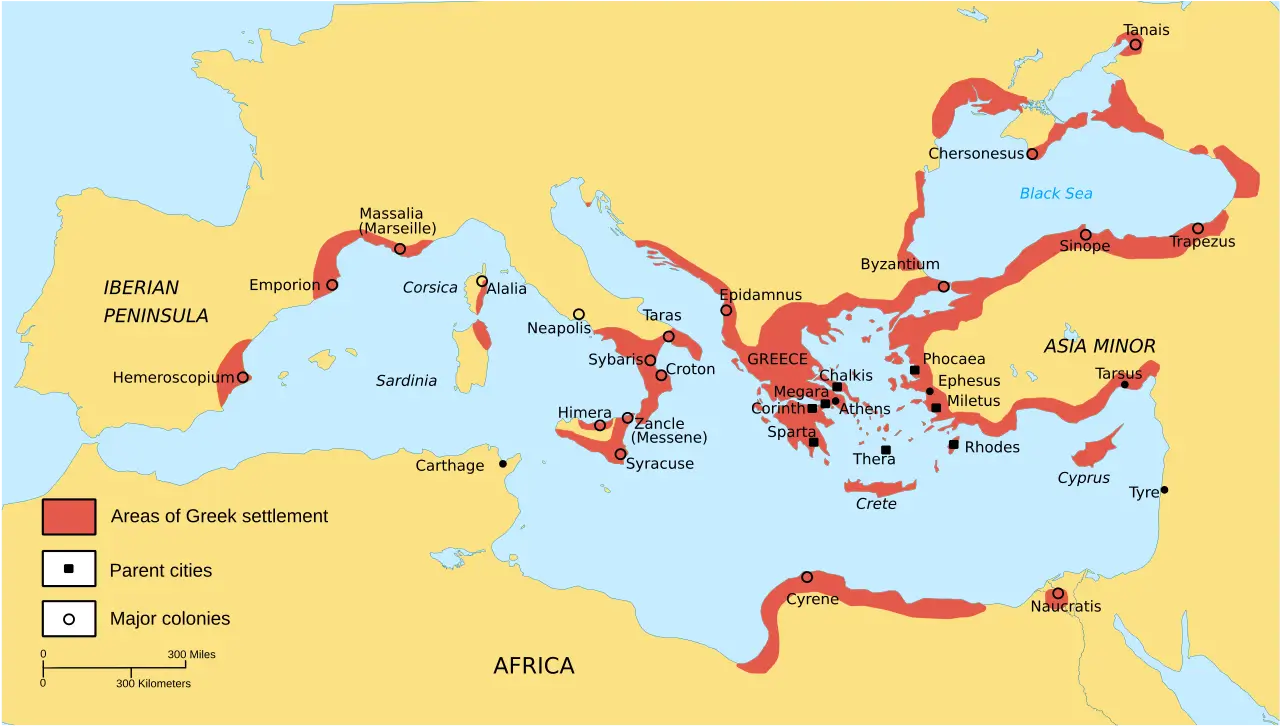
Greek colonization followed clear patterns. Settlements concentrated in regions that offered a balance of arable land, strategic position, and access to trade routes. Over time, several key zones emerged, each serving a distinct role within the wider Greek network.
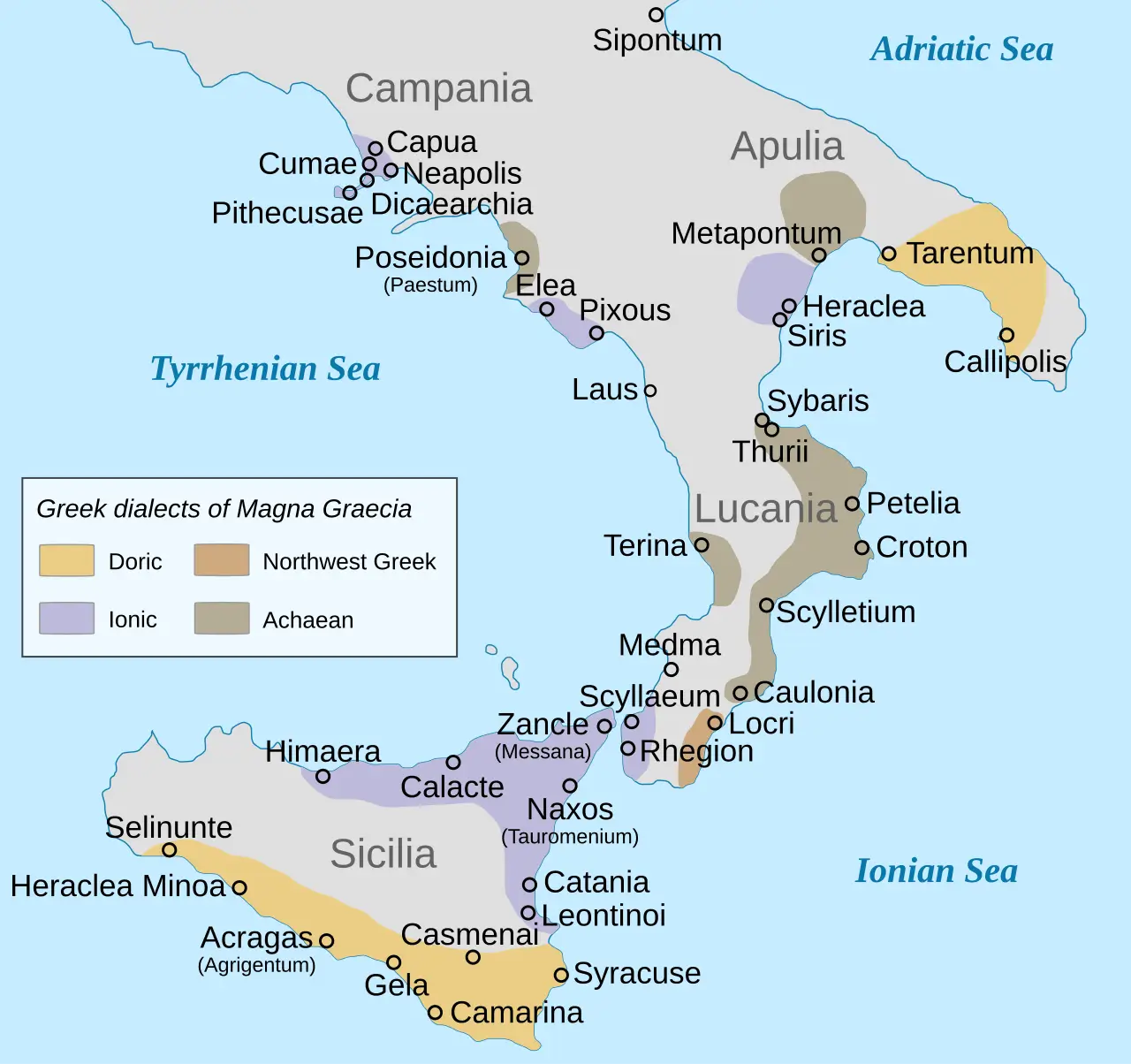
The most prominent region was southern Italy and Sicily, later known as Magna Graecia. These areas provided fertile land on a scale unavailable in mainland Greece, allowing colonies to achieve stability and growth quickly. Cities such as Syracuse developed into major economic and political centers, in some cases surpassing their original mother cities in influence.
To the northeast, Greek colonies expanded around the Black Sea. This expansion was driven by a specific economic need: access to grain. The region became a critical supplier of food, helping to offset agricultural limitations in the Greek mainland. Colonies here were often smaller, but strategically essential within the broader trade system.
Along the western coast of Asia Minor, colonization took on a different character. Greek settlements were established early and became deeply integrated into regional dynamics. Cities like Miletus were not just colonies—they became major centers of expansion themselves, particularly in founding new settlements around the Black Sea.
In North Africa, colonies such as Cyrene combined access to fertile land with control over regional trade routes. While fewer in number, these settlements played a significant economic role, especially in agricultural production.
What defines these regions is function rather than geography. Each served a role within a larger system:
- fertile land to relieve population pressure
- coastal positions to control trade routes
- strategic locations to connect different parts of the Mediterranean
The result was not scattered expansion, but a structured network of cities, each positioned to support and extend Greek economic and cultural reach.
Colonies as Trade Networks
Greek colonies did not operate as isolated settlements—they functioned as interconnected nodes within a wider Mediterranean trade system. Their locations were chosen with this in mind. Coastal access, proximity to key routes, and links to resource-rich regions allowed each colony to serve a specific role in circulation, not just local survival.
The network worked through specialization. Different regions provided different goods: grain from the Black Sea, metals and timber from the northern Aegean and beyond, agricultural products from Sicily and southern Italy. Colonies secured these resources at the source and moved them through maritime routes to other Greek cities. This reduced dependence on local production and stabilized supply across the network.
Trade was not centrally managed, but it was structurally connected. Shared language, practices, and commercial habits made exchange predictable. Merchants could move between colonies with fewer barriers, and agreements could be made without a formal imperial framework. The consistency came from culture and habit, not administration.
Ports were the critical infrastructure. A successful colony was, in effect, a controlled access point—linking inland resources to maritime routes. Once established, these ports attracted further activity: merchants, craftsmen, and secondary settlements. Over time, some colonies shifted from being endpoints to becoming hubs, redistributing goods across multiple directions.
This system also expanded reach. Greek trade moved beyond the Aegean into the western Mediterranean and the Black Sea, creating long-distance connections that would not have been possible from mainland cities alone. Colonization extended the range of economic activity without requiring direct control over large territories.
The key point is that colonization scaled the Greek economy. It created a distributed network where production, movement, and exchange were spread across multiple locations. Each colony contributed to that system, not as a dependent unit, but as an active participant within a shared commercial space.
Cultural Impact and Greek Identity Expansion
Greek colonization did more than extend trade—it expanded a shared cultural framework across distant regions. As new settlements formed, they reproduced key elements of Greek life: language, religious practices, urban structure, and social organization. This was not imposed through centralized control; it spread through replication.
Language was the most immediate connector. Greek became the medium of communication across colonies, allowing ideas, transactions, and traditions to move with relative ease. Even where local populations remained distinct, Greek often became the language of trade and public life within the colony.
Religion reinforced continuity. Colonies established the same deities and rituals as their mother cities, creating a shared sacred landscape. Temples, festivals, and offerings maintained a sense of belonging to a broader Greek world, even at great distances from the mainland.
Urban form also carried identity. Colonies were built as poleis, with defined public spaces, defensive structures, and organized land distribution. This physical layout reflected a familiar model, making new settlements recognizable extensions of Greek civic life, even though they were politically independent.
At the same time, colonization was not a one-way process. Contact with local populations introduced new influences—materials, techniques, and practices—that could be absorbed and adapted. This produced regional variation within a shared framework. Greek identity expanded, but it also evolved.
What emerged was not a unified state, but a cultural sphere. Greek identity became portable—no longer tied strictly to a specific location, but maintained across a network of cities connected by language, religion, and shared practices. Colonization made it possible for that identity to persist and grow far beyond its original geographic limits.
The Limits of Colonization
Greek colonization expanded reach, but it did not eliminate risk. The system depended on conditions that were not always stable, and when those conditions failed, colonies struggled or collapsed.
The first limitation was local resistance. Not all regions were open or underpopulated. In many cases, colonies were established in areas already inhabited, which led to conflict over land and resources. Success depended on the balance of power. Where settlers could not secure territory or maintain control, settlements remained fragile.
Distance was another constraint. Colonies operated independently by design, but that independence meant limited external support. If a colony faced economic failure, military threat, or internal instability, the mother city was not obligated—or often able—to intervene. Survival depended on local strength, not distant ties.
Economic viability also varied. Not every location delivered the expected return. Poor access to trade routes, limited agricultural output, or competition from nearby settlements could undermine a colony’s purpose. Without a sustainable economic base, growth stalled and populations declined.
Internal cohesion was not guaranteed. Colonies were composed of settlers from specific groups, often under pressure or displacement. Maintaining unity in a new environment—without established institutions or long-standing social structures—required effective leadership. When that failed, instability followed.
There were also structural limits to expansion. Colonization relied on available land and navigable routes. As prime locations were occupied, new opportunities became harder to find. Expansion slowed, and existing colonies became more focused on consolidation than growth.
The result is that Greek colonization was not a continuous or uniform process. It was a system that worked under certain conditions—access to land, strategic location, and internal organization. Where those conditions were absent, the system reached its limits.
- Greek colonies were independent city-states, not imperial outposts
- Colonization solved land shortages and expanded economic opportunities
- Each colony was strategically placed to support trade and resource access
- The system created a network of connected but autonomous cities
- Greek culture spread through replication, not centralized control
- Colonization expanded influence but had clear geographic and structural limits
Frequently Asked Questions
What were Greek colonies?
They were independent city-states founded by settlers from a Greek polis.
Why did the Greeks establish colonies?
To relieve population pressure, gain land, and expand trade opportunities.
Were Greek colonies controlled by their mother cities?
No, they were politically independent but maintained cultural ties.
Where were most Greek colonies located?
Southern Italy, Sicily, the Black Sea, Asia Minor, and North Africa.
What was the role of trade in colonization?
Colonies acted as nodes in a wider Mediterranean trade network.
Who led the founding of a colony?
A leader called the oikist organized and directed the settlement.
Did colonization create an empire?
No, it created a decentralized network of independent cities.
Sources & Rights
- Boardman, John. The Greeks Overseas. Thames & Hudson.
- Osborne, Robin. Greece in the Making 1200–479 BC. Routledge.
- Graham, A.J. Colony and Mother City in Ancient Greece. Manchester University Press.
- Hall, Jonathan. A History of the Archaic Greek World. Wiley-Blackwell.
- Snodgrass, Anthony. Archaic Greece. University of California Press.
- Malkin, Irad. Religion and Colonization in Ancient Greece. Brill.
- Malkin, Irad. A Small Greek World. Oxford University Press.
- Hansen, Mogens Herman. Polis: An Introduction. Oxford University Press.
- Cartledge, Paul. Ancient Greece: A Very Short Introduction. Oxford.
- Hornblower, Simon. The Greek World 479–323 BC. Routledge.
- Thucydides. History of the Peloponnesian War.
- Herodotus. Histories.
- Strabo. Geography.
- Diodorus Siculus. Library of History.
- Finley, M.I. The Ancient Economy. University of California Press.
- Van Wees, Hans. Greek Warfare: Myths and Realities. Duckworth.
- Shipley, Graham. The Greek World After Alexander. Routledge.
- Burkert, Walter. Greek Religion. Harvard University Press.
- Whitley, James. The Archaeology of Ancient Greece. Cambridge.
- de Polignac, François. Cults, Territory, and the Origins of the Greek City-State. Chicago.
- Coldstream, J.N. Geometric Greece. Routledge.
- Boardman, John. The Archaeology of Nostalgia. Thames & Hudson.
Written by H. Moses — All rights reserved © Mythology and History