Scribal Schools in Ancient Egypt: Education and Training of Scribes
In ancient Egypt, becoming a scribe was not a matter of talent alone, nor a casual apprenticeship learned at home. It was the result of a long, disciplined educational process designed to produce reliable administrators for the state. Scribal schools were the institutional backbone of Egyptian governance, training boys-sometimes from a very young age-to master writing, calculation, record-keeping, and the disciplined habits required for bureaucratic life. Without these schools, temples could not function, taxes could not be collected, and the machinery of the Egyptian state would have collapsed.
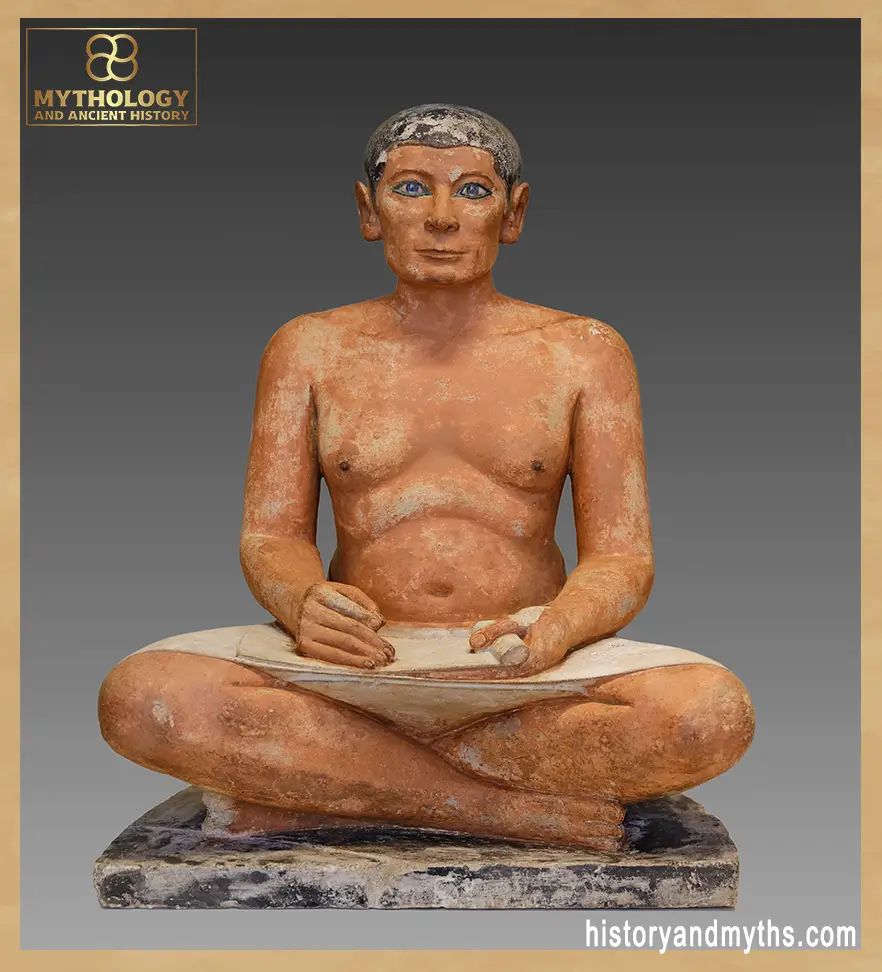
Modern discussions often romanticize the Egyptian scribe as a privileged intellectual, seated comfortably with palette and papyrus. What they rarely explain is how such figures were formed. Scribal training was rigorous, repetitive, and hierarchical. Students copied texts endlessly, memorized model compositions, learned formal administrative language, and endured strict discipline meant to shape obedience as much as literacy. Education was not abstract or philosophical; it was practical, standardized, and deeply tied to employment within temples, estates, and royal administration.
This article examines scribal schools not as symbolic institutions, but as working educational systems. It explores where scribes were trained, who was admitted, what they studied, how they were disciplined, and why this form of education mattered so profoundly to the survival of Egyptian civilization. By focusing on evidence from instructional texts, training ostraca, and administrative records, the discussion moves beyond generalizations to reveal how ancient Egypt deliberately engineered knowledge, authority, and social continuity through formal education.
What Were Scribal Schools in Ancient Egypt?
Scribal schools in ancient Egypt were not informal gatherings or private tutoring arrangements. They were structured educational environments embedded within the institutions that governed Egyptian society. Most operated in close association with temples, royal estates, and administrative centers, where literacy was not an abstract skill but a practical necessity for managing land, labor, taxation, and ritual obligations.
The Egyptians themselves did not use a single generic word equivalent to “school” in the modern sense. Instead, education took place within institutional spaces tied to authority. The most important of these was the House of Life (Per Ankh), an elite center attached to major temples. While the House of Life was not exclusively a school, it functioned as a hub for advanced training, textual transmission, and the preservation of sacred and administrative knowledge. Scribal students destined for higher positions were often trained in or around such environments, where learning and state service were inseparable.
At a more basic level, scribal instruction also occurred in smaller temple schools and administrative offices, especially in provincial towns. These settings focused on practical training rather than intellectual breadth. Students learned to write standard administrative formulas, copy model texts, and calculate accounts accurately. Instruction was supervised by senior scribes whose authority derived not from pedagogy alone, but from their official roles within the bureaucracy.
What defined a scribal school, therefore, was not a dedicated building or a fixed curriculum in the modern sense, but institutional purpose. Education existed to reproduce the administrative class. Literacy was taught as a controlled skill, shaped by the needs of the state and limited to those expected to serve it. This explains why scribal training remained conservative and repetitive across centuries: innovation was less important than reliability.
Unlike elite philosophical education in later cultures, Egyptian scribal schooling emphasized conformity. Students copied the same model texts generation after generation, learning not only handwriting but approved ways of thinking, phrasing, and recording reality. The school was thus a mechanism of cultural continuity. Through it, the state ensured that laws, taxes, rituals, and royal decrees would be recorded in familiar, standardized forms that reinforced authority rather than challenged it.
| Aspect | Details |
|---|---|
| Primary Purpose | Training professional scribes to serve state administration, temples, and estates |
| Institutional Setting | Temples, administrative offices, royal estates, and elite centers such as the House of Life |
| Age of Entry | Typically between 5 and 10 years old |
| Social Background | Mostly sons of scribes or families tied to administration; limited social mobility |
| Core Subjects | Hieratic writing, mathematics, accounting, administrative formulas, legal records |
| Advanced Training | Hieroglyphs, religious texts, literary compositions, temple documentation |
| Teaching Methods | Copying model texts, repetition, memorization, supervised correction |
| Training Materials | Ostraca, papyrus, reed pens, ink palettes |
| Discipline | Strict supervision; corporal punishment referenced in instructional texts |
| Post-School Training | Apprenticeship under senior scribes; supervised administrative work |
| Final Outcome | Employment in bureaucracy, temples, granaries, courts, or royal administration |
Who Could Become a Scribe?
Scribal education in ancient Egypt was not open to the population at large. Access was selective, shaped by social position, family background, and institutional need rather than individual ambition alone. While later texts sometimes present the scribal path as attainable through effort and discipline, the reality was more constrained. Most students came from families already connected to administrative, temple, or estate work, where literacy was both familiar and economically useful.
Admission typically began at a young age, often between five and ten years old. This early start was essential, as mastering hieratic script, numerical systems, and formal administrative language required years of repetitive training. Families who placed children into scribal instruction needed the resources to support long periods of non-productive study, something unavailable to most agricultural households. As a result, scribal schools largely reproduced an existing bureaucratic class rather than creating social mobility on a wide scale.
Inheritance played a significant role. Many scribes explicitly identified themselves as “sons of scribes” in tomb inscriptions and administrative records. This was not merely a matter of prestige; it reflected continuity of training, access to learning materials, and familiarity with institutional culture. A child raised in a scribal household would already be exposed to writing tools, documents, and professional networks before formal instruction even began.
That said, scribal education was not strictly hereditary. Talented boys from non-scribal families could be admitted, particularly if they were connected to temple estates or local officials. Instructional texts such as The Satire of the Trades emphasize effort and discipline, suggesting that advancement was possible for those who endured the demands of training. These texts, however, functioned as motivational literature rather than neutral descriptions of social reality. They promoted scribal life as desirable while downplaying the structural barriers that limited access.
Importantly, scribal schools were overwhelmingly male. While women could be literate and occasionally held administrative or religious titles involving writing, there is no evidence for systematic female participation in formal scribal training. Education reflected broader gender roles within Egyptian administration, where record-keeping and official documentation were male-dominated activities.
Becoming a scribe, therefore, required more than learning to write. It demanded early admission, sustained family support, acceptance by institutional authorities, and conformity to social expectations. Scribal education was less a ladder open to all than a carefully managed gateway into state service, ensuring that literacy remained both valuable and controlled.
Inside the Scribal Classroom
Scribal classrooms in ancient Egypt were environments of discipline, repetition, and close supervision. They were not designed to encourage creativity or debate, but to instill precision, obedience, and consistency. Learning to write was inseparable from learning how to behave within a hierarchical system. Every aspect of the classroom—materials, exercises, and discipline—reinforced this goal.
Learning Materials: Tools of Training
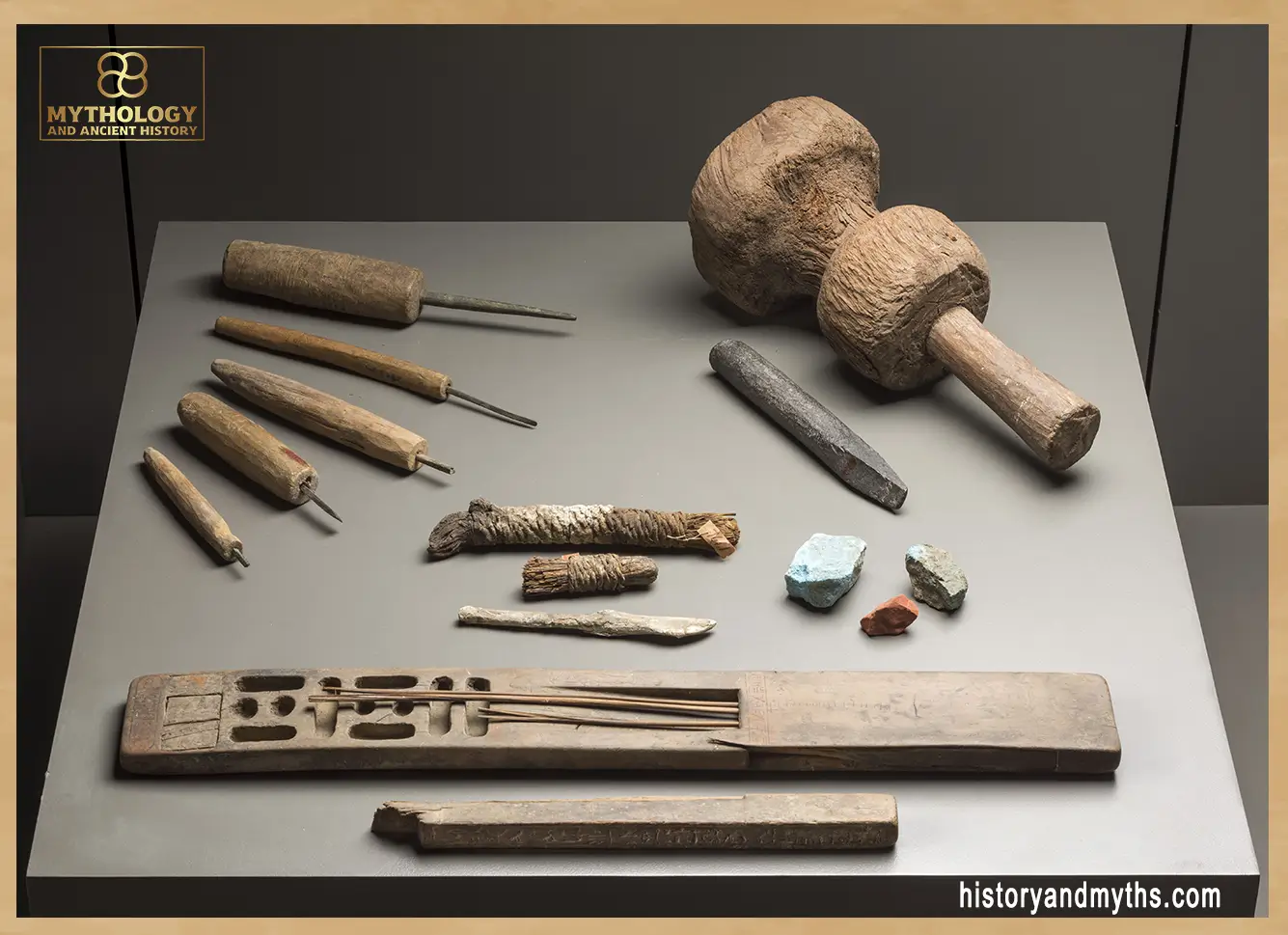
Students did not begin their education on expensive papyrus. Early instruction relied heavily on ostraca—flakes of limestone or broken pottery—cheap, reusable surfaces ideal for repeated practice. Writing palettes with red and black ink, reed pens, and water pots were standard equipment. These tools trained students to control spacing, line order, and stroke sequence, skills essential for producing legible administrative documents.
Papyrus was introduced later, once a student demonstrated sufficient control and reliability. This progression reflects the practical priorities of scribal education: materials were allocated according to competence, not status. Errors were expected early on, but waste was not.
Copying, Repetition, and Memorization
The core pedagogical method was copying. Students copied model texts line by line, often under direct supervision. These texts ranged from simple word lists and formulaic phrases to longer instructional compositions. Accuracy mattered more than comprehension at early stages. The goal was to internalize approved forms of writing—standard spellings, accepted phrasing, and conventional layouts.
Repetition was relentless. Surviving training ostraca show the same sentence copied dozens of times, sometimes with corrections written by a teacher above or beside the student’s attempt. This process trained not only handwriting, but memory and discipline. A competent scribe was expected to reproduce correct forms automatically, without hesitation.
Discipline and Authority in the Classroom
Discipline was strict and explicitly acknowledged in instructional literature. Texts such as The Instruction of Khety describe physical punishment as a normal part of education, presenting it as necessary for moral and professional development. While these texts exaggerate for rhetorical effect, archaeological and textual evidence confirms that correction was firm and hierarchical.
Teachers were senior scribes, not pedagogical specialists. Their authority came from experience and office, and their role was to shape students into reliable subordinates. Obedience, endurance, and respect for rank were learned alongside literacy. The classroom thus functioned as a miniature version of the bureaucratic world students were being prepared to enter.
What emerges from this evidence is a learning environment focused on standardization. Scribal classrooms did not aim to produce individual thinkers, but dependable record-keepers. Through controlled materials, repetitive exercises, and strict discipline, Egypt ensured that its administrative knowledge remained stable across generations—a crucial factor in the longevity of its institutions.
The Scribal Curriculum Explained
Scribal education followed a carefully layered curriculum that moved from mechanical skill to applied knowledge. The goal was not broad intellectual development, but professional readiness. Each subject served a direct administrative function, and mastery was measured by accuracy and reliability rather than originality.
Writing Systems: From Control to Competence
Students began with hieratic, the cursive script used for daily administration. Its speed and flexibility made it essential for accounts, letters, and legal records. Training focused on stroke order, spacing, and standardized spellings, ensuring that documents could be read easily by other officials. Hieroglyphs, by contrast, were taught later and selectively. They were required for monumental inscriptions, religious texts, and formal display, but not for routine bureaucratic work. This distinction reflects a practical hierarchy of scripts within the curriculum.
Early exercises emphasized copying isolated signs and short phrases before progressing to full sentences and model texts. Accuracy mattered more than speed at this stage; a poorly formed sign could alter meaning and compromise a document’s authority.
Mathematics and Accounting
Numeracy was central to scribal training. Students learned to calculate rations, wages, land areas, and tax assessments using Egyptian fractional notation. Mathematical problems preserved on papyri and ostraca reveal a curriculum grounded in real administrative tasks rather than abstract theory. Exercises included dividing bread and beer rations, measuring fields after inundation, and converting units for storage and transport.
These skills prepared scribes for work in granaries, estates, workshops, and treasury offices. Errors were costly, and the curriculum reflects an expectation of precision under practical conditions.
Administrative and Legal Texts
As training advanced, students copied formal documents: letters, inventories, contracts, and court records. These texts taught not only language but bureaucratic etiquette—how to address superiors, how to record disputes, and how to frame official decisions. Formulaic expressions were memorized and reused, reinforcing institutional continuity.
Instructional compositions such as The Satire of the Trades functioned as both reading practice and ideological reinforcement. By contrasting scribal life with manual labor, such texts promoted obedience, diligence, and loyalty to administrative service, aligning personal ambition with state needs.
Religious and Literary Training
Advanced students encountered religious hymns, ritual instructions, and literary narratives. This material was not included for aesthetic reasons alone. Temples were major employers of scribes, and familiarity with sacred language was essential for copying ritual texts, managing temple property, and recording offerings. Literary texts also served as models of refined language, teaching style and structure appropriate for elite communication.
The curriculum, taken as a whole, reveals an education system designed for function. Every subject—writing, mathematics, administration, and religious knowledge—fed directly into employment. Scribal schools did not teach knowledge for its own sake; they trained specialists whose skills sustained the economic, legal, and ritual operations of the Egyptian state.
Training Beyond the Classroom
Formal schooling alone did not produce a functioning scribe. Classroom training provided technical foundations, but professional competence was completed through apprenticeship and on-the-job learning. Newly trained scribes were placed under senior officials, where they learned how education translated into real administrative work.
This phase involved copying live documents, recording deliveries, assisting in audits, and observing legal proceedings. Mistakes here had consequences, which reinforced caution and accuracy far more effectively than classroom exercises. Supervision remained strict, and responsibility increased gradually. A scribe proved his readiness not through exams, but through sustained reliability.
Training also varied by location. In major centers such as Memphis or Thebes, instruction was broader and more specialized, reflecting the complexity of central administration and temple economies. In provincial towns, training was narrower and more practical, focused on land records, local taxation, and correspondence. Despite these differences, standards remained consistent, ensuring documents produced across Egypt followed recognizable formats.
This extended training phase explains why scribes formed a cohesive professional class. Shared methods, language, and administrative habits created uniformity across generations. Education did not end with schooling; it continued as controlled professional conditioning, aligning individual skill with institutional expectations.
How Long Did It Take to Become a Scribe?
- Average Training Period: 5–10 years of continuous education
- Early Stage: Copying signs and short phrases on ostraca
- Intermediate Stage: Administrative formulas, mathematics, and accounting
- Advanced Stage: Legal texts, religious compositions, and hieroglyphic writing
- Final Phase: Apprenticeship under senior scribes in real administrative settings
- Completion: No formal exams — advancement depended on accuracy, discipline, and reliability
© historyandmyths.com — Educational use
Why Scribal Education Mattered to the State
Scribal education was essential to the survival of the Egyptian state because governance depended on written control. Taxes, labor obligations, land boundaries, temple incomes, and legal decisions existed only insofar as they were recorded accurately. Training scribes was therefore not an intellectual luxury; it was a structural necessity.
The education system ensured standardization. By teaching fixed formulas, approved vocabulary, and consistent document layouts, the state reduced ambiguity and limited personal interpretation. This uniformity allowed records from different regions and periods to remain legible and authoritative, even when administrations changed. Knowledge was stabilized, not reinvented.
Scribal training also functioned as a mechanism of social discipline. Students learned obedience, hierarchy, and responsibility long before they held authority themselves. This produced officials who enforced rules rather than questioned them, aligning personal success with institutional loyalty. Education shaped behavior as much as skill.
Finally, restricting advanced literacy to trained scribes protected power. Writing conferred access—to resources, decisions, and memory itself. By controlling who could read, write, and calculate at professional levels, the state controlled administration, religion, and historical record. Scribal schools were thus instruments of continuity, ensuring that Egypt’s complex systems endured for centuries without structural collapse.
Key Takeaways
- Scribal schools were institutional tools designed to serve the state, not centers of abstract learning.
- Education focused on repetition, standardization, and obedience rather than creativity.
- Access to scribal training was selective, favoring families already connected to administration.
- The curriculum combined writing, mathematics, and administrative practice with limited religious training.
- Formal schooling was only the first stage; professional apprenticeship completed a scribe’s formation.
- By controlling literacy, the state controlled bureaucracy, resources, and historical record.
© historyandmyths.com — Educational use
Frequently Asked Questions
Were scribal schools common in ancient Egypt?
No. Scribal schools were limited institutions attached to temples, royal estates, and administrative centers, created to meet state needs rather than public education.
How long did scribal training usually last?
Scribal training typically lasted between five and ten years, followed by practical apprenticeship under senior scribes.
Did all scribes learn hieroglyphs?
No. Most scribes were trained primarily in hieratic script for daily administrative work. Hieroglyphs were taught only at advanced levels or for religious and monumental purposes.
Were scribal schools only for boys?
Formal scribal education was overwhelmingly male. While some women were literate, there is no evidence for systematic female participation in scribal schools.
What texts did scribal students copy?
Students copied word lists, administrative formulas, letters, legal documents, and instructional compositions such as the Satire of the Trades.
Was scribal education religious or secular?
Scribal education was primarily administrative but included religious texts, especially for students expected to work within temple institutions.
Sources & Rights
- Assmann, Jan. The Mind of Egypt: History and Meaning in the Time of the Pharaohs. Cambridge, MA: Harvard University Press, 2002.
- Baines, John. “Literacy and Power in Ancient Egypt.” Man 18, no. 3 (1983): 572–599.
- Baines, John. “Restricted Knowledge, Hierarchy, and Decorum.” Journal of the American Research Center in Egypt 27 (1990): 1–23.
- Lichtheim, Miriam. Ancient Egyptian Literature, Volume I: The Old and Middle Kingdoms. Berkeley: University of California Press, 1973.
- Parkinson, R. B. Poetry and Culture in Middle Kingdom Egypt: A Dark Side to Perfection. London: Continuum, 2002.
- Parkinson, R. B. Voices from Ancient Egypt: An Anthology of Middle Kingdom Writings. London: British Museum Press, 1991.
- British Museum. Egyptian Writing and Education. London.
- UNESCO. Documentary Heritage of Ancient Egypt. Memory of the World Programme.
Written by H. Moses — All rights reserved © Mythology and History