Land Ownership in Ancient Egypt: Property Law and Legal Control
Land lay at the heart of ancient Egyptian life. It was the source of food, wealth, status, and power, and it shaped relationships between individuals, families, temples, and the state. Yet one of the most persistent claims about ancient Egypt—that all land belonged to the pharaoh—has obscured how property actually functioned on the ground. Behind this formula lay a far more complex legal reality.
This article examines property law and land ownership as a working legal system, not a theoretical principle. It explains how land could be owned, transferred, inherited, and disputed; how private rights coexisted with state and temple control; and how courts protected property without modern land registries. By focusing on legal practice rather than ideology, the article reveals how Egyptians balanced royal authority with everyday ownership in one of the world’s longest-lasting civilizations.
The Pharaoh and the Idea of Ultimate Ownership
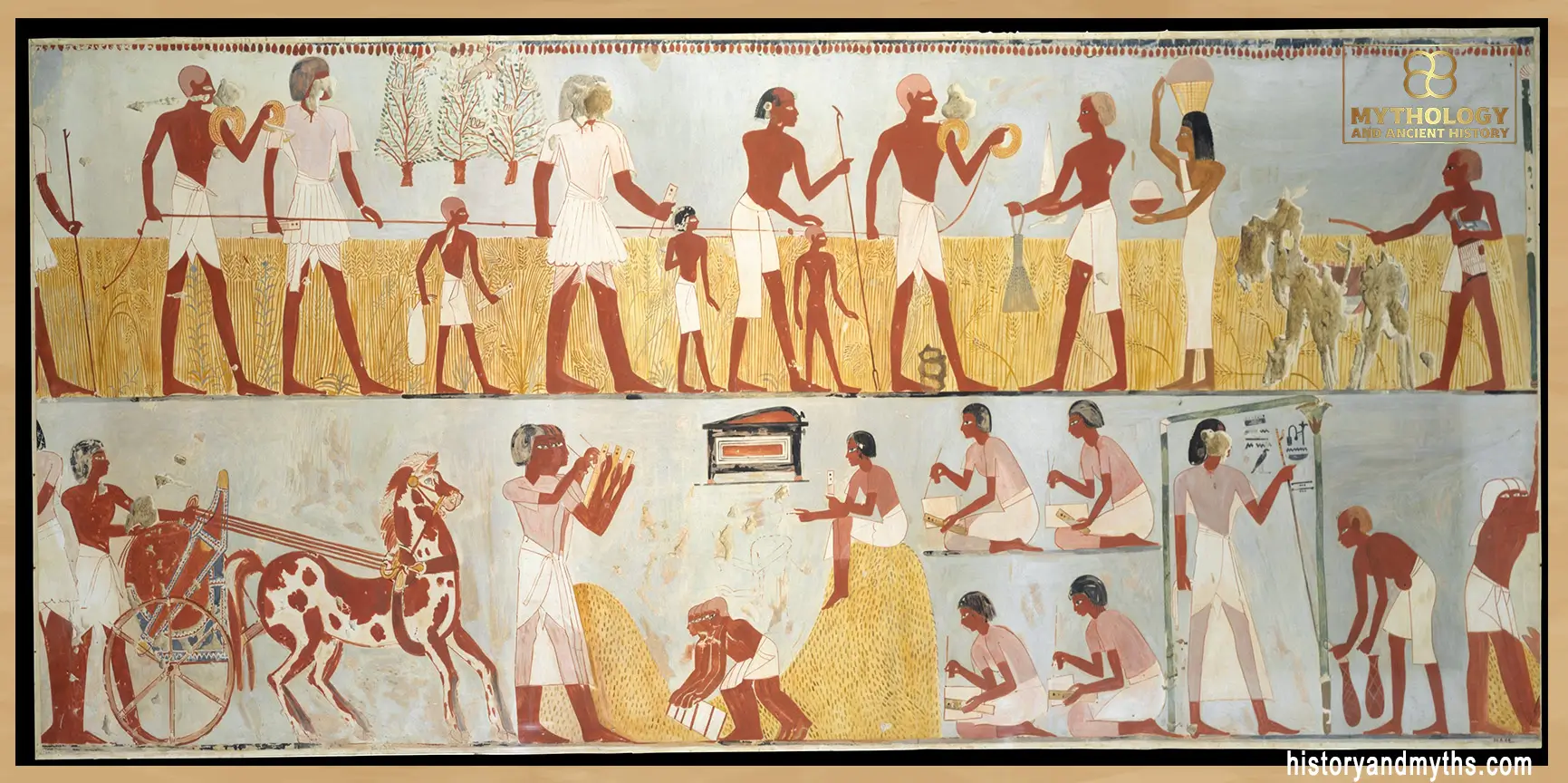
In ancient Egypt, the pharaoh was described as the lord of the land, a formula that expressed sovereignty rather than day-to-day possession. This concept framed the king as the guarantor of order, fertility, and legal authority over the territory of Egypt, but it did not eliminate private or institutional property rights. Understanding this distinction is essential to avoid confusing political ideology with legal reality.
Royal ownership functioned at a symbolic and administrative level. As ruler, the pharaoh had the authority to allocate land, confirm holdings, levy taxes, and redistribute estates in cases of rebellion, corruption, or reform. Royal decrees and administrative texts reflect this power, especially in relation to large estates, agricultural output, and labor obligations. However, these texts do not suggest that the crown managed every plot directly or that individuals lacked recognized claims.
In practice, land was controlled through a layered system of rights. While the king stood at the top as the ultimate authority, temples, officials, villages, and private families exercised legally protected control over specific parcels. Contracts, inheritance documents, and court cases show that individuals could defend land rights against encroachment, even when the opposing party was an institution or official. This would not have been possible if all land were treated as royal property in a literal sense.
The concept of ultimate ownership therefore acted as a legal umbrella, allowing the state to regulate land without abolishing private tenure. It justified taxation, oversight, and redistribution when necessary, while leaving everyday ownership intact. Egyptian property law balanced centralized authority with local stability, ensuring that land remained productive, inheritable, and legally defensible across generations.
| Aspect | Property Law and Land Ownership in Ancient Egypt |
|---|---|
| Ultimate Authority | The pharaoh as symbolic sovereign, not daily landholder |
| Main Land Categories | Royal land, temple land, private land, communal village holdings |
| Private Ownership | Legally recognized, transferable, and inheritable |
| Land Transfers | Sales, gifts, grants, and endowments documented by contracts |
| Documentation | Written contracts, boundary descriptions, witnesses, scribal records |
| Inheritance | Flexible distribution among heirs, including women and minors |
| Land Disputes | Resolved through courts using documents and testimony |
| Women’s Land Rights | Women could own, inherit, sell, and defend land independently |
| Legal Purpose | Stability of land use and protection of economic continuity |
Types of Land Ownership
Land ownership in ancient Egypt was diverse and legally differentiated, reflecting the needs of the state, religious institutions, and private individuals. Rather than a single model of possession, Egyptian property law recognized multiple categories of land, each governed by distinct rights and obligations.
Royal land formed the administrative backbone of the state. These estates supported the palace, funded public works, and sustained officials through land grants tied to office rather than permanent ownership. Control over royal land could be reassigned, revoked, or redistributed, especially during political transitions or reforms. Yet even here, management was delegated, and cultivation relied on local labor and customary arrangements.
Temple land constituted one of the largest and most stable categories of property. Temples owned vast agricultural estates, workshops, and storage facilities, all legally protected and economically productive. These lands were dedicated to sustaining cult rituals, priestly staff, and festivals. While temples operated under royal oversight, their property enjoyed a high degree of continuity, and encroachment upon temple land was treated as a serious legal offense.
Private land was owned by individuals and families and could be bought, sold, inherited, or pledged. Contracts and court records demonstrate that private owners exercised real control over their property, including the right to defend it legally. Private landholding formed the basis of family wealth and social status, particularly among farmers, artisans, and local officials.
Village and communal holdings also existed, especially in agricultural communities where land use was organized collectively. While individual families cultivated specific plots, rights were often embedded within village structures and local agreements. These arrangements balanced flexibility with stability, ensuring access to land while reducing conflict.
Together, these categories reveal a legal system that recognized ownership as functional and enforceable, not merely symbolic. Egyptian property law allowed different forms of landholding to coexist, each integrated into a broader framework of state supervision and legal protection.
Buying, Selling, and Transferring Land
Land in ancient Egypt was not static property; it could be legally transferred through sale, donation, or grant, provided the transaction followed recognized procedures. These processes reveal a legal culture that valued clarity, documentation, and public acknowledgment.
Sales of land were formalized through written contracts, typically recorded by scribes and witnessed by multiple parties. These documents identified the seller and buyer, described the land precisely—often by boundaries and neighboring plots—and specified the agreed compensation. Payment might be made in silver, grain, or other goods, reflecting the mixed economy of the time. Once concluded, the transfer was treated as binding and enforceable.
Witnesses and documentation were central to legitimacy. The presence of witnesses protected both parties and reduced future disputes. Scribes played a critical role, ensuring standardized language and preserving records that could later be produced in court. This reliance on documentation compensated for the absence of a centralized land registry, creating a functional system of proof through texts and testimony.
Land could also be transferred without sale, such as through gifts, endowments, or grants tied to service. Officials sometimes received land as part of their remuneration, while private individuals could dedicate land to temples or family members. These transfers followed similar formalities, emphasizing transparency and consent.
Importantly, transactions did not exist outside state oversight. While private parties controlled their property, the legal framework allowed authorities to recognize, confirm, or challenge transfers when disputes arose. This balance ensured that land remained alienable and economically active while remaining subject to broader legal order.
Inheritance and Family Property
Inheritance was one of the primary mechanisms through which land changed hands in ancient Egypt, and property law provided clear, practical ways to manage family succession. Land was treated as a transferable asset that could pass through generations without losing legal protection or economic value.
Property could be inherited by sons, daughters, spouses, or other designated relatives, depending on family arrangements and documented intent. Wills and declarations allowed individuals to distribute land according to personal choice rather than rigid custom. This flexibility reduced uncertainty and helped prevent disputes after death.
Family land was often divided among heirs, but division did not always mean fragmentation. In some cases, land remained jointly held, with specific usage rights assigned to each family member. This approach preserved agricultural productivity while recognizing individual claims. Where disputes arose—over boundaries, shares, or legitimacy—courts acted as arbiters, relying on documents and testimony rather than lineage alone.
Widows and children received particular legal attention. Surviving spouses could retain control over land, either permanently or until remarriage, and guardians were appointed to manage property on behalf of minors. These arrangements ensured continuity of ownership and protected vulnerable family members from dispossession.
Inheritance law thus reinforced stability. By recognizing family property as legally defensible and transferable, Egyptian law allowed land to function as a long-term economic foundation, binding households together across generations while remaining adaptable to changing circumstances.
Land Disputes and Legal Protection
Despite clear norms of ownership and transfer, land disputes were inevitable in a society where agriculture sustained the economy and boundaries were marked by natural features rather than fixed cadastral maps. Egyptian property law addressed these conflicts through formal legal mechanisms, reinforcing the idea that land rights were enforceable, not merely customary.
Disputes commonly arose from boundary encroachments, inheritance disagreements, unpaid obligations, or competing claims following transfers of land. When negotiation failed, aggrieved parties could submit a formal complaint to a local court or administrative authority. These petitions laid out the claim, identified the land in question, and cited witnesses or documents to support ownership.
Courts relied heavily on documentary evidence and testimony. Contracts, wills, and prior judgments were examined alongside witness statements from neighbors and community members familiar with the land. The credibility of scribal records was central; written proof often carried decisive weight, especially when corroborated by multiple witnesses.
Legal protection extended even against powerful opponents. Surviving cases show individuals challenging officials, temple administrators, or neighboring estates when boundaries were violated. While outcomes were not always equal, the very existence of such cases demonstrates that property rights could be defended within the legal system. Unlawful seizure or misuse of land by officials was treated as a serious offense, as it threatened both economic stability and public trust.
Remedies emphasized restoration rather than punishment. Courts ordered the return of land, reaffirmed boundaries, or confirmed rightful ownership. By prioritizing correction over retaliation, Egyptian property law reduced prolonged conflict and maintained agricultural productivity.
Through these procedures, land law functioned as a stabilizing force. It protected households, regulated competition, and ensured that disputes over Egypt’s most vital resource were resolved through law rather than force.
Property Law in Ancient Egypt
- Not all land was royal: The pharaoh held ultimate authority, but private and institutional ownership was legally recognized.
- Multiple land categories: Royal, temple, private, and communal lands coexisted under state supervision.
- Legal transfers: Land could be sold, gifted, inherited, or granted through documented contracts.
- Strong documentation culture: Contracts, witnesses, and scribes replaced a formal land registry.
- Court protection: Owners could defend land rights through legal petitions and court rulings.
- Women as landholders: Women could independently own, inherit, and manage land.
© historyandmyths.com — Educational use
Women and Land Ownership
Women in ancient Egypt could own, inherit, buy, and defend land in their own names, a capacity clearly reflected in property documents and court cases. This legal standing did not depend on marriage or male guardianship; women retained independent control over property before, during, and after marriage.
Land owned by women could be transferred through sale, donation, or inheritance using the same legal procedures applied to men. Contracts identify female owners as principal parties, naming boundaries, witnesses, and compensation without qualification. When disputes arose, women appeared as plaintiffs and defendants, presenting documents and testimony to assert their claims.
Inheritance practices further reinforced these rights. Daughters could receive land alongside sons, and widows could retain control of property or manage estates on behalf of children. In cases involving minors, guardians administered land temporarily, but ownership remained legally attached to the child—male or female—until adulthood.
This recognition of women’s property rights strengthened household stability and reduced conflict. By allowing women to hold and defend land, Egyptian property law broadened the base of legal ownership and ensured continuity of land use across family transitions. Importantly, these rights were not exceptional privileges but part of the ordinary functioning of property law.
Key Takeaways: Property Law in Ancient Egypt
- Land ownership in ancient Egypt combined royal authority with legally protected private rights.
- Different categories of land—royal, temple, private, and communal—coexisted under law.
- Land could be transferred through sale, inheritance, or grants using written contracts.
- Courts played a central role in resolving land disputes and protecting ownership.
- Women could independently own, inherit, and defend land rights.
- Property law ensured economic stability and continuity across generations.
Frequently Asked Questions about Property Law in Ancient Egypt
Did all land in ancient Egypt belong to the pharaoh?
No. While the pharaoh held ultimate authority, private individuals, temples, and villages held legally recognized land rights.
Could private individuals own land?
Yes. Private land ownership was common and legally protected, allowing owners to buy, sell, inherit, and defend land.
How was land bought and sold?
Land transfers were formalized through written contracts, witnessed agreements, and scribal records.
Were land disputes common?
Yes. Disputes over boundaries, inheritance, and ownership occurred and were resolved through local courts.
Did women have the right to own land?
Women could independently own, inherit, manage, and defend land in court.
Was there a land registry system?
No centralized registry existed; proof of ownership relied on contracts, witnesses, and legal testimony.
How did the state control land without confiscation?
The state regulated land through taxation, oversight, and legal authority while allowing private ownership to function.
Sources & Rights
- Breasted, James Henry. Ancient Records of Egypt, Vols. I–V. Chicago: University of Chicago Press, 1906–1907.
- Breasted, James Henry. A History of Egypt from the Earliest Times to the Persian Conquest. New York: Charles Scribner’s Sons, 1905.
- Gardiner, Alan H. Egypt of the Pharaohs: An Introduction. Oxford: Oxford University Press, 1961.
- Kemp, Barry J. Ancient Egypt: Anatomy of a Civilization. London: Routledge, 1989.
- Johnson, Janet H. The Legal System of Ancient Egypt. Chicago: Oriental Institute of the University of Chicago, 1992.
- McDowell, Andrea G. Village Life in Ancient Egypt: Laundry Lists and Love Songs. Oxford: Oxford University Press, 1999.
- Menu, Bernadette. Recherches sur l’histoire juridique, économique et sociale de l’Égypte ancienne. Cairo: Institut Français d’Archéologie Orientale, 2001.
- Menu, Bernadette. “Land Tenure and Property Rights in Ancient Egypt.” In State and Society in Ancient Egypt. Leuven: Peeters, 2004.
- Trigger, Bruce G., Barry J. Kemp, David O’Connor, and Alan B. Lloyd. Ancient Egypt: A Social History. Cambridge: Cambridge University Press, 1983.
- Allam, Schafik. Beiträge zum ägyptischen Recht. Wiesbaden: Harrassowitz, 1976.
- Allam, Schafik. Juristische und soziale Stellung der Frau im pharaonischen Ägypten. Berlin: Akademie-Verlag, 1963.
- Goedicke, Hans. Studies in the Hekanakhte Papers. Baltimore: Johns Hopkins University Press, 1959.
- Haring, Ben J. J. Divine Households: Administrative and Economic Aspects of the New Kingdom Royal Memorial Temples. Leiden: Brill, 1997.
- Van Blerk, Nicolaas Johannes. The Concept of Law and Justice in Ancient Egypt. PhD diss., University of South Africa, 2018.
- Quirke, Stephen. The Administration of Egypt in the Late Middle Kingdom. London: British Museum Press, 1990.
- Redford, Donald B., ed. The Oxford Encyclopedia of Ancient Egypt. Oxford: Oxford University Press, 2001.
- Shaw, Ian, ed. The Oxford History of Ancient Egypt. Oxford: Oxford University Press, 2000.
- VerSteeg, Russ. “Property Law in Ancient Egypt.” In Law and Legal Theory in Ancient Civilizations. New York: Routledge, 2002.
- Lorton, David. The Juridical Terminology of International Relations in Egyptian Texts through Dyn. XVIII. Baltimore: Johns Hopkins University Press, 1974.
- Assmann, Jan. The Mind of Egypt: History and Meaning in the Time of the Pharaohs. Cambridge, MA: Harvard University Press, 2002.
- Wilson, John A. The Culture of Ancient Egypt. Chicago: University of Chicago Press, 1951.
Written by H. Moses — All rights reserved © Mythology and History