Childhood in Ancient Egypt: How Children Lived, Learned, and Worked
Children in Ancient Egypt grew up in family-based households, learned practical skills at home, and in some cases received formal scribal education. Their daily life included chores, training, games, and early preparation for adult roles in farming, crafts, or administration. This article explains childhood routines, education, work, and social expectations.
Ancient Egyptian children grew up inside the rhythm of real life. They learned by watching their parents, imitating older siblings, and participating in household tasks long before formal education was even an option. Play, work, learning, and responsibility blended naturally, forming a practical system that trained children for the roles they would one day assume as farmers, craftsmen, scribes, priests, or household managers.
This article explores what childhood was truly like after birth and early infancy—how children lived, played, learned, and slowly transitioned into adult responsibilities. Rather than repeating common discussions about pregnancy or divine birth myths, we focus on the everyday experience of growing up in ancient Egypt: the games children played, the skills they learned, and the moment when society stopped seeing them as children and began treating them as adults.
What Did Children Do in Ancient Egypt Each Day?
In ancient Egypt, childhood was not defined by a specific birthday, but by survival, mobility, and usefulness within the household. Once a child passed the dangerous years of infancy—roughly after weaning, around the age of three—the community began to see them not merely as dependents, but as growing individuals with emerging roles.
This stage marked the true beginning of childhood in Egyptian society. Children started to move freely, interact socially, and observe the world around them with increasing awareness. From this point onward, learning happened constantly, not through formal instruction, but through participation and imitation. A child learned by watching a mother bake bread, a father tend fields, or an older sibling craft tools. Knowledge was absorbed through daily exposure rather than structured lessons.
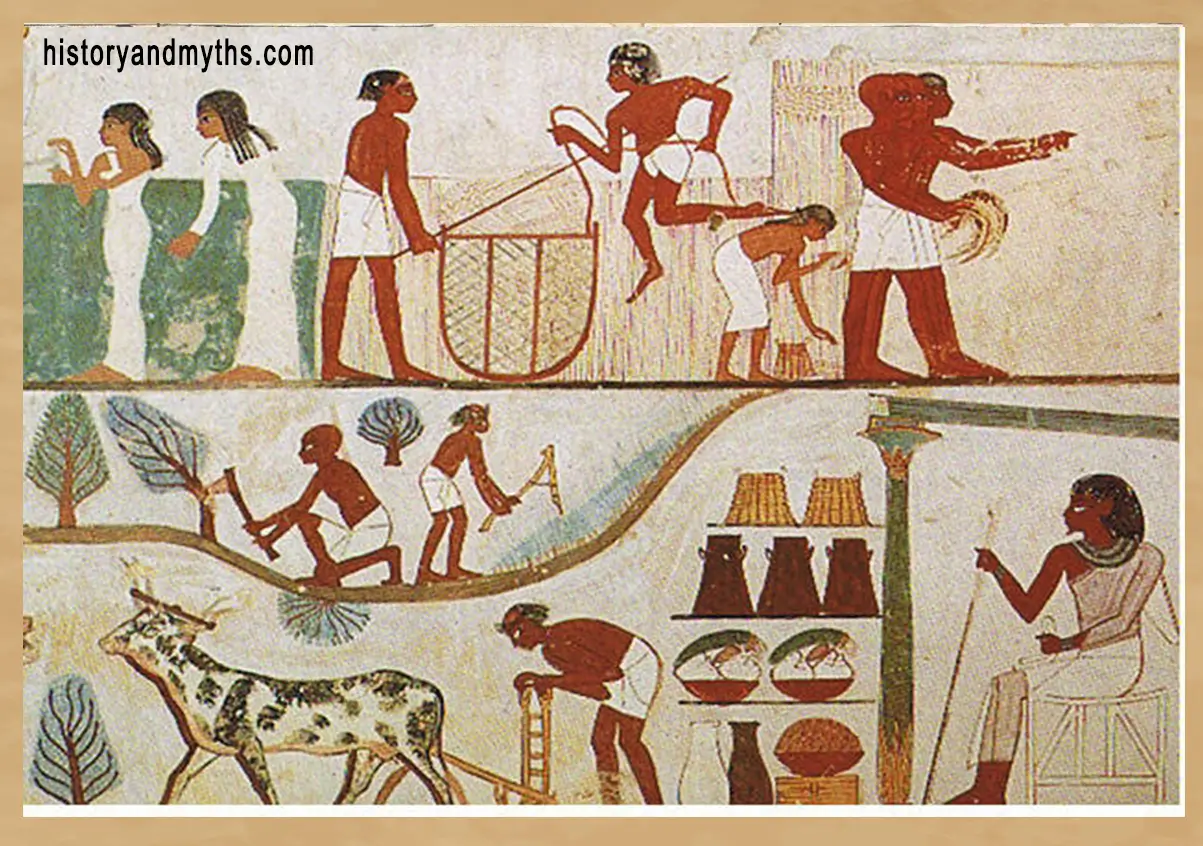
Unlike modern societies, ancient Egypt did not isolate children from adult life. There was no sharp division between a child’s world and the world of grown-ups. Instead, children were gradually introduced to responsibility in ways appropriate to their age and strength. Simple tasks—carrying water, herding small animals, assisting in workshops—were part of everyday life and formed the foundation of social education.
Social class played a decisive role at this stage. A peasant child’s early childhood revolved around agricultural life, seasonal labor, and physical endurance. In contrast, children born into elite or administrative families were more likely to remain within the household for longer periods, preparing for literacy or bureaucratic training. Childhood, therefore, was not a universal experience, but a socially shaped one.
This gradual integration into adult life ensured continuity. By the time children reached their early teens, they were already familiar with their expected roles. Childhood in ancient Egypt was less about protection and more about preparation—a steady transition from dependence to contribution, shaped by family structure, class, and daily reality.
| Aspect | Childhood in Ancient Egypt |
|---|---|
| Beginning of Childhood | After weaning, usually around the age of three, once survival was secured |
| Main Learning Environment | The household and daily life, not formal schools |
| Role of Play | Preparation for adult roles through imitation and physical training |
| Education Access | Formal education limited mainly to elite boys destined for scribal or priestly careers |
| Gender Expectations | Boys prepared for labor or administration; girls trained in domestic and family roles |
| End of Childhood | Marked by responsibility, adolescence, and rites of passage such as circumcision |
| Purpose of Childhood | Practical preparation for adult life and social continuity |
Games and Play in Ancient Egypt
Play in ancient Egypt was never meaningless. While children certainly laughed, ran, and enjoyed themselves, their games often mirrored adult activities and prepared them for future responsibilities. Play functioned as an informal training system—one that taught skills, discipline, coordination, and social roles long before adulthood.
Archaeological evidence shows that Egyptian children played with simple handmade toys: balls made of leather or plant fibers, dolls crafted from wood or cloth, animal figurines, and small boats. These objects were not random. Dolls prepared girls for future roles in household management and childcare, while miniature tools, animals, and boats familiarized boys with agriculture, hunting, fishing, and transportation. Through imitation, children rehearsed the adult world they were expected to enter.
Physical games also played an essential role. Running, jumping, wrestling, and balance-based activities strengthened the body and built endurance—an important skill in a society dependent on manual labor. Boys, especially in rural areas, were encouraged to develop strength and agility from a young age, preparing them for farming, construction, or military service. Girls, meanwhile, often participated in rhythmic games and dances that improved coordination and social bonding, skills valued in domestic and ceremonial life.
Social rules were learned through play as well. Games taught cooperation, hierarchy, and respect for authority. Older children often led younger ones, reinforcing age-based structure and responsibility. Conflict resolution, obedience, and teamwork emerged naturally during play, embedding social norms without formal discipline.
Importantly, play was not limited to the elite. Children across all social classes played, though the nature of their games reflected their environment. Urban children had access to crafted toys and domestic games, while rural children played outdoors using tools and materials from the fields. In both contexts, play acted as a bridge between childhood and adulthood, transforming leisure into preparation.
Rather than shielding children from adult life, ancient Egyptian society used play as a subtle form of education. By the time a child outgrew games, they had already internalized the physical skills, social expectations, and behaviors required of an adult. Play was not an escape from reality—it was an introduction to it.
Learning at Home: Family Duties and Practical Skills
Before any child entered a formal school—or learned how to write—education in ancient Egypt began inside the home. The family was the primary institution of learning, and most children never went beyond this stage. Knowledge was transmitted orally and practically, passed down from parents to children through daily repetition and observation.
Children learned by doing. Boys followed their fathers into fields, workshops, or administrative spaces, gradually absorbing the skills required for farming, craftsmanship, or trade. Girls learned domestic management by assisting their mothers—preparing food, spinning linen, caring for younger siblings, and maintaining the household. These activities were not seen as chores, but as essential training for adult responsibility.
This form of education was deeply practical. A child was taught what they needed to survive and function within their social environment. There was little abstract instruction and no separation between learning and work. Skills were mastered through imitation and correction, creating a strong continuity between generations. In this system, experience mattered more than explanation.
Moral and social values were also taught at home. Respect for elders, obedience to authority, honesty, and self-control were reinforced through daily behavior rather than formal lessons. Wisdom literature later recorded these ideals, but long before they were written, they were lived and practiced inside Egyptian households.
Social class strongly influenced this stage of education. For most rural and working-class children, home-based learning was the entirety of their education. Elite families, however, treated this phase as preparation for something more. Children born into administrative or priestly households were trained early in discipline, speech, and behavior suitable for future scribal or religious roles.
This early domestic education ensured that every child—regardless of background—entered adolescence already shaped by the expectations of society. By the time formal schooling became an option, the foundation had already been laid. Home was not just a place of upbringing; it was the first school of ancient Egypt.
Schooling and Scribal Training (Who Actually Went to School?)
Formal education in ancient Egypt was not universal, nor was it expected for every child. Schooling was reserved for a specific segment of society—those destined for administrative, religious, or scribal careers. Literacy was power, and access to it was carefully limited.
Most children never entered a school. Their education ended at the household level, where they learned practical skills needed for survival and social continuity. Schools existed primarily to serve the state, training boys who would become scribes, officials, priests, or record keepers. Education was therefore functional, not ideological—it produced workers for the bureaucracy rather than thinkers in the modern sense.
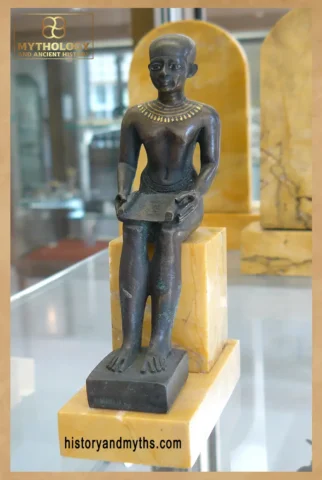
Scribal education began at a young age, often around the age of seven. Children attended institutions attached to temples or administrative centers, where they learned reading, writing, mathematics, and accounting. Instruction focused on mastering hieroglyphic and hieratic scripts, copying texts repeatedly until precision and discipline were achieved. Learning was based on memorization, imitation, and correction, not creativity.
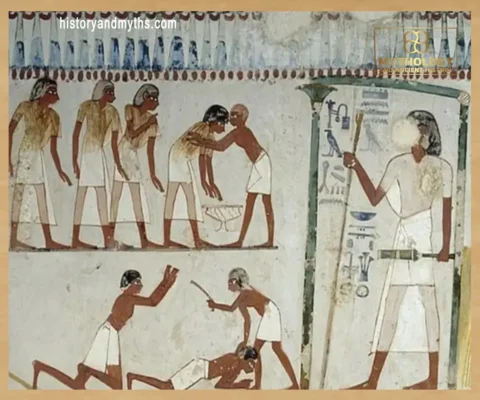
Discipline was strict. Ancient texts openly describe corporal punishment as part of the educational process, reflecting the belief that obedience and endurance were essential traits for future officials. Wisdom literature repeatedly emphasized that success in life depended on submitting to instruction and respecting authority. Education shaped character as much as skill.
Social class determined access. Sons of scribes, priests, and officials were far more likely to receive formal education, often following their fathers’ professions. While there is limited evidence that some girls from elite families were literate, formal schooling overwhelmingly favored boys. Education reinforced social hierarchy rather than challenging it.
For those who completed scribal training, the rewards were significant. Literacy opened the door to stable employment, social mobility, and exemption from physical labor. The scribe occupied a privileged position, portrayed in texts as clean, respected, and intellectually superior to manual workers. Education, therefore, functioned as a gateway—not for all children, but for a carefully selected few.
In ancient Egypt, school was not about childhood enrichment. It was a mechanism of state control and continuity, producing disciplined individuals capable of maintaining the administrative and religious machinery of civilization.
Childhood, Gender Roles, and Social Class
Childhood in ancient Egypt was shaped not only by age, but by gender and social expectation. From an early stage, boys and girls were prepared for distinct paths, reflecting the roles they were expected to assume as adults. These differences were not imposed suddenly, but developed gradually through daily experience, behavior, and responsibility.
Boys were generally raised with an emphasis on physical endurance, outdoor activity, and preparation for labor or administrative life. In rural settings, they assisted in farming, animal herding, and seasonal work alongside male relatives. In urban or elite households, boys were trained in discipline, obedience, and literacy-related skills if a scribal future was anticipated. Strength, resilience, and authority were encouraged, as boys were expected to become providers, workers, or officials.
Girls, by contrast, were primarily prepared for domestic and familial roles. From a young age, they learned household management by observing and assisting their mothers. Tasks such as food preparation, linen production, childcare, and home organization formed the core of female education. These activities were not viewed as secondary or inferior; managing a household was essential to social stability, and women held recognized authority within the domestic sphere.
Despite these differences, childhood was not a period of strict confinement for either gender. Artistic scenes and textual evidence show girls participating in games, music, and communal life alongside boys, especially during early childhood. Gender roles became more clearly defined as children approached adolescence, when society began to impose clearer expectations regarding behavior, modesty, and responsibility.
Social class intensified these distinctions. Elite girls often remained within the household for longer periods, protected and prepared for marriage within their social class. Lower-status girls, however, frequently contributed to economic activity at a younger age, assisting in labor-intensive domestic or agricultural tasks. Childhood experiences were therefore shaped as much by class as by gender.
By the onset of adolescence, childhood effectively ended. Society no longer viewed the individual as a child, but as a young adult expected to fulfill social obligations. Gender determined the form of responsibility, but the transition itself was universal. Childhood in ancient Egypt was not prolonged—it was a preparation phase, deliberately structured to ensure social continuity and stability.
- ~Age 3+: Childhood “truly” begins after weaning—mobility and awareness increase.
- Home = First School: Most children learn through observation, imitation, and daily tasks.
- Play with a Purpose: Games mirror adult life—strength, coordination, and social rules.
- Class Shapes Everything: Elite children may prepare for literacy; rural children prepare for labor.
- Gender Roles Form Gradually: Boys trained for work/administration; girls for household leadership.
- School is Not for Everyone: Formal scribal training is limited and tied to state and temple needs.
- Childhood Ends with Responsibility: Adolescence + rites of passage mark entry into adult status.
When Did Childhood End in Ancient Egypt?
In ancient Egypt, childhood did not fade gradually—it ended when society decided it had served its purpose. There was no fixed age that marked the transition to adulthood. Instead, the end of childhood was defined by responsibility, physical capability, and social readiness.
For most children, adolescence marked the turning point. By their early teens, boys were expected to contribute fully to labor, whether in agriculture, workshops, or administration. Those trained as scribes were already immersed in disciplined routines, copying texts and performing clerical tasks. Girls, meanwhile, were prepared for marriage and household leadership, often entering married life at a young age. Childhood, therefore, was not prolonged; it was functional and deliberately limited.
Rites of passage reinforced this transition. Circumcision, for boys, symbolized entry into adulthood and eligibility for marriage, military service, or temple access. This act was not merely physical—it marked a social rebirth. From that moment onward, the individual was no longer treated as a child, but as a responsible member of society.
Unlike modern concepts of adolescence as a protected stage, ancient Egyptian society viewed extended dependency as impractical. Survival, stability, and continuity required individuals to assume adult roles early. Childhood existed to prepare—not to delay—adulthood.
By the time a child reached maturity, their future was already shaped. Skills had been learned, roles internalized, and expectations clearly defined. In this way, childhood in ancient Egypt functioned as a structured passage, guiding individuals efficiently from vulnerability to responsibility within one of the world’s longest-lasting civilizations.
- Childhood in ancient Egypt began after survival was secured, not at birth.
- The household—not school—was the primary place of learning for most children.
- Play functioned as practical training, preparing children for adult roles.
- Formal education was limited and designed to serve the state and temples.
- Gender and social class shaped childhood experiences from an early age.
- Childhood ended when responsibility began, often during early adolescence.
When did childhood begin in ancient Egypt?
Childhood effectively began after weaning, usually around the age of three, once a child survived infancy and became mobile.
Did all children go to school in ancient Egypt?
No. Formal education was limited mainly to boys from elite families who were trained for scribal, priestly, or administrative roles.
How did children learn if they did not attend school?
Most children learned at home by observing parents, assisting in daily tasks, and imitating adult behavior.
What role did play have in ancient Egyptian childhood?
Play served as practical training, helping children develop physical strength, coordination, and social skills needed for adulthood.
Were boys and girls raised differently?
Yes. Boys were generally prepared for labor or administration, while girls were trained in household management and family roles.
At what age did childhood end in ancient Egypt?
Childhood usually ended in early adolescence, when individuals were expected to assume adult responsibilities.
Did social class affect childhood?
Strongly. Elite children had access to education and protection, while lower-class children entered work roles much earlier.
Sources & Rights
- Breasted, James Henry. Development of Religion and Thought in Ancient Egypt. New York: Charles Scribner’s Sons, 1912.
- Davies, Norman de Garis, and Nina M. Davies. The Tomb of Menna at Thebes. New York: Metropolitan Museum of Art, 1936.
- Erman, Adolf. Life in Ancient Egypt. London: Macmillan and Co., 1894.
- Hawass, Zahi. The Golden Age of the Pharaohs. Cairo: American University in Cairo Press, 2005.
- Lesko, Leonard H. Pharaoh’s Workers: The Villagers of Deir el-Medina. Ithaca: Cornell University Press, 1994.
- Meskell, Lynn. Private Life in New Kingdom Egypt. Princeton: Princeton University Press, 2002.
- Robins, Gay. Women in Ancient Egypt. Cambridge, MA: Harvard University Press, 1993.
- Tyldesley, Joyce. Daily Life in Ancient Egypt: Recreating Lahun. London: Thames & Hudson, 2003.
Written by H. Moses — All rights reserved © Mythology and History