Svipdagsmál: The Quest for Menglöð in Norse Mythology
Svipdagsmál tells the story of Svipdagr, a young man sent by his stepmother on a seemingly impossible quest to find Menglöð. Before setting out, he summons his dead mother, Gróa, who recites nine protective spells to help him survive the journey. When he finally reaches Menglöð’s guarded hall, he must deal with the watchman Fjölsviðr, whose answers reveal the secrets of the place and who is allowed to enter.
The story survives in two Old Norse poems, Grógaldr and Fjölsvinnsmál, commonly published together as Svipdagsmál. Although they form a connected narrative, whether they were originally composed as one work remains uncertain. The poems also leave much of Svipdagr’s journey untold, making the surviving dialogue and its details especially important to understanding the story.
What Is Svipdagsmál?
Svipdagsmál, meaning “The Lay of Svipdagr,” is the collective title for two Old Norse poems: Grógaldr (“Gróa’s Spell”), consisting of 16 stanzas, and Fjölsvinnsmál (“The Sayings of Fjölsviðr”), with 50. Both are composed in ljóðaháttr, a verse form used in Eddic poetry, but their structures differ. Grógaldr takes the form of a mother’s protective spells for her son, while Fjölsvinnsmál develops through a dialogue that gradually reveals the inhabitants and defenses of Menglöð’s residence.
Although often included in modern editions of the Poetic Edda, neither poem appears in the Codex Regius, the medieval manuscript preserving many of the collection’s best-known works. The surviving texts come from later paper manuscripts, with the earliest dating to the seventeenth century. The name Svipdagsmál is a modern scholarly convention for reading the two poems together, rather than an original title preserved in a medieval manuscript.
Why Did Svipdagr Seek Menglöð?
Svipdagr’s quest begins with an impossible demand from the woman he calls deceitful, Svipdagr’s quest begins with an impossible demand from a deceitful woman who had embraced his father, generally understood to be his stepmother. She orders Svipdagr to seek Menglöð, whom he believes impossible to reach. Grógaldr gives no reason for the command, leaving the stepmother’s motives unexplained.
He turns to his dead mother, Gróa, visiting her burial mound and calling her back from the grave. She had instructed him to seek her there if he needed help. When Gróa asks what misfortune has brought him, Svipdagr explains his predicament. She acknowledges the long journey ahead but leaves open the possibility that he may reach his goal.
Afraid of dying on the road and believing himself too young for such a task, Svipdagr asks Gróa to chant protective spells. Her response provides the nine charms that occupy the remainder of the poem.
What Were Gróa’s Nine Protective Spells?
In Grógaldr (stanzas 6–14), Gróa chants nine spells to protect Svipdagr against dangers he may encounter. The poem describes their intended effects without preserving the actual magical formulas.
- Fear and self-reliance: The first spell helps Svipdagr face frightening situations and remain in control of his actions. Gróa attributes it to Rindr, who once chanted it to Rani, a figure whose identity remains uncertain.
- Protection on the road: The second calls upon the protective power of Urðr, one of the Norns, to guard Svipdagr as he travels unwillingly along unfamiliar paths.
- Dangerous rivers: The third protects him from deadly currents. Gróa names the rivers Horn and Ruðr, commanding them to turn toward Hel and diminish before him.
- Hostile enemies: The fourth protects him from armed opponents, turning their hostility toward reconciliation rather than violence.
- Escape from captivity: The fifth releases chains and shackles from his limbs. Its reference to Leifnir’s flames is obscure, and some editors interpret the passage as describing a loosening incantation.
- Perilous waters: The sixth promises safe passage across dangerous seas, calming the turbulent waters that might otherwise overwhelm him.
- Extreme cold: The seventh prevents deadly mountain frost from damaging his body.
- Supernatural threats: The eighth protects him against harm from a dead Christian woman during a nighttime journey along a misty road. The reference to Christianity is unusual, but its presence alone cannot establish when the entire poem was composed.
- Wisdom in speech: The ninth equips Svipdagr with eloquence and judgment when exchanging words with a formidable giant. In Edward Pettit’s edition, this wisdom comes from Mímir’s heart, although other textual readings refer to the mind or mouth and heart.
Read Also:
Vafþrúðnismál: Odin’s Wisdom Contest in Norse Mythology
The ninth spell has a possible connection to Fjölsvinnsmál, where Svipdagr engages the guardian Fjölsviðr in an extended dialogue. The poems do not explicitly confirm that he uses the charm during their exchange.
Gróa concludes by telling her son to carry her words in his heart, promising him lasting good fortune as long as he remembers them.
What Happened at Menglöð’s Guarded Hall?
Fjölsvinnsmál opens with Svipdagr arriving at a fortified residence belonging to the giant-folk, surrounded by dangerous flames. At the entrance, a watchman challenges him, demanding to know what he seeks and ordering him to leave.
The stranger responds sharply to this unwelcome reception. The watchman identifies himself as Fjölsviðr and declares that the stranger will never pass through the gates. Yet the golden halls catch Svipdagr’s attention. Rather than retreat, he remarks that he would gladly make his home there.
Asked about his family, Svipdagr conceals his identity behind a series of names associated with cold. He calls himself Vindkaldr (“Wind-Cold”), son of Várkaldr (“Spring-Cold”) and grandson of Fjölkaldr (“Much-Cold”). The poem does not explain why he chooses these names.
Svipdagr then takes control of the conversation by questioning Fjölsviðr. He learns that Menglöð rules the estate and its treasures, and that her father was a son of Svafrþorinn. Having established who governs the residence, he begins asking about its formidable defenses.
What Did Svipdagr Learn from Fjölsviðr?
Svipdagr’s questions uncover the defenses surrounding Menglöð’s residence. The gate, Þrymgjöll, was built by the three sons of Sólblindi and traps anyone who attempts to open it. Beyond the gate lies Gastropnir, a fortified enclosure that Fjölsviðr claims to have constructed from the limbs of Leirbrimir. The name Leirbrimir suggests a connection with clay, although the nature of this strange construction remains uncertain.
Two fierce dogs, Gífr and Geri, guard the entrance. One sleeps during the day and the other at night, ensuring that the passage is never left unguarded. Fjölsviðr explains that they can be distracted only with pieces of meat from Viðófnir, a golden, gleaming rooster perched in the branches of Mímameiðr.
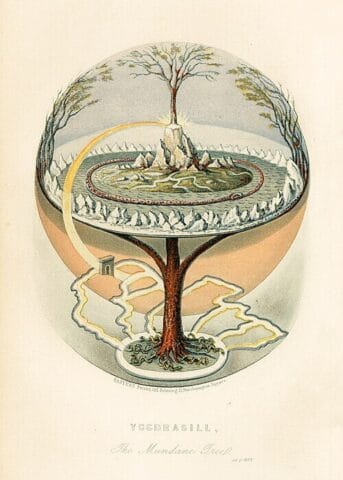
This mysterious tree spreads its branches across all lands, while the origin of its roots is unknown. Neither fire nor iron can destroy it. Its fruit also possesses an unusual property: when placed over a fire, it is said to help women suffering from an obscure condition, possibly involving the womb. The precise meaning of this passage is disputed. Mímameiðr shares characteristics with the world-tree Yggdrasil, but the poem never explicitly identifies them as the same tree.
Obtaining meat from Viðófnir creates another difficulty. The rooster can be killed only with Lævateinn, a magical weapon or twig associated with Loptr, another name for Loki. The poem says Loptr caused it to be plucked beneath the gates of the dead. It is kept beside the giantess Sinmara in an iron chest secured by nine locks.
Read Also:
Eir: Norse Goddess of Healing or a Valkyrie?
Sinmara will surrender the weapon only in exchange for a shining sickle said to lie among Viðófnir’s joints. This creates an apparently circular condition: obtaining the means to kill the rooster requires something associated with the very creature the weapon is meant to destroy.
Fjölsviðr also describes a hall surrounded by flickering flames. The hall’s name varies between manuscripts, with readings of Lýr and Hyr. Editors disagree over which form is preferable. He lists several figures involved in its construction, including Dellingr and Loki, adding another layer of supernatural craftsmanship to the guarded residence.
How Did Svipdagr Finally Reach Menglöð?
As Svipdagr continues questioning Fjölsviðr, he notices a woman on a rocky height within the enclosure. Fjölsviðr calls the place Lyfjaberg, Fjölsviðr calls the place Lyfjaberg, a healing mountain said to restore the health of women who climb it. The precise illness mentioned in the poem is disputed. Nine maidens sit beside Menglöð, including Eir. The watchman explains that these women also help those who make offerings to them at sacred altars.
Svipdagr then asks who may rest in Menglöð’s arms. Fjölsviðr answers that no man except Svipdagr has that privilege, for she is destined to become his wife. The stranger immediately reveals his true name and demands that the gates be opened, though he still wants to know whether Menglöð will welcome him.
Fjölsviðr announces his arrival. The guard dogs greet Svipdagr, and the house opens. Menglöð initially threatens the watchman with a terrible punishment if he is lying, then asks the newcomer to establish his identity. Svipdagr names his father, Sólbjartr, describes his journey along cold, windswept roads, and declares that no one can resist Urðr’s decree, however harshly imposed. His reference to Urðr recalls the protective spell Gróa had given him earlier.
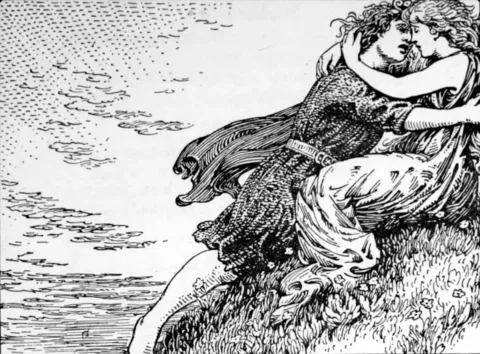
Menglöð welcomes him, speaks of a kiss accompanying their reunion, and reveals that she has waited for him day after day. Their longing ends with the promise of a life together.
The poem describes no battle, no recovery of Lævateinn, and no killing of Viðófnir. Svipdagr enters because he is the man Menglöð has been awaiting, not because he has defeated her supernatural guards.
Were Grógaldr and Fjölsvinnsmál Originally One Poem?
The surviving manuscripts do not establish whether Grógaldr and Fjölsvinnsmál were originally composed as one work. Peter Robinson examined 46 manuscript witnesses, but the earliest surviving copies date from the second half of the seventeenth century. Although the poems belong to the same manuscript tradition, there is no firm evidence that their copyists regarded them as two halves of a single composition.
The connection emerged through Scandinavian folk ballads known collectively as Ungen Svejdal, preserved in Danish, Swedish, and Norwegian versions. These tell of a young man who seeks magical assistance from his dead mother before traveling to the woman he hopes to marry. In the 1850s, Svend Grundtvig recognized the parallels with Grógaldr. Sophus Bugge subsequently connected the ballad’s conclusion with Fjölsvinnsmál and proposed the collective title Svipdagsmál in 1860.
The relationship raises a further question: did the ballads develop from the Eddic poems, or did both draw on an older story? Joseph Harris favors the latter explanation, proposing a shared Norwegian oral narrative resembling a legendary saga. His reconstruction remains hypothetical, however, and the gap between the two poems does not establish that a third poem once existed.
The date of composition is equally uncertain. Robinson argued for the early thirteenth century, while other scholars have proposed different chronologies. The seventeenth-century manuscripts establish when the surviving texts were copied, not when their stories were first composed.
Is Menglöð the Goddess Freyja?
Menglöð’s name, commonly interpreted as “Necklace-Glad,” has encouraged scholars to identify her with Freyja, the goddess who possesses Brísingamen. Joseph Harris considers the name a plausible epithet of Freyja, although Fjölsvinnsmál never mentions Brísingamen or explicitly connects the two figures.
The story offers further parallels, but none settles the question. Menglöð’s guarded, flame-surrounded residence resembles the setting of Gerðr’s courtship in Skírnismál. This suggests a shared narrative pattern rather than a common identity. In the nineteenth century, Viktor Rydberg argued that Menglöð was Freyja and Svipdagr was her absent husband Óðr. Both identifications depend on interpreting similarities between separate mythological accounts.
Another interpretation concerns Menglöð’s relationship with Gróa. Lotte Motz proposed that they represented different aspects of a mother goddess and that Svipdagr’s journey reflected a ritual of initiation. Joseph Harris questioned this identification, particularly the idea that Svipdagr undergoes a symbolic death and resurrection. The poems themselves present Gróa as his dead mother and Menglöð as the woman he seeks.
Menglöð rules her own residence and is surrounded by attendants associated with healing, but the poem never explicitly calls her a goddess. Nor is there surviving evidence of an independent cult devoted to her. Her connection with Freyja remains a scholarly interpretation, not an established identification.
What Does Svipdagsmál Reveal About Norse Storytelling?
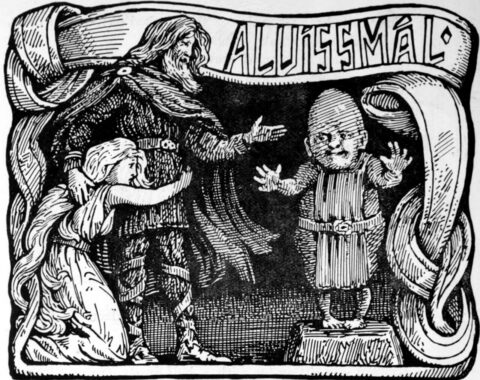
The dialogue in Fjölsvinnsmál resembles the wisdom contests of Vafþrúðnismál and Alvíssmál, but serves a different purpose. Svipdagr is not trying to defeat an opponent through superior knowledge. His questions allow the poet to introduce the supernatural landscape surrounding Menglöð, while the answers reveal the conditions governing access to her residence.
The poems also display a striking concern with numerical patterns and repetition. Gróa chants nine protective spells, nine maidens attend Menglöð, and Svipdagr’s exchange with Fjölsviðr contains eighteen questions and answers. Giorgio Basciu examined these patterns and proposed rearranging stanzas 9–40 of Fjölsvinnsmál to restore what he considered a more coherent structure. His reconstruction remains a scholarly proposal, not an established original sequence.
Fate provides another link between the poems. Grógaldr invokes the Norns, while Svipdagr later declares that no one can resist Urðr’s decree. Joseph Harris also draws attention to the hero’s unusually limited independence: his stepmother determines the quest, Gróa supplies his protection, and Menglöð’s earlier promise makes their reunion possible. This contrasts with the more active role expected of heroes in conventional bridal quests.
Rather than presenting a straightforward heroic adventure, Svipdagsmál brings together Eddic dialogue, protective magic, and courtship traditions in a story where destiny shapes the outcome.
Conclusion
Svipdagr reaches Menglöð without defeating her guards or overcoming the formidable defenses described by Fjölsviðr. His identity, rather than a victory in combat, secures their reunion. Read together, Grógaldr and Fjölsvinnsmál connect a mother’s protective magic with a quest resolved through questioning and recognition. Their narrative relationship is clear, but whether they were originally composed as a single work remains uncertain.
Sources & Primary Texts
This article draws on the Old Norse texts of Grógaldr and Fjölsvinnsmál, modern critical editions, and academic studies of their manuscript history, narrative structure, and mythological interpretations.
- Pettit, Edward (2023).
“Svipdagsmál (Gróugaldr and Fjǫlsvinnsmál).”
In The Poetic Edda: A Dual-Language Edition, pp. 831–862. Open Book Publishers. Old Norse texts, English translations, and textual commentary. - Robinson, Peter M. W. (1991).
An Edition of Svipdagsmál.
Doctoral thesis, University of Oxford. Critical edition and analysis of the surviving manuscripts, textual variants, and possible dates of composition. - Harris, Joseph (2014).
“Svipdagsmál: Gender, Genre, and Reconstruction.”
In Narration and Hero: Recounting the Deeds of Heroes in Literature and Art of the Early Medieval Period, pp. 403–445. De Gruyter. Examines the poems’ relationship with Scandinavian ballads, narrative traditions, and mythological interpretations. - Basciu, Giorgio (2015).
“Marred in Transmission? A New Proposal for the Questioning Sequence in the Old Norse Svipdagsmál.”
Rhesis: International Journal of Linguistics, Philology and Literature 6(1), pp. 5–15. An examination of stanza order, numerical patterns, and textual transmission. - Motz, Lotte (1975).
“The King and the Goddess: An Interpretation of the Svipdagsmál.”
Arkiv för nordisk filologi 90, pp. 133–150. A ritual interpretation of the poem and its principal characters. The link opens the journal volume containing the study.
Copyright Notice
© 2026 History & Myths. Original article written and edited by H. Moses. All rights reserved. Unauthorized reproduction or republication of the original article requires prior permission.
Historical texts and academic sources are acknowledged in the references above. Images, where applicable, are credited separately according to their respective licenses.