Þorgerðr Hölgabrúðr: Norse Goddess or Guardian Spirit?
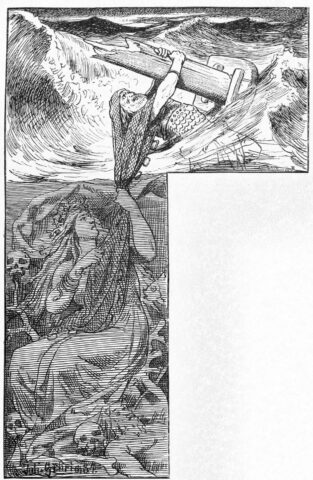
Þorgerðr Hölgabrúðr was a mysterious female figure in Norse tradition, closely associated with Hákon Jarl, who ruled Norway in the late tenth century. Medieval sagas describe Hákon offering sacrifices to her and seeking her protection, while one famous account tells how Þorgerðr and her sister Irpa intervened during the Battle of Hjörungavágr.
Yet her identity remains disputed. Was she a local Norse goddess, a guardian spirit protecting Hákon’s family, or a revered ancestral figure? The surviving accounts provide evidence of her importance in Norse religious tradition, but most were written long after Hákon’s lifetime, making the historical nature of her worship difficult to establish.
Who Was Þorgerðr Hölgabrúðr?
Unlike Freyja, Frigg, or Skaði, Þorgerðr Hölgabrúðr has no developed mythology in the surviving Eddic poems. Most accounts of her appear instead in medieval sagas and Snorri Sturluson’s Skáldskaparmál.
She is most closely associated with northern Norway and the Háleygjar, the lineage connected to the jarls of Lade in Trøndelag. Stories about her also survive in Icelandic literature, where she appears as a supernatural figure capable of protecting or threatening those who sought her favor.
In Njáls saga, her image stands alongside those of Thor and Irpa inside a temple. The account portrays her as a figure who received worship, although it does not establish the historical existence of the sanctuary described.
Unlike Thor, associated with thunder, or Njörðr, connected with the sea, Þorgerðr has no clearly defined divine domain. Her importance in the surviving sources rests primarily on regional religious traditions and her connection with a powerful ruling family.
What Does Þorgerðr Hölgabrúðr’s Name Mean?
The byname Hölgabrúðr is usually translated as “Hölgi’s bride.” Its second element, brúðr, means bride or woman, while Hölgi was a legendary ruler associated with the name of Hálogaland in northern Norway.
The relationship is less straightforward in the surviving sources. In Skáldskaparmál, Snorri Sturluson identifies Þorgerðr as Hölgi’s daughter and states that sacrifices were offered to both. He also describes Hölgi’s burial mound as containing alternating layers of earth, stone, and precious metals given as offerings. Gunnhild Røthe argues that the meaning of brúðr instead supports identifying Þorgerðr as Hölgi’s wife and a possible ancestral mother of the Háleygjar lineage. Neither relationship can be established historically.
Medieval manuscripts preserve several variations of her name, including Hörgabrúðr, Hörðabrúðr, and Hölgatröll. The element hörgr can refer to a sacred place or stone-built cult site, while tröll associates her with threatening supernatural beings.
These variations complicate attempts to reconstruct her original identity. Some scholars regard the names ending in tröll as evidence of later Christian hostility toward the old religion, although the surviving forms cannot be placed in a simple sequence from goddess to monster.
Why Did Hákon Jarl Worship Þorgerðr?
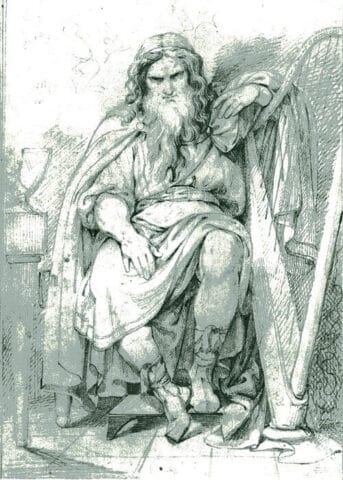
Hákon Sigurðarson, who ruled Norway during the late tenth century, is portrayed in medieval sagas as a devoted worshipper of Þorgerðr. His reliance on her appears closely connected to the ruling family of Lade and its traditions of sacred ancestry.
In Færeyinga saga, Hákon asks Sigmundr Brestisson what he trusts before sailing to the Faroe Islands. Sigmundr replies that he relies on his own strength, but Hákon urges him to seek Þorgerðr’s protection instead. He takes Sigmundr to her shrine, offers silver, and obtains a gold ring from her image to give him.
Another tradition preserved in Flateyjarbók calls Þorgerðr Hákon’s fulltrúi, a supernatural figure in whom he placed particular trust. Her protection was therefore portrayed as extending beyond Hákon to those who served him.
Gunnhild Røthe and Triin Laidoner interpret this relationship in connection with ancestral worship. If Þorgerðr was regarded as a guardian or sacred foremother of the Háleygjar, devotion to her could also strengthen the family’s claims to political authority. This remains a scholarly interpretation rather than an established account of religious practice at Hákon’s court.
Þorgerðr and Irpa at the Battle of Hjörungavágr
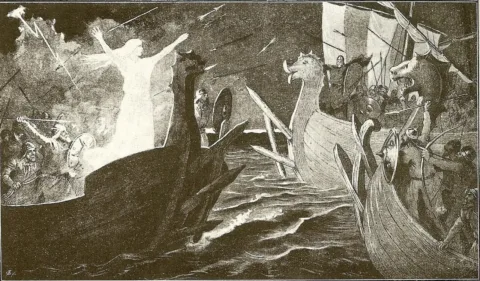
Þorgerðr’s most dramatic appearance occurs in Jómsvíkinga saga, during the Battle of Hjörungavágr in the late tenth century. Hákon Jarl and his sons faced an invading fleet of Jómsvíkingar led by Sigvaldi. When the fighting turned against him, Hákon withdrew to a wooded island and appealed to Þorgerðr for help.
According to the saga, she rejected his initial offerings, including the lives of other men, until he promised his seven-year-old son Erlingr. The boy was killed, and Hákon returned to his ships convinced that Þorgerðr would grant him victory.
A violent storm then swept across the battlefield, driving hail into the faces of the Jómsvíkingar. Some warriors reportedly saw Þorgerðr among Hákon’s forces, with arrows flying from her fingertips and striking their enemies. When the storm weakened, Hákon invoked her again, together with her sister Irpa. The two women appeared aboard his ship as the weather grew even worse.
Sigvaldi eventually withdrew, declaring that his men were fighting supernatural beings rather than ordinary warriors. The saga even claims that some hailstones were later weighed and found to be extraordinarily heavy.
The story differs from Snorri Sturluson’s account in Heimskringla, which mentions a tradition that Hákon sacrificed his son before the storm but does not describe Þorgerðr and Irpa fighting alongside him. The sacrifice and supernatural intervention remain elements of medieval narrative, not independently established historical events.
How Old Is the Evidence for Þorgerðr’s Worship?
The earliest surviving reference to Þorgerðr appears in the First Grammatical Treatise, an Icelandic work generally dated to the twelfth century. It mentions Hölgatröll, a name associated with her, as part of a linguistic example. This shows that the figure was already familiar in Iceland, but reveals nothing definite about how she was worshipped.
Skaldic poetry provides further evidence. Búadrápa, attributed to Þorkell Gíslason and probably composed in the first half of the twelfth century, describes a terrifying supernatural woman shooting arrows during the Battle of Hjörungavágr, although it does not explicitly name Þorgerðr. Bjarni Kolbeinsson’s Jómsvíkingadrápa, composed around 1200, connects Hölgabrúðr more directly with the storm.
A potentially earlier allusion occurs in Hákonardrápa, attributed to Tindr Hallkelsson, a poet contemporary with Hákon Jarl. John McKinnell cautions that its reference to a female figure called Gerðr may simply be a conventional poetic expression rather than a reference to Þorgerðr.
The detailed accounts of her sacrifices, temples, and supernatural interventions survive mainly in later prose narratives. Although these may preserve older traditions, their distance from the tenth century makes it difficult to determine which details reflect actual religious practices.
What Do the Sagas Say About Her Temples and Sacred Rings?
In Færeyinga saga, Hákon Jarl visits a richly decorated wooden shrine surrounded by a fence. The building contains numerous divine images and glass windows, with Þorgerðr’s figure occupying a prominent position. The gold ring Hákon obtains from her image is presented as a sign of supernatural favor, granted only after his offerings.
Njáls saga describes a temple belonging to Hákon and Guðbrandr, where the outlaw Víga-Hrappr discovers a seated image of Þorgerðr as tall as a grown man, wearing a headdress and a large gold arm-ring. He steals her ornaments, takes additional rings from the images of Thor and Irpa, and burns the building. Hákon later condemns the desecration.
In Harðar saga ok Hólmverja, the chieftain Grímkell consults Þorgerðr about his daughter’s marriage. She speaks directly to him, withholding her favor from his son Hörðr because he stole a gold ring from the burial mound of her brother Sóti. Angered by her warning, Grímkell burns the shrine and its images. He dies suddenly that evening, just as Þorgerðr had predicted.
These accounts describe a tradition of offerings, sacred images, valuable rings, and supernatural protection or punishment. They remain literary testimony, however, and no excavated sanctuary has been securely identified as belonging to Þorgerðr.
Who Was Irpa in Norse Mythology?
Irpa appears in medieval Norse literature as Þorgerðr Hölgabrúðr’s sister, but little is known about her independent identity. She shares Þorgerðr’s supernatural powers in Jómsvíkinga saga, while Njáls saga places her image alongside those of Þorgerðr and Thor. Neither source provides a genealogy or a separate account of her origins.
Her name is generally connected to the Old Norse adjective jarpr, meaning dark brown or swarthy. John McKinnell suggests that Irpa may represent a darker, more threatening aspect of Þorgerðr, or possibly a figure associated with Hel. Triin Laidoner offers a more cautious interpretation, noting that the name might simply have referred to dark hair rather than a distinct supernatural character.
No independent mythology or securely identified cult site establishes Irpa’s status as a separate goddess. Her surviving appearances are closely tied to Þorgerðr, leaving their original relationship uncertain.
Was Þorgerðr a Goddess, Fylgja, or Ancestral Spirit?
John McKinnell interprets Þorgerðr as a local goddess whose worship shared features with that of the Vanir, particularly Freyja. He compares her relationship with Hákon Jarl to the bond between a deity and a favored royal devotee, although this does not establish that she belonged to the Vanir.
Gunnhild Røthe proposes a different origin. Building on Else Mundal’s research, she identifies Þorgerðr as a fylgja, a guardian spirit of the Háleygjar family. Røthe suggests that she may originally have been a deceased ancestral woman venerated by her descendants before acquiring a broader supernatural status. Triin Laidoner likewise examines her within traditions of ancestor worship among Scandinavian elites.
Other interpretations associate Þorgerðr with the dísir, female supernatural beings connected with family protection and fortune. Lotte Motz instead emphasizes her resemblance to giantesses, whose powers could inspire both reverence and fear.
These interpretations need not be entirely exclusive. A supernatural figure could receive offerings, protect a particular lineage, and possess traits associated with more than one category of Norse beings. The surviving accounts do not establish whether Þorgerðr’s worship originated with a local goddess or a revered ancestor.
How Did Christian Saga Writers Portray Þorgerðr?
In Flateyjarbók, an Icelandic compilation from the late fourteenth century, Þorgerðr appears as a dangerous representative of the old religion. Her supernatural powers are increasingly associated with sorcery and the Devil rather than divine protection.
In Þorleifs þáttr jarlsskálds, Hákon Jarl seeks help from Þorgerðr and Irpa to avenge an insulting poem. Following their advice, he creates a wooden figure containing a murdered man’s heart and brings it to life through Satan’s power. The creature is then sent to Iceland to kill the poet Þorleifr.
Another account, preserved in Óláfs saga Tryggvasonar, describes King Óláfr seizing Þorgerðr’s statue, stripping away its ornaments, and dragging it behind his horse. He makes his followers publicly reject her worship before burning the image alongside one of Freyr.
These episodes reflect the Christian authors’ interest in portraying the defeat of pagan religion. Gunnhild Røthe argues that Þorgerðr’s increasingly demonic characterization served this purpose. Although the stories may preserve elements of older traditions, their hostile treatment of her cannot be taken as an accurate description of pre-Christian belief.
Conclusion
Þorgerðr Hölgabrúðr’s place in Hákon Jarl’s religious traditions is clear from the sagas: she received offerings and was believed to protect his ruling family. Her original identity is less certain. Whether she began as a local goddess or a revered ancestral guardian remains unresolved, particularly because the surviving accounts were shaped by authors writing long after the conversion to Christianity.
Academic Sources & Primary Texts
- Røthe, Gunnhild (2007).
Þorgerðr Hölgabrúðr: The Fylgja of the Háleygjar Family.
Scripta Islandica, 58, pp. 33–55.
Examines Þorgerðr as a possible ancestral guardian and her changing portrayal in medieval sagas. - McKinnell, John (2005).
The Goddess and Her Lover.
In Meeting the Other in Norse Myth and Legend, D. S. Brewer.
Discusses Þorgerðr’s possible divine identity and comparisons with other Norse female deities. - Laidoner, Triin (2020).
Ancestor Worship and the Elite in Late Iron Age Scandinavia: A Grave Matter.
Routledge.
Explores ancestor veneration, ruling families, and the religious significance of Þorgerðr. - Jesch, Judith (2014).
Jómsvíkinga Sǫgur and Jómsvíkinga Drápur: Texts, Contexts and Intertexts.
Scripta Islandica, 65, pp. 81–100.
Compares skaldic poetry and saga narratives concerning the Jómsvíkingar. - Finlay, Alison, and Þórdís Edda Jóhannesdóttir, translators (2018).
The Saga of the Jómsvikings: A Translation with Full Introduction.
Medieval Institute Publications.
A scholarly translation of the saga recounting Hákon Jarl’s sacrifice and the supernatural intervention attributed to Þorgerðr and Irpa. - Snorri Sturluson.
Edda: Skáldskaparmál.
Edited by Anthony Faulkes (1998), Viking Society for Northern Research.
Primary source for Þorgerðr’s relationship with Hölgi, his burial mound, and their reported worship. - Færeyinga saga.
The Saga of the Faroe Islanders.
Translated by Anthony Faulkes (2016), Viking Society for Northern Research.
Describes Hákon Jarl’s devotion to Þorgerðr, her shrine, and the gold ring given to Sigmundr Brestisson. - Medieval Icelandic Sagas.
Njáls saga, Chapter 88;
Harðar saga ok Hólmverja, Chapter 19.
Primary narratives describing Þorgerðr’s images, sacred ornaments, prophetic powers, and the destruction of shrines. - Flateyjarbók.
Þorleifs þáttr jarlaskálds.
Medieval Icelandic narrative portraying Hákon’s appeal to Þorgerðr and Irpa through supernatural practices associated with Christian descriptions of pagan sorcery.
Copyright & Content Rights
© 2026 History & Myths. All rights reserved.
Original article by H. Moses. Historical interpretations are based on the medieval Norse texts and academic research cited above. The article’s original text may not be reproduced without permission, except as permitted by applicable copyright law. Historical source texts, quotations, and third-party images remain subject to their respective rights and licenses.