Sigyn: The Norse Goddess Who Protected Loki from Venom
Sigyn is best known for protecting her husband, Loki, while he lies bound beneath a venomous serpent. In Snorri Sturluson’s Gylfaginning, she catches the poison in a bowl, but whenever she leaves to empty it, the venom falls on Loki, causing him to writhe so violently that the earth shakes.
Sigyn also appears in older Norse poetry. Völuspá places her beside the captive Loki, while Haustlöng refers to him through a poetic expression involving her name. Snorri counts her among the Ásynjur, yet the surviving sources reveal little about her origins or any independent role among the gods. Even her family relationships are difficult to reconstruct, and there is no secure evidence that she received worship in pre-Christian Scandinavia.
Who Was Sigyn in Norse Mythology?
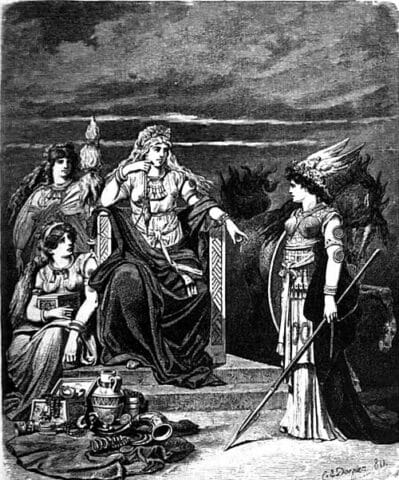
Sigyn belonged to the Ásynjur, the goddesses associated with the Æsir. In Skáldskaparmál, Snorri Sturluson names her among the goddesses attending Ægir’s feast in Asgard, alongside Frigg, Freyja, Iðunn, and Nanna. The passage establishes her place among the gods but assigns her no particular powers or responsibilities.
In Gylfaginning, chapter 33, Snorri identifies Sigyn as Loki’s wife and names their son Nari, also called Narfi. Nothing is said about her parents, how she married Loki, or where she lived. Unlike several other Norse goddesses, she has no surviving independent myth, and none of the preserved accounts records her speaking.
Sigyn and Loki’s Punishment
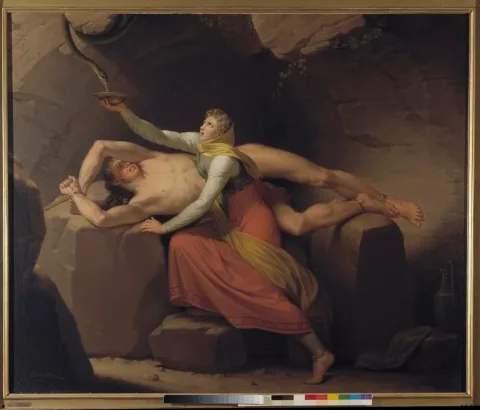
In Gylfaginning, chapter 50, Snorri Sturluson describes how the Æsir captured Loki and took him to a cave. They bound him across three upright stone slabs using his son’s entrails, which hardened into iron. Skaði then fastened a venomous serpent above him so that its poison would drip onto his face.
Sigyn stood beside Loki, holding a basin beneath the serpent to catch the venom. Whenever the basin filled, she had to leave to empty it, briefly exposing him to the poison. His violent convulsions when the venom struck his face were said to cause earthquakes.
Loki was condemned to remain bound until Ragnarök. Sigyn, however, was not herself described as a prisoner or as having been sentenced by the gods. Snorri records her efforts to shield Loki but gives no explanation for her presence or her reasons for remaining beside him.
Sigyn in the Old Norse Sources
Völuspá: Sigyn Beside Her Bound Husband
In Völuspá, stanza 35, the seeress sees a captive resembling the treacherous Loki beneath Hveralundr, with Sigyn seated nearby. The Old Norse phrase þeygi um sínum ver vel glýjuð indicates that she is not pleased about her husband’s condition.
The stanza contains no mention of the serpent or the bowl. Its reference to Loki’s imprisonment without explaining the circumstances suggests that the poet expected the audience to recognize the scene.
Haustlöng: An Early Reference to Sigyn
An earlier reference appears in Haustlöng, a skaldic poem attributed to Þjóðólfr of Hvinir and generally dated to around 900 CE. During Loki’s encounter with the giant Þjazi, the poet calls him farmr Sigynjar arma, meaning “the burden of Sigyn’s arms.”
This expression is a kenning, a poetic description that identifies Loki through his relationship with Sigyn. The same stanza also refers to Loki as someone whom the divine powers see in bonds. Some scholars interpret this wording as an allusion to his later imprisonment.
The immediate scene, however, concerns Þjazi, disguised as an eagle, trapping Loki through a magical attachment to a pole. Haustlöng therefore confirms that Sigyn was already associated with Loki in early skaldic poetry, but does not recount her actions during his punishment.
Lokasenna and Skáldskaparmál
Sigyn does not speak or appear as a participant in the poetic dialogue of Lokasenna. She enters the account in its prose conclusion, which describes Loki’s capture, the serpent, and her efforts to collect its venom. The date of this prose ending is uncertain, and it should not automatically be treated as contemporary with the poem’s verses.
In Skáldskaparmál, Snorri also identifies Loki through the expression ver Sigynjar, meaning “Sigyn’s husband.” This provides another example of their relationship being used in traditional poetic terminology, without supplying a separate narrative about Sigyn herself.
Who Were Sigyn’s Children?
In Gylfaginning, chapter 33, Snorri Sturluson identifies Nari, also called Narfi, as the son of Sigyn and Loki. The two names are presented as alternatives for the same child, not as two separate sons.
Chapter 50 introduces another son of Loki, Váli. During Loki’s punishment, the Æsir transform Váli into a wolf, causing him to tear his brother Narfi apart. They then use Narfi’s intestines to bind their father. Although Sigyn is Loki’s wife, Snorri does not explicitly name her as Váli’s mother. This Váli should not be confused with Odin’s son of the same name, who avenges Baldr.
The prose ending of Lokasenna preserves a different account. It states that Loki was bound with Nari’s intestines, while Narfi became a wolf, without describing one brother killing the other. Some editors substitute Váli for Nari to reconcile the passage with Snorri’s version, but the manuscript preserves the name Nari. Skáldskaparmál introduces a further variation by naming Nari and Áli among Loki’s children. Áli may be another form of Váli, although the text does not explain their relationship.
Fenrir, Jörmungandr, and Hel belong to a different branch of Loki’s family. Gylfaginning, chapter 34, identifies their mother as the giantess Angrboða, not Sigyn.
What Does the Name Sigyn Mean?
The name Sigyn is traditionally interpreted as “victory-friend,” linking Old Norse sigr (victory) with an element associated with vinr (friend). However, this interpretation presents linguistic difficulties, particularly concerning the name’s second element. No surviving Norse text explains its original meaning.
In a 2018 study, linguist Riccardo Ginevra proposed a different etymology. He argued that the metre of Haustlöng requires the form Sígyn, with a long first vowel, and traced the name to an Indo-European root meaning “to pour.” His proposed meaning, “she of the pouring,” draws on parallels with Vedic Sanskrit sécanī (pouring) and Sēquana, the Celtic river goddess associated with the Seine. This interpretation also connects the name with Sigyn’s role in collecting and emptying the serpent’s venom.
Ginevra further suggested that the imagery might preserve traces of rituals involving liquids poured onto fire. This remains a hypothesis based on linguistic and mythological comparisons, rather than evidence of a documented ritual involving Sigyn.
Read Also
Was Sigyn the Norse Goddess of Loyalty?
Sigyn is often described as the Norse goddess of loyalty, devotion, or marital fidelity. However, no surviving Old Norse source assigns her any of these divine responsibilities. The titles arise from later interpretations of her efforts to protect Loki during his punishment.
In Gylfaginning, Snorri describes Sigyn’s actions without mentioning a vow, a sacred obligation, or her reasons for remaining beside Loki. Völuspá, stanza 35, portrays her as unhappy about her husband’s condition. Her distress is evident, but the poem does not explain her feelings toward Loki or why she stays with him.
Her actions can reasonably be interpreted as expressions of loyalty, compassion, or endurance, but these remain readings of the myth rather than established religious attributes. The sources also leave her later fate unknown. Although Loki escapes his bonds at Ragnarök, no surviving account describes what becomes of Sigyn.
Was Sigyn Worshipped in the Viking Age?
There is no secure evidence of a cult dedicated to Sigyn in pre-Christian Scandinavia. No surviving inscription, place-name, or ritual account clearly identifies worship directed toward her. Although Snorri includes Sigyn among the Ásynjur, this does not establish that she had temples, received offerings, or possessed an independent cult.
Viking Age carvings offer a different kind of evidence. The early tenth-century Gosforth Cross in Cumbria, England, depicts a bound figure beneath a serpent, with a woman holding a bowl above him. The scene is widely interpreted as Loki’s punishment, with Sigyn collecting the venom. The cross also contains Christian imagery, reflecting an Anglo-Scandinavian setting in which both religious traditions were familiar.
A possible parallel appears on the Ardre VIII picture stone from Gotland, Sweden. A figure lies within an enclosure surrounded by serpents, beside two women. One holds a vessel and turns away, possibly representing Sigyn emptying her bowl. Scholars have proposed alternative interpretations of the scene, however, and no inscription identifies the figures.
These carvings suggest that the story of Loki’s punishment was known beyond the medieval Icelandic manuscripts. They cannot establish whether Sigyn received religious devotion, and no independent cult of hers can be reconstructed from the surviving evidence.
Conclusion
Sigyn is remembered chiefly for protecting Loki from the serpent’s venom, but her presence in Norse tradition extends beyond Snorri’s account. Haustlöng identifies her through Loki in early skaldic poetry, while Völuspá places her beside her bound husband. Neither poem reveals much about her life or motives.
Her actions have made her a symbol of loyalty and endurance, although the surviving texts never establish these qualities as her divine responsibilities. What remains is a recognizable figure in Norse mythology whose identity beyond her relationship with Loki is still largely unknown.
Academic Sources & Primary Texts
- Pettit, Edward, ed. and trans. (2023).
The Poetic Edda: A Dual-Language Edition.
Open Book Publishers.
Völuspá, stanza 35, and
Lokasenna, including its prose conclusion.
Read source. - Sturluson, Snorri.
Edda: Prologue and Gylfaginning.
Edited by Anthony Faulkes, 2nd ed.
Viking Society for Northern Research, 2005.
Chapters 33, 34, and 50.
Read source. - Sturluson, Snorri.
Edda: Skáldskaparmál.
Edited by Anthony Faulkes.
Viking Society for Northern Research, 1998.
Includes the preserved verses of
Þjóðólfr of Hvinir’s Haustlöng.
Read source. - Samplonius, Kees (2000).
“Undir hveralundi: Notes on Völuspá 35.”
In Noordse Letters, pp. 111-122.
Read study. - Ginevra, Riccardo (2018).
“Old Norse Sígyn: ‘She of the Pouring’,
Vedic Sécanī, Celtic Sēquana and PIE
*sei̯ku̯- ‘Pour’.”
In Proceedings of the 29th Annual
UCLA Indo-European Conference,
Hempen Verlag, pp. 65-76.
View publication. - Oehrl, Sigmund (2017).
“Documenting and Interpreting the Picture
Stones of Gotland: Old Problems and New
Approaches.”
Current Swedish Archaeology,
25, pp. 87-122.
Read study. - Historic England.
High Cross in St Mary’s Churchyard,
Gosforth.
National Heritage List for England,
Entry No. 1012643.
View archaeological record.
Copyright & Content Notice
© 2026 History & Myths. All rights reserved.
Written by H. Moses. This article is an original
historical and mythological analysis based on
Old Norse primary texts and academic research.
Reproduction or redistribution without permission
is prohibited. Ancient myths and historical source
materials remain in the public domain.