Sulis Minerva: The Celtic Goddess of Roman Bath
At Roman Bath, a man named Docilianus turned to Sulis Minerva after someone stole his hooded cloak. He asked the goddess to punish the thief until the garment was returned. His appeal, inscribed on a metal tablet, was deposited at a sanctuary where worshippers also offered gifts and dedicated altars. These objects provide unusually direct evidence of what people expected from a deity whose name combined the local goddess Sulis with the Roman Minerva.
Sulis Minerva was worshipped beside the natural hot springs of Aquae Sulis, in what is now Bath, England. She is commonly described as a goddess of healing, yet the archaeological evidence for that role is less conclusive than her modern reputation suggests. Research by archaeologist Eleri Cousins challenges the assumption that Bath was primarily a healing sanctuary. The surviving inscriptions, curse tablets, and temple remains reveal a more complex cult, shaped by local religious traditions, Roman imperial influence, and worshippers seeking divine intervention in everyday disputes.
Who Was Sulis Minerva?
Sulis was a local British goddess whose worship centered on the hot springs at Aquae Sulis, modern Bath. Under Roman rule, she became identified with Minerva, the Roman goddess associated with wisdom, crafts, and warfare. This combination, known as interpretatio Romana, allowed a local deity to be understood through the identity of a Roman goddess without necessarily replacing her original character.
The inscriptions show that Sulis retained her own name. One altar addresses her simply as Dea Sulis, while others invoke Sulis Minerva. The distinction is important: her worshippers did not always use the Roman identification, even after the establishment of the temple. Nor does the shared name prove that Sulis possessed every attribute traditionally associated with Minerva.
The meaning of Sulis’s name is also debated. Linguists have connected it with Old Irish súil, meaning “eye” or “sight”, and proposed a possible association with the sun. These connections remain uncertain, however, and cannot establish that she was originally a solar goddess.
Although Sulis probably received worship before the Roman conquest, no surviving pre-Roman inscription identifies her by name. Nor is there a preserved mythology describing her ancestry or adventures. Unlike many deities known through medieval Irish and Welsh literature, Sulis emerges primarily from the physical evidence of her cult, particularly the inscriptions left by those who worshipped her.
Why Was Bath Sacred to Sulis?
Bath’s religious importance began with its natural hot springs, where mineral-rich water rises from deep underground. The largest spring became the center of the sanctuary of Sulis Minerva. Its unusual warmth and continuous flow made it a distinctive feature of the landscape long before the construction of Roman buildings.
The spring may already have been a sacred place in the Iron Age. Archaeologists have identified an earthen bank projecting into the water, while several Iron Age coins recovered from the site may represent early offerings. Neither provides conclusive evidence for organized worship of Sulis before the Roman conquest, however.
During the later first century CE, the Romans transformed the location into a monumental sanctuary at Aquae Sulis. Engineers enclosed the spring within a stone reservoir lined with lead, while a classical temple rose above a courtyard containing a large sacrificial altar. The temple stood on a raised podium approached by steps and Corinthian columns, an architectural form uncommon in Roman Britain.
The sacred spring and the public baths served different purposes. Water flowed from the protected spring into the adjoining bathing complex, but the spring itself remained within the religious precinct. Initially an open pool, it was enclosed beneath a vaulted building during the second century, creating a more secluded setting for worship.
The resulting sanctuary combined a natural sacred feature with Roman monumental architecture. Archaeologist Eleri Cousins interprets its construction partly as an assertion of imperial authority over an established local sacred landscape, rather than simply the enlargement of an earlier shrine.
How Was Sulis Minerva Worshipped?
Worship at Aquae Sulis involved public ceremonies, personal vows, and offerings deposited in the sacred spring. A large altar stood in the temple courtyard, where priests performed animal sacrifices. The Roman writer Solinus also described perpetual fires burning in Minerva’s temple, leaving stone-like lumps rather than ordinary ash. These remains are generally interpreted as evidence of coal burning, a distinctive feature of the sanctuary.
Stone inscriptions record individual acts of devotion. One altar (RIB 150) identifies Sulinus, son of Maturus, who fulfilled a vow to Sulis Minerva. The Latin formula votum solvit libens merito indicates that he discharged his obligation willingly and deservedly. The inscription does not reveal what he had requested from the goddess or what led him to fulfill his promise.
The sacred spring received a wide variety of objects. Excavations recovered more than 12,000 Roman coins, alongside brooches, jewelry, metal vessels, and other personal possessions. The finds included vessels made of pewter and silver. Depositing such objects in the water could place them beyond ordinary human use, although the purpose of individual deposits often remains uncertain.
Some objects had been deliberately altered before entering the spring. Among them was a pewter plate that had been pierced, a detail examined by archaeologist Eleri Cousins. She argues that the vessels may have acquired religious significance during their use and that depositing them in the spring could provide a ritually appropriate way to relinquish them. Their materials, condition, and placement therefore matter as much as their presence in the water. Not every deposit necessarily represented the same kind of offering or request to the goddess.
What Do the Bath Curse Tablets Reveal?
Around 130 inscribed tablets dating from the second to fourth centuries CE have been recovered from Bath’s sacred spring. Written on thin sheets of lead or tin alloy, most concern stolen property. Their authors appealed to divine authority when they wanted a thief identified, punished, or compelled to make restitution.
The language could be severe. Some petitioners demanded that offenders lose their health, sleep, or even their lives. Because the culprit was often unknown, the texts used formulas covering every possibility, whether the thief was male or female, enslaved or free. Worshippers sometimes symbolically surrendered the stolen property or the offender to the deity, expecting divine punishment in return.
One tablet (Tab. Sulis 97) records a woman named Basilia seeking vengeance for a stolen silver ring. Her curse extends to anyone who stole it or knowingly concealed the theft. Although Basilia dedicates the ring to the temple of Mars, the tablet was deposited in Sulis’s sacred spring. The inscription does not explain why she referred to one sanctuary while leaving her petition at another.
The collection also contains an unusual text (Tab. Sulis 94) concerning an oath sworn at Sulis’s spring and the consequences of breaking it. This extends the evidence beyond ordinary theft complaints to the enforcement of sworn promises.
The tablets reveal a form of religious justice shaped by everyday grievances. Their wording often resembles legal petitions, but the punishment requested depended on supernatural intervention rather than a court. They document what worshippers believed the gods could do, not whether the curses were fulfilled.
Was Sulis Minerva Really a Healing Goddess?
Sulis Minerva is commonly described as a healing goddess because her sanctuary stood beside natural hot springs. Roman worshippers elsewhere sought cures at mineral springs, and Minerva herself could have healing associations. Eberhard Sauer argued that these traditions help explain the identification of Sulis with Minerva at Bath. Yet evidence from other sanctuaries cannot establish how the goddess was worshipped there.
Some discoveries appear to support a healing function. A pair of ivory breasts and a bronze breast recovered from Bath have been interpreted as anatomical offerings, possibly connected with health or childbirth. Their intended purpose remains uncertain. Likewise, inscriptions dedicated for someone’s salus, meaning welfare or safety, do not necessarily record recovery from illness.
Archaeologist Eleri Cousins challenges the traditional interpretation more directly. In The Sanctuary at Bath in the Roman Empire (2020), she argues that Bath’s later reputation as a therapeutic spa influenced how antiquarians understood its Roman remains. The presence of elaborate bathing facilities demonstrates that visitors used the thermal waters, but it does not establish that healing was the sanctuary’s principal religious purpose.
This does not mean that worshippers never sought relief from illness. Such requests are plausible, but the surviving evidence cannot establish their importance within the cult. Sulis Minerva’s identification as primarily a healing goddess is therefore a scholarly interpretation, not a securely documented fact.
What Did Sulis Minerva Look Like?
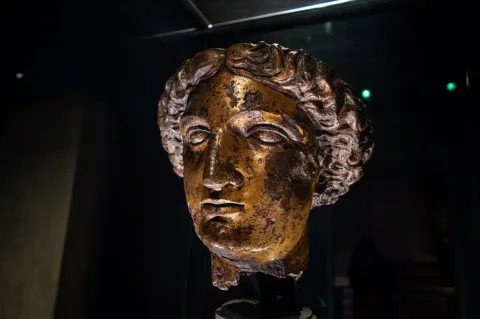
The clearest surviving image associated with Sulis Minerva is a gilt-bronze head discovered at Bath in 1727. Slightly larger than life-size, it probably belonged to the cult statue displayed inside her temple. Its idealized features and carefully arranged hair follow Roman representations of Minerva. Small holes along the hairline once secured a tall Corinthian helmet, now lost. Examination revealed six layers of gilding, with the first two applied through fire gilding and the later four as gold leaf.
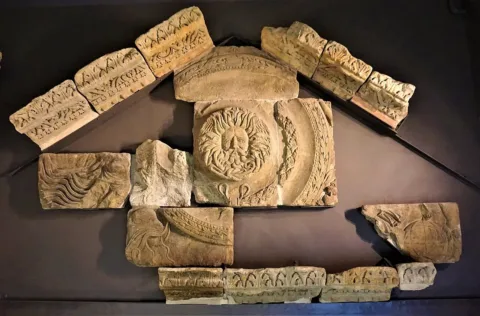
A more puzzling image decorated the temple’s triangular pediment. Commonly called the Bath Gorgon, it depicts a bearded, moustached face with snakes entwined in its hair and beard. Unlike the female Gorgon of classical mythology, this figure appears male. Scholars have variously interpreted it as an unconventional Gorgon, a water deity, or an image combining different artistic traditions. It should not be mistaken for a portrait of Sulis herself.
Eleri Cousins offers a different explanation in her 2016 study of the pediment. She connects its central shield, winged Victories, and surrounding imagery with imperial monuments inspired by the Forum of Augustus in Rome. Similar compositions appeared in Roman Gaul and Spain, suggesting that the sculpture expressed imperial power rather than representing an exclusively Celtic religious symbol.
Neither object reveals how Sulis was imagined before her identification with Minerva. The surviving images belong to the Roman sanctuary and reflect the artistic conventions through which her worship was presented.
Who Worshipped Sulis Minerva?
Inscriptions from Bath identify soldiers, freedmen, craftsmen, and religious specialists among Sulis Minerva’s worshippers. They also reveal connections extending beyond Britain.
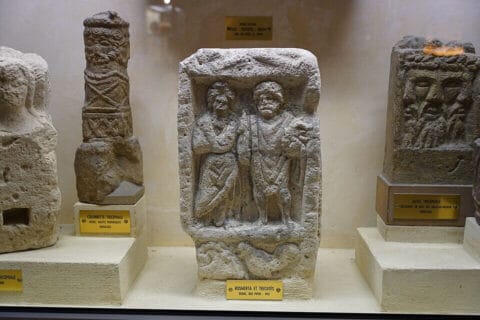
One of the clearest records of her priesthood is the tombstone of Gaius Calpurnius Receptus (RIB 155), who served as sacerdos deae Sulis, priest of the goddess Sulis. He died aged seventy-five, and his memorial was erected by Calpurnia Trifosa, described as both his freedwoman and wife. The inscription confirms an established priestly office, although it provides no details of the priest’s duties.
Roman military personnel also appear prominently. Gaius Curiatius Saturninus, a centurion of the Second Legion Augusta, dedicated an altar to Sulis Minerva and the divine powers of the emperors (RIB 146). Another altar (RIB 143) was erected by the freedman Aufidius Eutuches for the welfare of his former master, a centurion of the Sixth Legion Victrix. These dedications show how worship at Bath could express personal loyalty alongside religious devotion.
The sanctuary attracted people from farther afield. Priscus, son of Toutius, identified himself as a stonemason from the Carnutes, a people of central Gaul (RIB 149). Another inscription names Lucius Marcius Memor as a haruspex, a specialist who interpreted divine signs through the entrails of sacrificed animals.
Eleri Cousins argues that military dedications also reflect how soldiers expressed their place within Roman imperial society. Yet the surviving inscriptions represent only those whose names were preserved in stone. They provide valuable evidence of the sanctuary’s social connections without establishing the full composition of its worshipping community.
Read Also
What Happened to the Temple of Sulis Minerva?
By the late fourth century CE, the sanctuary at Bath was losing much of its former grandeur. Excavations revealed rough paving laid over earlier floors, with fragments of carved architecture reused as building material. The great sacrificial altar had been dismantled and was never rebuilt. These changes suggest that the temple’s traditional ceremonies were declining, although activity around the sacred spring may have continued.
Christianity’s growing influence and imperial restrictions on traditional religious practices provide a possible context for the sanctuary’s decline. In 391 CE, Emperor Theodosius I issued measures against pagan worship. Yet no surviving evidence establishes that Christians immediately closed or destroyed the temple at Bath.
Archaeologist James Gerrard challenged the assumption that the sanctuary disappeared with Roman rule. Combining excavation records with radiocarbon dates, his 2007 study placed the temple’s final demolition between approximately 450 and 500 CE, decades after Roman imperial administration in Britain had ended. Gerrard considered the possibility of deliberate destruction amid the political and religious changes of post-Roman Britain, but the precise motive remains uncertain.
The distinction between the end of worship and the demolition of the building is crucial. The temple’s religious importance may have faded before its structures were removed, while the continuing use of parts of the precinct does not necessarily prove that the cult of Sulis Minerva survived unchanged.
Conclusion
Sulis Minerva’s importance lies in the unusually detailed evidence left by her worshippers. The inscriptions, offerings, and curse tablets from Bath reveal a goddess approached for divine protection, justice, and personal concerns, while her temple reflects the influence of Roman religion and imperial power.
Her original British identity remains difficult to reconstruct, and her reputation as a healing goddess is less firmly established than often assumed. What survives is not a mythology of Sulis, but a record of how people worshipped her, and how a local deity retained her name within the Roman religious world.
Sources & Primary Texts
Primary Sources and Inscriptions
- Roman Inscriptions of Britain: Aquae Sulis (Bath).
Corpus of inscriptions documenting dedications, priests, military worshippers, and religious activity at Bath. - RIB 143,
RIB 146,
RIB 150, and
RIB 155.
Altars and funerary evidence concerning Sulis Minerva, votive dedications, and her priesthood. - Tomlin, R. S. O. (1988).
Tabellae Sulis: Roman Inscribed Tablets of Tin and Lead from the Sacred Spring at Bath.
In The Temple of Sulis Minerva at Bath, Vol. II, edited by Barry Cunliffe. Oxford University Committee for Archaeology.
Academic Studies
- Cousins, Eleri H. (2020).
The Sanctuary at Bath in the Roman Empire.
Cambridge University Press. A comprehensive archaeological reassessment of the sanctuary, imperial influence, and its supposed healing function. - Cousins, Eleri H. (2014).
“Votive Objects and Ritual Practice at the King’s Spring at Bath”.
In TRAC 2013: Proceedings of the Twenty-Third Annual Theoretical Roman Archaeology Conference. Oxbow Books. - Cousins, Eleri H. (2016).
“An Imperial Image: The Bath Gorgon in Context”.
Britannia, 47, 99–118. An interpretation of the temple pediment within Roman imperial visual culture. - Sauer, Eberhard (1996).
“An Inscription from Northern Italy, the Roman Temple Complex in Bath and Minerva as a Healing Goddess in Gallo-Roman Religion”.
Oxford Journal of Archaeology, 15(1), 63–93. - Gerrard, James (2007).
“The Temple of Sulis Minerva at Bath and the End of Roman Britain”.
The Antiquaries Journal, 87, 148–164. Archaeological evidence concerning the sanctuary’s late history and demolition.
Copyright & Image Credits
© 2026 History & Myths. All rights reserved.
Original article text, historical analysis, and editorial commentary
by History & Myths. Ancient inscriptions, archaeological evidence,
and academic research are discussed for educational and research
purposes. Third-party images remain subject to their respective
licenses and attribution requirements. Individual image credits
are provided alongside the relevant illustrations.