The Two Sanctuaries of Asclepius at Epidaurus: New Evidence
Epidaurus in ancient Greece was home to two sanctuaries dedicated to Asclepius, the god of healing. Beyond the famous Asklepieion outside the city, excavations near the Small Theatre have uncovered a second sacred precinct, with a courtyard, fountain, and covered colonnade. A pottery fragment bearing the god’s name supports its identification with the urban sanctuary described by the second-century CE traveler Pausanias.
The newly identified sanctuary contains structures dating back to the fourth century BCE, alongside substantial Roman alterations. Meanwhile, excavations beneath the Tholos at the larger Asklepieion have revealed evidence of earlier religious activity. Together, these discoveries raise important questions about when Asclepius worship began at Epidaurus, how the two sanctuaries developed, and whether they served different ritual purposes.
Where Were the Two Sanctuaries of Asclepius?
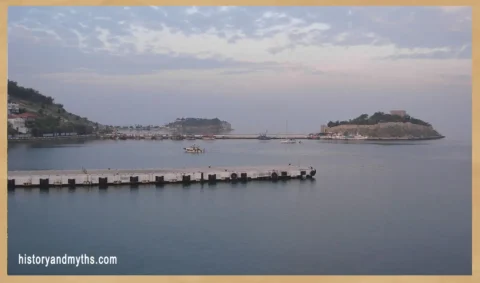
The two sanctuaries stood in different parts of ancient Epidaurus, in the Argolid region of the northeastern Peloponnese. The smaller sanctuary was located within the coastal city, near the Small Theatre on the Nisi peninsula, where modern Palaia Epidavros now stands.
The larger sanctuary, known as the Asklepieion, lay several kilometers inland, in a valley northwest of Mount Kynortion. Although separated from the city, it belonged to the Epidaurian community and developed into one of the most important healing centers of the Greek world. Its monumental complex included the Temple of Asclepius, the Tholos, the Abaton, where worshippers underwent ritual sleep, and the famous Great Theatre of Epidaurus. The Great Theatre and the Small Theatre therefore belonged to separate archaeological sites.
Above the Asklepieion, on Mount Kynortion, stood the sanctuary of Apollo Maleatas. Religious activity at this location dates back to the Bronze Age, although its association with Apollo is documented from around the eighth century BCE. The mountain sanctuary remained closely connected with the worship of Asclepius in the valley below, forming part of a religious complex whose origins preceded the famous Classical monuments.
When Was the Lost Sanctuary Discovered?
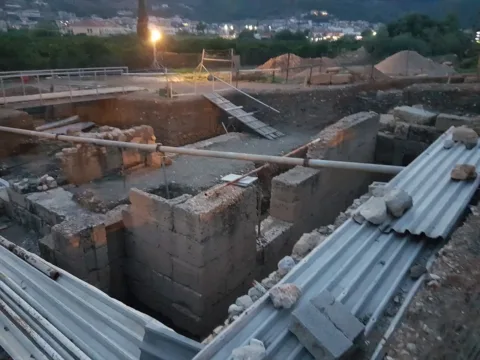
The sanctuary near the Small Theatre of Epidaurus was identified through years of archaeological investigation. Between 2007 and 2015, the Committee for the Conservation of the Epidaurus Monuments uncovered substantial portions of a fourth-century BCE fountain house and a Roman-period stoa northwest of the theatre. The buildings formed a complex within the ancient agora, but their connection to Asclepius had not yet been established.
In 2016, a research team from the National and Kapodistrian University of Athens continued the excavations. By 2020, investigators were considering whether the complex corresponded to the urban sanctuary described by Pausanias. Further work revealed an open-air sacred enclosure north of the fountain, while inscriptions and votive objects provided stronger evidence for its identification.
The researchers presented their findings at an academic symposium in June 2023. On January 11, 2024, the Greek Ministry of Culture published a detailed account of the sanctuary’s architecture and archaeological discoveries. Renewed media coverage in November 2026 followed a University of Athens presentation on November 9, rather than a new discovery of the sanctuary.
Pausanias and the Identification of the Urban Sanctuary
Pausanias provides an important ancient description of the sanctuary in Description of Greece (2.29.1). Visiting Epidaurus in the second century CE, he recorded a sacred precinct (temenos) within the city containing statues of Asclepius and Epione, traditionally identified as his wife. Both statues stood outdoors and were made of Parian marble. His account distinguishes this urban sanctuary from the larger Asklepieion described earlier in his work.
Excavations near the Small Theatre revealed an open-air enclosure adjoining a Classical fountain. Along its stepped eastern wall, archaeologists identified cuttings that could have held inscribed monuments or votive offerings. Although the statues described by Pausanias have not been securely identified, the enclosure’s layout is consistent with his account.
A pottery fragment bearing part of Asclepius’s name provides direct evidence of the sanctuary’s dedication. Excavators also recovered terracotta votive discs decorated with female busts in relief and pierced for suspension, alongside figurines, lamps, and fragments of ceramic heating vessels. Bronze medical instruments found during earlier excavations in the nearby theatre may also have originated from the sanctuary, although their connection remains uncertain.
A marble statue of a draped woman, discovered in December 2021, has raised the possibility of identifying one of the figures mentioned by Pausanias. Its clothing and gesture resemble representations of married women and appear in the iconography of both Epione and Hygeia. The statue was found without its head or separately attached arms, and no inscription identifies the figure. Its attribution to Epione therefore remains uncertain.
The Architecture and Water System of the Urban Sanctuary
The urban sanctuary of Asclepius developed around a monumental fountain house dating to the fourth century BCE. Excavations revealed three connected spaces: an open-air sacred courtyard measuring approximately 100 square meters, a fountain and reservoir complex covering about 220 square meters, and a later colonnaded portico (stoa) occupying 128 square meters.
A stone-lined well in the center of the courtyard supplied the fountain through an underground masonry passage with a pointed roof. The original water-drawing area had an Ionic facade with three columns between projecting piers. Inside, basins fitted with water spouts allowed visitors to collect water from the reservoir.
The water system remained in use for centuries. An inscription discovered during the 2020 excavations records repairs to the fountain and its aqueduct in the first century BCE, documenting maintenance before the sanctuary underwent substantial Roman alterations.
During the second century CE, builders added a stoa along the western side of the complex, occupying part of the earlier courtyard. Its plaster-coated columns stood on a three-stepped base, while access to the reservoir was incorporated into the new portico. The older fountain thus remained accessible despite the changes to the sanctuary’s layout.
The water installations occupied a prominent place in the sanctuary, but their surviving architecture does not establish whether they were used for healing baths or other specific rituals.
How Early Did Asclepius Worship Begin at Epidaurus?
Religious activity at Epidaurus long preceded the construction of its famous Classical sanctuary. Excavations on Mount Kynortion have revealed evidence of cult practices dating to the Bronze Age, long before the site became associated with Apollo Maleatas. Earlier scholarship generally placed the establishment of Asclepius worship in the valley below around the middle of the sixth century BCE. Recent excavations have challenged that chronology.
Research conducted between 2015 and 2022 identified earlier religious structures within the main Asklepieion. These include an early phase of the sacred well near the Abaton, an ash altar inside Building E, and an altar east of the Tholos. Vassilios Lambrinoudakis and his colleagues now argue that religious activity in the valley began as early as the eighth or seventh century BCE.
The most substantial architectural discovery is an Archaic building excavated immediately east of and partly beneath the later Tholos. Dated by pottery, other finds, and architectural evidence to the late seventh or early sixth century BCE, it had mudbrick walls and a wooden colonnade supported by stone bases. Beneath its ground floor lay a chamber cut into the bedrock, with red-plastered walls and a floor decorated with white pebbles. Excavators also identified traces of a staircase leading to the underground chamber and a basin in its southwestern corner.
The building was demolished in the early fourth century BCE to make way for the Tholos. Its underground chamber and similarities to the later structure have led the excavators to interpret it as an earlier place of worship associated with the chthonic, or underworld-related, aspect of Asclepius. The precise rituals performed there remain uncertain.
These discoveries establish sacred activity in the valley before the construction of the Classical Asklepieion. Whether its earliest religious structures were dedicated specifically to Asclepius, however, remains a question of archaeological interpretation.
Healing Rituals and Sacred Sleep: What Does the Evidence Show?
Healing at the main Asklepieion of Epidaurus centered on incubation (enkoimesis), a ritual in which worshippers slept within the sanctuary seeking divine intervention. The practice was associated with the Abaton, a sleeping area near the Temple of Asclepius. In Description of Greece (2.27.2), Pausanias describes a place opposite the temple where suppliants slept, confirming that the practice continued into the second century CE.
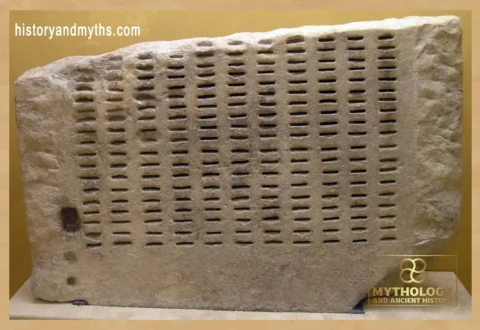
Earlier evidence comes from four surviving inscribed stone stelai, known as the Epidaurian iamata, dating to the late fourth century BCE. They preserve accounts of visitors seeking relief from illness, blindness, infertility, and other conditions. Some describe Asclepius appearing in dreams, performing cures, or giving instructions to patients. These inscriptions document the sanctuary’s healing traditions, although their miraculous accounts are religious testimonies rather than independently verified medical outcomes.
Whether similar rituals took place at the smaller urban sanctuary is less certain. The excavators suggest that its Roman-period stoa may have accommodated incubation, but no comparable collection of healing inscriptions has been identified there. Sacred sleep remains a possibility rather than an established practice at the urban sanctuary.
Read Also
Roman Changes, Building K, and the Later History of the Sanctuaries
The second-century CE remodeling of the urban sanctuary has been tentatively linked to Emperor Hadrian’s visit to Epidaurus in 124 CE, although his involvement in the construction remains unconfirmed.
At the larger Asklepieion, Building K stood west of the Sacred Way. According to archaeologist Stylianos Katakis, the Roman complex was constructed during the reign of Antoninus Pius (138–161 CE) by the senator Antoninus Pythodorus, over an earlier Hellenistic building. Its rooms included a hall with a water basin, an adjoining circular chamber, and a drainage system. The complex underwent several alterations during the Roman and Late Antique periods.
Around the end of the fourth century CE, or possibly later, renovations blocked earlier water conduits and introduced a staircase leading to an underground chamber known as the Crypt. This three-part space incorporated reused architectural elements and openings that admitted sunlight at noon on certain days. Archaeologists also discovered the lower portions of four amphorae embedded in the bedrock. Numerous lamp fragments suggest nighttime activity in Building K, but do not establish its purpose. The excavators have proposed a possible connection with mystery rituals, although the ceremonies and deity involved remain unidentified.
Religious activity at the main Asklepieion continued to change during Late Antiquity. A fourth-century reorganization included a surrounding stoa and alterations to several altars. In the early fifth century, a five-aisled Christian basilica was built outside the sacred precinct. Repairs to Building K and continued use of nearby baths indicate that parts of the older complex remained active, but whether traditional worship continued alongside Christian practices is uncertain. The surviving evidence also does not establish when the smaller urban sanctuary ceased functioning.
Conclusion
Excavations near the Small Theatre have provided archaeological support for Pausanias’s account of an urban sanctuary dedicated to Asclepius. At the larger Asklepieion, structures discovered beneath the Classical monuments reveal religious activity that predates the famous sanctuary buildings.
What remains uncertain is when the earliest activity in the valley became specifically associated with Asclepius and whether the urban sanctuary offered the same healing rituals as the larger site. The discoveries provide a clearer history of both sanctuaries without establishing that they developed or functioned in the same way.
Academic Sources & Primary Texts
- Pausanias. Description of Greece, Book 2, sections 2.27.2–3 and 2.29.1. Ancient descriptions of the main Asklepieion, sacred sleep, healing inscriptions, and the urban sanctuary containing statues of Asclepius and Epione.
Book 2.27 |
Book 2.29. - Inscriptiones Graecae, IV² 1, nos. 121–124. The Epidaurian iamata, four inscribed stelai preserving accounts of miraculous healings associated with the sanctuary of Asclepius.
Scholarly analysis of the inscriptions. - Hellenic Ministry of Culture. “Αποκαλύπτονται σημαντικά κτήρια και οι χρήσεις τους στον περιβάλλοντα χώρο του Ασκληπιείου, στην Επίδαυρο” [Important Buildings and Their Uses Revealed at Epidaurus]. January 11, 2024. Official excavation report on the urban sanctuary, its fountain complex, architectural phases, and Building K.
Official report. - Hellenic Ministry of Culture. “Νέο εύρημα στην Επίδαυρο: Άγαλμα γυναικός με ποδήρη χιτώνα” [New Discovery at Epidaurus: Statue of a Woman Wearing a Long Tunic]. December 29, 2021. Official announcement concerning the marble female statue discovered near the urban sanctuary.
Official announcement. - National and Kapodistrian University of Athens. “University Excavations at the Asklepieion and the Agora of the Ancient City of Epidaurus.” November 3, 2020. Excavation findings concerning the Archaic building beneath the Tholos, the urban fountain, and an inscription recording repairs to its water supply.
University excavation report. - Lambrinoudakis, Vassilios, Alkistis Papadimitriou, Evangelos Kazolias, Nikolaos Katsaraios, and Alexandra S. Sfyroera. “Ανασκαφή αρχαϊκού Κτηρίου με υπόγειο στο Ασκληπιείο της Επιδαύρου (2016–2021)” [Excavation of an Archaic Building with a Basement at the Asklepieion of Epidaurus]. 2024. Research on the building beneath and east of the Tholos.
Research publication. - Lambrinoudakis, Vassilios, Evangelos Kazolias, and Alexandra S. Sfyroera. “The Sanctuary of Apollo and Asclepios at Epidauros: Recent Excavations Shed New Light on the Early History of the Site.” 2025. Archaeological interpretation of early religious activity on Mount Kynortion and in the valley sanctuary.
Research publication. - Katakis, Stylianos E. “The Twilight of the Asklepios Cult in Epidauros: The Evidence of the Building Activity, Inscriptions, and Sculptures.” In Zeit(en) des Umbruchs, edited by Gabrielle Kremer et al., 249–262. Austrian Archaeological Institute, Sonderschriften 64. Vienna, 2024. Study of Building K, the Crypt, and religious changes during Late Antiquity.
Academic publication. - Solin, Heikki. “Inschriftliche Wunderheilungsberichte aus Epidauros.” Zeitschrift für antikes Christentum 17, no. 1 (2013): 7–50. Academic analysis of the Epidaurian healing inscriptions and their religious and historical context.
DOI.
Copyright & Attribution
© 2026 History & Myths. All rights reserved. Article by H. Moses. Historical and archaeological information is based on the ancient texts, excavation reports, and academic studies cited above. Rights to referenced publications, archaeological photographs, and other third-party materials remain with their respective owners. Image credits and applicable licenses are provided separately.