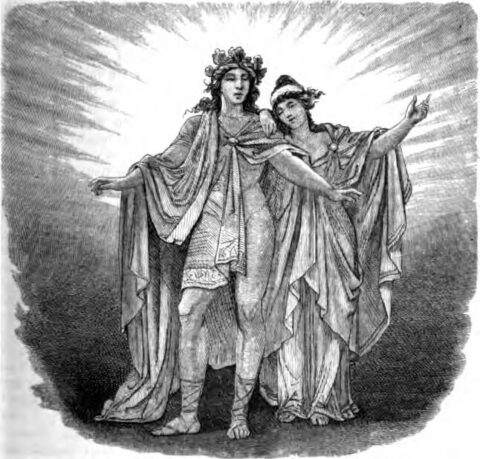
Hœnir: The Norse God Who Helped Create Humanity
Hœnir appears in several important Norse myths, but the surviving texts never clearly define his role among the Æsir. In Völuspá, he joins Odin and Lóðurr in giving the first humans, Askr and Embla, the qualities needed for life. His gift is óðr, an Old Norse term associated with thought, awareness, and inspiration.
In Ynglinga saga, Hœnir is sent to the Vanir as a hostage and relies on Mímir’s counsel when difficult decisions arise. Other stories place him alongside Odin and Loki, while Völuspá names him in the renewed world after Ragnarök, choosing mysterious lot-twigs. These accounts reveal a god involved in major mythological events, yet leave his specific religious function and historical worship largely unknown.
Who Was Hœnir in Norse Mythology?
Hœnir belonged to the Æsir, the group of Norse gods that included Odin and Thor, although his particular responsibilities remain unknown. In Skáldskaparmál, Snorri Sturluson names him among twelve gods seated as judges during Ægir’s visit to Asgard. Yet Hœnir is absent from the main catalogue of gods in Gylfaginning, and the surviving sources provide no reliable account of his parentage or family relationships.
His name also appears as Hænir in some Old Norse editions, while Hoenir is a simplified English spelling. Its etymology remains disputed. Scholars have proposed connections with the Old Norse noun hæna, meaning “hen,” and the verb hæna, meaning “to attract” or “entice,” but neither derivation has gained general acceptance.
Skáldskaparmál also preserves several poetic descriptions of Hœnir. He is called Odin’s bench-mate, companion, and confidant, suggesting a close association between the two gods. His other titles include hinn skjóti áss (the swift god), hinn langi fótr (the long-footed one), and aurkonungr (mud-king or king of clay). Their meanings are not fully understood, and some may refer to myths that have been lost.
Hœnir and the Creation of Askr and Embla
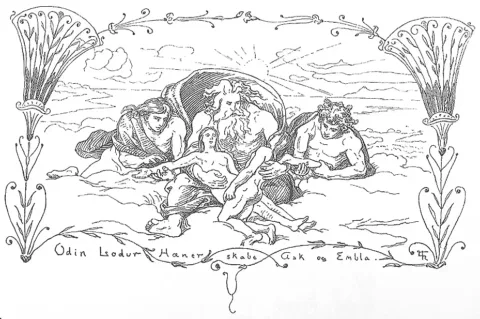
In Völuspá, stanzas 17 and 18, Hœnir joins Odin and Lóðurr in the creation of the first humans. The three gods find Askr and Embla on land, weak and örlöglausa, meaning “without fate.” The poem does not explain how their bodies were formed. Instead, it describes the qualities each god gives them.
Odin grants ǫnd, generally understood as breath or life-spirit. Hœnir provides óðr, a term encompassing thought, awareness, and inspiration. Translating it simply as “intelligence” overlooks its broader meaning. Lóðurr gives lá, an uncertain term sometimes interpreted as vital warmth or blood, together with a healthy or pleasing appearance. These gifts transform Askr and Embla into fully living human beings.
Snorri Sturluson’s Gylfaginning, chapter 9, preserves a different account. Here, the three sons of Borr find two trees on the seashore and shape them into a man and woman. They grant their creations life, understanding, movement, bodily form, speech, hearing, and sight. Although Borr’s sons are named elsewhere as Odin, Vili, and Vé, Snorri never identifies Hœnir with Vili or Vé. The proposed identification of Lóðurr with Loki also remains disputed.
Both accounts describe three gods giving humanity its essential qualities, but only Völuspá explicitly names Hœnir and identifies his gift as óðr. This establishes his participation in human creation without proving that he held a separate divine responsibility for intelligence.
Why Was Hœnir Sent to the Vanir?
Hœnir was sent to the Vanir as a hostage to secure peace following their war with the Æsir. In chapter 23 of Gylfaginning, Snorri Sturluson briefly mentions his exchange for Njörðr. Chapter 4 of Ynglinga saga provides a fuller account: the Vanir send Njörðr, Freyr, and Kvasir, while the Æsir send Hœnir and Mímir.
In Ynglinga saga, Hœnir is described as tall, handsome, and well suited to leadership. The Vanir appoint him chief, but Mímir provides the advice on which his decisions depend. Whenever a difficult matter arises at an assembly without Mímir present, Hœnir responds, ráði aðrir, meaning “Let others decide.”
Believing they have been deceived, the Vanir behead Mímir and send his head back to the Æsir. Odin preserves it with herbs and spells, restoring its ability to speak and reveal hidden knowledge. The saga does not explain what subsequently happens to Hœnir.
The episode portrays Hœnir as a leader unable to act independently, but it does not establish that he lacked intelligence. Ynglinga saga, composed in the thirteenth century, presents the gods as legendary rulers. Its account may preserve an older myth, but Snorri’s treatment of political authority also shapes how the story is told.
Another difference between the sources concerns Kvasir. Ynglinga saga identifies him as a wise hostage sent by the Vanir, whereas Skáldskaparmál describes his creation from the gods’ mingled saliva as a symbol of peace. The two accounts cannot simply be combined into a single, consistent version of the settlement.
Hœnir’s Journeys with Odin and Loki
Hœnir accompanies Odin and Loki in two Old Norse accounts, although he plays a less prominent role than his companions. One of the earliest references appears in Haustlǫng, a skaldic poem attributed to Þjóðólfr ór Hvini and preserved in Snorri Sturluson’s Skáldskaparmál.
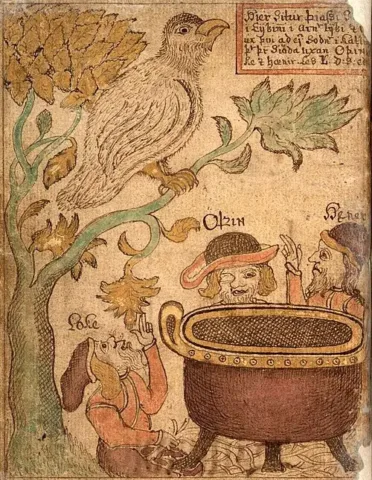
The three gods are cooking an ox when the giant Þjazi, disguised as an eagle, prevents the meat from cooking and demands a share. Loki strikes the eagle but becomes trapped and is carried away, eventually promising to lure Iðunn out of Asgard. The poem calls Loki Hœnis vinr (“Hœnir’s friend”) in stanza 3 and hugreynandi Hœnis (“Hœnir’s mind-tester”) in stanza 12. These poetic expressions provide early evidence of their association, although they reveal little about Hœnir’s individual role in the episode.
The trio also appears in the prose introduction to Reginsmál. While traveling near a waterfall, Loki kills an otter that proves to be Ótr, the son of Hreiðmarr. The gods are then forced to compensate his family with gold obtained from the dwarf Andvari. This treasure carries a curse that later shapes the story of Fáfnir and Sigurðr. Hœnir accompanies the other gods, but the narrative gives him no separate action.
A later Faroese ballad, Lokka táttur, gives Hœnir a more active role. When a giant threatens to take a farmer’s son, Hœnir hides the boy as a feather on a swan’s head. The giant catches the bird and tears at its neck, but Hœnir calls the boy back to safety. Loki eventually defeats the giant. First documented in 1822, the ballad preserves the association between the three gods in later folklore, though its late recording cannot establish how Hœnir was understood during the Viking Age.
Does Hœnir Survive Ragnarök?
Hœnir appears in the renewed world after Ragnarök in Völuspá, stanza 63 in many modern editions. Following the earth’s emergence from the sea and the return of Baldr and Höðr, the poem states:
Þá kná Hœnir hlautvið kjósa.
The line can be translated as “Then Hœnir can choose the lot-twigs.” His presence confirms a place in the world after Ragnarök, but the poem does not explain whether he survived the destruction or returned afterward.
The term hlautviðr is generally understood to refer to wooden lots or twigs used in a ritual context. The Hauksbók manuscript preserves the variant hlutviðr, strengthening the interpretation of the objects as lots associated with divination. Some scholars have linked them to sacrificial blood, although this connection lacks independent confirmation.
Hœnir’s selection of the twigs has led scholars to suggest a priestly or divinatory role in the renewed world. Yet Völuspá describes neither the ritual nor its purpose, and it does not identify him as the gods’ new leader. Snorri’s account of the surviving gods in Gylfaginning, chapter 53, does not mention Hœnir.
Was Hœnir Associated with Birds or Divination?
Hœnir’s unusual titles have led some scholars to associate him with birds. His descriptions as swift and long-legged, together with the title aurkonungr (“mud-king”), have prompted comparisons with wading birds, particularly storks. Another proposed connection is linguistic: his name may be related to the Old Norse hæna, meaning “hen.”
Birds appear in several Norse accounts involving supernatural knowledge and the passage between worlds. In Völuspá, three roosters announce the approach of Ragnarök. Eiríks saga rauða describes the seeress Þorbjǫrg sitting on a cushion stuffed with hen feathers during a ritual of seiðr. In Saxo Grammaticus’s Gesta Danorum, a woman accompanying King Hadingus into the underworld tears the head from a rooster and throws it beyond a wall, where the bird is heard crowing. This episode has been compared with Mímir’s severed head, which continues to speak after Odin preserves it.
In a 2025 study, Karen Bek-Pedersen and Benjamin Weber Pedersen examine these parallels alongside Hœnir’s name, his relationship with Mímir, and his selection of lot-twigs after Ragnarök. They also consider Ibn Fadlan’s tenth-century description of chickens sacrificed during a Rus funeral on the Volga. Together, these examples support their proposal that Hœnir may have been associated with prophecy and transitions between the living and the dead.
The interpretation remains uncertain. No surviving Norse myth depicts Hœnir taking bird form or performing divination with chickens. The proposed connection rests on linguistic possibilities and comparisons between separate traditions, rather than direct evidence of his religious function.
Was Hœnir Worshipped in the Viking Age?
There is no securely documented evidence of a cult dedicated to Hœnir in Viking Age Scandinavia. Unlike Odin, Thor, and Freyr, whose worship is supported by place-name evidence, Hœnir has no reliably identified cult-related place-names, dedicatory inscriptions, or archaeological finds. No sanctuary has been confidently linked to him.
This does not rule out local or undocumented worship. Religious practices varied across Scandinavia, and much of the evidence has been lost. Hœnir’s appearances in early skaldic poetry show that he was known in the mythological tradition, but they do not establish whether people prayed to him, made offerings, or performed rituals in his honour.
Conclusion
Hœnir’s surviving appearances do not fit neatly into a single divine role. His gift of óðr to humanity contrasts with his dependence on Mímir’s advice in Ynglinga saga, while his selection of lot-twigs after Ragnarök suggests another possible function. These episodes come from different sources, and there is no firm evidence that they once formed a consistent account of his character.
His appearances alongside Odin and Loki, together with his unusual poetic titles, show that he held a place in Norse mythological tradition. Yet neither his precise responsibilities nor an independent cult can be securely established. Hœnir remains a figure whose surviving stories are more revealing than any single explanation of what kind of god he was.
Sources & Primary Texts
This article draws on medieval Old Norse texts and modern scholarship. Interpretations of Hœnir’s identity, divine functions, and possible religious associations are distinguished from what the surviving sources explicitly record.
Academic Studies
- Bek-Pedersen, Karen, and Benjamin Weber Pedersen. (2025). “Hœnir: Being a Chicken in Old Norse.” In Good Thoughts on Folklore and Mythology: Festschrift in Honour of Terry Gunnell, Vol. 2, pp. 124–135. Trivent Publishing.
- Lindow, John. (2025). “Spittle-Man and the Talking Head: Hostages, Boundaries, and Transformations in the Peace Settlement of the Æsir and Vanir.” In Good Thoughts on Folklore and Mythology, Vol. 2, pp. 112–123. Trivent Publishing.
Primary Texts and Critical Editions
- Völuspá, stanzas 17–18 and 63. In The Poetic Edda. Old Norse text and linguistic commentary, University of Texas at Austin.
- Snorri Sturluson. Edda: Prologue and Gylfaginning, chapters 9, 23, and 53. Edited by Anthony Faulkes, 2nd ed., Viking Society for Northern Research, 2005.
- Snorri Sturluson. Edda: Skáldskaparmál. Edited by Anthony Faulkes, Viking Society for Northern Research, 1998. Includes Hœnir’s poetic names, material from Haustlǫng, and the account of Kvasir.
- Snorri Sturluson. Heimskringla I: The Beginnings to Óláfr Tryggvason, Ynglinga saga, chapter 4. Translated by Alison Finlay and Anthony Faulkes, 2nd ed., Viking Society for Northern Research, 2016.
Copyright & Editorial Notice: © 2026 History & Myths. All rights reserved. This article is an original historical and mythological analysis based on primary texts and academic research. Interpretations of disputed evidence are identified as scholarly hypotheses rather than established facts. Unauthorized reproduction or redistribution of the article’s original content is prohibited.