Behbeit el-Hagar: Home to Egypt’s Granite Temple of Isis
Behbeit el-Hagar is a village and archaeological site in Egypt’s Nile Delta, near ancient Sebennytos. It is best known for the ruins of a monumental granite temple dedicated to Isis, built largely under Nectanebo II in the fourth century BCE and completed with further decoration and additions under the Ptolemies.
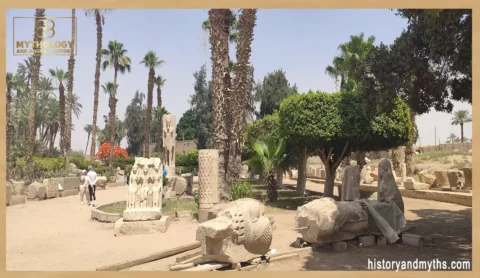
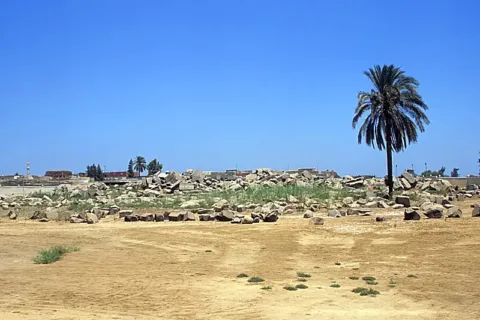
Today, the temple lies in ruins, its massive granite blocks scattered across the site. Many preserve hieroglyphic inscriptions and carved religious scenes. The cause of the building’s collapse remains uncertain, with structural problems and an earthquake among the proposed explanations.
Discoveries announced in October 2026, including fragments of two colossal statues associated with Ramesses II, have renewed interest in Behbeit’s earlier history. Their original setting remains unknown, so the finds cannot yet be linked to a specific building at the site.
What Is Behbeit el-Hagar?
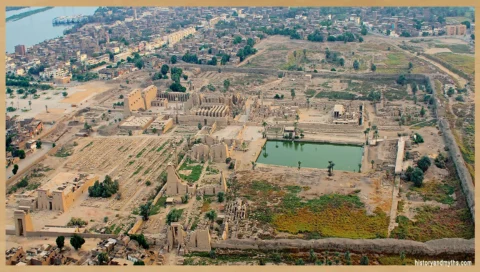
Behbeit el-Hagar is located in Egypt’s Gharbia Governorate, approximately seven kilometres northeast of Samannud, the site of ancient Sebennytos. It lies near the Damietta branch of the Nile, in what was once the twelfth nome, or administrative district, of Lower Egypt.
The name Behbeit is linked to the ancient Egyptian Hebyt or Per-Hebyt, which Egyptologist Christine Favard-Meeks interprets as the domain of the goddess of festivals. The Arabic addition el-Hagar, meaning “the stones,” refers to the granite ruins that dominate the site.
Behbeit was closely associated with Sebennytos, the home city of Egypt’s Thirtieth Dynasty, but the two were distinct locations. The sanctuary of Isis at Behbeit was known in Greek as the Iseion. Rather than a major independent city, ancient Behbeit may have functioned primarily as a religious centre connected with nearby Sebennytos.
The name Hebyt appears in earlier Egyptian records, although not every ancient reference can be securely identified with the present site.
Why Was Behbeit el-Hagar Important?
Behbeit el-Hagar was an important religious centre in Lower Egypt, closely associated with the worship of Isis and the renewal of Osiris. In the later temple, Isis played a central role in restoring and protecting Osiris, whose rebirth was linked to the legitimacy of Horus and Egyptian kingship.
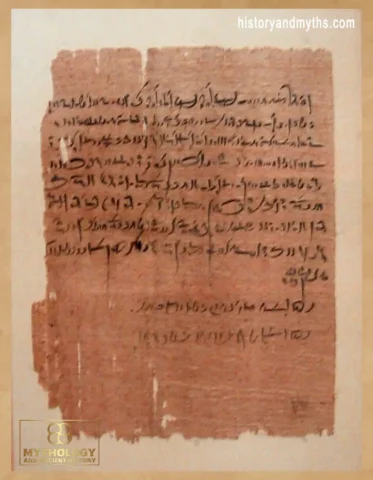
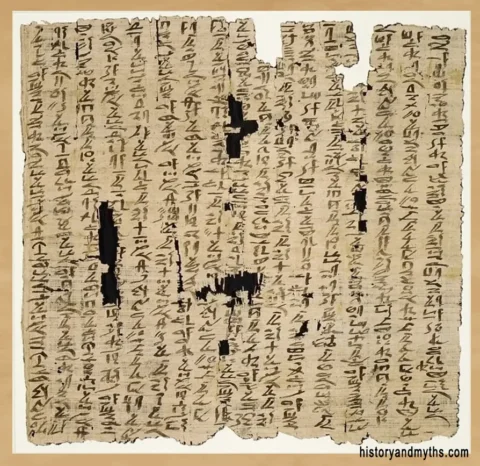
The site’s religious traditions predated the surviving granite sanctuary. The Delta Papyrus, an earlier Egyptian religious text, describes rituals involving clay figures representing the body of Osiris. These figures were prepared for ceremonies associated with the god’s survival and renewal. The text also reveals differences from later worship: Isis appears in the form of Chentayt, while Hathor performs an offering role that Isis would assume in the temple of Nectanebo II.
Another important deity was Osiris-Hemag, a particular manifestation of Osiris associated with Behbeit. Nectanebo II dedicated an extensively decorated chapel to him, suggesting that his worship held a prominent place in the temple’s ritual activities.
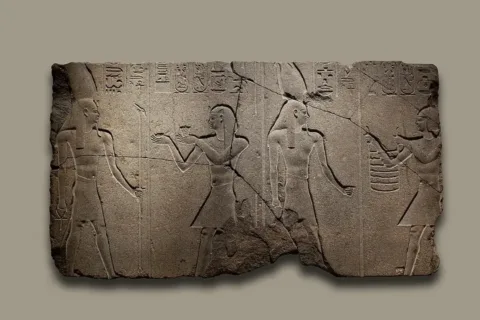
The sanctuary also had royal significance. Its reliefs show Egyptian kings making offerings to Isis and Osiris, connecting royal authority with the gods whose protection and renewal were central to the temple’s religious purpose.
Who Built the Temple of Isis?
The granite Temple of Isis at Behbeit el-Hagar was built primarily under Nectanebo II (360–343 BCE), the last native Egyptian pharaoh before the second Persian conquest. The building remained unfinished when his reign ended, and work continued under the early Ptolemaic rulers.
Nectanebo II constructed most of the main temple, including its sanctuary and chapels. He had nearly completed the decoration of an important chapel dedicated to Osiris-Hemag, but much of the remaining decoration was unfinished when the Persian conquest interrupted the project in 343 BCE.
Work resumed under Ptolemy II Philadelphus, whose craftsmen completed the decoration of the sanctuary and its surrounding chapels.
Ptolemy III Euergetes later expanded the complex by adding and decorating a hypostyle hall and a monumental western façade. These additions completed the main architectural sequence of the temple known from its surviving remains.
Architecture of the Granite Temple
The Temple of Isis at Behbeit el-Hagar was remarkable for its extensive use of granite. Unlike most Egyptian temples, which were built primarily from sandstone or limestone, its main structure consisted of massive granite blocks. The surviving stones range from dark grey to pink, many still bearing finely carved reliefs and hieroglyphic inscriptions.
Although the building no longer preserves a complete floor plan, archaeologists have proposed a ceremonial approach, or dromos, leading to its western façade. A hypostyle hall stood before the sanctuary of Isis. This arrangement is reconstructed from surviving architectural fragments rather than intact rooms.
Beyond the sanctuary were chapels dedicated to different forms of Osiris. Large staircase blocks indicate access to the roof, where the chapel of Osiris-Hemag was located. Other Osirian chapels may also have occupied elevated parts of the building.
One surviving relief from the Osiris-Hemag chapel, now in the Metropolitan Museum of Art, depicts Nectanebo II offering incense and a collar to the god. The carving is unfinished: Osiris’s sceptre and ankh are absent from part of the scene, providing evidence of the decoration process before work stopped.
The temple’s original arrangement remains partly uncertain because its architectural blocks collapsed and many were subsequently removed. Their dimensions and inscriptions nevertheless allow researchers to identify sections of the building and propose how they once fitted together.
Was There an Earlier Temple at Behbeit el-Hagar?
The granite Temple of Isis built under Nectanebo II may have replaced an older sanctuary. According to the Metropolitan Museum of Art, an earlier temple was probably begun at Behbeit el-Hagar during Egypt’s Twenty-sixth Dynasty (664–525 BCE), although little is known about its original structure.
There is also evidence of material dating to the reign of Ramesses II (1279–1213 BCE). In 2017, Egyptologists Mahmoud Emam and Ehab Abd el-Zaher published a study of two stone fragments, numbered 477 and 624, bearing the king’s cartouches. Both had been recovered during infrastructure work near the later temple.
The researchers suggested that these fragments might indicate a building from Ramesses II’s reign or an even earlier period. However, the stones could have been moved or reused, and no securely identified Ramesside structure has been established at the site. Their discovery alone cannot determine whether such a building existed or what purpose it served.
The written evidence raises another question. Egyptologist Christine Favard-Meeks has challenged attempts to identify Behbeit with the sacred place called Netjer in much older Egyptian texts. The connection between these names is securely attested only in later inscriptions, so the earlier references cannot establish that a temple of Isis already stood at Behbeit during the Old Kingdom.
Why Did the Temple Collapse?
The Temple of Isis at Behbeit el-Hagar collapsed sometime after the reign of Ptolemy III in the third century BCE and before the early third century CE. Its exact date of destruction and the cause remain uncertain.
Structural weakness is one possible explanation. Researchers have suggested that unstable foundations may have struggled to support the temple’s enormous granite masonry. An earthquake, possibly around 24 BCE, has also been proposed, but no specific event has been conclusively linked to the collapse.
A conservation study published in 2021 documented cracks, microfractures, salt crystallisation, and other forms of deterioration in the surviving stones. These findings help explain the damage visible today but cannot independently establish when the temple originally fell.
After the collapse, the ruins became a source of building material. Granite blocks were removed and reused, while others eventually entered museums and private collections. The surviving remains have also suffered from weathering and human activity over the centuries.
Read More on History & Myths
The Ramesses II Discoveries of 2026
In October 2026, Egyptian archaeologists announced the discovery of substantial remains of two colossal royal statues at Behbeit el-Hagar. One was identified as Ramesses II (1279–1213 BCE), while the second was provisionally attributed to the same pharaoh.
The finds followed a report from a local resident who discovered an inscribed stone block while working on his property. Rescue excavations conducted by the Supreme Council of Antiquities uncovered the statue fragments and additional inscribed material.
The first statue is represented by a head measuring approximately 1.60 metres in height, showing Ramesses II wearing the Double Crown. Part of its back pillar bears the king’s Horus name, Hor Ka Nakht Mery Maat. Archaeologists estimate that the complete statue, including its base, may have stood around 8.5 metres tall.
The surviving portion of the second statue measures approximately 2.40 metres, with its legs and base missing. Its well-preserved head shows a royal figure wearing the nemes headdress, although the upper part is damaged. A nearby pink granite block, measuring 1.30 metres, carries the royal titles Nesu-Bity (King of Upper and Lower Egypt) and Sa-Ra (Son of Ra).
Together, the finds provide additional evidence of Ramesside monuments associated with Behbeit. Their original location and architectural setting remain to be established, leaving open whether they belonged to an earlier structure at the site or were brought there later.
Archaeological Research and the Temple’s Future
Much of what is known about Behbeit el-Hagar comes from documenting its scattered granite blocks. Excavations directed by Pierre Montet between 1948 and 1952 uncovered previously buried fragments. Christine Favard-Meeks began collecting evidence in 1972 and 1973, before undertaking a larger photographic and epigraphic documentation programme with Dimitri Meeks from 1977 to 1988.
Favard-Meeks’s 1990 doctoral research catalogued 324 blocks at the site or believed to belong there, along with approximately 20 pieces held in museums. Her work later developed into a database combining inscriptions, historical drawings, photographs, and archaeological records.
A reconstruction project undertaken with Egypt’s Supreme Council of Antiquities in 1993 was not completed. A further survey in 2006 documented surviving blocks and improved the archaeological records.
In April 2026, Egyptian antiquities officials examined new proposals for conserving and potentially reconstructing parts of the temple. These included recording the remaining inscriptions, assessing the weight of the granite blocks, testing soil stability, and considering how selected fragments could be displayed safely.
No approved reconstruction programme had been confirmed at that stage. Reassembling the temple would require identifying the original positions of its blocks and conducting engineering studies to determine whether they could be safely supported.
Academic Sources & Historical References
This article draws on Egyptological scholarship, archaeological documentation, museum collections, and reports of recent discoveries. Interpretations of the site’s earliest history and the causes of the temple’s collapse remain subject to ongoing research.
Egyptological Studies
Le temple de Behbeit el-Hagara: Essai de reconstitution et d’interprétation
Christine Favard-Meeks, 1991. Studien zur Altägyptischen Kultur, Beihefte 6.A foundational study of the temple’s architecture, inscriptions, religious significance, and proposed reconstruction.
Les toponymes Netjer et leurs liens avec Behbeit El-Hagara et Coptos
Christine Favard-Meeks, 2002. Topoi, Supplement 3, pp. 29-45.Examines ancient place-names, the Delta Papyrus, and the evidence for religious traditions predating the surviving temple.
Pharaoh and Temple Building in the Fourth Century BCE
Martina Minas-Nerpel, 2018. In Ptolemy I Soter and the Transformation of Egypt, 404-282 BCE. Brill.Places Nectanebo II’s building activities within the wider architectural and political developments of Egypt’s final native dynasties.
Two New Fragments of Ramesses II from the Temple of Behbeit el-Hagar
Mahmoud A. Emam and Ehab Abd el-Zaher, 2017. Studien zur Altägyptischen Kultur, Vol. 46.Documents two fragments bearing Ramesses II’s cartouches and discusses the possibility of earlier construction at the site.
The Environmental Factors Affecting the Archaeological Buildings in Egypt: III. Deterioration by Severe Seismic Hazards
M. El-Gohary, 2021. Egyptian Journal of Archaeological and Restoration Studies, 11(2), pp. 147-164.Investigates seismic damage and deterioration affecting the temple’s surviving masonry, including fractures and salt crystallisation.
Museum & Archaeological Documentation
Nectanebo II Offers to Osiris Hemag
The Metropolitan Museum of Art, Department of Egyptian Art.Provides evidence for the temple’s construction phases, the Osiris-Hemag chapel, its surviving reliefs, and proposed explanations for its collapse.
Temple de Behbeit el-Hagara: Archaeological Documentation Project
AOROC, École Normale Supérieure / CNRS. Scientific direction: Christine Favard-Meeks.Documents excavations, surveys, inscribed blocks, historical photographs, and the research behind attempts to reconstruct the temple’s architecture.
Archaeological Discoveries of 2026
Egypt Discovers Remains of Two Colossal Statues of Ramses II
Ahram Online, October 13, 2026. Reporting statements from Egypt’s Supreme Council of Antiquities.Reports the rescue excavation, statue fragments, inscriptions, estimated dimensions, and the provisional identification of the second statue.
Ramesside fragments and statues provide evidence of monuments associated with Behbeit el-Hagar, but their original locations have not been securely established. The evidence does not yet demonstrate that Ramesses II constructed the surviving Temple of Isis. Likewise, proposed explanations for the temple’s collapse should not be treated as confirmed events.
Copyright Notice
© 2026 History & Myths. All rights reserved.
The original written content of this article is protected by copyright. Reproduction or republication of substantial portions requires prior permission, except as permitted by applicable copyright law.
Historical sources and third-party materials remain subject to their respective rights and licenses. Sources are acknowledged in the references above.