What If Set Had Defeated Horus and Ruled Egypt? Alternate Scenario
Set’s defeat by Horus did more than settle a dispute between two gods. It helped define one of the central ideas of Egyptian kingship: Horus became the rightful heir of Osiris, while the living pharaoh was identified with Horus and presented as the legitimate ruler of the Two Lands.
But what if the judgment had gone the other way?
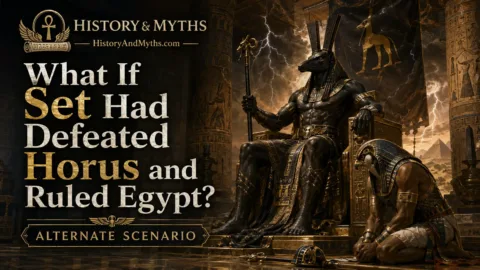
If Set defeated Horus and gained the throne with the approval of the gods, Egypt would not simply become a kingdom ruled by chaos. Set was more complex than a god of destruction. Egyptian tradition also associated him with strength, storms, dangerous landscapes, and, in some periods, the defense of Ra against the serpent Apophis.
The deeper change would be political and religious. A kingship built around Horus would need to be rewritten. The relationship between the living king and Osiris would become harder to explain, Isis would face the permanent defeat of her son’s claim, and Set himself would inherit a role that required the ruler to preserve ma’at rather than undermine it.
The result might be a very different Egyptian monarchy, one in which Set could keep the throne only by becoming a protector of the order he once challenged.
The Mythological Turning Point
The struggle between Horus and Set begins with the death of Osiris and a problem that Egyptian myth had to resolve: who had the right to inherit his kingship?
Horus claimed the throne as the son and heir of Osiris. Set challenged that claim, presenting himself as the stronger contender and refusing to surrender power simply because Horus had inherited a family right. Their dispute was therefore more than a personal feud. It was a contest over what made a ruler legitimate: descent, strength, divine approval, or some combination of all three.
Egyptian sources preserve different episodes and versions of this conflict. The most extensive surviving narrative, The Contendings of Horus and Set, describes the gods debating the rival claims before a divine tribunal while Horus and Set endure a long series of contests and confrontations. The dispute is repeatedly delayed because Set remains powerful enough to challenge a quick decision in Horus’s favor.
Eventually, Horus receives the throne of Osiris and becomes the legitimate king. Set is defeated in the succession struggle, although he is not removed from Egyptian religion. He continues to possess divine power and, in other traditions, performs important roles of his own.
That outcome matters because Horus’s victory became closely connected with Egyptian ideas of kingship. The living king could be identified with Horus, while the dead ruler was associated with Osiris. Succession therefore mirrored the divine pattern: Osiris dies, Horus inherits, and legitimate rule continues.
This scenario changes that single decision. Set wins the contest and receives the throne instead. The question is no longer whether he can defeat Horus, but whether Egyptian kingship itself could function once the heir of Osiris had lost.
The Scenario Used in This Article
This is a hypothetical scenario, not a claim about what actually happened.
This article assumes that Set defeats Horus decisively enough for the gods to recognize his claim to the throne. He does not merely seize power by force. He becomes the legitimate ruler of Egypt within the divine order.
Horus survives, Isis remains an important goddess, and Osiris continues to rule the dead. The wider Egyptian pantheon also remains intact. What changes is the principle at the center of kingship: the throne that historically belonged to the heir of Osiris now belongs to Set.
The scenario does not assume that Egypt falls into permanent chaos or that Set replaces every other god. A ruler of Egypt would still be expected to preserve ma’at, defend the country, maintain temples, and uphold divine order.
The central question is therefore:
Can Set rule Egypt successfully without changing what Set himself represents?
Could Egyptian Kingship Be Rebuilt Around Set?
If the gods recognized Set as king, his victory would be more than a seizure of power. Egyptian religion would have to treat him as a legitimate ruler and explain why the throne no longer passed from Osiris to Horus.
That would require changes to royal ideology, but Egyptian history suggests that association between Set and kingship was not impossible. During the Second Dynasty, King Peribsen placed the Seth animal above his serekh instead of the usual Horus falcon. Later, Khasekhemwy displayed both Horus and Seth above his royal name. The meaning of these choices remains debated, but they show that Set could be incorporated into royal identity at the highest level.
In this scenario, what was exceptional could become permanent.
The Horus name might lose some of its central importance, while royal titles and imagery increasingly linked the king with Set’s strength. The ruler could be presented as dangerous to Egypt’s enemies, capable of suppressing disorder, and supported by the gods to govern the Two Lands.
The harder problem would be succession. Horus was the son and heir of Osiris, while Set was his rival and killer in the mythic cycle. A Set-centered monarchy would therefore need to separate royal legitimacy from descent through Osiris and replace it with another principle, perhaps divine judgment, strength, or the ability to maintain ma’at.
Set could become a legitimate king, but only by changing the theological rules that had made Horus the natural model of the throne.
Would Horus Still Have a Place in Set’s Kingship?
Horus would probably lose his exclusive claim over kingship, but he would be far too important to disappear from Egyptian religion.
If Set became the recognized ruler, Horus could remain a sky god, protector, and major cult figure while no longer serving as the automatic divine model of every reigning king. His defeat might also give him a new role as the displaced heir or guardian of lawful succession.
Egyptian royal ideology already had ways to accommodate both gods. Horus and Set could appear together as opposing forces brought into balance within kingship rather than as enemies whose conflict required one to vanish completely.
That offers a likely solution to the problem created by Set’s victory. Set could hold the throne while Horus remained part of the symbolic structure that supported the unity and legitimacy of Egypt. The relationship between them would change from a contest for exclusive rule into a hierarchy in which Set governed but Horus still represented a necessary counterweight.
Such an arrangement would preserve Horus’s religious importance without restoring him to power. It would also make Set’s monarchy easier to integrate into traditions that had linked Horus with kingship for centuries.
Set might defeat Horus, but ruling Egypt successfully could still require keeping his rival inside the royal order.
Could Set Actually Uphold Ma’at?
Set’s victory would create an immediate contradiction. The king of Egypt was expected to preserve ma’at, yet Set was often associated with violence, disruption, and forces that threatened stability.
That contradiction would not necessarily make his rule impossible.
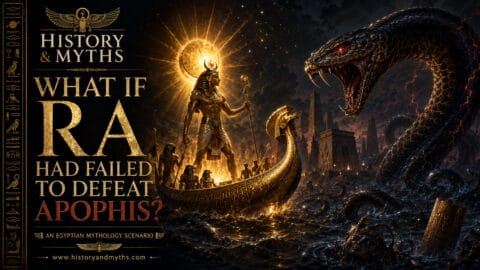
Set was never limited to a single destructive role. Egyptian religion could also present him as a necessary force against greater threats. In New Kingdom traditions, he appears defending Ra’s solar bark against Apophis, using his strength against the serpent that represented a far more fundamental danger to cosmic order.
A Set-centered monarchy could build on that side of his character. Royal ideology would emphasize the king as aggressive toward Egypt’s enemies, dangerous to forces outside the ordered world, and powerful enough to keep chaos beyond the country’s boundaries. Set’s violence would not disappear. It would be redirected.
This would also change how Set himself was understood. Instead of representing a permanent challenger to legitimate rule, he could become the force that protects legitimate rule once he possesses it.
Ma’at would therefore remain central. Egyptian kingship could hardly function without the idea that the ruler maintained the balance between gods, people, and the ordered world. The theological adjustment would be to argue that Set’s strength served that balance rather than opposed it.
The paradox is that victory might domesticate Set more effectively than defeat ever did. To remain king, the god who challenged order would have to become one of its defenders.
What Happens to Osiris and the Afterlife?
Set’s victory would not automatically remove Osiris from the afterlife. His authority there rested on a different role: Osiris was the dead king, ruler of the underworld, and a central figure in resurrection and judgment.
The real disruption would be the relationship between death and succession.
In the traditional royal pattern, the dead king could be identified with Osiris while his successor took the place of Horus. That created a clear cycle: the old king dies, the rightful heir succeeds him, and kingship continues without breaking the divine order. If Set replaced Horus, that pattern would no longer work in the same way. The ruler of the living world would be the god who had opposed Osiris rather than his son and heir.
Egyptian theology would therefore need a new explanation for how royal power passed from one generation to the next. Osiris could remain lord of the dead, but he might cease to be the direct source of legitimacy for the living king.
That would affect kingship more than ordinary hopes for the afterlife. Egyptians could still expect judgment, rebirth, and association with Osiris after death. Those beliefs did not depend entirely on Horus sitting on the earthly throne.
The larger change would be symbolic. Egypt would now contain two divine kingships that no longer formed a natural succession: Osiris ruling the dead and Set ruling the living.
For a Set-centered monarchy to remain stable, Egyptian religion would eventually have to explain how those two realms could coexist without restoring Horus to the throne.
What Would Happen to Isis After Horus’s Defeat?
Isis would survive Set’s victory, but one of her most important royal roles would become harder to sustain.
Her authority did not depend entirely on Horus. She was the wife of Osiris, a goddess of protection and restoration, and a major figure in beliefs surrounding death and rebirth. Those functions could continue even if her son lost the throne.
What would change is her connection with the reigning king. Because Isis was the mother of Horus, she could also be understood symbolically as the mother of the pharaoh. A monarchy centered on Set would weaken that relationship. The royal mother would no longer naturally mirror Isis protecting and raising the future Horus.
She would also remain a theological problem for Set. In the succession myth, Isis repeatedly defends her son’s claim. If Horus were permanently denied the throne, Egyptian tradition would have to decide whether she accepted the divine judgment or continued to represent the legitimacy of the defeated heir.
The most plausible outcome is not the suppression of Isis, but a narrower royal role. She could remain one of Egypt’s major protective and funerary goddesses while losing some of her direct connection to the ideology of the living king.
That would leave Set with an uncomfortable reality: defeating Horus would not erase the divine family whose throne he had taken.
Read More
- Set: Egyptian God of Chaos, Osiris and Ra
- Horus: Falcon God of Kingship, War and the Eye of Protection
- What If Osiris Had Never Been Murdered?
- Isis and Osiris: Love, Betrayal and Resurrection
- Osiris: Ancient Egyptian God of the Afterlife, Fertility and Justice
- What If Ra Refused to Reveal His Secret Name to Isis?
Would Egypt Still Remain United?
Set’s victory would not necessarily divide Egypt. The stronger question is whether a Set-centered monarchy could still present itself as ruler of the Two Lands.
Egyptian kingship depended on the idea that Upper and Lower Egypt formed a single political and cosmic order under one ruler. Horus became closely associated with that unity, but Egyptian symbolism also preserved Set as part of the same royal structure. Some traditions paired Horus and Set as opposing powers that could be reconciled within a unified kingdom rather than treating one as a force that had to vanish completely.
That gives Set two possible paths after victory.
He could claim sole authority over both lands, forcing royal ideology to present him as a universal king rather than a regional or rival god. More plausibly, Horus might remain part of the symbolism of unity even after losing the throne. Set would rule, but the monarchy could continue using both gods to express the balance of different forces within Egypt.
This would be especially useful politically. A king identified only with Set might struggle to inherit all the symbolism already attached to Horus. A system that placed Set above Horus politically while preserving both within royal ritual would require far less disruption.
Egypt therefore would not need to split simply because Horus lost. The more likely outcome is that the meaning of unity would change.
Instead of Horus defeating Set and establishing rightful rule, Egyptian ideology might present unity as Set possessing the throne while Horus remains necessary to complete the balance of the Two Lands.
Would Set’s Cult Become the Center of Royal Religion?
Set would almost certainly receive far greater royal patronage, but that would not make him the only major god of Egypt.
Egyptian religion was too diverse for one cult to replace the rest. A Set-centered monarchy would still need Amun, Ra, Ptah, Osiris, Isis, and the many local gods whose temples were tied to cities, priesthoods, and royal ritual.
What would change is Set’s position at court. His temples could receive more land, wealth, and building projects, while royal inscriptions emphasized his strength, protection, and connection with the king. Places already associated with his worship could gain greater political importance.
There is a historical precedent for strong royal support of Set. During the Ramesside period, Set was worshipped at Pi-Ramesses alongside other major deities, and royal names such as Seti show that association with him could exist at the highest level of the state.
In this scenario, that patronage would no longer be occasional or dynastic. It could become a permanent feature of kingship.
Set would not replace the Egyptian pantheon. He would move much closer to its political center.
Would Set Still Become a Feared or Demonized God Later?
Probably not in the same way.
Set’s reputation changed greatly across Egyptian history. During the New Kingdom, he could receive royal patronage and even act as a protector of Ra against Apophis. In later periods, however, his image became increasingly hostile, especially as traditions emphasized his role as the murderer of Osiris and enemy of Horus.
If Set had been remembered instead as the legitimate victor in the succession dispute, that later demonization would have been much harder to sustain. Royal theology would have spent generations presenting his power as necessary, lawful, and protective.
That would not make Set harmless. His storms, aggression, and association with dangerous regions could still give him a threatening character. But fear and legitimacy can coexist. He might be respected as a dangerous guardian rather than condemned as the defeated enemy of rightful kingship.
The largest change, then, would be his historical memory. A victorious Set could remain one of Egypt’s most unsettling gods without becoming its clearest divine villain.
What Would Probably Not Change
Set’s victory would not erase Egyptian religion. Osiris would remain central to the afterlife, Isis and the major gods would retain their cults, and ma’at would still define legitimate rule.
The main disruption would be narrower but profound: kingship, succession, and the divine identity of the living ruler.
Most Likely
The most likely outcome is a monarchy that recasts Set as a legitimate protector of Egypt.
His cult would gain greater royal importance, Horus would lose his exclusive link with kingship, and Set’s strength would be presented as serving order rather than threatening it.
Plausible but Uncertain
Egyptian kings might adopt stronger Set-based titles and imagery, while Horus survived as a balancing figure within royal ideology.
Set’s cult centers could also gain political influence, and the traditional Osiris-Horus model of succession might be revised rather than abandoned.
Highly Unlikely
A Set victory would not turn Egypt into a kingdom of permanent chaos.
Horus would not simply disappear, the major gods would not be replaced, and ma’at would remain essential to kingship. A complete collapse of the traditional pantheon is the least credible version of this scenario.
Final Verdict: Set Could Win the Throne, but He Would Have to Change
If Set had defeated Horus and become Egypt’s legitimate ruler, the greatest change would be to kingship itself.
Horus would lose his exclusive position as the model of the living king, while Set would inherit a role that demanded stability, protection, and the defense of ma’at. Osiris, Isis, and the wider pantheon could survive, but the logic of royal succession would have to be rewritten.
The most plausible result is not an Egypt transformed into chaos, but a Set transformed by kingship.
Set could win the throne. To keep it, he would have to become a guardian of the order he once challenged.
Frequently Asked Questions
What would happen if Set defeated Horus?
If Set defeated Horus and was recognized by the gods as Egypt’s legitimate ruler, the greatest change would likely affect kingship. Horus would lose his exclusive connection with the living pharaoh, while royal theology would have to explain how Set could rule while preserving ma’at.
Would Set’s victory mean that chaos ruled Egypt?
Probably not. Set had destructive and disruptive qualities, but Egyptian religion also gave him protective roles. A legitimate king was expected to defend order, so a victorious Set would likely be reinterpreted as a dangerous force used to protect Egypt rather than destroy it.
Would Horus disappear if Set became king?
No. Horus was too important to Egyptian religion to simply vanish. He could remain a major sky and protective god while losing his exclusive role as the divine model of the reigning king.
Could Egyptian pharaohs have been associated with Set instead of Horus?
There is historical evidence that Set could be incorporated into royal identity. Second Dynasty king Peribsen placed the Seth animal above his serekh instead of the usual Horus falcon, showing that association between Set and kingship was possible, even though the exact meaning of that choice remains debated.
What would happen to Osiris if Set ruled Egypt?
Osiris would likely remain ruler of the dead and central to beliefs about death and rebirth. The larger problem would be royal succession, because the traditional relationship between the dead Osiris and his living heir Horus would no longer define the throne.
Would Set still become a feared god if he had defeated Horus?
He could still remain dangerous and intimidating, but his later reputation might develop differently. Generations of royal support could present his aggression as legitimate strength used against Egypt’s enemies and threats to divine order.
Sources & Further Reading
This article draws on museum, university, and Egyptological sources for the mythology, kingship, and religious concepts behind the scenario.
MYTHOLOGICAL TEXT
The Metropolitan Museum of Art:
The Contendings of Horus and Seth
Discussion of Papyrus Chester Beatty I and the divine hearing over the rival claims of Horus and Seth to succeed Osiris.
MYTH & SUCCESSION
University College London, Digital Egypt:
Gods and Goddesses in Ancient Egypt: Creation
Overview of Osiris, Isis, Seth, and Horus, including the succession struggle and Horus’s eventual recognition as heir and king.
KINGSHIP
University College London, Digital Egypt:
Kingship in Ancient Egypt
Explains the king’s identification with Horus, the Horus name, royal titulary, and the divine character of Egyptian kingship.
HORUS, SETH & ROYAL TITLES
University College London, Digital Egypt:
The Horus Name
Documents the Horus name and the exceptional Second Dynasty cases of Peribsen using the Seth animal and Khasekhemwy displaying both Horus and Seth.
ROYAL ORDER
University College London, Digital Egypt:
What Does a King Have to Do in Ancient Egypt?
Examines the king’s responsibility to uphold what was right, oppose disorder, serve the gods, and maintain the functioning of the state.
SETH’S COMPLEX ROLE
Institute for the Study of Ancient Cultures, University of Chicago:
François Gaudard, Studies on Seth
Egyptological discussion of Seth’s complex character, including positive roles such as defending Re against Apophis and acting as a protective divine force.
ISIS, HORUS & ROYAL LEGITIMACY
The Metropolitan Museum of Art:
Isis and Horus
Discusses Isis as the mother of Horus and symbolically the mother of the pharaoh, as well as Horus’s association with legitimate rule over Egypt.
Research note: The historical and mythological background in this article is based on the sources above. The alternate outcome in which Set defeats Horus and rules Egypt is a hypothetical analytical scenario. Its proposed consequences are interpretations of how Egyptian kingship and religion might have adapted, not claims about events that actually occurred.
Copyright & Use
Written by H. Moses
This article is original content published by History & Myths. Its alternate-history analysis, structure, and written interpretation may not be reproduced, republished, or redistributed in full without permission.
Short quotations may be used for reference or discussion when accompanied by clear attribution and a link to the original article on HistoryAndMyths.com.