Duat: The Egyptian Underworld, Afterlife and Judgment
To the ancient Egyptians, death was not a sudden ending or a leap into the unknown. It was a passage into a hidden realm governed by laws as precise as those that ruled the living world. This realm was the Duat—not a distant heaven, not a place of eternal punishment, but a complex landscape where order was tested, chaos confronted, and existence itself was either renewed or erased. Every hope for immortality, every fear of failure after death, and every promise of cosmic balance converged within it.
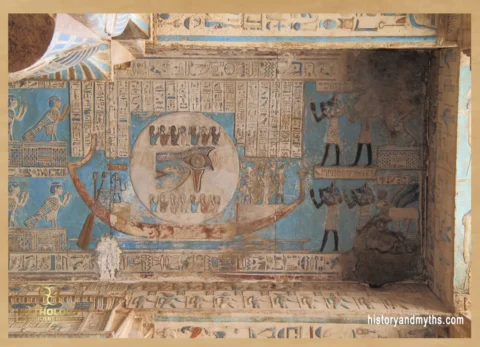
Unlike later ideas of the underworld as a single destination, the Duat functioned as a system. It was the space through which the sun god traveled each night to be reborn at dawn, and at the same time, the domain every human soul had to navigate after death. Gates, guardians, judges, and hidden regions filled its depths—not as random obstacles, but as expressions of a worldview obsessed with balance, knowledge, and moral order. Survival in the Duat depended less on brute strength and more on understanding: knowing names, speaking truth, and aligning oneself with Ma’at, the principle of cosmic justice.
This article explains the Duat as the Egyptians understood it: not as mythic scenery, but as the backbone of their afterlife beliefs. By tracing how the Duat appears across funerary texts, divine journeys, and judgment rituals, we can see why it became the most powerful concept in Egyptian mythology of death. The Duat was where gods proved the stability of the cosmos—and where humans learned whether their existence was worthy of continuing beyond the grave.
What Is the Duat? (And Why It Was Not “Hell”)
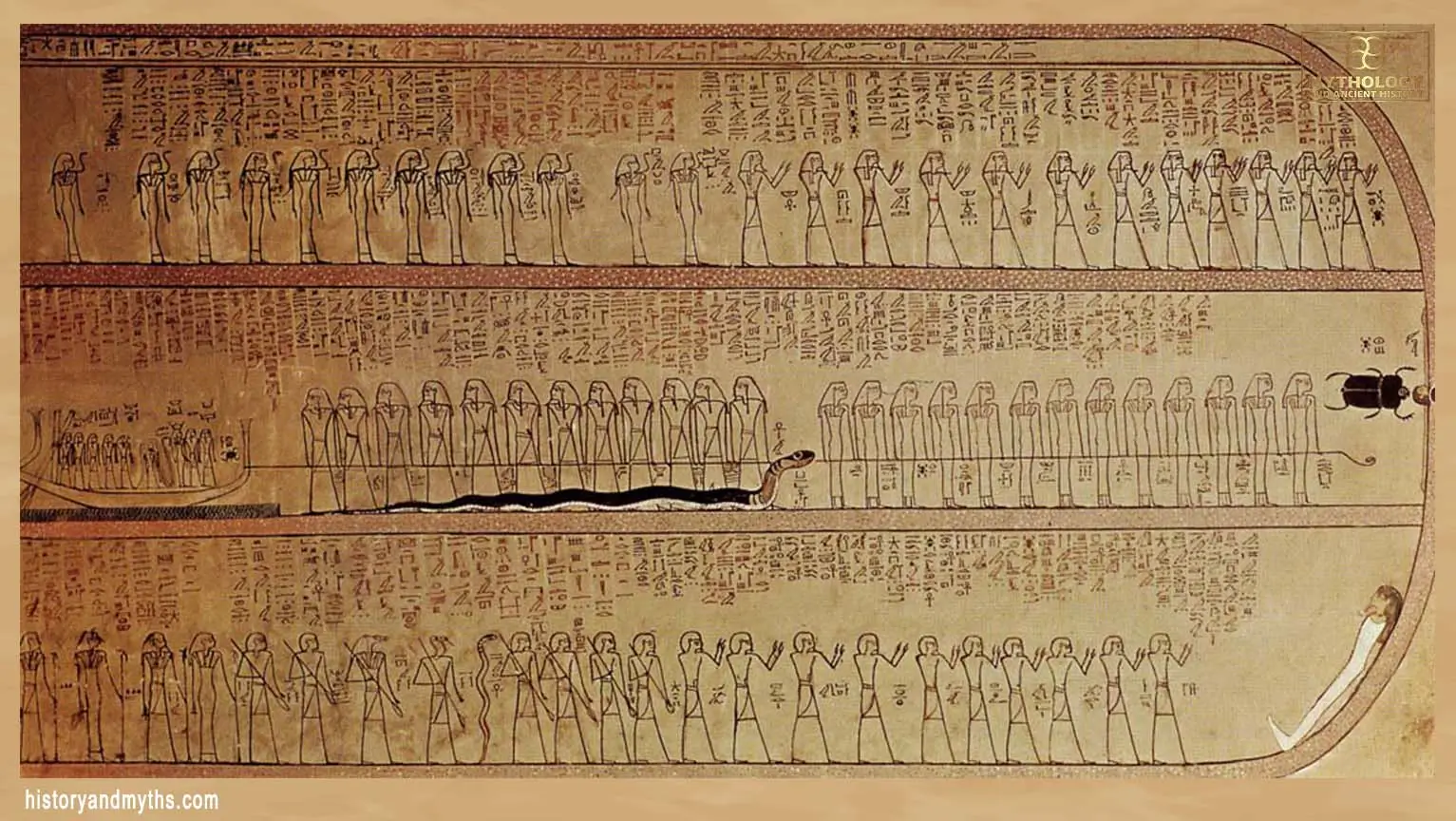
In Egyptian thought, the Duat was not simply “the land of the dead.” It was a hidden dimension of existence, operating alongside the visible world yet governed by different rules. Its name itself suggests secrecy and inaccessibility—a realm concealed from ordinary sight. The Duat could appear as an underground domain, a celestial region beyond the horizon, or a liminal space reached at sunset and dawn. This flexibility was not confusion; it reflected a belief that reality extended far beyond what the living could perceive.
Crucially, the Duat was not a place of automatic reward or punishment. Entry into it did not guarantee bliss, nor did it condemn the dead by default. Instead, it functioned as a testing ground where the stability of existence was evaluated. The dead entered the Duat carrying their identity, memory, and moral record, and only those who proved themselves in harmony with cosmic order could continue. Failure did not usually mean eternal torment—it meant non-existence. To the Egyptians, being erased, silenced, or devoured was far worse than suffering.
This is where later comparisons with “hell” break down. The Duat was not designed to punish sinners for the sake of justice alone. Its primary role was cosmic maintenance. It protected the universe from disorder by filtering out what could not endure. The terrifying beings, dark waters, and hostile forces found there were not sadistic punishers; they were expressions of chaos, entropy, and resistance to order. To pass through the Duat was to demonstrate worthiness—not moral perfection, but alignment with truth, balance, and rightful order.
Understanding the Duat this way explains why it appears so differently across texts and images. It was never meant to be a single, fixed “underworld map.” It was a process, a realm where transformation occurred—where the sun was reborn each morning and where human existence was either renewed or brought to a final end.
| Aspect | Explanation |
|---|---|
| What the Duat Is | A hidden cosmic realm where order is tested and existence is either renewed or ended. |
| Is It “Hell”? | No. It is not a place of eternal punishment, but a system of judgment, renewal, and possible annihilation. |
| Main Purpose | To maintain cosmic balance by filtering chaos from what is fit to endure. |
| Two Key Journeys | The nightly passage of the sun god and the one-time journey of the deceased human soul. |
| Ruler of the Duat | Osiris, who presides over judgment and guarantees lawful order after death. |
| Role of Knowledge | Names, speech, and recognition determine passage through gates and hidden regions. |
| Greatest Threat | Chaos and non-existence, not suffering or eternal torment. |
| Successful Outcome | Arrival at Aaru (Field of Reeds), an ideal continuation of ordered life. |
| Why It Matters | The Duat explains how order survives death and why moral balance sustains the universe. |
Two Journeys That Defined the Duat
The Duat was shaped by two parallel journeys, each essential to the survival of the cosmos. One was divine and cyclical, repeated every night without fail. The other was human and irreversible, undertaken only once. Together, these journeys explain why the Duat was not merely an afterlife realm, but the engine that kept existence itself in motion.
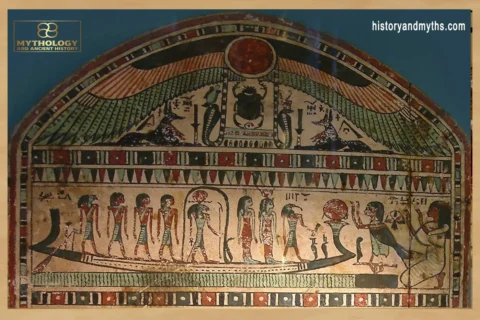
The first journey belonged to the sun god. Each evening, as the sun disappeared beyond the western horizon, it did not simply vanish—it entered the Duat. There, it traveled through a series of hidden regions, confronting darkness, hostile forces, and the ever-present threat of chaos. This passage was not a symbolic death, but a process of regeneration. By overcoming resistance within the Duat, the sun restored cosmic order and emerged renewed at dawn. Night, in this sense, was not absence, but labor—the unseen work required to keep the universe functioning.
The second journey was that of the deceased individual. Unlike the sun’s eternal cycle, the human passage through the Duat happened only once and carried permanent consequences. The dead entered carrying their heart, their name, and the record of their life. Their movement through the Duat was shaped by recognition, judgment, and knowledge. Progress depended on knowing how to address guardians, how to cross boundaries, and how to demonstrate harmony with Ma’at. Success meant continuation; failure meant erasure.
What made these journeys inseparable was their shared space. Gods and humans did not pass through different underworlds—they moved within the same cosmic system. The nightly triumph of the sun proved that order could overcome chaos, offering a model and a promise for human souls. At the same time, every successful human passage reinforced the moral structure that the gods themselves relied upon. In the Duat, divine order and human destiny were tested together, bound by the same laws and the same dangers.
The Duat in Funerary Texts (Why Its “Maps” Never Fully Match)
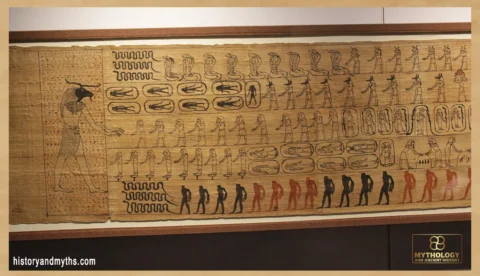
Much of what we know about the Duat comes not from a single sacred book, but from layers of funerary texts written across centuries. This is why the Duat often appears inconsistent or even contradictory. It was never recorded as one authoritative blueprint. Instead, each text presented the Duat through a specific purpose, audience, and moment in religious thought.
Early funerary traditions approached the Duat as an elite, restricted realm, closely tied to royal power and cosmic renewal. Over time, this vision expanded. Later texts made the journey through the Duat more accessible to non-royal individuals, but they did not standardize it. Different texts emphasized different dangers, helpers, regions, and outcomes. What mattered was not cartographic accuracy, but ritual effectiveness—what knowledge the dead needed in order to endure.
Some compositions focus on movement and transformation, describing hidden regions the soul must traverse, often filled with gates, guardians, or perilous waters. Others emphasize judgment and moral testing, where the dead must demonstrate alignment with truth and order. Still others present the Duat as a cosmic battlefield, where order and chaos clash nightly. These perspectives do not cancel one another out; they reflect how the Egyptians understood reality itself—as layered, functional, and dependent on context.
Because of this, attempts to reduce the Duat to a single diagram or a fixed number of regions miss the point. The Duat was not designed to be “mapped” like a physical landscape. It was a ritual space, shaped by speech, memory, and action. Knowing the correct names, utterances, and roles mattered more than knowing precise directions. Survival depended on recognition—being recognized by the system of order that governed the unseen world.
This explains why the Duat could be described as underground in one text, celestial in another, and liminal in a third. Each description was true within its own framework. The Duat was not unstable; it was multidimensional, reflecting a worldview where existence itself operated on multiple levels at once.
Who Ruled the Duat? Order, Judgment, and the Authority of Osiris
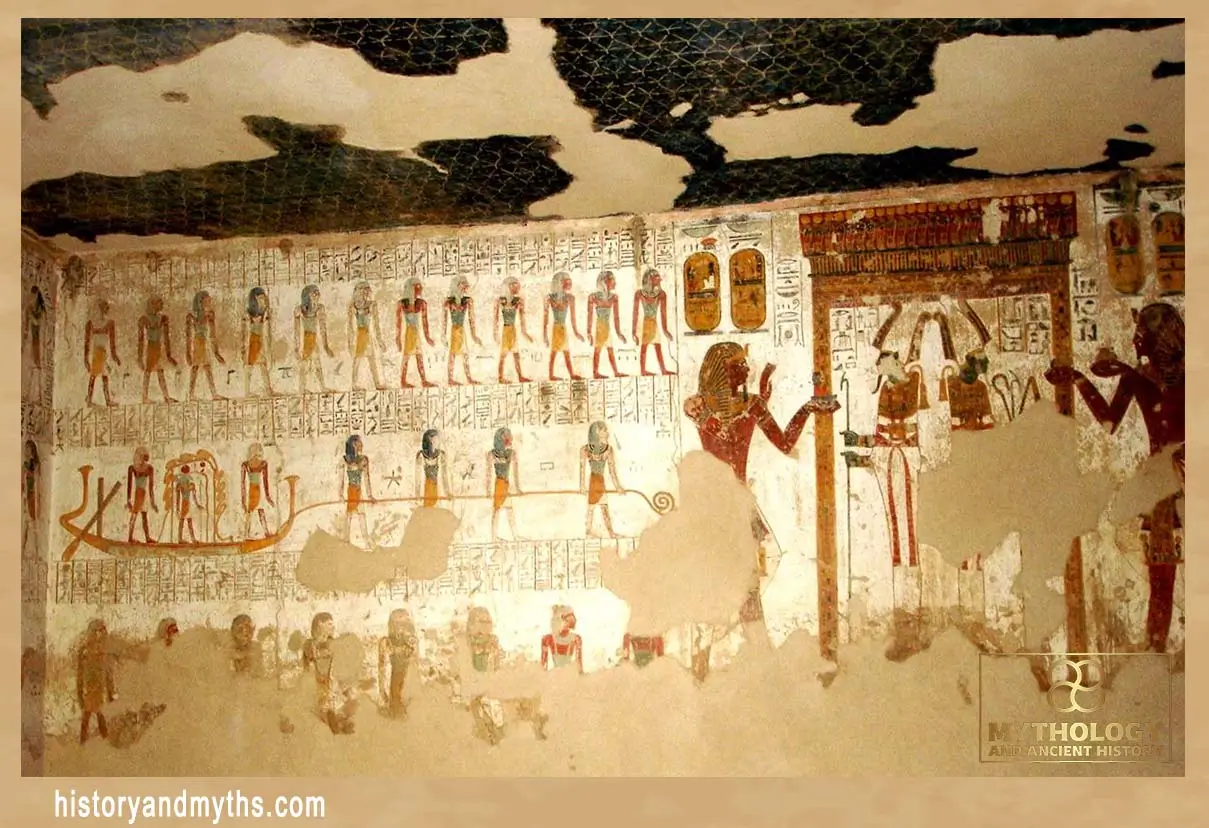
Despite its shifting landscapes and multiple descriptions, the Duat was never imagined as lawless. At its core stood authority and judgment, embodied above all by Osiris. Unlike solar gods who moved through the Duat in cycles, Osiris was fixed within it. He represented stability, continuity, and the promise that order could survive even after death. As ruler of the Duat, he was not a tyrant or punisher, but the guarantor that justice would be applied correctly.
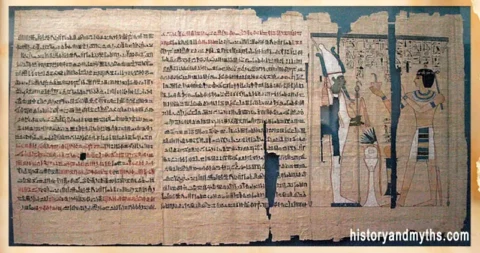
Osiris’s court was not symbolic theater. Judgment in the Duat determined whether existence would continue at all. The dead were assessed according to Ma’at—the principle of truth, balance, and rightful order that governed both gods and humans. This was not morality in an abstract sense. It was practical alignment: had the individual lived in a way that upheld balance, respected divine order, and avoided becoming a source of chaos? The Duat did not ask whether someone was perfect; it asked whether they were fit to endure.
Surrounding Osiris was a structured judicial system. Assessors, divine witnesses, and ritual procedures ensured that judgment was not arbitrary. The heart, believed to contain memory and moral identity, played a central role. It could not be deceived, silenced, or replaced. If the heart failed to align with truth, the outcome was final. There was no appeal, no cycle of punishment and redemption—only continuation or disappearance.
This judicial structure reveals why fear and hope coexisted so strongly in Egyptian afterlife belief. The Duat was dangerous, but it was not unjust. Its ruler did not invent rules; he enforced cosmic order. Osiris embodied the idea that death did not dissolve responsibility. Even beyond the grave, existence remained conditional upon balance, truth, and rightful place within the universe.
What Existed Within the Duat? Gates, Guardians, and the Logic of Knowledge
The Duat was not an empty void ruled only by judges and gods. It was filled with structures, beings, and thresholds that shaped every movement within it. Gates blocked passage, guardians demanded recognition, and entire regions existed solely to test whether a soul truly belonged within the ordered universe. These elements were not obstacles placed for cruelty—they were mechanisms designed to filter chaos from continuity.
Gates were among the most prominent features of the Duat. They did not open through force or status, but through knowledge. Knowing a gate’s name, the identity of its guardian, and the correct form of address was essential. Speech itself had power. A soul that could name and recognize correctly demonstrated awareness, memory, and alignment with order. Silence, ignorance, or confusion marked a being as unstable—something that could not safely persist.
Guardians varied widely in form, often appearing intimidating or monstrous. Their appearance, however, was symbolic rather than malicious. Many embodied dangerous forces—fire, darkness, sharpness, or aggression—but they were bound by rules. They attacked only what failed to identify itself properly. In this sense, the Duat rewarded clarity of identity. To know who you were, and to be able to state it correctly, was to prove your right to continue.
Alongside these guardians existed threats that represented pure disorder, most notably the great serpent of chaos that opposed cosmic renewal. Such forces were not judges and could not be reasoned with. They embodied the risk that order might fail altogether. Their presence explains why passage through the Duat was never guaranteed, even for gods. Each successful crossing reaffirmed that chaos could be contained—but never permanently destroyed.
Together, gates, guardians, and threats formed a system based on recognition and resistance. The Duat did not test strength or obedience; it tested understanding. To pass through it was to demonstrate that one belonged to the structure of existence itself.
How the Duat Functions as a System
- Not a single place: The Duat is a layered, hidden realm described differently across funerary texts.
- Two parallel journeys: The nightly regeneration of the sun and the one-time passage of the human soul.
- Knowledge over force: Names, speech, and recognition allow movement through gates and regions.
- Judgment, not torture: Failure leads to non-existence, not eternal suffering.
- Cosmic purpose: The Duat protects order by confronting chaos every night.
- Successful outcome: Endurance leads beyond survival to Aaru, the perfected continuation of life.
© historyandmyths.com — Educational use
The Destination Beyond Survival: Aaru and the Meaning of Success
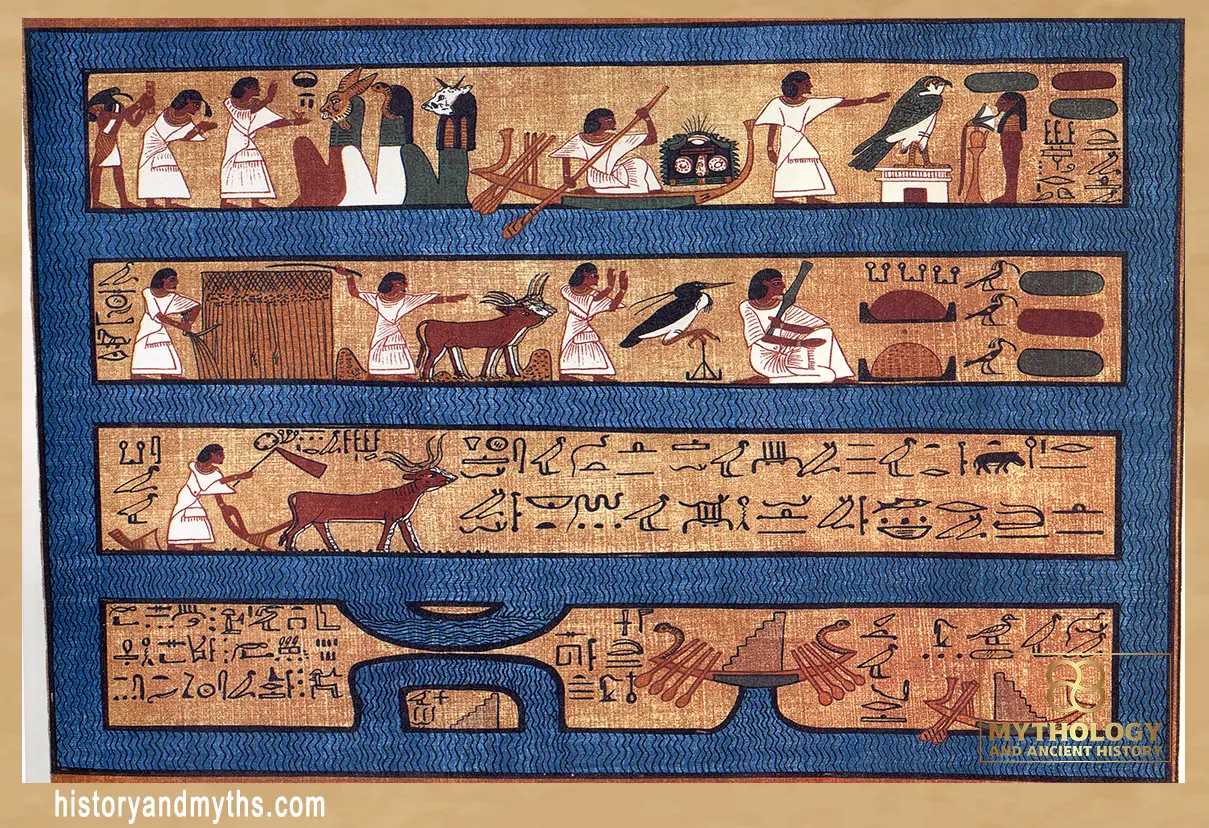
Passing through the Duat was not an end in itself. Survival, judgment, and recognition were all means, not goals. For those who succeeded, the journey opened into Aaru, often called the Field of Reeds—a realm that represented fulfillment rather than escape. Aaru was not a paradise detached from earthly life; it was an idealized continuation of it.
In Aaru, existence was stable, ordered, and meaningful. Fields were fertile, labor was purposeful, and abundance was guaranteed—not as reward, but as the natural state of a life aligned with Ma’at. The dead did not dissolve into abstract spirits. They retained identity, memory, and agency. What changed was not who they were, but the conditions under which they existed. Hunger, injustice, and cosmic threat were removed because they belonged to chaos, not to order.
This vision reveals something crucial about the Egyptian concept of the afterlife. Eternal life was never imagined as passive rest. It was active continuity—a life worth living because it functioned correctly within the universe. The Duat filtered existence; Aaru preserved it. One tested worthiness, the other confirmed it.
Importantly, Aaru was not guaranteed by belief alone. It was the outcome of a successful passage through the Duat’s system. This is why funerary practices focused so heavily on preparation: spells, names, and rituals were not superstition, but tools designed to ensure that life could continue under ideal conditions. To reach Aaru was to prove that one’s existence deserved to last—not temporarily, but forever.
Why the Duat Became the Core of Egyptian Afterlife Belief
The power of the Duat lies in the fact that it answered the Egyptians’ deepest anxiety: what happens to existence when order is no longer visible. Death removed individuals from the structured world of society, law, and daily ritual. The Duat provided a framework that ensured this loss did not dissolve meaning. It explained how order could persist even when life ended—and how chaos could be confronted without denying its presence.
Unlike simple visions of reward or punishment, the Duat offered a coherent cosmic logic. It linked morality, knowledge, divine authority, and natural cycles into a single system. The same realm that tested human souls also renewed the sun each night. This connection meant that personal survival was never separate from cosmic stability. A just life contributed to universal order, while failure threatened not only the individual but the balance of existence itself.
The Duat also endured because it was adaptable. As religious texts evolved, political power shifted, and access to the afterlife expanded beyond royalty, the Duat absorbed these changes without losing its core function. New texts added gates, regions, and figures, but the underlying idea remained constant: survival after death depended on alignment with truth, recognition, and order. This flexibility allowed the Duat to remain relevant for thousands of years.
Ultimately, the Duat was not feared because it was cruel—it was respected because it was necessary. It acknowledged that chaos could never be fully erased, only resisted and contained. By placing that struggle at the heart of the afterlife, Egyptian mythology transformed death from a meaningless end into a final participation in the maintenance of the cosmos.
The Duat as a Mythic System, Not a Story
What ultimately distinguishes the Duat from most underworld concepts is that it was never meant to function as a single myth or narrative. It was a framework—a way of thinking about death, order, danger, and continuity all at once. There was no definitive story of “entering the Duat and reaching the end.” Instead, there was a system that could be entered from many angles: through the journey of the sun, through funerary ritual, through judgment scenes, or through protective spells carved on tomb walls.
This is why the Duat resists simplification. It cannot be reduced to a checklist of stages, a fixed map, or a moral fable. Every description served a purpose: to prepare the dead, to reinforce cosmic order, or to explain why renewal was possible at all. Even its most terrifying elements were not there to frighten, but to define boundaries—to show where order ended and chaos began.
Seen this way, the Duat was one of the most intellectually sophisticated ideas in Egyptian mythology. It connected life, death, ethics, language, and the movement of the cosmos into a single invisible mechanism. To understand the Duat is to understand how the Egyptians made sense of mortality itself—not by escaping it, but by integrating it into the structure of the universe.
Key Takeaways — Understanding the Duat
- The Duat was not a “hell,” but a hidden system where existence was tested and filtered.
- It hosted two inseparable journeys: the nightly renewal of the sun and the soul’s passage after death.
- Judgment in the Duat focused on alignment with order, not moral perfection or punishment.
- Knowledge—names, speech, and recognition—was the key to survival, not strength or status.
- Failure meant non-existence, while success led to Aaru, an ideal continuation of life.
- The Duat endured because it explained how order could survive death and resist chaos.
Frequently Asked Questions About the Duat
What was the Duat in ancient Egyptian belief?
The Duat was a hidden cosmic realm where the dead were judged and where order was tested before existence could continue beyond death.
Was the Duat the Egyptian version of hell?
No. The Duat was not a place of eternal punishment. Failure there usually meant non-existence, not endless suffering.
Who ruled the Duat?
Osiris ruled the Duat as judge and guarantor of cosmic order, ensuring that justice followed the principle of Ma’at.
Why did the Duat have gates and guardians?
Gates and guardians tested knowledge, identity, and recognition. Knowing names and proper speech proved alignment with order.
Did all souls pass through the same Duat?
Yes. Gods and humans moved within the same cosmic system, though their journeys and outcomes differed.
What happened to those who failed judgment in the Duat?
Those who failed were erased from existence, a fate considered worse than suffering in Egyptian belief.
What was the goal after surviving the Duat?
The ultimate goal was reaching Aaru, the Field of Reeds, where life continued in a perfected, stable form.
Why does the Duat appear differently across Egyptian texts?
Each funerary text described the Duat according to ritual purpose, not as a fixed or unified map.
Sources & Rights
- Assmann, Jan. Death and Salvation in Ancient Egypt. Ithaca: Cornell University Press, 2005.
- Hornung, Erik. The Ancient Egyptian Books of the Afterlife. Translated by David Lorton. Ithaca: Cornell University Press, 1999.
- Hornung, Erik. The Egyptian Amduat: The Book of the Hidden Chamber. Zurich: Living Human Heritage Publications, 2007.
- Allen, James P. Middle Egyptian: An Introduction to the Language and Culture of Hieroglyphs. 2nd ed. Cambridge: Cambridge University Press, 2010.
- Taylor, John H. Death and the Afterlife in Ancient Egypt. London: British Museum Press, 2001.
- Faulkner, Raymond O. The Ancient Egyptian Book of the Dead. Rev. ed. Austin: University of Texas Press, 2010.
- Quirke, Stephen. Ancient Egyptian Religion. London: British Museum Press, 1992.
- Wainwright, G. A. “The Sky-Religion in Egypt.” Journal of Egyptian Archaeology 22 (1936): 25–36.
Written by H. Moses — All rights reserved © Mythology and History