What If Ra Refused to Reveal His Secret Name to Isis?
In the Egyptian story of Isis and Ra’s secret name, Isis does not seek the name simply to increase her power. She needs it to remove the poison from Ra’s body. Only after he reveals the hidden name can she complete the cure.
But what if Ra had refused?
Isis would remain a powerful goddess and magician, but Ra would stay poisoned. For an ageing ruler, that could turn a private contest over magical knowledge into a much larger problem of authority.
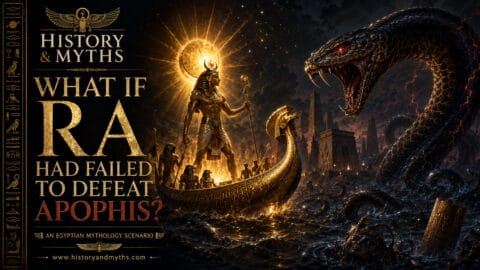
Another Egyptian tradition already tells of humanity rebelling against an elderly Ra before he withdraws from the earth and rises to the sky. If Ra were also weakened by a poison he could not remove, that rebellion might unfold very differently.
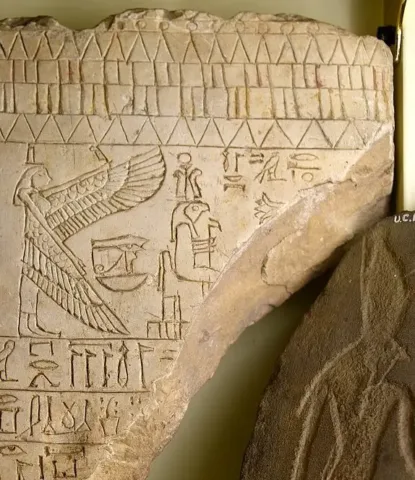
The Original Turning Point: Why Ra Gave Isis His Secret Name
In the surviving spell, Ra does not reveal his secret name willingly. He gives it up because the poison has overwhelmed him and Isis makes knowledge of that name the condition for removing it.
The text presents Ra as an ageing god. Isis uses his own spittle to create the serpent that bites him, and the poison spreads through his body until he trembles in pain and cannot identify what has attacked him.
Ra tries to avoid surrendering the secret by reciting several of his divine names and identities. Isis rejects them, and the poison remains. Only then does he allow the hidden name to pass from his body to her.
The name was something Ra had deliberately concealed from other gods and magicians. By gaining it, Isis crosses a boundary he had carefully protected. Ra also instructs her to pass the secret to Horus under oath.
Once the name is transferred, Isis commands the poison to leave, and the spell declares that Ra lives while the poison dies. Without that transfer, the cure described in the text never reaches its conclusion.
The Alternative Scenario: Ra Refuses to Reveal the Name
In this version of the story, Ra refuses to surrender the hidden name.
Isis still possesses the knowledge and magic she had before the encounter, but she cannot complete the cure in the way the surviving spell describes. Ra keeps his most protected secret, while the poison remains in his body.
Neither side gets everything it wants. Isis fails to obtain the name, and Ra preserves it at the cost of remaining weakened.
From here, the question is no longer simply who controls a secret. It becomes what happens when the ruler of gods and humans must continue ruling while visibly diminished.
Ra Remains Poisoned
The immediate consequence is that the poison does not leave Ra.
The surviving text describes it spreading through his body until his lips shake, his limbs tremble, and the pain becomes overwhelming. Even after he recites several divine names, the poison remains.
Only after the hidden name passes to Isis does the spell reverse the condition and declare that Ra lives while the poison dies. If that transfer never happens, the text gives us no second cure.
The source does not say whether the poison would eventually kill him. What it does support is continued suffering and weakness: an ageing god who survives, but cannot recover through the remedy preserved in the story.
Could Ra’s Weakness Trigger a Rebellion?
Another Egyptian tradition makes that possibility worth considering.
In the Book of the Heavenly Cow, humanity rebels against Ra after he has grown old. The text does not say that age or physical weakness caused the revolt, but it places rebellion in a world where Ra is no longer the ruler of an earlier, stronger age.
In this alternate scenario, the poison would make that vulnerability harder to ignore. A ruler who remains powerful in status but visibly weakened by magic could appear easier to challenge.
The poisoning story and the Heavenly Cow belong to separate traditions, so the connection is speculative. In this alternate scenario, Ra’s illness gives the rebellion a more dangerous setting: his authority is still intact, while his personal strength is not.
Would the Gods Still Obey Ra?
There is no reason to assume the gods would abandon Ra immediately.
In the Book of the Heavenly Cow, he calls the gods into council before responding to humanity’s rebellion. His rule is central, but it already operates through a wider divine order rather than through Ra acting alone.
A weakened Ra would likely depend on that order more heavily. Other gods could take on greater responsibility simply because he was less able to act with the same independence.
The change would therefore be gradual rather than revolutionary. Ra remains king, but more of his authority would have to be exercised through the gods around him.
Would Ra Still Leave Earth for the Sky?
He could, but under different circumstances.
In the Book of the Heavenly Cow, Ra leaves the earth after humanity rebels against him. He rises to the sky, reorganizes the cosmos, and delegates responsibilities to other gods. That tradition is separate from the story of Isis and the secret name, but it offers a useful parallel for what happens when Ra’s direct rule on earth becomes unstable.
If the poison were still weakening him, withdrawal could become even more appealing. Withdrawal to the heavens could place Ra beyond the immediate reach of further challenges while allowing him to continue his rule from above.
In the Heavenly Cow, Ra withdraws after rebellion. In this alternate version, he would leave as both a challenged ruler and a weakened one, making his departure look less like a simple cosmic reorganization and more like a retreat from direct earthly rule.
Would Ra Still Rule the Sun?
Yes. Nothing in the secret-name story suggests that the poison strips Ra of his solar identity.
The poison weakens his body, but it does not transfer his role as sun god to Isis or any other deity. A wounded Ra is still Ra, and the story gives no reason to assume that the sun would stop moving or that another god would replace him.
The crisis would therefore affect his authority more than his solar function. Ra could remain the sun god even while becoming less capable of ruling the earth directly.
Read More
What Would Isis Gain and Lose?
Isis would lose the one prize the story is built around: Ra’s hidden name.
Without it, she would never gain the knowledge he had deliberately concealed from other gods and magicians, and she could not pass that secret on to Horus.
But she would not lose the magic or intelligence she already possessed. The story presents her as highly skilled before she learns the name. She creates the serpent, engineers the crisis, and brings Ra close to surrender through her own abilities.
She fails to take his deepest secret, but the episode still leaves her as the magician who succeeded in making the sun god dependent on her help.
What Would Horus Lose?
The clearest loss for Horus would be Ra’s secret name itself.
In the surviving spell, Ra allows Isis to learn the hidden name and instructs her to pass it on to Horus. If Isis never gains that knowledge, Horus cannot inherit it from her.
That removes one specific source of magical knowledge from his story. It does not erase his identity, his parentage, or the wider traditions built around him.
Would the Struggle with Set Change?
The conflict between Horus and Set rests on far more than Ra’s secret name.
Horus is the son of Isis and Osiris and the heir who challenges Set for his father’s kingship. Isis remains central to his protection and support throughout that struggle.
Without Ra’s hidden name, however, Horus would enter the conflict without one piece of knowledge the original spell says was to be passed to him. That could make some confrontations less favorable, especially where magic and divine authority matter.
There is no basis for saying he would automatically lose. The struggle with Set survives, but Horus would face it without one advantage he possessed in the original tradition.
Would Isis Still Become One of Egypt’s Greatest Goddesses?
Yes. Isis’s importance did not depend on Ra’s secret name alone.
She was already central to the Osiris tradition as his wife and as the mother and protector of Horus. Her identity also became closely associated with magic, kingship, protection, and the afterlife.
Losing Ra’s hidden name would remove one of the strongest stories of her outmaneuvering another major god, but it would not erase the much larger religious tradition built around her. Her cult later spread far beyond Egypt and became one of the most successful Egyptian cults in the Mediterranean world.
In this alternate version, Isis remains a major goddess, but one of her most striking victories over Ra never happens.
What Happens to the Healing Spell Itself?
The change would affect more than Ra and Isis. It would also alter the logic of the story as a healing spell.
The surviving text was used in a magical-medical context against poison. Ra’s suffering provides the divine model: poison enters his body, Isis gains the hidden name, and the poison is driven out. A human patient could then be treated through the same mythic pattern.
If Isis never learns the name, that pattern has no successful ending. Ra remains poisoned, so the story no longer provides the same model of recovery.
This would not erase Egyptian remedies for snakebite or poison, but this particular spell would lose the resolution that gives it force: Isis curing a god whom no one else can save.
Most Likely Outcome
The most plausible outcome is a weakened Ra who survives without surrendering his secret name.
His illness would make direct rule harder and leave his authority more exposed to challenge. Rebellion becomes easier to imagine, and his eventual withdrawal from the earth could happen under greater pressure.
Isis remains powerful but never gains Ra’s deepest secret, while Horus never inherits it from her. The divine order survives, but with a more vulnerable Ra and a different balance of power among the gods.
Why Ra’s Secret Name Mattered
Ra’s secret name was not simply another piece of divine knowledge. It was something he had deliberately hidden from gods and magicians because access to it meant access to a deeper level of power over him.
When Isis gained the name in the original story, she did more than cure Ra. She crossed a boundary he had tried to keep closed and gained knowledge that could later be passed to Horus.
That is what makes the alternate scenario significant. If Ra never reveals the name, the chain of transfer ends with him. Isis remains powerful, Horus remains his heir through other traditions, but this particular passage of hidden knowledge never takes place.
Academic Sources
This article is based on surviving Egyptian texts and modern Egyptological scholarship.
The alternate scenario is clearly separated from what the ancient sources themselves state.
Primary Texts and Academic Editions
- UCL Digital Egypt.
Isis and the Name of Ra.
Translation and commentary on the Ramesside incantation preserved in sources including
Papyrus Turin 1993 and Papyrus Chester Beatty XI.
This is the principal source for Ra’s poisoning, Isis’s demand for the hidden name,
the cure, and the instruction that the name later be passed to Horus. - William Kelly Simpson, ed. (2003).
The Literature of Ancient Egypt: An Anthology of Stories, Instructions, Stelae,
Autobiographies, and Poetry. 3rd ed., Yale University Press.
Includes scholarly translations of The Book of the Heavenly Cow and
The Contendings of Horus and Seth. - Erik Hornung (1999).
The Ancient Egyptian Books of the Afterlife.
Translated by David Lorton. Cornell University Press.
Includes a scholarly discussion of The Book of the Heavenly Cow,
Ra’s withdrawal from earth, and the reorganization of the cosmic order.
Modern Egyptological Scholarship
- Robert K. Ritner (1993; rev. printing 2008).
The Mechanics of Ancient Egyptian Magical Practice.
Studies in Ancient Oriental Civilization 54, Oriental Institute, University of Chicago.
A major scholarly study of Egyptian magical practice, including the role of names,
spoken power, ritual actions, healing, and magical medicine. - Geraldine Pinch (2004).
Egyptian Myth: A Very Short Introduction.
Oxford University Press.
See “The Big Fight: Conflict and Reconciliation” for the traditions surrounding
Horus, Seth, divine kingship, and the succession of Osiris.
DOI: 10.1093/actrade/9780192803467.003.0008 - Birgitte Bøgh (2013).
“The Graeco-Roman Cult of Isis.”
In The Handbook of Religions in Ancient Europe, pp. 228–241.
Acumen Publishing.
Useful for Isis’s development as a major goddess of magic, kingship, protection,
and healing, and for the later expansion of her cult beyond Egypt. - Lindsey A. Mazurek (2022).
Isis in a Global Empire: Greek Identity through Egyptian Religion in Roman Greece.
Cambridge University Press.
A modern archaeological and historical study of the spread and transformation of
Isis worship in the wider Mediterranean world.
DOI: 10.1017/9781009032209
Note: The story of Isis and Ra’s secret name and the Book of the Heavenly Cow
are separate Egyptian traditions. This article brings them together only as the basis
for an explicitly hypothetical “What If” scenario and does not present them as a single
continuous ancient narrative.
Copyright Notice
© 2026 History & Myths. All rights reserved.
This article is original editorial content created for HistoryAndMyths.com.
Unauthorized reproduction, republication, or substantial copying of the text,
structure, or original analysis is prohibited without prior written permission.
Brief quotations are permitted for commentary, research, or educational use
when accompanied by clear attribution and a link to the original article.