The Twelve Hours of the Night — Inside Egypt’s Underworld
In ancient Egyptian thought, the night was not an empty interval between sunset and dawn. It was a structured, dangerous, and necessary realm of transformation. The twelve hours of the night were understood as a sacred sequence in which death, dissolution, judgment, protection, and renewal unfolded according to cosmic law. This division was not merely poetic or astronomical—it reflected how the Egyptians believed existence itself was regenerated through darkness.
Rather than focusing only on what happens in each hour, the Egyptians treated the night as a system. Each hour marked a distinct state of being within the Duat, governed by its own rules, guardians, threats, and possibilities. Time during the night was not passive; it acted upon gods, souls, and the cosmic order itself. Survival through these hours was neither guaranteed nor automatic—it depended on knowledge, balance, and alignment with Ma’at.
This article examines the twelve hours of the night not as a simple itinerary of Ra’s journey, but as a framework that shaped Egyptian views of death, the afterlife, and rebirth. By exploring why the night was divided into twelve hours, how these hours functioned symbolically and ritually, and what they meant for both gods and the dead, we uncover a deeper logic beneath the Egyptian underworld—one in which darkness was not the opposite of life, but its essential crucible.
Why the Night Was Divided into Twelve Hours
The division of the night into twelve hours was not a narrative choice but a structural one. In Egyptian cosmology, time itself required order, even in darkness. Just as the day was governed by the visible sun and measured light, the night demanded its own regulated system—one capable of containing death without allowing chaos to prevail.
The number twelve carried a temporal logic rather than a numerical symbolism alone. It reflected a complete cycle: a full passage from disappearance to reemergence. By dividing the night into twelve segments, the Egyptians transformed darkness into a sequence of controlled stages. Each hour became a measurable threshold, ensuring that the sun’s absence did not mean the collapse of cosmic order. Night was therefore not a void, but a disciplined process.
This structure also solved a theological problem. If the sun god could die—or appear to die—each evening, his survival could not be left to chance. The twelve hours functioned as safeguards. Every hour introduced specific forces: some hostile, others protective. Movement through the night required cooperation between divine beings, spoken knowledge, and ritualized order. Without the segmentation of time, the journey would be amorphous and uncontrollable.
Crucially, the division of the night was not designed for the sun god alone. Human souls were believed to traverse the same temporal architecture after death. By mapping the night into known stages, the Egyptians provided the dead with a navigable afterlife. Knowledge of the hours—names, functions, and dangers—was a form of survival. Time itself became a gatekeeper, separating those who could proceed from those who could not.
In this way, the twelve hours transformed night from a threat into a mechanism of rebirth. Darkness was not eliminated; it was organized. Only by passing through every hour—without skipping or resisting the process—could renewal occur. Dawn was not guaranteed by light alone, but earned through endurance, order, and correct passage through time.
| Aspect | The Twelve Hours of the Night |
|---|---|
| Core Concept | A structured nocturnal cycle governing death, transformation, and rebirth in the Duat. |
| Function of Time | Time acts as an active force that tests, filters, and enables renewal. |
| Primary Actor | The Sun God Ra, undergoing vulnerability and regeneration. |
| Role of the Hours | Each hour represents a distinct state of existence with specific rules and thresholds. |
| Threats | Forces of stagnation and chaos that block illegitimate passage. |
| Guardians | Custodians of boundaries who regulate access through knowledge and order. |
| Helpers | Restorative beings who protect and renew the sun god during the night. |
| Meaning for the Dead | A navigable temporal framework guiding the soul toward rebirth. |
| Relation to Funerary Texts | Conceptual system expressed differently in the Amduat and Book of Gates. |
| Final Outcome | Completion of the night results in cosmic renewal and rebirth at dawn. |
The Solar Barque and the Journey Through the Hours
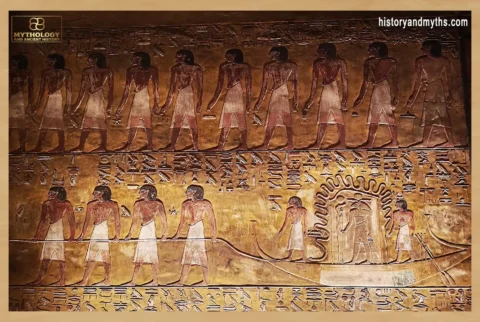
During the night, the solar barque is not a symbol of triumph but of vulnerability. Once the sun disappears beyond the western horizon, Ra no longer moves as a sovereign force illuminating the world. Inside the Duat, he becomes a being in transition, dependent on protection, guidance, and cooperation. The barque is the only structure that allows movement through the twelve hours, and without it, the journey would collapse into stillness or destruction.
The barque functions as a mobile boundary between order and chaos. It carries Ra through regions where time behaves differently, where space is compressed, and where hostile forces attempt to halt motion altogether. Progress is never automatic. In several hours, the barque must be pulled, guarded, or defended, revealing that forward movement through the night requires collective effort rather than divine dominance. The sun survives not by power alone, but by alignment with cosmic order.
Those who accompany Ra are not passive attendants. Protective deities, justified spirits, and guardian figures serve precise functions at specific hours. Some repel threats, others maintain direction, and others restore vitality to the sun god when his strength wanes. Their presence reinforces a core Egyptian belief: renewal is a shared responsibility. Even a god cannot complete the night alone.
For the dead, the solar barque represents more than divine transport. It models the ideal path through the afterlife. Souls aligned with Ma’at could join or follow the barque, benefiting from its protection and rhythm. Those who lacked knowledge or balance were left behind, unable to synchronize with the movement of sacred time. The barque therefore became both a promise and a filter.
The journey through the twelve hours transforms Ra himself. By the deepest point of night, he is no longer the same entity that entered the Duat at sunset. His passage strips away visible authority and prepares him for renewal. The barque does not merely carry the sun—it preserves the possibility of rebirth. Without this guided journey through structured time, dawn would be impossible.
The Hours as Stages of Death, Transformation, and Renewal
The twelve hours of the night were never understood as interchangeable moments. Each hour marked a distinct condition of existence, governed by its own logic and consequences. In Egyptian thought, death was not a single event but a gradual process, and the night provided the temporal framework for that process to unfold safely—if navigated correctly.
Early hours of the night represent separation. Here, the sun god and the soul alike are cut off from the world of the living. Identity begins to loosen, and familiar forms lose their stability. This is not yet judgment or punishment; it is disorientation. The Egyptians recognized this phase as necessary. Without dissolution, no transformation could follow. Resistance at this stage meant stagnation rather than survival.
As the journey deepens, the middle hours introduce confrontation and reconfiguration. These hours are not defined by movement alone but by interaction—encounters with forces that test legitimacy, knowledge, and balance. Hostile beings are not random monsters; they embody breakdown, inertia, and cosmic threat. Overcoming them does not require brute strength but correct alignment with order. Names must be known, roles respected, and boundaries maintained. Transformation here is conditional.
The final hours of the night are devoted to reconstruction. What was stripped away earlier is now reshaped. The sun god regains coherence, not by returning to his former state, but by becoming something new. This phase reflects a core Egyptian belief: rebirth is not restoration, but renewal through change. Dawn is possible only because the night has altered what passes through it.
For human souls, the same pattern applied. The twelve hours formed a temporal anatomy of the afterlife. Each stage demanded readiness, awareness, and moral integrity. Progress was cumulative—failure in one hour could prevent access to the next. Time itself functioned as a judge, advancing only those who could endure its demands.
Seen this way, the twelve hours were not simply periods of darkness but a disciplined sequence of becoming. Death occurred gradually, transformation was earned, and renewal was the result of successful passage through ordered time. The night was not an interruption of life—it was the mechanism by which life could begin again.
Threats, Guardians, and Helpers of Each Hour
The beings encountered during the twelve hours of the night were not decorative figures added to dramatize the underworld. Each presence—whether hostile, protective, or restorative—served a precise function within the machinery of cosmic order. The Duat was imagined as an active environment, and every hour required a specific balance of resistance and support to prevent collapse into chaos.
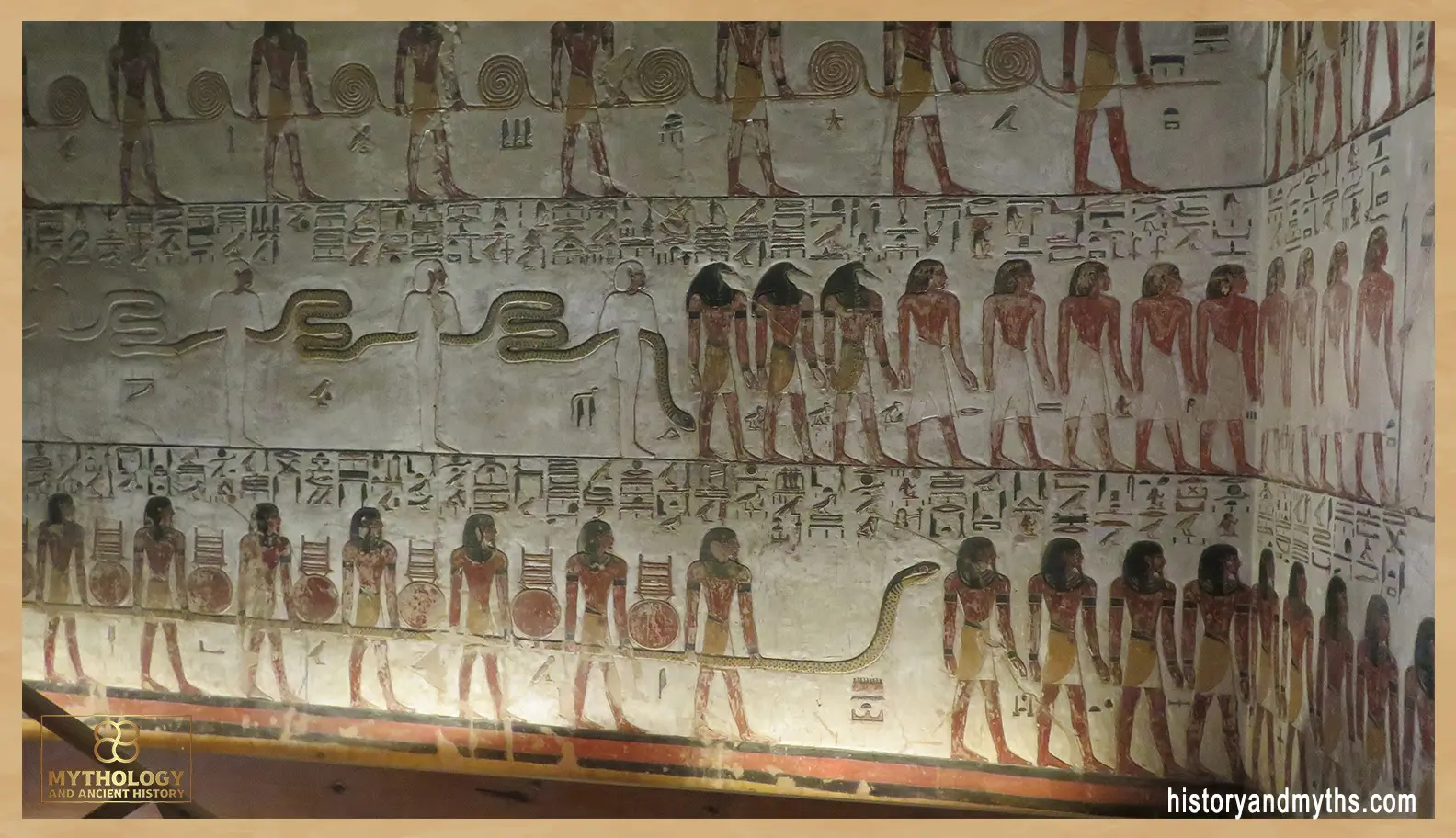
Threats appear where movement slows or order weakens. Serpents, constricting forces, and immobilizing entities represent more than danger; they embody stagnation. Their role is to stop what should not proceed. In Egyptian logic, not every soul deserved rebirth, and not every force could be allowed to pass freely. Hostile beings therefore functioned as filters. They tested legitimacy rather than spreading indiscriminate destruction.
Guardians operate differently. They do not attack at random, nor do they offer protection unconditionally. Guardians are custodians of thresholds. Their task is to enforce boundaries—between hours, regions, and states of being. Passage requires recognition: the correct name, the correct form of address, or alignment with Ma’at. Failure is not punished violently; it results in exclusion. The unprepared simply cannot advance.
Helpers appear where restoration is needed. As the sun god weakens during the night, certain beings replenish his vitality, repair the barque, or stabilize direction. Their presence confirms a critical Egyptian belief: renewal is cooperative. Even divine continuity depends on participation from multiple forces acting in harmony. No single power sustains the cosmos alone.
For the dead, these roles carried practical meaning. Knowledge of threats allowed avoidance, recognition of guardians enabled passage, and alignment with helpers ensured survival through exhaustion and disintegration. Funerary texts preserved this knowledge not as mythology, but as instruction. The afterlife was navigable—but only for those who understood its rules.
Together, threats, guardians, and helpers transformed the night into a regulated system. Danger existed, but it was purposeful. Protection was available, but conditional. The twelve hours were structured to prevent chaos while allowing renewal, ensuring that only what was balanced, legitimate, and prepared could reach the moment of rebirth.
The Final Hour and the Moment of Rebirth
The final hour of the night is not simply the last obstacle before dawn. It is the point at which the entire journey is either justified or nullified. Everything that occurred in the preceding hours—dissolution, confrontation, repair—converges here. Rebirth is not assumed; it must be earned through successful passage across ordered time.
By this hour, the sun god has been reduced to a state that allows renewal. His former authority has been stripped away, his power redistributed, and his identity reshaped. What remains is potential. The final hour functions as a liminal threshold where transformation solidifies into becoming. It is here that Ra is prepared to emerge not as the same god who entered the Duat, but as a renewed manifestation aligned once again with cosmic order.
This moment is often misunderstood as a sudden victory over darkness. In Egyptian thought, however, darkness is not defeated—it is completed. Night fulfills its purpose by finishing the work of regeneration. The final hour represents the successful containment of chaos, not its destruction. Dawn follows because the night has done its work correctly.
For the dead, this hour determines destiny. Souls that endured the full sequence of transformation could join the cycle of renewal, either accompanying the sun or entering the blessed realms beyond judgment. Those who failed earlier stages never reached this threshold. The final hour therefore marks separation as much as rebirth: inclusion for the prepared, exclusion for the unfit.
Rebirth at dawn is not symbolic optimism. It is a cosmological statement. The sun rises because the system holds. Time remains ordered, Ma’at is restored, and existence is renewed through disciplined passage rather than effortless return. Every sunrise reenacts the successful completion of the twelve hours.
The Twelve Hours vs. the Book of Amduat and the Book of Gates
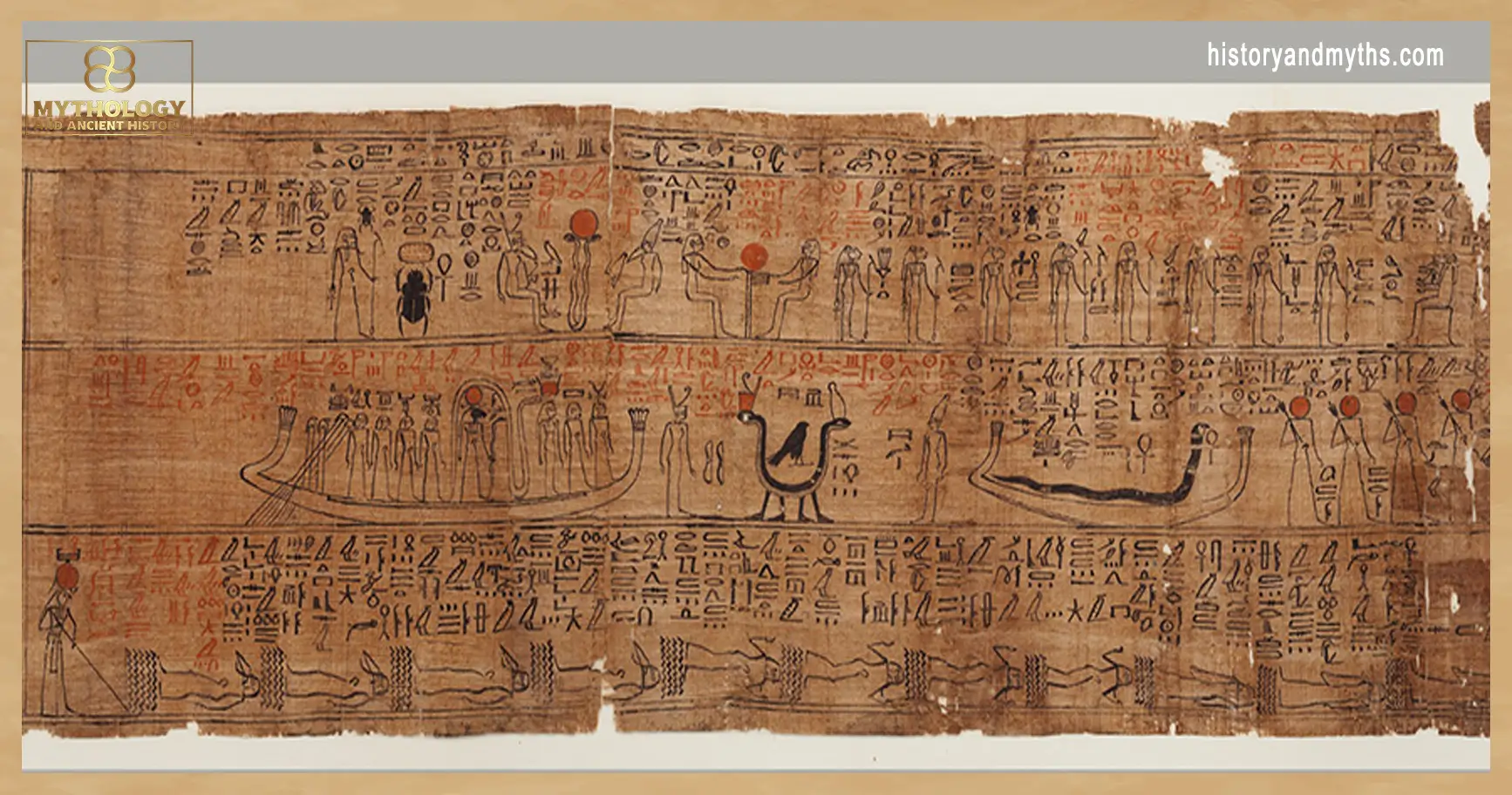
One of the most persistent misconceptions in modern discussions is treating the twelve hours of the night as identical to a single funerary text. In reality, the twelve-hour structure predates and transcends any one book. It is a conceptual framework—while texts like the Amduat and the Book of Gates are literary and ritual expressions of that framework, each with its own priorities and logic.
The Amduat presents the night as a continuous journey through time. Its focus lies in progression: movement through regions, transformation across hours, and preservation of cosmic continuity. The twelve hours here function as stages in a process. Emphasis is placed on what must occur so that renewal becomes possible. Knowledge, cooperation, and correct alignment allow the journey to continue. The logic is cumulative—each hour builds upon the previous one.
The Book of Gates shifts the emphasis. Instead of time flowing smoothly, the night is structured around thresholds. Gates replace regions, and access becomes the central concern. The hours still exist, but their significance is filtered through permission, recognition, and exclusion. This text highlights judgment and control more than transformation. Progress depends less on endurance and more on legitimacy. Who may pass matters as much as how the passage occurs.
These differences are not contradictions. They reflect complementary perspectives on the same nocturnal reality. The twelve hours remain constant as a temporal system, but each text interprets that system differently—one through movement and renewal, the other through separation and authority. Later compositions, such as the Book of Caverns, further emphasize punishment and containment, narrowing the focus to what must be restrained rather than what must be renewed.
Understanding this distinction prevents a critical error. The twelve hours are not a story copied from a book; the books are attempts to map and control a reality believed to unfold every night. The framework came first. The texts adapted it for royal tombs, ritual use, and theological refinement. By separating the concept from its literary expressions, the structure of the Egyptian night becomes clearer—and far more coherent.
The Twelve Hours of the Night — Core Insights
- The twelve hours form a regulated temporal system that governs death, transformation, and renewal within the Duat.
- Nighttime was not chaotic by default; it was structured to prevent cosmic collapse and ensure rebirth.
- Each hour represents a specific state of existence, not merely a moment in time.
- Progress through the hours depends on knowledge, balance, and alignment with Ma’at, not strength alone.
- Threats, guardians, and helpers function as filters that regulate legitimate passage through the night.
- The system applied to both gods and humans, making the afterlife a navigable but conditional journey.
- Rebirth at dawn is the result of successful passage through all twelve hours, not an automatic outcome.
What the Twelve Hours Meant for the Dead, Not Just the Sun God
Although the twelve hours of the night are most visibly associated with the journey of the sun god, their deeper significance lay in what they offered to the human dead. The Egyptian afterlife was not imagined as an instant transition from death to peace. It was a process—slow, conditional, and governed by the same temporal structure that guided the sun through the Duat.
For the deceased, the twelve hours functioned as a map of survival. Each hour represented a state the soul would enter, endure, and either overcome or fail. Progress was never guaranteed by status alone. Kings, priests, and common individuals alike faced the same nocturnal architecture. What differed was preparation: moral alignment, ritual knowledge, and the ability to exist in harmony with Ma’at.
The hours explained why death could not be bypassed. Just as the sun had to pass through darkness to rise again, the soul had to experience dissolution before renewal. Identity was tested, stripped down, and reassembled. The dead were not simply judged once and released; they were subjected to time itself. Passing through the hours meant proving endurance, legitimacy, and balance across an entire cycle of transformation.
This belief gave funerary texts their urgency. Spells, names, and instructions were not symbolic comforts—they were tools for navigating time. Knowing how to respond to guardians, recognizing moments of danger, and understanding the rhythm of the night allowed the dead to move forward rather than become trapped in stagnation or annihilation. The twelve hours thus turned the afterlife into a disciplined journey rather than a passive reward.
Ultimately, the hours provided reassurance as much as warning. Death was frightening, but it was not chaotic. The same system that renewed the sun each morning governed the fate of human souls. If the night could be endured correctly, rebirth was possible. The twelve hours promised that existence did not end in darkness—it was refined by it.
Key Takeaways
- The twelve hours of the night form a structured system, not a symbolic story.
- Nighttime in Egyptian belief was an active process of death, testing, and renewal.
- Each hour represents a distinct state of existence with its own rules and dangers.
- Survival through the night depends on order, knowledge, and alignment with Ma’at.
- The journey applies to both the sun god and human souls.
- Rebirth at dawn is earned through successful passage, not automatically granted.
Frequently Asked Questions
What are the Twelve Hours of the Night in Egyptian mythology?
They are a structured sequence of nocturnal stages in the Duat through which the sun god and human souls pass, leading from death and dissolution to renewal and rebirth.
Are the Twelve Hours the same as the Book of Amduat?
No. The twelve hours are a conceptual framework, while the Book of Amduat is one textual expression that describes this framework in narrative and ritual form.
Why did the ancient Egyptians divide the night into twelve hours?
To impose order on darkness and ensure that death, transformation, and rebirth occurred within a controlled cosmic system rather than chaos.
What happens during the Twelve Hours of the Night?
The night unfolds as a process of separation, testing, transformation, and reconstruction, culminating in the rebirth of the sun at dawn.
Who travels through the Twelve Hours?
Both the sun god Ra and the souls of the dead were believed to pass through the same nocturnal structure, though success depended on preparation and alignment with Ma’at.
Are the dangers of the night symbolic or real?
They were understood as real cosmic threats representing chaos, stagnation, and illegitimacy rather than mere symbolic imagery.
Does every soul reach rebirth after the Twelve Hours?
No. Only those who successfully endure all stages of the night are renewed; failure at any stage prevents rebirth.
How are the Twelve Hours different from the Book of Gates?
While the hours emphasize transformation over time, the Book of Gates focuses on access, authority, and controlled passage through guarded thresholds.
Sources & Rights
- Hornung, Erik. The Ancient Egyptian Books of the Afterlife. Cornell University Press, 1999.
- Assmann, Jan. Death and Salvation in Ancient Egypt. Cornell University Press, 2005.
- Faulkner, Raymond O. The Ancient Egyptian Book of the Dead. University of Texas Press, 1990.
- Taylor, John H. Journey through the Afterlife: Ancient Egyptian Book of the Dead. British Museum Press, 2010.
- Hornung, Erik. The Egyptian Amduat: The Book of the Hidden Chamber. Living Human Heritage Publications, 2007.
- Allen, James P. Middle Egyptian: An Introduction to the Language and Culture of Hieroglyphs. Cambridge University Press, 2014.
- Shafer, Byron E., ed. Religion in Ancient Egypt: Gods, Myths, and Personal Practice. Cornell University Press, 1991.
Written by H. Moses — All rights reserved © Mythology and History