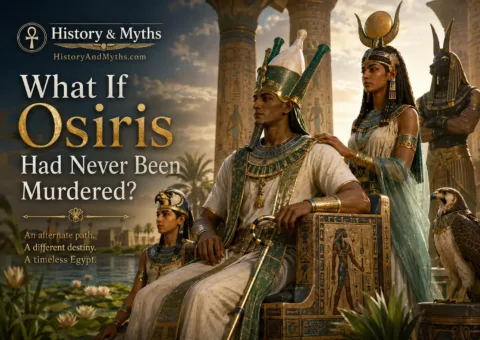
What If Osiris Had Never Been Murdered? The Myth Reimagined
If Osiris had never been murdered, one of the central patterns of Egyptian mythology would change completely. Osiris could remain a king of the living rather than becoming the ruler of the dead, while Horus would lose the crisis that made him the avenger and rightful successor of his father.
The consequences would extend far beyond the throne. Isis would no longer need to recover and restore her murdered husband, and Set would not become the usurper whose conflict with Horus defines one of Egypt’s most important divine struggles.
Egyptian beliefs about death and the afterlife would not simply disappear. They drew on several religious traditions, but Osiris became exceptionally important as a model of death, restoration, judgment, and renewed existence. Without his murder and transformation, those ideas would likely develop around a different divine pattern.
The biggest change, then, is not that the gods would live peacefully. Removing Osiris’s death would alter the relationships linking kingship, succession, resurrection, and the afterlife forcing some of the most familiar roles of Horus, Isis, Set, and Osiris himself to develop in very different ways.
The Mythic Turning Point
There was no single ancient Egyptian text that told the story of Osiris in exactly the form familiar today. The myth developed across different periods and sources, while later writers such as Plutarch preserved a more continuous narrative. Even so, its central pattern remained remarkably influential: Osiris is killed, Isis restores him, Horus becomes his heir, and Set is challenged for the throne.
That sequence does more than explain a family conflict among the gods. It gives each major figure a defining role. Osiris becomes the dead king who continues to rule in the afterlife. Isis becomes the protector who preserves both her husband and her son. Horus represents legitimate succession, while Set becomes the rival whose claim must be overcome.
Removing the murder therefore changes the structure of the myth itself. Osiris never needs to be restored, Horus has no murdered father to avenge, and the struggle for kingship cannot unfold in the same way.
For this scenario, the key assumption is simple: Set never succeeds in killing Osiris, and Osiris remains alive and able to rule.
This scenario assumes that Osiris is never murdered and continues to rule rather than becoming king of the dead.
It does not assume that conflict disappears from Egyptian mythology. Set can still challenge the existing order, Horus may still emerge as an important divine figure, and other gods could take on roles that Osiris historically came to dominate.
The purpose is not to invent an entirely new mythology, but to follow the most direct consequences of removing one event: Osiris’s death. From that point, the main questions are who rules, whether Horus still inherits the throne, how Set’s role changes, and what happens to beliefs about resurrection and the afterlife.
Would Osiris Remain King?
If Osiris remained alive, the clearest change would be political: he would have no reason to leave the throne to Horus through death and succession.
In the traditional myth, Osiris becomes a ruler of the dead only after his murder and restoration. Without that transformation, his identity would remain tied more closely to kingship among the living, fertility, renewal, and the maintenance of order.
That does not mean he would rule forever. Egyptian mythology allows for changing divine roles, rival claims, and transfers of authority. Horus could still become important as a younger royal god, but his rise would need a different explanation perhaps through succession, delegation, or conflict rather than revenge for a murdered father.
Osiris’s survival therefore delays the central transfer of kingship. Instead of beginning with a dead father and a contested heir, the myth would begin with a living king whose continued authority changes the position of every god around him.
What Happens to Set?
Without the murder of Osiris, Set would lose the act that turns him into the central rival of the royal family. He could still represent violence, desert power, storms, disorder, and dangerous strength, but he would not automatically become the usurper who seizes a murdered king’s throne.
That distinction matters because Set was never simply an Egyptian version of absolute evil. In other traditions he could protect Ra against hostile forces and act as a necessary, if dangerous, power within the divine order.
Conflict with Osiris or Horus could still develop, especially over authority and succession, but it would begin as a political or cosmic rivalry rather than revenge for murder.
Set would therefore remain threatening and unpredictable, yet his mythology would likely be less dominated by the role of criminal king-killer.
Would Horus Still Become King?
Horus could still become king, but not for the same reason. In the traditional cycle, his claim is strengthened by being the son of a murdered ruler who must recover his father’s throne from Set.
If Osiris remained alive, Horus would lose that role as avenger and immediate restorer of legitimate kingship. His rise would depend instead on a normal transfer of authority, a decision by Osiris, or a later dispute over succession.
That could make Horus less defined by conflict with Set and more by his status as the next generation of divine kingship. He might still become the model of the living ruler, but the symbolism behind that role would be very different.
The crucial change is that Horus would no longer need to prove his right to rule through his father’s death. His kingship would become a question of inheritance rather than restoration.
Isis Without the Search for Osiris
Isis would lose one of the roles that most strongly defines her mythology: the wife who searches for Osiris, restores him, and protects the future of their son.
Without the murder, she would still remain a powerful goddess associated with magic, protection, motherhood, and royal legitimacy, but those qualities would develop without the same story of loss and recovery.
Her relationship with Horus would also change. Instead of raising and protecting a vulnerable heir against Set, Isis could appear more as a royal mother within an intact divine family.
The result would not be a weaker Isis, but a different one. Her importance could remain enormous while the themes of mourning, restoration, and protection after death became less central to her identity.
Who Would Rule the Underworld?
If Osiris never died, he would have no obvious reason to become lord of the underworld. That role would need to remain with another divine figure or develop along a different religious path.
Anubis is the strongest candidate for a larger role. Long before Osiris became dominant in funerary belief, Anubis was already closely connected with burial, embalming, cemeteries, and the protection of the dead. Without Osiris’s transformation, those responsibilities could remain more central to his identity.
The judgment of the dead might also develop without a single divine king at its center. Egyptian afterlife beliefs drew on several traditions, including solar and funerary ideas, so removing Osiris would not leave the dead without a religious framework.
The underworld would therefore still exist, but its hierarchy could look very different. Osiris might remain among the gods of life and kingship, while Anubis and other funerary deities carried more of the authority later associated with him.
Explore Related Egyptian Mythology
How Egyptian Kingship Would Change
The link between Osiris and Horus gave Egyptian kingship a powerful pattern: the dead king could be identified with Osiris, while the living king embodied Horus as his successor.
If Osiris never died, that cycle would lose much of its mythic foundation. Kingship could still be hereditary and divine, but the passage from dead ruler to living heir would need a different religious model.
The pharaoh might remain more closely associated with Horus during life without becoming Osiris after death, while other funerary gods took greater responsibility for the deceased king.
That would not destroy royal ideology, but it could change one of its most enduring ideas: that legitimate rule continues through death, renewal, and succession.
Would Resurrection and Funerary Beliefs Change?
Egyptian beliefs about death would not disappear without the murder of Osiris, but one of their strongest models of resurrection would be missing.
Osiris came to represent the possibility that death was not final. His restoration and continued existence in the afterlife gave Egyptians a powerful divine pattern for renewal, especially in funerary religion. Without that story, ideas of survival after death would rely more heavily on other traditions, including solar rebirth, preservation of the body, and the protection of funerary gods.
Mummification, tombs, offerings, and rituals for the dead would still have strong religious foundations. What changes is the meaning attached to them. Instead of hoping to share in the fate of Osiris, the deceased might be understood through a different combination of solar and funerary beliefs.
The afterlife would therefore remain central to Egyptian religion, but the specifically Osirian language of death, restoration, and renewed existence would be far less dominant.
What Would Probably Not Change
Removing Osiris’s murder would not erase the wider structure of Egyptian religion. Ideas of divine order, kingship, rebirth, protection, and the journey after death already drew on many gods and traditions beyond the Osiris cycle.
Ra would still dominate solar theology, Ma’at would remain central to cosmic and political order, and funerary practice would continue to depend on ritual, preservation of the body, offerings, and divine protection.
Horus, Isis, Set, and Anubis would also remain important, even if their relationships and functions developed differently. Egyptian religion was flexible enough to absorb changing roles without replacing one complete system with another.
The most realistic change is therefore not the disappearance of familiar beliefs, but a shift in emphasis. Osiris would become less central to death and resurrection, while other gods and traditions carried more of that religious weight.
Most Likely
Osiris remains a living ruler, while Horus grows into an heir rather than an avenger. Set continues to represent dangerous and disruptive power, but without the murder of Osiris he never becomes defined primarily as the usurper of the divine throne.
The greatest religious change would come after death. Osiris would no longer become the central model of the deceased ruler or the dominant king of the underworld. Anubis, solar theology, and other funerary traditions would therefore carry more of the religious weight later absorbed into Osirian belief.
Egyptian religion would remain recognizable, but the connection between death, resurrection, and royal succession would be much weaker than in the mythology that actually developed.
Plausible but Uncertain
Horus could still become king while Osiris remained alive, perhaps through a peaceful transfer of authority rather than a struggle with Set. That would preserve Horus as a royal successor while removing the cycle of murder, vengeance, and restoration.
Set might also retain a more balanced religious role. Without becoming the killer of Osiris, his associations with chaos and dangerous power could coexist more strongly with his protective functions.
It is also possible that Osiris would gradually acquire some connection with death and renewal through other traditions, but he would be far less likely to dominate the underworld in the same way without his own death and restoration.
Highly Unlikely
It is highly unlikely that Osiris could remain alive while the rest of Egyptian mythology developed almost exactly as it did. His murder is too closely tied to the rise of Horus, the rivalry with Set, and Osiris’s authority over the dead.
It is also unlikely that Egyptian afterlife beliefs would disappear altogether. Funerary religion had broader foundations than the Osiris cycle, including solar rebirth, burial ritual, and the protection of other gods.
The least plausible outcome is therefore a mythology in which only one event changes. If Osiris survives, the roles of Horus, Isis, Set, and the underworld must change with him.
Final Verdict: Osiris’s Survival Would Rewrite Egyptian Mythology
If Osiris had never been murdered, Egyptian mythology would lose one of its most important chains of cause and effect. Osiris would likely remain a living ruler, Horus would inherit without avenging a slain father, and Set would no longer be defined by the same act of usurpation.
The largest change would come in religion. Osiris would not naturally become king of the dead, so funerary belief would rely more heavily on Anubis, solar rebirth, and other traditions already present in Egyptian religion. The familiar link between the dead king as Osiris and the living king as Horus would also weaken.
Egyptian religion would still contain death, rebirth, kingship, and cosmic conflict. But the relationships tying those ideas together would develop along a different path. Osiris’s murder was not just one episode in the myth—it was the event that gave several of Egypt’s most important gods the roles by which they became best known.
Frequently Asked Questions
What if Osiris had never been murdered?
Osiris would likely remain a living ruler instead of becoming king of the dead. Horus, Isis, Set, and the religious meaning of resurrection and royal succession would all develop differently.
Would Horus still become king?
Possibly, but not as the avenger of a murdered father. His rise would more likely depend on inheritance, a peaceful transfer of power, or a later dispute over succession.
Would Set still be an enemy of Horus?
Conflict could still occur, especially over power and succession, but without the murder of Osiris it would no longer begin as a struggle to avenge the dead king.
Who would rule the underworld if Osiris stayed alive?
Anubis could retain a much larger funerary role, while solar and other afterlife traditions might carry functions that later became strongly associated with Osiris.
Would Egyptian beliefs about the afterlife disappear?
No. Egyptian funerary religion had many foundations beyond Osiris, including solar rebirth, mummification, ritual protection, offerings, and other gods connected with the dead.
How would Isis change if Osiris never died?
Isis would still remain a major goddess of magic, protection, motherhood, and royal legitimacy, but the themes of mourning, restoration, and protecting a vulnerable Horus would become far less central to her mythology.
Sources and Further Reading
This article is a counterfactual exploration based on ancient Egyptian religious traditions, surviving texts, archaeological evidence, and modern Egyptological scholarship. The alternate outcomes are interpretive, while the roles of Osiris, Isis, Horus, Set, Anubis, kingship, and funerary belief are grounded in the sources below.
Ancient Texts and Mythological Sources
1. Papyrus Chester Beatty I — The Contendings of Horus and Set
One of the most important surviving Egyptian narratives concerning the struggle between Horus and Set and the dispute over legitimate kingship.
UCL Digital Egypt
2. Plutarch, Isis and Osiris (De Iside et Osiride)
A much later Greco-Roman account preserving a continuous version of the Osiris myth. It is valuable for comparison but should not be treated as a single authoritative Egyptian version of the story.
Perseus Digital Library
Egyptology and Religious Context
3. UCL Digital Egypt — Gods and Goddesses: Creation
Overview of the Osiris–Isis–Horus–Set cycle, including the murder of Osiris, his transformation into ruler of the dead, and Horus’s eventual claim to kingship.
University College London
4. UCL Digital Egypt — Kingship in Ancient Egypt
Explores the divine character of Egyptian kingship and the long association between the living king and Horus.
University College London
5. UCL Digital Egypt — The Horus Name
Documents the exceptionally early and enduring relationship between Horus and Egyptian royal identity.
University College London
6. Richard Bussmann, The Archaeology of Pharaonic Egypt: Funerary Culture
Modern archaeological study of Egyptian beliefs and practices surrounding death, burial, tombs, and funerary texts.
Cambridge University Press
7. Richard Bussmann, Kingship Sacred and Social
Examines Egyptian kingship, its religious foundations, and the connection between royal ideology, funerary culture, and the Osiris tradition.
Cambridge University Press
8. The Metropolitan Museum of Art — Isis and Horus
Curatorial discussion of Isis as wife of Osiris, mother and protector of Horus, and her connection with royal legitimacy and the Osirian myth.
The Metropolitan Museum of Art
Archaeological and Funerary Evidence
9. The Greenfield Papyrus — Book of the Dead of Nestanebetisheru
A major funerary manuscript containing imagery of Osiris and Isis and illustrating the importance of Osirian belief in Egyptian mortuary religion.
The British Museum
10. Egyptian Funerary Stela EA1428
Material evidence combining Osiris, Isis, Nephthys, Horus, Anubis, and solar imagery within an Egyptian funerary context, illustrating how several divine traditions could operate together rather than as isolated belief systems.
The British Museum
© Copyright Notice
Copyright Notice: This article is an original alternate-mythology analysis published by History and Myths. It draws on established ancient Egyptian mythological traditions, surviving texts, archaeological evidence, and modern scholarship to explore a hypothetical scenario. The alternate outcomes presented here are interpretive and should not be treated as part of the original ancient Egyptian myths.
Copying, republishing, translating, adapting, or substantially reproducing this content, in whole or in part, without prior written permission is prohibited.
Written by H. Moses
All rights reserved ©
History and Myths