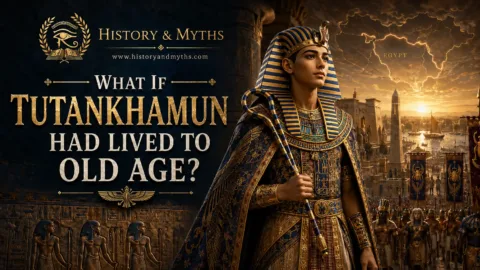
What If Tutankhamun Had Lived Longer? Ancient Egypt Alternate History
Tutankhamun died at around nineteen years old, after a reign of less than a decade and without a surviving heir. His death opened the way for Ay and later Horemheb to take the throne, helping bring Egypt’s Eighteenth Dynasty toward its end.
But what if Tutankhamun had survived and ruled for several more decades?
A longer reign could have changed far more than the fate of one young king. Tutankhamun might have grown into an independent ruler, completed the restoration of Egypt’s traditional religion after Akhenaten, produced an heir, and prevented the succession that eventually led to Horemheb and the Nineteenth Dynasty.
That would also raise larger questions. Would Egypt have responded differently to the growing Hittite threat? Would Seti I and Ramesses II ever have become pharaohs? And if Tutankhamun had lived to old age, would his tomb, and his modern fame, have existed at all?
The Historical Turning Point
When Tutankhamun died, Egypt was still emerging from one of the most disruptive episodes of the Eighteenth Dynasty. The court had abandoned Akhenaten’s capital at Amarna, the traditional cults had been restored, and Amun once again held a central place in state religion. Tutankhamun was therefore ruling during a restoration that was already underway but far from complete.
His position was also unusual. He had come to the throne as a child, while senior figures such as Ay and the general Horemheb held enormous influence. Horemheb commanded the army and carried the title “King’s Deputy,” giving him authority well beyond that of an ordinary military officer. Tutankhamun’s early death meant that he never had the chance to outgrow this political environment and establish what his own mature rule might have looked like.
The succession made that death especially important. Tutankhamun left no surviving children, and the direct royal line was suddenly vulnerable. Ay took the throne first, followed only a few years later by Horemheb. Neither man was a son of Tutankhamun, and Horemheb was not of royal birth.
That sequence was not inevitable before the king died. If Tutankhamun had survived, Egypt would still have faced the same religious, political, and foreign pressures, but the struggle over who controlled the future of the dynasty would have begun from a very different position.
The Scenario Used in This Article
For this alternate timeline, Tutankhamun survives the illness or medical crisis that ended his life and remains on the throne for several more decades, potentially living into his fifties or beyond.
Everything before that point remains unchanged. Akhenaten’s religious revolution has already collapsed, the royal court has left Amarna, the restoration of Amun and the traditional cults is underway, and powerful figures such as Ay and Horemheb still surround the young king.
The key difference is time. Instead of dying before he could establish an independent adult reign, Tutankhamun now has the opportunity to shape Egypt himself. Whether he succeeds depends on questions that history never had the chance to answer: could he reduce the influence of his senior officials, secure the succession, and preserve Egypt’s position abroad?
This scenario assumes only his survival. It does not assume that he becomes a great ruler, produces an heir, or avoids political and military setbacks.
Could Tutankhamun Become an Independent Pharaoh?
Survival alone would not have transformed Tutankhamun into a powerful ruler. At the start of his reign he was a child, while experienced men such as Ay and Horemheb occupied positions close to the center of government. Horemheb was not merely a general. He commanded the army and held the title “King’s Deputy,” evidence of how much authority could exist around the young king.
Time, however, would have changed that balance.
By his twenties and thirties, Tutankhamun would no longer have needed senior officials to govern on his behalf in the same way. A longer reign would have allowed him to build his own court, appoint officials loyal to him, control royal patronage, and develop direct relationships with the army and the priesthood. Egyptian kingship also gave the pharaoh enormous religious and political legitimacy, so an adult king with an established reign would have been difficult for any courtier to overshadow permanently.
There is no evidence that Tutankhamun was destined to become an exceptional statesman. His surviving monuments mainly show a reign devoted to restoring institutions damaged during the Amarna Period, not a clear personal political program.
The most plausible outcome, therefore, is not a sudden struggle for power. It is a gradual shift. As Tutankhamun matured, Ay and Horemheb would probably have remained important, but their ability to determine Egypt’s future would increasingly depend on the king rather than the other way around.
What Would Happen to Ay?
Ay’s path to the throne depended heavily on Tutankhamun dying without a surviving heir. He was already a senior court figure and had served under the Amarna rulers, but nothing suggests that he possessed an automatic right to become pharaoh while Tutankhamun was alive.
If the young king survived into adulthood, Ay would most likely remain influential for a time rather than disappear from politics overnight. His experience, court connections, and proximity to the royal family would still make him useful, especially during the early years of Tutankhamun’s independent rule.
Age, however, worked against him. Ay was already an older official by the time Tutankhamun ruled, and his historical reign lasted only a few years. In a timeline where Tutankhamun survives for decades, Ay would probably die long before another succession crisis emerged.
That makes one consequence relatively strong: Ay almost certainly loses his historical opportunity to become pharaoh. His importance would survive in the court, but his brief kingship would likely vanish from the sequence of Egyptian rulers altogether.
Would Horemheb Ever Become Pharaoh?
Horemheb is the harder case. Unlike Ay, he was younger, militarily powerful, and already positioned near the center of government. Under Tutankhamun he served as commander-in-chief and held the unusual title “King’s Deputy,” making him one of the strongest men in Egypt.
If Tutankhamun lived for decades, however, Horemheb’s path to the throne would become much narrower. As long as the king remained alive, there was no obvious reason for a non-royal general to replace him. Horemheb could still have built an exceptional career, commanded campaigns, and become the most influential military figure in the kingdom, but that is very different from becoming pharaoh.
The decisive issue would be succession. If Tutankhamun eventually produced a surviving son, Horemheb’s chance of ruling would probably collapse. If the king remained childless, Horemheb might still emerge as a candidate after his death, especially if he retained control of the army and royal administration.
So a long-lived Tutankhamun would not necessarily remove Horemheb from history. It would more likely change him from a future king into a powerful general whose ultimate fate depended on whether the Eighteenth Dynasty could produce another legitimate heir.
Could Tutankhamun Complete the Restoration After Akhenaten?
Tutankhamun did not begin Egypt’s return from the Amarna experiment, but his reign gave that reversal royal authority. The cults of Amun and other traditional gods were restored, temples received renewed attention, and new statues replaced images that had been damaged or destroyed under Akhenaten.
Had Tutankhamun lived for several more decades, this restoration would probably have become one of the defining policies of his reign. He could have rebuilt neglected sanctuaries, restored temple wealth and personnel, and tied his kingship more closely to the traditional religious institutions that had supported Egyptian rule for generations.
A longer reign might also have changed how Egypt remembered Akhenaten. Historically, Horemheb later pursued a much more aggressive effort to erase the Amarna rulers from the official record. Tutankhamun had already rejected Akhenaten’s religious program, but there is no clear evidence that he intended the same systematic campaign of historical deletion.
The likely result is a firm restoration without necessarily following Horemheb’s later approach. Egypt would still return decisively to its traditional gods, but that transition might have been remembered primarily as Tutankhamun’s achievement rather than as part of Horemheb’s political reconstruction of the state.
Could Tutankhamun Have Produced an Heir?
This is where a longer life could have changed the dynasty most sharply. Tutankhamun died without a surviving child, but that does not mean he was incapable of producing one. Two mummified female fetuses were found in his tomb, and genetic testing has supported the possibility that they were his daughters.
If Tutankhamun had lived for another twenty or thirty years, he would have had far more time to secure the succession. A surviving son would have transformed the political landscape. Ay would lose any realistic path to the throne, Horemheb’s claim would weaken dramatically, and the Eighteenth Dynasty could continue through Tutankhamun’s own line.
But this remains the largest uncertainty in the scenario. His known pregnancies did not produce a surviving heir, and we cannot assume that additional years would have changed that. A long-lived but childless Tutankhamun would still leave Egypt facing a succession crisis eventually.
So the most important question is not simply whether Tutankhamun lived longer. It is whether that extra time produced a legitimate successor. If it did, almost everything that followed his historical death becomes less likely to happen in the same way.
Would the Eighteenth Dynasty Have Lasted Longer?
Probably, but only if Tutankhamun secured a successor.
Historically, his death without a surviving heir left the dynasty dependent on men outside the direct royal line. Ay ruled briefly, then Horemheb became the last king of the Eighteenth Dynasty. Horemheb, in turn, appears to have designated Ramesses I as his successor, opening the way for the Nineteenth Dynasty.
A surviving son of Tutankhamun would interrupt that sequence at its most vulnerable point. Instead of searching for a new ruler after each reign, Egypt could pass the throne within the existing royal house. That would give the Eighteenth Dynasty a realistic chance to continue for another generation or more.
But longevity would not be guaranteed. A new heir could die young, face rivals, or inherit the same military and foreign pressures that challenged the late dynasty. The important point is narrower: Tutankhamun did not need to create a completely new political order to prolong the Eighteenth Dynasty. He only needed to leave behind a viable royal succession.
Without that, even a fifty-year reign might simply postpone the same problem.
How Would Egypt Face the Hittite Threat?
Tutankhamun would not have inherited a quiet empire. By his reign, the Hittites were already expanding into northern Syria, while several Egyptian client states in the Levant were struggling to remain loyal under growing pressure.
A longer reign would have forced Tutankhamun to deal with that problem directly. Egypt could not afford to ignore Syria, because its northern territories protected important trade routes, allied cities, and the approaches to the Egyptian sphere of influence. Losing them gradually would strengthen the Hittites and push the strategic frontier south.
Tutankhamun would therefore have needed a more active foreign policy, probably combining military campaigns with diplomacy and support for loyal local rulers. In that context, Horemheb’s military experience could remain valuable even if he never became pharaoh.
But a longer reign would not guarantee Egyptian success. The Hittite Empire under Suppiluliuma I was expanding aggressively, and Egypt was competing against a major regional power rather than suppressing a minor rebellion.
The more realistic possibility is that Tutankhamun might have slowed Egypt’s losses in Syria or responded earlier to Hittite expansion. Completely reversing the balance of power would have required sustained military success that we cannot assume from the evidence.
Could Egypt Have Held More of Syria?
Possibly, but Egypt would have needed to act earlier and more consistently than it did historically.
By Tutankhamun’s reign, Egyptian influence in northern Syria was already under pressure. The Hittites were advancing south under Suppiluliuma I, while cities that had once operated within Egypt’s sphere were being forced to choose between two competing powers. In the years after Tutankhamun’s death, Amurru and Ugarit fell firmly into the Hittite orbit, while Kadesh became one of the main points of contention between the two empires.
A long-lived Tutankhamun could have devoted more resources to reinforcing Egyptian allies, responding to defections, and supporting military operations before Hittite control became firmly established. That might have preserved a stronger Egyptian position along the Syrian coast or around Kadesh.
Recovering all of northern Syria is much less plausible. The Hittites had become a major imperial power with their own armies, allies, and permanent bases in the region.
The realistic gain, therefore, would not be the restoration of Egypt’s old frontier near the Euphrates. It would be a stronger defensive position, fewer lost vassals, and perhaps a more favorable boundary between Egyptian and Hittite influence.
Could the Nineteenth Dynasty Still Rise?
The Nineteenth Dynasty began because Horemheb eventually chose Ramesses I as his successor. Ramesses had no royal ancestry. He was a military officer and vizier who rose through the state under Horemheb, then inherited the throne when the king died without an heir.
A long reign by Tutankhamun could break that chain well before Ramesses ever became a candidate for kingship. If Tutankhamun produced a surviving heir, Horemheb might never rule, which in turn means he would never be in a position to designate Ramesses as his successor.
That does not mean Ramesses and his family disappear from Egyptian history. They could still rise through the army and administration, especially during a period of conflict with the Hittites. But military influence is not the same as a path to the throne.
The Nineteenth Dynasty could still emerge after a later succession crisis, but probably not at the same time or under the same circumstances. Its historical rise depended on a sequence of childless or non-dynastic successions that a longer-lived Tutankhamun had a realistic chance of disrupting.
What Happens to Seti I and Ramesses II?
A longer-lived Tutankhamun would not necessarily erase Seti I or Ramesses II from history. Both could still have been born into the same military family and risen through Egypt’s army and administration. What becomes uncertain is whether either man would ever become pharaoh.
Historically, Seti I inherited the throne from his father, Ramesses I, who had been chosen as Horemheb’s successor. Ramesses II then succeeded Seti and built one of the most famous reigns in Egyptian history. That entire royal sequence depended on the Nineteenth Dynasty reaching the throne in the first place.
If Tutankhamun preserved the Eighteenth Dynasty through a surviving heir, Seti might remain a senior commander rather than a king. Ramesses could likewise become an important prince of a powerful non-royal family, but without an inherited claim to kingship.
That would have enormous consequences. Seti’s campaigns in the Levant, Ramesses II’s wars and eventual peace with the Hittites, the development of Pi-Ramesses, and many of the monuments associated with the Ramesside age might never occur in the same form.
The safest conclusion is not that Ramesses II disappears. It is that the historical path that made him pharaoh becomes far less likely once Tutankhamun survives long enough to secure another royal succession.
Read Also
The Tutankhamun Paradox: Would We Know His Name Today?
Tutankhamun’s modern fame is tied less to what he accomplished as king than to what happened after his early death.
His tomb, KV62, is unusually small for a royal burial and appears to have been adapted in haste. Egyptian authorities note that its modest size and layout may reflect the fact that Tutankhamun died after only about nine years on the throne, before a more ambitious royal tomb could be completed. Yet that same burial survived with much of its contents relatively intact until Howard Carter discovered it in 1922.
If Tutankhamun had lived into old age, he would have had decades to prepare a larger royal tomb. Such a monument might have attracted more attention from ancient tomb robbers, like many other royal burials in the Valley of the Kings.
The irony is striking. A longer reign might have made Tutankhamun more important in ancient Egyptian history, while making him less famous in the modern world.
Without the extraordinary discovery of KV62 and its thousands of objects, “King Tut” might today be known mainly to Egyptologists rather than as one of the most recognizable names from ancient Egypt.
What Would Probably Not Change?
Even with a longer reign, Tutankhamun would still inherit the same basic problems: the aftermath of Akhenaten’s religious revolution, a powerful priesthood, ambitious military officials, and growing Hittite pressure in Syria.
Egypt would also remain a monarchy dependent on court alliances, temple wealth, and military strength. A longer-lived king could manage those forces differently, but he could not remove them.
The biggest mistake would be to imagine that Tutankhamun’s survival automatically creates a stronger or more stable Egypt. It changes who has time to shape events. It does not erase the pressures already facing the kingdom.
Most Likely
The most likely outcome is a much longer Eighteenth Dynasty transition.
Tutankhamun would probably continue restoring traditional religion, gradually reduce his dependence on senior courtiers, and prevent Ay from becoming pharaoh simply by outliving him. Horemheb could remain one of Egypt’s most powerful generals, but his eventual accession would become far less certain.
If Tutankhamun produced a surviving heir, the political consequences would be larger still. The throne could remain within the existing royal house, disrupting the sequence that historically led from Horemheb to Ramesses I and the beginning of the Nineteenth Dynasty.
Plausible but Uncertain
It is plausible that a mature Tutankhamun could strengthen Egypt’s position in the Levant by reacting more consistently to Hittite expansion and supporting Egyptian allies before they were lost.
It is also possible that a surviving royal heir could extend the Eighteenth Dynasty for another generation or more.
Neither outcome is secure. We know too little about Tutankhamun’s abilities as an adult ruler, and additional years would not guarantee children, military victories, or political stability. These possibilities fit the historical conditions, but they depend on decisions and events that cannot be reconstructed with confidence.
Highly Unlikely
It is highly unlikely that Tutankhamun’s survival would produce an Egyptian superpower capable of permanently defeating the Hittites or dominating the entire Near East.
It is equally difficult to justify claims that he would become another Thutmose III or Ramesses II simply because he lived longer. His short historical reign gives us too little evidence about his military or administrative abilities to support that conclusion.
A realistic alternate history should therefore avoid turning survival into greatness. The strongest consequences come from altered succession and political timing, not from assuming extraordinary personal ability.
Final Verdict
If Tutankhamun had lived to old age, the greatest change would probably have been dynastic rather than military.
His survival could remove Ay from the throne, greatly reduce Horemheb’s chance of becoming pharaoh, and give the Eighteenth Dynasty time to produce another legitimate successor. That alone could delay or prevent the historical rise of the Nineteenth Dynasty, changing the path that eventually brought Seti I and Ramesses II to power.
Egypt would still face the Hittites, internal rivalries, and the difficult legacy of the Amarna Period. But the political chain created by Tutankhamun’s early death would no longer unfold in the same way.
The final irony is that a longer and potentially more important reign might leave us with a less famous Tutankhamun. His short life helped produce the unusual burial whose discovery in 1922 made him a global icon.
Frequently Asked Questions
How old was Tutankhamun when he died?
Tutankhamun died at around nineteen years old after ruling Egypt for roughly a decade. His early death left no surviving heir and created a major succession problem at the end of the Eighteenth Dynasty.
What might have happened if Tutankhamun had lived longer?
He could have developed into an independent adult ruler, continued the restoration of traditional Egyptian religion, and possibly secured the succession with a surviving heir. That would have changed the political path that later brought Ay, Horemheb, and the Nineteenth Dynasty to power.
Could Tutankhamun have had a surviving heir?
It is possible, but not certain. Two mummified fetuses were found in his tomb and have been identified as probable daughters of Tutankhamun. A longer life would have given him more time to produce an heir, but there is no way to know whether that would actually have happened.
Would Horemheb still have become pharaoh?
Possibly, but his chances would have been much lower. If Tutankhamun had lived for decades and produced a legitimate successor, Horemheb might have remained a powerful general rather than becoming king.
Would Ramesses II still have become pharaoh?
Not necessarily. Ramesses II became king because his grandfather Ramesses I founded the Nineteenth Dynasty after being selected as Horemheb’s successor. If Tutankhamun had preserved the Eighteenth Dynasty, that exact succession could have been disrupted.
Would Tutankhamun still be famous today if he had lived to old age?
Perhaps not to the same degree. Much of his modern fame comes from the discovery of his unusually well-preserved tomb in 1922. A longer reign might have resulted in a very different burial, changing how the modern world came to know him.
Sources & Further Reading
This alternate-history analysis is based on established archaeological, historical, and scientific evidence. The speculative conclusions are clearly separated from the documented historical record.
- Hawass, Z., Gad, Y. Z., Ismail, S., et al.
Ancestry and Pathology in King Tutankhamun’s Family
.
JAMA, 2010;303(7):638–647.
doi:10.1001/jama.2010.121. - The Metropolitan Museum of Art.
Tutankhamun’s World: A Self-Guided Tour
.
Overview of Tutankhamun’s reign, the post-Amarna transition, and the restoration of traditional Egyptian religion. - The Metropolitan Museum of Art.
Head of the God Amun
.
Archaeological evidence for Tutankhamun’s restoration of monuments of Amun damaged during Akhenaten’s reign. - The Metropolitan Museum of Art.
Haremhab: The General Who Became King
.
Historical background on Horemheb’s military career under Tutankhamun and his later accession as the final king of Dynasty 18. - The Metropolitan Museum of Art.
Relief from the West Wall of a Chapel of Ramesses I
.
Evidence for Ramesses I’s career as general and vizier under Horemheb and his designation as Horemheb’s successor. - Ministry of Tourism and Antiquities, Egypt.
Tomb of Tutankhamun
.
Official archaeological overview of KV62, Tutankhamun’s short reign, and the significance of Howard Carter’s 1922 discovery.
Copyright & Use
Written by H. Moses
This article is original content created for
History & Myths
.
Reproduction, republication, or redistribution of the full article without prior permission is not permitted.
Short quotations may be used for educational, academic, or commentary purposes when properly attributed and linked back to
HistoryAndMyths.com
.