Esus: The Mysterious God of Ancient Gaul
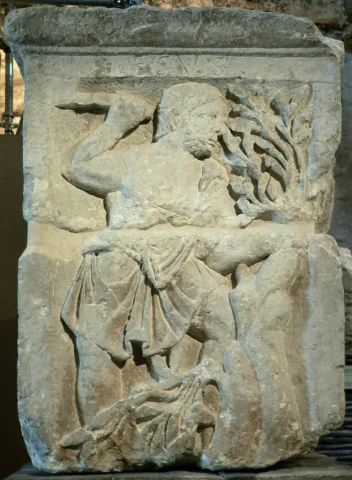
Esus is one of the few Gaulish gods whose name survives beside an image of him, yet the scene remains difficult to explain. On the first-century CE Pillar of the Boatmen in Paris, he is depicted cutting branches from a tree. A neighbouring panel shows Tarvos Trigaranos, a bull accompanied by three cranes, while a relief from Trier brings the tree, bull, and birds into a single composition. Together, these carvings suggest a religious story whose details have been lost.
The Roman poet Lucan names Esus alongside Teutates and Taranis in a passage evoking bloody sacrifices. Later commentators describe particular sacrificial rites and offer conflicting identifications with Mars and Mercury. Neither the literary accounts nor the surviving sculptures establish Esus’s precise powers or explain his role in the depicted scene. What remains is a small but revealing body of archaeological and literary evidence, rather than a complete picture of his worship.
Who Was Esus in Celtic Religion?
Esus was a Gaulish deity known primarily through inscriptions and sculptures dating to the Roman period. His appearance on the first-century CE Pillar of the Boatmen, erected in Lutetia (modern Paris) during the reign of Tiberius (14–37 CE), provides evidence of his recognition within a Gallo-Roman community. The monument was commissioned by the boatmen of the Parisii in honour of Jupiter and the emperor, and included both Roman and indigenous deities. Esus’s presence does not establish that he was the boatmen’s patron god, but it places him among the divine figures they considered worthy of representation.
Evidence for his worship is limited, though not confined to Gaul. A votive inscription from Caesarea in Mauretania records devotion to Esus in Roman North Africa, while a relief from Trier is attributed to him through comparison with the Paris monument. No sanctuary or priesthood specifically devoted to Esus has been securely identified. His cult may have originated before the Roman conquest, but its early development and religious organization remain unknown.
The Name Esus: Meaning and Origins
The name Esus is preserved as ESVS on the Pillar of the Boatmen in Paris, while the variant Hesus appears in the Latin literary tradition. Its meaning has long been debated. One interpretation connects the name with Latin erus (“master” or “lord”), giving rise to the proposed meaning “Good Master.” Other scholars have compared it with ancient Italic terms for divinity or Indo-European roots associated with goodness. None of these etymologies establishes a definitive translation, and the surviving inscriptions offer no explanation of the name.
The element Esu- also appears in personal names recorded during the Roman period, including Esugenus, Esumagius, and Esunertus. The last contains the Celtic element nerto-, meaning “strength” or “power,” and has been interpreted as referring to strength derived from Esus. Such formations may preserve references to the deity, although the identification of every Esu- element with his name is not certain. A possible connection has also been proposed with the Esuvii, a people of western Gaul mentioned by Julius Caesar. Their name may share the same linguistic root, but its precise relationship with the god remains unresolved.
Esus on the Pillar of the Boatmen in Paris
The Pillar of the Boatmen (Pilier des Nautes) was discovered beneath Notre-Dame Cathedral in Paris in the early eighteenth century. Its limestone blocks had been reused in a Late Roman wall and are now preserved at the Musée de Cluny. The monument is among the earliest securely dated examples of Gallo-Roman sculpture in France. Its carved panels depict Roman gods, including Jupiter and Vulcan, alongside Gaulish deities such as Cernunnos, Smertrios, and Esus.
The panel inscribed ESVS shows a bearded man wearing a short tunic that leaves his right shoulder bare. He holds a curved billhook used for pruning trees, while a severed branch lies near his feet. The scene depicts Esus engaged in a recognizable task, but the inscription provides no indication of why the god is cutting the branches.
On another face of the same block, a bull stands among trees with two birds perched on its back and a third near its horns. The inscription TARVOS TRIGARANUS identifies the animal as the “Bull with Three Cranes.” The two named scenes appear beside one another, although neither depicts a direct interaction between Esus and the bull. Their possible connection becomes more significant when compared with the relief from Trier.
The Esus Relief from Trier
A limestone votive monument from Trier, dating to the early Roman imperial period, provides another depiction associated with Esus. Its inscription (CIL XIII 3656) records a dedication to Mercury by Indus, a member of the Mediomatrici. The principal face shows Mercury beside a female deity generally identified as Rosmerta, while another unidentified goddess appears on the opposite side.
The right-hand panel depicts a man in a short tunic using a tool against the trunk of a tree. Among its leafy branches are a bull’s head and three birds. Unlike the Paris monument, where Esus and Tarvos Trigaranos occupy separate panels, the Trier sculpture combines the figures in a single scene. Paul-Marie Duval noted that the birds have heavier bodies and shorter necks than those in Paris, making their identification as cranes less certain.
No inscription identifies the woodcutter as Esus. His identification rests on the close correspondence with the Parisian relief, particularly the combination of the tree, bull, and birds. Mercury’s presence on the principal face does not establish that he and Esus were the same deity. The monument depicts several divine figures, and its dedication to Mercury cannot by itself determine the identity or religious function of the woodcutter.
Esus and Tarvos Trigaranos: A Lost Gaulish Myth?
The association between Esus and Tarvos Trigaranos, the “Bull with Three Cranes,” may preserve part of a lost Gaulish myth. Paul-Marie Duval argued that the recurrence of the tree-cutting figure, bull, and birds on the monuments from Paris and Trier points to a shared narrative rather than a collection of unrelated religious symbols. The sculptures offer evidence of a recognizable mythological subject, but neither records the events or relationships that would explain it.
Scholars have approached the imagery through several interpretations. Some have connected the tree-cutting scene with vegetation and renewal, while others have sought parallels in medieval Irish literature. One proposed comparison involves the Táin Bó Cúailnge, particularly Cúchulainn’s felling of trees and the Morrígan’s appearance in bird form. The parallel remains problematic: the Irish birds are crows rather than the three cranes named on the Paris monument, and the surviving Irish narrative cannot be treated as a direct account of a Gaulish myth. Anne Ross also examined the religious significance of cranes in Celtic traditions, but these comparisons have not established the meaning of the original scene.
The central question remains what Esus was doing to the tree and why the bull and birds were associated with his actions. The imagery may depict an episode familiar to ancient worshippers, but it provides too little information to reconstruct its sequence or outcome.
Esus in Roman Literature
The principal literary reference to Esus comes from the Roman poet Lucan, writing under Nero in the first century CE. In Bellum Civile, also known as the Pharsalia (1.444–446), he names Esus alongside Teutates and Taranis while describing Gaulish communities after Julius Caesar withdrew troops at the outbreak of the Roman civil war in 49 BCE.
Lucan describes Teutates as appeased with dreadful blood, Esus as associated with savage altars, and the altar of Taranis as no less cruel than that of the Scythian Diana, a goddess associated in classical literature with human sacrifice. The passage forms part of a wider account of Gaulish peoples and religious traditions, including bards, Druids, and sacred groves. Its dramatic language reflects Roman literary perceptions of foreign religious practices rather than an eyewitness description of individual rituals. Nor does the appearance of the three names together establish that they formed a recognized divine triad.
A later reference occurs in Lactantius’s Divine Institutes (1.21.3), written in the early fourth century CE. Lactantius explicitly states that the Gauls appeased Esus and Teutates with human blood. His account forms part of a Christian argument condemning sacrificial practices, including those attributed to the Romans themselves. Although Lactantius may have drawn on Lucan or other earlier traditions, he provides no independent details about where or how Esus received such offerings. Neither author explains the god’s religious functions or the imagery preserved on his monuments.
Read Also
Was Esus Worshipped Through Human Sacrifice?
The most detailed description of a sacrifice to Esus appears in the Commenta Bernensia, a collection of Latin commentaries on Lucan preserved in a manuscript dating to the late ninth century. One passage begins Hesus Mars sic placatur, identifying Esus with Mars, and describes a man suspended from a tree until blood loss causes his limbs to go limp. Unlike Lucan’s poetic reference to savage altars, the commentary presents a particular method of sacrifice.
The account leaves important details unexplained. It does not specify how the victim was wounded or attached to the tree. Paul-Marie Duval emphasized that the Latin suspenditur does not necessarily mean hanging by the neck. He also rejected an interpretation that compared the ritual with an execution in which a victim’s body was torn apart by branches. Although the Commenta Bernensia may preserve material from earlier centuries, the origin and reliability of this particular description remain uncertain.
Julius Caesar also reports human sacrifice among the Gauls in De Bello Gallico (6.16), describing offerings made during serious illness or danger in battle, sometimes under Druidic supervision. He does not name Esus or connect these practices with the worship of any particular Gaulish deity. Archaeological evidence from Iron Age Europe suggests that ritual killing may have occurred, but individual cases are often open to alternative interpretations. No archaeological discovery securely identifies a victim sacrificed to Esus, and neither the Paris nor Trier relief depicts a human sacrifice.
The literary accounts therefore associate Esus with blood sacrifice, but the specific ritual described by the medieval commentator remains unverified.
Was Esus a Tree God, Mars, or Mercury?
Esus is often described as a god of trees, forests, or vegetation because both surviving reliefs associated with him show a figure cutting a tree. Yet neither monument identifies him as a woodland deity, and the literary sources assign him no responsibility for forests or seasonal renewal. Paul-Marie Duval also cautioned against connecting the tree in the sculptures directly with the sacrificial practice described in the Commenta Bernensia. The cutting scene may represent a particular mythological episode rather than the god’s principal religious function.
The medieval commentaries on Lucan offer two conflicting Roman identifications. One equates Esus with Mars without explaining the association, while another identifies him with Mercury because merchants were said to honour him. Duval considered the second argument particularly weak: merchants could seek protection from many gods, not only Mercury. Moreover, the Trier monument depicts Mercury separately from the figure identified as Esus. No surviving inscription explicitly equates Esus with either Roman deity.
Comparisons with the Norse god Odin arose partly from the association between trees and sacrificial hanging. In Hávamál (stanza 138), Odin describes hanging from a tree for nine nights, wounded by a spear and offered to himself, before obtaining the runes. The Gaulish evidence tells a different story: the Commenta Bernensia describes a human victim suspended in honour of Esus, while the sculptures show the god cutting a tree. Nothing indicates that Esus underwent a sacrifice comparable to Odin’s or shared his mythological identity.
Where Was Esus Worshipped?
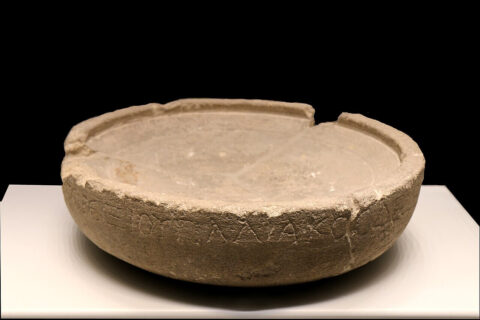
Evidence for the worship of Esus extends beyond northern Gaul. One of the most important inscriptions comes from the Gail Valley in Noricum, in present-day Austria. A small bronze pedestal, probably associated with the ancient settlement of Gurina, once supported a statuette that has since been lost. Its inscription records a vow fulfilled to Aeso, a form of the god’s name, by Adginnos, son of Vercombogios. Usually dated to the second half of the first century BCE, this dedication predates the Pillar of the Boatmen and provides direct evidence of devotion to Esus in the eastern Alpine region.
Another significant inscription was discovered at Caesarea in Mauretania (modern Cherchell, Algeria). The fragmentary marble stele (AE 1985, 934) names Esus and appears to record an action performed by a man named Peregrinus in response to the god’s command. Philippe Leveau and Bernard Rémy, who studied the inscription in 2014, dated it to approximately the late first century BCE or early first century CE. They proposed that Peregrinus may have been a Gaulish soldier who thanked Esus for protection from an unspecified danger. His military background remains hypothetical, and the dedication does not establish an organized cult of Esus in North Africa.
These inscriptions demonstrate that devotion to Esus was not geographically restricted to the communities represented by the Paris and Trier sculptures. They also reveal different circumstances of worship, from the fulfilment of a personal vow in Noricum to a possible expression of gratitude for divine protection in Mauretania. The surviving monuments, however, are too few to establish the full distribution or organization of his cult.
Conclusion
Esus is known through an unusual combination of religious images, inscriptions, and literary accounts. The carvings from Paris and Trier suggest a shared Gaulish narrative, while dedications from Noricum and Mauretania indicate that devotion to him extended beyond northern Gaul. Yet these scattered records reveal little about the organization of his cult or the meaning of the tree-cutting scene.
Lucan’s description of savage altars, expanded by later commentators into accounts of sacrifice, offers no explanation of the god’s imagery or powers. Identifying Esus simply as a god of trees, war, or sacrifice would go beyond the available evidence. His name and images have survived, but much of the religious tradition that gave them meaning has been lost.
Academic Sources & Primary Texts
Academic Studies
- Duval, Paul-Marie. “Notes sur la civilisation gallo-romaine, IV: Teutates, Esus, Taranis.” Études celtiques 8, no. 1 (1958): 41–58.
Read study. - Duval, Paul-Marie. “Esus et ses outils sur des bas-reliefs à Trêves et à Paris.” In Travaux sur la Gaule (1946–1986), 463–470. Collection de l’École française de Rome 116. Rome: École française de Rome, 1989.
Read study. - Ross, Anne. “Esus et les trois « grues ».” Études celtiques 9, no. 2 (1961): 405–438.
Read study. - Charrière, Georges. “Le Taureau aux trois grues et le bestiaire du héros celtique.” Revue de l’histoire des religions 169, no. 2 (1966): 155–192.
Read study. - Leveau, Philippe, and Bernard Rémy. “És us en Afrique: À propos d’une inscription fragmentaire de Caesarea Mauretaniae commémorant l’exécution d’une injonction d’Ésus.” Antiquités africaines 50 (2014): 85–92.
Read study. - Breeze, Andrew. “Lucan on Human Sacrifice and the God Esus.” The Explicator 82, no. 2 (2024): 43–50.
Journal record.
Ancient Literary Sources
- Lucan. Bellum Civile (Pharsalia), 1.444–446. Roman literary reference to Esus, Teutates, and Taranis.
Perseus Digital Library. - Commenta Bernensia in Lucanum, commentary on Lucan, Book 1. Bern, Burgerbibliothek, Cod. 370, late ninth century. Medieval scholia describing sacrifices attributed to Esus.
Manuscript record and facsimile. - Lactantius. Divinae Institutiones, 1.21.3. Late Roman Christian testimony concerning Esus and Teutates.
Latin text, University of Zurich. - Julius Caesar. Commentarii de Bello Gallico, 6.16. Description of human sacrifice among the Gauls, without naming Esus.
Latin text and commentary.
Inscriptions & Archaeological Evidence
- Pillar of the Boatmen (Pilier des Nautes), Paris, first century CE. Inscribed representations of Esus and Tarvos Trigaranos. Musée de Cluny; French Ministry of Culture.
Archaeological record. - Votive Monument to Mercury and Esus, Trier, CIL XIII 3656. Dedication by Indus of the Mediomatrici. Rheinisches Landesmuseum Trier.
Museum collection record. - Votive Inscription to Aeso, Noricum, ILLPRON 2091. Bronze dedication by Adginnos, son of Vercombogios, from the Gail Valley, Austria.
University of Vienna epigraphic record. - Votive Inscription Naming Esus, Caesarea Mauretaniae (Cherchell, Algeria), AE 1985, 934. Fragmentary dedication associated with Peregrinus.
Inscription and scholarly analysis.
Copyright & Content Notice
© 2026 History & Myths. All rights reserved.
Original article written by H. Moses. Historical interpretations are based on the academic studies, ancient literary accounts, inscriptions, and archaeological evidence cited above. No copyright is claimed over ancient texts or artifacts. Images remain subject to their respective licenses and attribution requirements. Unauthorized reproduction of the original article text is prohibited.