Food and Drink in Ancient Egypt: Bread, Beer, and Daily Life
Ancient Egyptians ate a practical daily diet built around bread and beer, supported by seasonal vegetables, fruit, and whatever fish or meat their household could afford. Food wasn’t just “what people liked to eat”—it was a working system of grain processing, baking, brewing, and ration distribution that kept families, labor crews, and institutions running.
Most people didn’t live on luxury meals. They lived on reliable calories: bread in many forms, beer as liquid nutrition, and simple sides that changed with the harvest. The real story of Egyptian food is how a civilization turned grain into routine survival—then used that routine to organize labor, status, and even religious life.
What Did Ancient Egyptians Eat and Drink Every Day?
For most people in ancient Egypt, daily eating wasn’t about variety—it was about reliable calories. The routine diet was built around bread and beer, with vegetables, fruit, and fish filling in the gaps depending on season, location, and income. Meat existed in the Egyptian food world, but for many households it was not the everyday centerpiece people imagine when they picture banquets on tomb walls.
The simplest way to understand Egyptian daily food is to see it as a grain-based survival system. Grain could be stored, measured, taxed, transported, and turned into two things that were easy to distribute and hard to live without: bread as solid nourishment and beer as drinkable nutrition. That’s why both show up constantly in sources describing household routines, labor rations, and offerings—because they were the stable foundation, not an occasional treat.
Bread: the daily constant
Bread was the default food across social levels. It could be baked in different shapes and textures, eaten alone, dipped into stews, or combined with vegetables and herbs. For ordinary people, bread wasn’t “one item on the table”—it was the table. The rest of the meal often worked as support: small additions to make bread more filling, easier to eat, or simply less repetitive.
Beer: not luxury, but liquid food
Beer was also a daily reality, but it didn’t function like modern beer in a “going out for drinks” sense. It was commonly thick, nourishing, and sometimes strained, making it closer to a practical drink that delivered calories and hydration in a reliable form. When people talk about ancient Egyptians drinking beer constantly, the important point isn’t indulgence—it’s that beer was part of normal food intake, especially in contexts where clean hydration and energy mattered.
Vegetables and fruit: the everyday “second layer”
Alongside grain, Egyptians ate common vegetables and seasonal produce. These were the foods that added freshness and balance to a bread-heavy diet: onions and other greens, legumes, and whatever could be harvested or traded locally. Fruit—especially items like dates and figs—was also important, partly because it could be eaten fresh but also because it preserved well and carried sweetness and energy.
This part of the diet is where daily meals became more “personal.” A household’s access to gardens, markets, river resources, and storage capacity shaped what ended up on the plate. Two families could both live on bread and beer, but one might eat more vegetables, another more fish, and another rely more heavily on dried or preserved foods.
Fish and meat: present, but not equal for everyone
Fish was one of the most practical protein sources for many Egyptians because the Nile made it accessible in ways that large amounts of meat were not. Meat certainly existed—cattle, goats, sheep, and poultry appear in elite contexts and religious imagery—but daily consumption depended heavily on status and resources. For many people, the normal pattern was likely simple: grain every day, vegetables and fish when available, and meat more often tied to special occasions, higher income, or institutional settings.
What “every day” really means in ancient Egypt
The key point is that “daily diet” in ancient Egypt wasn’t a fixed menu. It was a framework:
- Bread and beer formed the core.
- Vegetables and fruit added the day-to-day variation.
- Fish and meat depended on geography and social class.
- Bigger meals were often tied to festivals, wealth, or temple-related distributions.
Ancient Egyptians didn’t need complex cuisine to survive. They needed a stable system that worked across farms, villages, cities, and work crews—and that system started with grain.
Want to understand why daily food looked so different from one household to another? Diet in ancient Egypt followed social rank closely—from basic bread-and-beer rations to elite feasts.
| Food/Drink | Daily Role | Who Ate It Most | Why It Mattered |
|---|---|---|---|
| Bread | Core daily calories | Everyone | Stable, storable grain turned into reliable survival food |
| Beer | Daily drink + nutrition | Everyone (especially workers) | Practical hydration and energy; easy to issue with rations |
| Vegetables & legumes | Daily variety + nutrition | Most households | Seasonal “second layer” that made grain meals livable |
| Fruit | Energy + sweetness | Most households (by season) | Fresh when available, preserved when needed |
| Fish | Practical protein | Many Nile communities | Accessible compared to meat; fits daily routine better |
| Meat | Less frequent, more status-linked | Wealthier households / feasts | Marker of social advantage more than a daily staple |
Bread: The Real Backbone of Egyptian Survival
If you strip ancient Egyptian food down to what actually kept people alive day after day, you end up with one answer: bread. It wasn’t a side dish or a breakfast option—it was the core calorie source that made everything else possible. Vegetables, fish, fruit, and even meat mattered, but bread was the dependable baseline. It was the food that could be produced at scale, stored, moved, taxed, and turned into daily meals without needing constant access to fresh ingredients.
Bread also mattered because Egypt’s economy and administration were built around grain control. Grain could be counted and collected, which made it useful not only for feeding families, but for feeding a state. Once grain becomes the center of survival, bread becomes more than “food.” It becomes a tool of organization.
The grains behind the bread (and why they mattered)
Egyptian bread was usually made from cereals like emmer wheat and barley, both suited to Egyptian agriculture and storage. This matters because grain solves the biggest problem in any premodern diet: unpredictability. Fresh food comes and goes with seasons, but grain can be stored through shortages, moved to where labor is concentrated, and used as a buffer when harvests are uneven.
That stability is the hidden reason bread dominates the story. Egypt didn’t survive because it had the most exciting meals—it survived because it had a system that could consistently turn harvest into calories.
Bread was never “one thing”
A common mistake in modern summaries is describing Egyptian bread like a single product. In practice, bread could differ widely in:
- shape (small loaves, rings, cones, flat forms)
- texture (dense, coarse, or lighter depending on sieving and technique)
- use (eaten alone, used to scoop food, combined into stews, or carried as rations)
This variety didn’t necessarily mean luxury or choice in a modern sense. It often meant practical variation: whatever a household could produce efficiently, whatever ingredients were available, and whatever baking method matched the tools they had.
Grinding grain was the real labor cost
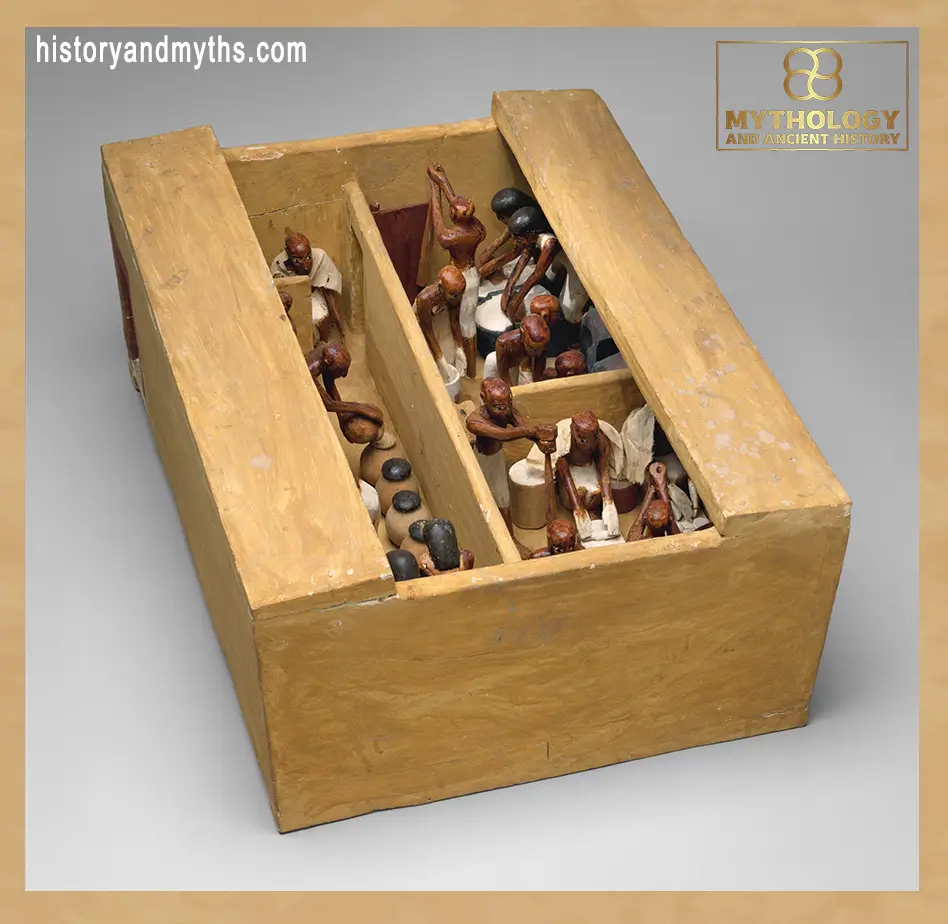
The “invisible work” behind bread was grinding. Turning grain into flour required time and physical effort, especially at household level. That matters because it explains something crucial: bread wasn’t just food, it was daily labor turned into calories. People didn’t simply “have bread.” They created it through repetitive work that structured household life, especially for families managing their own production.
Once you view bread as a labor product, you understand why it becomes such a dominant object in Egyptian daily life: it is the output of routine and the base of survival.
Bread as wages: the ration logic
One of the strongest reasons bread sits at the center of Egyptian society is that it could be used as ration pay—alongside beer and other staples. Bread wasn’t only consumed inside the home; it was issued in organized contexts where large numbers of people needed reliable food: work crews, temple staff, and state-managed labor.
This is where “bread” stops being kitchen-only and becomes political and economic. A system that can pay in bread (or grain equivalents) is a system that can mobilize workers and keep them alive without modern money markets. It’s practical administration: the state doesn’t need to invent complex salary structures if it can distribute measured calories.
Bread made “simple meals” work
Most Egyptian meals were not complex courses. They were combinations built around bread:
- bread + vegetables
- bread + fish
- bread + fruit
- bread + simple stews or sauces
This is why you can read ancient Egyptian diet as a hierarchy of layers. Bread was layer one, always there. The rest depended on access and season. Without bread, the diet collapses into scarcity. With bread, even minimal additions become enough to sustain daily life.
Why bread shaped status, not just survival
Even though bread was universal, the way it was produced and consumed could still reflect class:
- finer flour vs coarser flour
- more consistent supply vs occasional shortage
- bread as part of larger meals vs bread as the whole meal
So bread didn’t erase inequality. It carried it quietly. Two Egyptians could both be “eating bread,” but one household’s bread came with vegetables, fish, and stable supply—while another lived much closer to the edge.
Bread, in other words, didn’t just feed Egypt. It exposed how Egypt worked.

Beer in Ancient Egypt: Thick, Cloudy, and Everyday
If bread was the solid foundation of Egyptian survival, beer was the liquid one. Ancient Egyptian beer wasn’t a luxury drink, and it wasn’t consumed the way modern people think about alcohol. In daily life, beer functioned as hydration, calories, and routine nourishment—a practical drink woven into work, household meals, and institutional rations.
That’s why beer shows up constantly alongside bread: the two were not separate lifestyle choices. They were the most efficient way to turn grain into dependable daily energy.
Egyptian beer wasn’t “modern beer”
One of the fastest ways to misunderstand Egyptian beer is to picture it like today’s clear, heavily filtered product. In many cases, Egyptian beer was:
- cloudy or thick
- nutritive, not recreational
- sometimes strained before drinking, depending on how it was made
So when you see claims like “Egyptians drank beer all day,” the correct reading is not “they were constantly partying.” The correct reading is: beer was a normal part of getting through the day, especially for people whose life depended on physical labor and consistent calorie intake.
Beer was built from the same logic as bread
Beer and bread belong to the same production world: grain processing.
The key idea is simple: grain is stored safely for long periods, then converted into food and drink when needed. Bread handles the solid side of survival; beer handles the liquid side. Together they solve a practical problem every premodern society faces:
- How do you keep people fed year-round?
- How do you feed work crews reliably?
- How do you distribute food in measurable units?
Beer fits that model perfectly because it turns grain into something that is easy to consume, easy to share, and easier to ration than many fresh foods.
Beer as nutrition: why it mattered in real life
Beer wasn’t just a “drink with calories.” It was a daily shortcut to energy and hydration—especially in a society where water access and quality could vary by location and season.
This is also why beer makes sense as part of ordinary meals:
- bread provides a stable base
- beer provides hydration plus extra nourishment
- vegetables and fish add variety when available
A lot of modern summaries treat Egyptian beer like a fun cultural detail. In reality, it makes more sense to treat it like a survival technology.
Beer at work: a ration, not a treat
Beer also mattered because it integrated cleanly into organized labor systems. When institutions needed to support workers—whether in state projects, temple operations, or other labor contexts—beer could be issued as part of daily provisions.
“How did ancient Egyptians actually stay fed while working?”
Beer is part of that answer. It wasn’t only consumed at home—it was a rational solution to feeding people reliably.
The social meaning of beer depended on context
Beer could exist in several layers of Egyptian life at once:
- everyday beer as routine nourishment
- beer in feasts as part of celebration and social display
- beer in offerings as a religious item that reflects what people valued most
So beer wasn’t purely “common” or purely “elite.” It was universal—but its meaning changed depending on where and why it was consumed.
What beer tells you about Egyptian daily life
Beer is one of the clearest signals that Egyptian food culture wasn’t built around variety—it was built around systems:
- the system of storing grain
- the system of converting grain into daily food and drink
- the system of distributing rations efficiently
- the system of feeding both families and institutions
That’s why beer deserves a full section, not a throwaway line. It wasn’t background flavor—it was part of what kept Egypt functioning every day.
Vegetables, Fruits, and the Nile’s Seasonal Menu
After bread and beer, the everyday diet in ancient Egypt relied on whatever the land and river could reliably provide: vegetables, legumes, and seasonal fruit. These foods didn’t replace the grain core—they made it livable. They added flavor, basic nutrition, and variety to meals that would otherwise be repetitive.
Most households would have depended on simple plant foods that were easy to grow, store, or trade locally. Vegetables and greens could be eaten fresh when available, while legumes and dried produce helped bridge gaps when the season changed. Fruit—especially sweeter options like dates and figs—offered quick energy and could also be preserved, making it practical rather than “luxury.”
The important point is that ancient Egyptian meals weren’t designed for variety; they were built around seasonal access. Grain stayed stable year-round, but vegetables and fruit rose and fell with harvest cycles, storage ability, and household income.
Meat, Fish, and Class Differences
Fish was one of the most realistic protein sources for many Egyptians because the Nile made it accessible in everyday life. It could be caught locally, prepared simply, and added to grain-based meals without requiring elite resources.
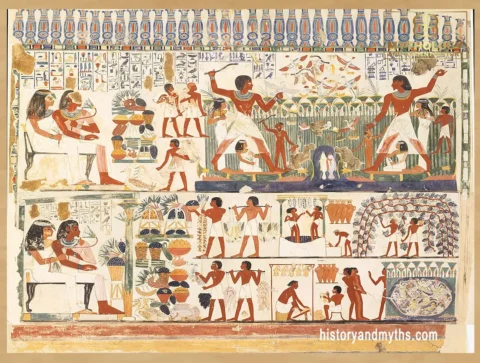
Meat existed, but it wasn’t evenly distributed. Tomb scenes and feast imagery can make it look like ancient Egyptians ate heavy meat meals all the time, but that reflects status and occasion, not the average household routine. For many people, meat would have been less regular—more likely tied to festivals, wealth, or institutional settings where food was issued in larger quantities.
So the clean rule is: bread and beer were universal, vegetables and fruit shaped the day-to-day variation, fish was often the practical protein, and meat was the clearest marker of social advantage.
Quick Infographic: How Food Actually Worked in Ancient Egypt
- Grain was the real “currency” — it could be stored, counted, taxed, and redistributed.
- Bread was survival math — a daily calorie base that didn’t depend on season.
- Beer was liquid nutrition — everyday hydration + energy, not a luxury drink.
- Vegetables and fruit added the human layer — seasonal variety and basic nutrients.
- Fish was practical protein — easier access for many Nile communities.
- Meat signaled status — more visible in feasts and elite contexts than daily routine.
Food at Work: How Meals Fit Into Labor, Temples, and Households
Food in ancient Egypt wasn’t only a private matter inside the home. It was also an organized system that supported labor and maintained institutions. Bread and beer worked especially well for this because they could be produced in bulk from stored grain, measured in predictable portions, and issued as routine provisions.
Inside households, daily eating depended on repetitive production: grinding grain, baking, brewing, and preparing simple sides. At the level of work crews, food functioned more like structured supply—meals weren’t chosen, they were allocated. This is one reason bread-and-beer diets remained dominant: they were efficient for feeding large groups consistently.
Temples also shaped the food economy through offerings and controlled distribution. Food moved through religious spaces not only as ritual, but as a practical part of maintaining staff, storage, and organized daily life.
Key Takeaways
- Daily food in ancient Egypt was built around bread and beer, not luxury meals.
- Grain storage made the diet stable through seasons and shortages.
- Beer worked like nourishment as much as it worked like a drink.
- Vegetables and fruit added seasonal variety more than they replaced the grain core.
- Fish was the practical protein for many communities, while meat was more status-linked.
- Food wasn’t just culture—it was part of Egypt’s labor and ration system.
Continue Reading
- Aging and Old Age in Ancient Egypt — how society treated the elderly and the realities of lifespan.
- Merchants and Middlemen in Ancient Egypt — how goods moved, traded, and reached households.
- Personal Hygiene and Cosmetics in Ancient Egypt — daily routines beyond food: cleanliness, oils, and identity.
FAQ: Food and Drink in Ancient Egypt
What was the most common food in ancient Egypt?
Bread was the most common daily food, made from staple grains and eaten by all social classes.
Did ancient Egyptians really drink beer every day?
Yes, beer was a common daily drink and often served as liquid nutrition alongside bread.
What vegetables did ancient Egyptians eat?
They relied on simple vegetables and greens, plus legumes, depending on season and local access.
Did poor Egyptians eat meat often?
Not usually. Meat was more strongly linked to wealth, special occasions, and elite feasting.
Was fish common in the ancient Egyptian diet?
Fish was a practical protein source for many Nile communities and often more accessible than meat.
What did children eat in ancient Egypt?
Children generally ate the same staples as adults—bread and simple household foods—adjusted to age and availability.
How did food show social class differences in ancient Egypt?
Higher-status households had more consistent access to variety, including meat and larger feasts, while most people relied on staples.
Did temples control food in ancient Egypt?
Temples managed offerings and storage, and food could move through religious systems as part of institutional life.
Sources & Rights
- Ikram, Salima. Food and Drink in Ancient Egypt. Cairo: American University in Cairo Press, 2006.
- Nicholson, Paul T., and Ian Shaw, eds. Ancient Egyptian Materials and Technology. Cambridge: Cambridge University Press, 2000.
- Samuel, Delwen. “Brewing and Baking.” In Ancient Egyptian Materials and Technology, edited by Paul T. Nicholson and Ian Shaw. Cambridge: Cambridge University Press, 2000.
- Wilkinson, Toby A. H. The Rise and Fall of Ancient Egypt. New York: Random House, 2010.
- Kemp, Barry J. Ancient Egypt: Anatomy of a Civilization. 2nd ed. London: Routledge, 2006.
- Shaw, Ian, ed. The Oxford History of Ancient Egypt. Oxford: Oxford University Press, 2000.
- Brewer, Douglas J., and Emily Teeter. Egypt and the Egyptians. 2nd ed. Cambridge: Cambridge University Press, 2007.
- Bard, Kathryn A. An Introduction to the Archaeology of Ancient Egypt. Malden, MA: Wiley-Blackwell, 2008.
- Grajetzki, Wolfram. The People of the Pyramids: Everyday Life in Ancient Egypt. London: Duckworth, 2006.
- Allen, James P. The Ancient Egyptian Pyramid Texts. Atlanta: Society of Biblical Literature, 2005.
Written by H. Moses — All rights reserved © Mythology and History