Viziers in Ancient Egypt: How Bureaucracy Ran the Kingdom
In Ancient Egypt, the vizier was the pharaoh’s top official and the executive head of government. He supervised administration, justice, and the work of scribes who managed records, taxation, and state resources. Bureaucracy was not optional—it was the mechanism that made royal power real across the entire country.
Pharaohs appear in inscriptions as absolute rulers, but a state that controls harvests, labor, courts, and provinces cannot run on charisma. Egypt ran on paperwork, inspections, and chains of authority. The vizier’s job was to turn royal ideology into daily administration—filtering chaos into reports, cases, and orders that could actually be enforced.
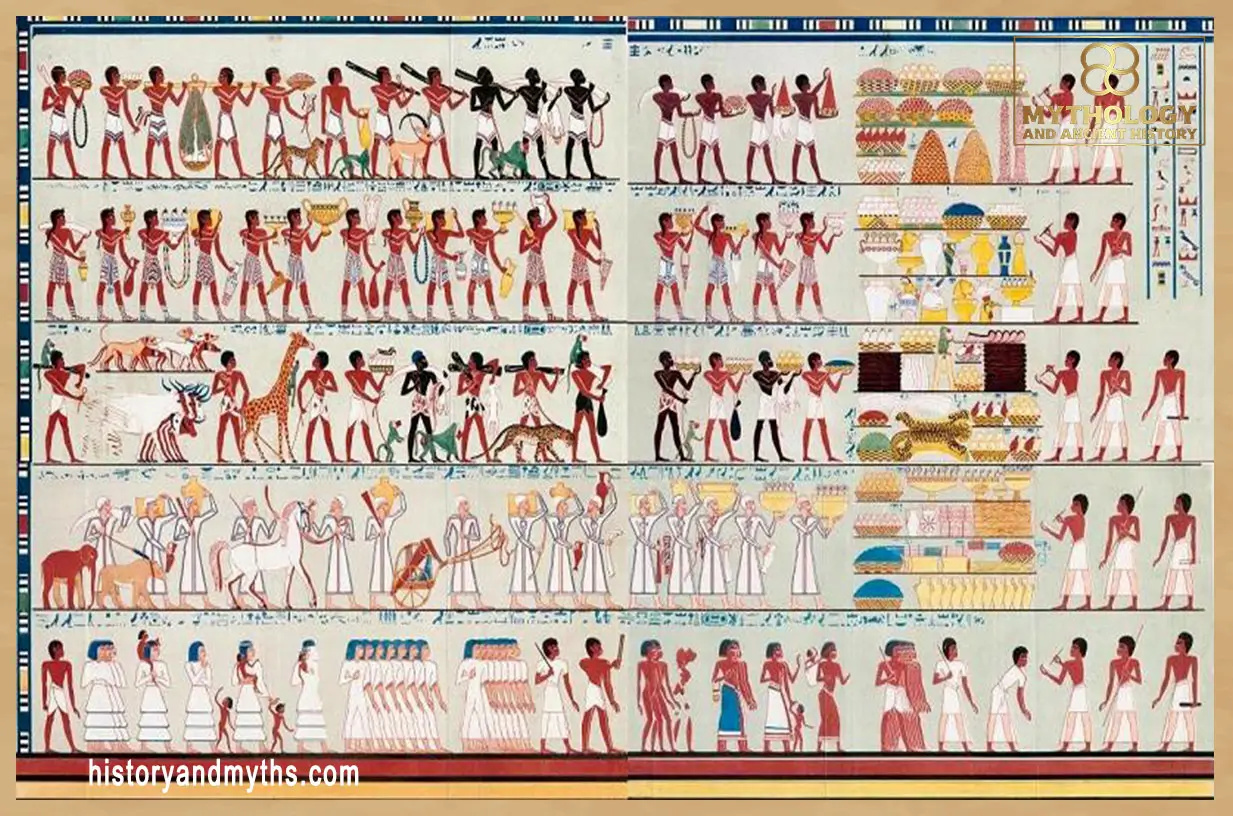
Image: Tribute scene from the tomb of Vizier Rekhmire (TT100), after George Alexander Hoskins, Travels in Ethiopia above the 2nd cataract (London, 1835) — Source: Wikimedia Commons (Public domain)
The Vizier Was Not a “Helper” — He Was the State’s Operating System
Calling the vizier a royal “advisor” is accurate but incomplete. In practice, the vizier (often rendered from Egyptian tjaty) functioned as the highest-ranking official beneath the king, coordinating the entire civil administration.
What made the vizier powerful?
The vizier’s power came from three structural responsibilities:
Control of administrative flow
Most information did not reach the pharaoh directly. The vizier organized what mattered, what could wait, and what required immediate state action—essential in a system where decisions depended on written reports and recordkeeping.
Judicial authority
Egyptian government did not separate “law” from “administration” the way modern states do. High officials could function as judges, and the vizier appears as a central figure in legal order and case-handling at the top of the system.
Oversight of scribes and documentation
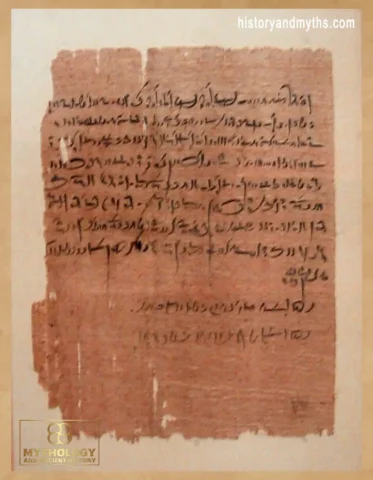
If you want to control tax, labor, and resources, you first need records. Egypt’s administration relied on scribes to count, measure, and document what the state could claim—especially as taxation became more systematic and record-driven over time.
The “Duties of the Vizier” tradition shows what Egypt valued
A major reason we can speak precisely about the vizier’s role is that Egyptian culture preserved idealized “job descriptions.” The best-known is the New Kingdom text often called The Duties of the Vizier (linked with Rekhmire’s installation). Even when phrased as moral instruction, it outlines a worldview where administration is almost sacred: early rising, roll calls, audits, hearing cases, and filtering issues so only the most important reach the king.
Viziers and Bureaucracy in Ancient Egypt (Quick Framework)
| System Element | What It Controlled | Why It Mattered | Typical Risk |
|---|---|---|---|
| Vizier | Executive oversight of administration and justice | Turns royal authority into enforceable decisions | Factional capture, access-control politics |
| Scribes | Records, counts, inventories, assessments | Creates visibility for taxation and planning | Manipulated reporting and selective documentation |
| Courts and hearings | Disputes, penalties, and legal order | Prevents disputes from becoming political instability | Uneven enforcement and influence-based outcomes |
| Taxation system | Grain, goods, labor obligations | Funds state institutions and state work | Under-collection, local resistance, hidden production |
| Provincial governance | Local officials, enforcement, logistics | Keeps the country coherent beyond the capital | Autonomy drift and competing power centers |
Inside the Bureaucracy: How Egypt Ran on Documents, Not Speeches
Ancient Egypt could not govern through royal presence alone. The kingdom was too long, the population too distributed, and the economy too seasonal. What made control possible was an administrative culture that treated writing as infrastructure. Orders had to be copied, stored, and retrieved. Goods had to be counted, measured, and recorded. Disputes had to be documented. Without this documentary routine, authority would remain symbolic rather than operational.
The scribal system was not a decorative elite hobby. It was the engine that turned fields into taxable units, labor into manageable quotas, and temple wealth into trackable inventories. The state’s intelligence was largely numeric and textual: lists, calculations, receipts, allocations, and summaries. When the system worked, the center could “see” the provinces through data, not guesswork.
Bureaucracy also created continuity. Pharaohs changed, and dynasties ended, but administrative habits could persist because a trained scribal class carried procedures forward. This is one reason Egypt’s governance often survived political turbulence better than outsiders expect. Institutions could absorb shocks by continuing to produce records, move resources, and enforce routine decisions, even when ideological unity weakened.
The vizier sat at the top of this structure. His influence was not based on theatrical power but on access to information, control of priorities, and the ability to coordinate departments. In practice, the vizier functioned as the state’s main processor, ensuring that reports were actionable, that resources were not lost in local confusion, and that administrative power remained coherent from the royal court down to village-level obligations.
The Vizier’s Core Responsibilities: Justice, Taxes, and State Work
The vizier’s job can be understood through what the Egyptian state had to accomplish every year, not through ceremonial titles. A kingdom built on agriculture needed predictable control of production, labor, and conflict resolution. Without those three, the state could not feed its institutions, pay its officials, or keep provincial society stable under central rule.
Justice was one of the vizier’s most important functions because law in Egypt was inseparable from administration. Disputes over property, inheritance, debt, labor obligations, or misconduct were not just private matters; they affected the flow of resources and the credibility of authority. A bureaucracy that cannot resolve disputes quickly creates local retaliation, informal power, and loss of control. The vizier therefore represented the highest level where order could be restored before problems became political crises.
Taxation was the second pillar. Egypt’s wealth was not stored as abstract money but as measurable outputs: grain, livestock, linen, and labor time. That meant taxation required consistent accounting. Officials had to know what existed, what could be taken, and what had already been assigned to temples, building projects, or state storage. The vizier’s power came from supervising the administrative machinery that turned harvests into obligations and obligations into redistributable resources.
The third pillar was state work. Large-scale construction, maintenance of temples, management of storehouses, and mobilization of crews depended on scheduling and discipline. These projects were not occasional; they were part of the state’s routine. Managing labor was not simply forcing people to work, but coordinating transport, supplies, supervision, and deadlines so that work produced results instead of chaos. In that sense, the vizier was not only overseeing officials. He was overseeing the state’s ability to transform planning into physical outcomes.
In a functioning system, these three responsibilities reinforced each other. Courts supported stability, stability enabled reliable taxation, and taxation funded the labor and materials that sustained the state’s institutions. When the system weakened, the cracks usually appeared in the same places: unpaid workers, disputed obligations, delayed supplies, and local officials gaining space to act independently.
Controlling Provinces from the Center
Egypt was long, regionally uneven, and not naturally easy to govern as a single unit. The Nile created a shared economic rhythm, but geography still produced distinct local interests, powerful families, and competing centers of influence. Central authority therefore depended on more than royal ideology. It depended on administration that could connect the capital to provincial realities without being physically present everywhere at once.
The vizier’s importance increases when you treat Egypt as a logistical problem. Harvest assessments had to reach officials who could act on them. Labor quotas had to be organized across communities. Disputes between local elites could not be allowed to escalate into private wars or fragmented rule. Bureaucracy created a channel through which the state could monitor and regulate provinces while preserving the appearance of unity under the king.
This also explains why provincial politics mattered so much. Local leaders were not merely passive recipients of orders. They controlled access to labor, storage, and enforcement. If local administration became too autonomous, the center could lose practical authority even while kingship remained ideologically intact. The vizier’s role was to prevent that drift by keeping information and accountability moving upward and instructions moving downward in a disciplined flow.
Over time, Egypt repeatedly shows the same pattern. When central power is strong, provincial structures become instruments of the state and monument building expands. When central power weakens, local rule becomes more independent, state obligations become harder to enforce, and the bureaucracy either fragments or is forced to negotiate. Understanding the vizier and bureaucracy is therefore not a side topic. It is one of the clearest ways to understand how Egypt held together for so long, and why it sometimes failed to do so.
Continue Reading
Bureaucracy Was Power: Why the System Could Outlast the King
One of the most important facts about Ancient Egypt is that the state could keep functioning even when individual rulers were weak. That resilience did not come from military force alone. It came from administrative continuity. Bureaucracy created routines that could continue regardless of personality: records were still produced, supplies still moved, labor was still scheduled, and disputes still required decisions. When those routines held, the state remained recognizable even under stress.
This is why bureaucratic positions were never “neutral.” Officials who controlled documents controlled reality. If a harvest was counted differently, taxation changed. If a labor list was delayed or altered, work slowed. If a complaint was ignored, local tension increased. Administrative power was the ability to decide what becomes visible to the center and what disappears into silence. The vizier’s authority was built on this visibility. He stood above departments not by symbolic rank, but by control of flow: information, approvals, discipline, and timing.
The system also created political risk. Because bureaucracy held so much practical power, it could become a competing center of influence. High officials could build networks through appointments, favors, and control over access to the king. In stable periods this strengthened government because it made administration effective. In unstable periods it could deepen factionalism because different offices became power bases. Egypt’s political history repeatedly shows that when court unity breaks, administration does not simply stop; it becomes the terrain where power is contested.
At its best, Egyptian bureaucracy turned a vast country into a manageable machine. At its worst, it became a filter that could slow reform, protect local interests, or isolate the king from realities outside the palace. Either way, the conclusion is the same. The bureaucracy was not background. It was one of the main reasons Egypt could rule itself for centuries, and one of the reasons central authority sometimes fractured when the system could no longer coordinate the whole country as one.
The Real Meaning of “Bureaucracy” in Ancient Egypt
Egypt’s bureaucracy was not paperwork for its own sake. It was the technology of control. Records turned harvests into obligations, disputes into rulings, and provinces into manageable territories. The vizier mattered because he controlled how information became action, and how action became state stability.
Corruption, Favor, and Administrative Limits
No bureaucracy runs on ideals alone. Ancient Egypt had regulations, hierarchy, and inspection, but it also had favoritism, personal networks, and officials protecting their own interests. Power concentrated in administration creates predictable distortions: access becomes a currency, appointments become political, and records can be shaped to benefit the people who control them.
Corruption did not always look like direct theft. It could appear as selective enforcement, delayed paperwork, manipulated counts, or quiet immunity for connected families. These practices matter because Egypt depended on accurate measurement and reliable obligation. If quotas were distorted or disputes were handled unevenly, the state’s authority weakened at the level where people actually felt government: taxes, labor demands, and legal decisions.
This is where the vizier’s role becomes sharper. A vizier who could enforce standards kept the system credible. A vizier who served factions, protected allies, or failed to discipline officials turned the bureaucracy into a political weapon rather than a state tool. In that sense, bureaucratic failure was rarely a technical problem. It was a legitimacy problem, because the state could not claim order while behaving arbitrarily.
Even without scandal, bureaucracy had limits. Communication across distance was slow. Local realities could be misunderstood. Provincial officials could adapt central orders to what was possible or profitable. The state could respond, but never instantly. That lag is one reason Egyptian government relied on routine: it reduced the need for constant intervention by keeping society within predictable administrative cycles.
What the Vizier and Bureaucracy Tell Us About Egyptian Power
Ancient Egypt’s stability was not just a product of kingship ideology. It was built on an administrative system that could measure resources, enforce obligations, and resolve disputes at scale. The vizier mattered because he concentrated executive control over that system: he supervised how information moved, how decisions were implemented, and how provincial power stayed connected to the center.
This changes how we should read Egyptian history. Political strength is not only visible in wars or monuments. It is visible in whether the state can collect, record, and coordinate. When administration functions, Egypt feels unified. When it fragments, the same geography produces competing local powers, weaker enforcement, and slower state action even if royal titles remain unchanged.
The practical conclusion is simple. The vizier was not a decorative official. He was the institutional proof that Egypt was governed through organization, not only through divine kingship.
Key Takeaways
- The vizier was the executive core of government beneath the pharaoh.
- Egypt ruled through records, audits, and predictable administrative routines.
- Justice, taxation, and labor control were the state’s main operating pillars.
- Provincial rule worked only when information and accountability flowed reliably.
- Bureaucracy could stabilize the state, but also become a political battleground.
FAQ
Was the vizier always more powerful than other officials?
In formal hierarchy, yes, but real power depended on the period, the king’s strength, and the vizier’s control of appointments and information.
Did Ancient Egypt have a “civil service” like modern states?
Not in a modern legal sense, but it had structured offices, career paths for scribes, and administrative routines that functioned like a state service.
Why were scribes so central to government?
Because taxation, labor demands, and temple resources depended on measurement and recordkeeping, not personal memory or oral commands.
Could local governors ignore the central administration?
They could resist or negotiate in weak periods, but strong central control relied on audits, reporting, and enforcement through administrative chains.
Was bureaucracy mainly about collecting taxes?
Taxes were crucial, but bureaucracy also managed courts, state labor, supply distribution, and the administration of temples and estates.
How did bureaucracy help Egypt survive political instability?
Routine administration can keep resources moving and decisions functioning even when leadership changes, delaying or reducing total collapse.
What was the biggest weakness of Egyptian administration?
Distance, slow communication, and the risk of favoritism or manipulation inside reporting systems where officials controlled visibility.
Sources & Rights
- Baines, John, and Jaromír Málek. Atlas of Ancient Egypt. New York: Facts On File, 1980.
- Kemp, Barry J. Ancient Egypt: Anatomy of a Civilization. 2nd ed. London: Routledge, 2006.
- Quirke, Stephen. The Cult of Ra: Sun-Worship in Ancient Egypt. London: Thames & Hudson, 2001.
- Shaw, Ian, ed. The Oxford History of Ancient Egypt. Oxford: Oxford University Press, 2000.
- Van De Mieroop, Marc. A History of Ancient Egypt. Malden, MA: Wiley-Blackwell, 2011.
- Wilkinson, Richard H. The Complete Temples of Ancient Egypt. London: Thames & Hudson, 2000.
Written by H. Moses — All rights reserved © Mythology and History