What Happened After Death at Home in Ancient Egypt?
Death at home in ancient Egypt was the first stage of the funerary process, before embalming and burial began. In the hours after death, families secured the body, started mourning inside the household, and prepared for the transfer to purification and embalming spaces. This domestic moment shaped memory, dignity, and social order.
This article focuses on what happened inside the house—who took control, how mourning began, what practical steps likely followed, how long the dead might remain at home, and how ordinary homes differed from elite households before the body ever reached an embalming place.
What “Death at Home” Meant in Ancient Egypt
In ancient Egypt, dying at home was not a private ending. It was the moment the household became responsible for managing a dangerous transition. Death created practical problems immediately: the body had to be secured, the home’s routine was disrupted, and grief had to be expressed in a way that was socially recognized. The house was the first stage of funerary order, where the family began turning loss into a controlled process rather than a collapse.
This stage mattered because it came before specialists and formal spaces took over. Embalming did not start the moment someone died, and burial was still far away. What happened first was domestic: family members and close community responded, organized the scene, and prepared the dead for departure. That preparation was not only logistical. It also marked the beginning of dignity, because the dead person’s identity was still present in the household, surrounded by those who knew them.
Seen through this lens, death at home was a social procedure. It forced the household to shift from ordinary life to ritual readiness. The family’s ability to respond correctly shaped how the deceased would be remembered, how grief would be managed, and how the transition from home to embalming would unfold. The house was not just where death occurred. It was where funerary control began.
| Stage | What Typically Happened | Who Was Involved | Why It Mattered |
|---|---|---|---|
| Immediate response | The household secured the body and stabilized the home | Family + close community | Order begins before any formal rites |
| Domestic mourning | Grief becomes public and socially recognized inside the house | Relatives, neighbors, mourners | Creates memory and legitimacy of loss |
| Household control | Someone takes charge and coordinates the response | Household authority figures | Protects dignity and reputation |
| Preparing departure | The body is organized for transfer out of the household | Family + arranged support | Home stage ends and formal processing begins |
| Later stages (not at home) | Purification, embalming, burial rites, and tomb-based practices | Specialists + wider ceremonial roles | Transforms the dead for afterlife identity |
The First Hours After Death: Securing the Body and the House
The first hours after death were defined by urgency, not ceremony. A household had to stabilize itself quickly. The body could not be treated as an ordinary object, and it could not be left unmanaged. The immediate goal was to secure the dead in a way that preserved dignity, limited disruption, and prevented the home from falling into chaos. Even before any formal ritual action, the act of controlling the situation was the first form of funerary responsibility.
This stage also reshaped the household’s social boundaries. A death created a focal point that drew family, neighbors, and close community inward. The home became a public space in practice, even if it was physically private. People arrived to witness, to mourn, and to participate in what society expected from a “proper” household response. That social presence mattered because it turned grief into an acknowledged event rather than hidden pain.
At the same time, practical decisions began immediately. The household needed to determine what would happen next, when the body would be moved, and how the transition would be organized. The dead could remain in the home for a short period before being transferred to purification and embalming spaces, depending on resources and context. What matters historically is not the exact duration, but the reality of a domestic interval: a gap between death and formal treatment, where the home carried the burden of order.
Who Took Control Inside the Household?
Death at home triggered an internal hierarchy. The household did not respond as a collection of individuals; it responded as a structured unit. Authority had to exist, because decisions had to be made quickly, and disorder could damage both dignity and reputation. The person who took control was not always the same across social classes, but the pattern is clear: responsibility clustered around those who managed the household in daily life and those who had the authority to coordinate others.
Family members were the first line of management, but they were rarely alone. Close relatives and neighbors could become part of the process, especially in communities where social life was tightly connected. Their role was not only emotional support. They helped turn mourning into an organized event and ensured that the household response looked “correct” to the wider community. In a society where reputation mattered, the handling of death was judged as much as it was felt.
In wealthier households, control could extend beyond family into specialist involvement. Even if professional embalming happened elsewhere, elite families had more capacity to arrange transfer, assign tasks, and maintain order. Ordinary homes had fewer buffers and less manpower, which made control more fragile and more urgent. Either way, death forced someone to step into command, because the household needed a clear center of coordination before the body ever left the home.
Mourning Begins Indoors: Grief as a Public Household Act
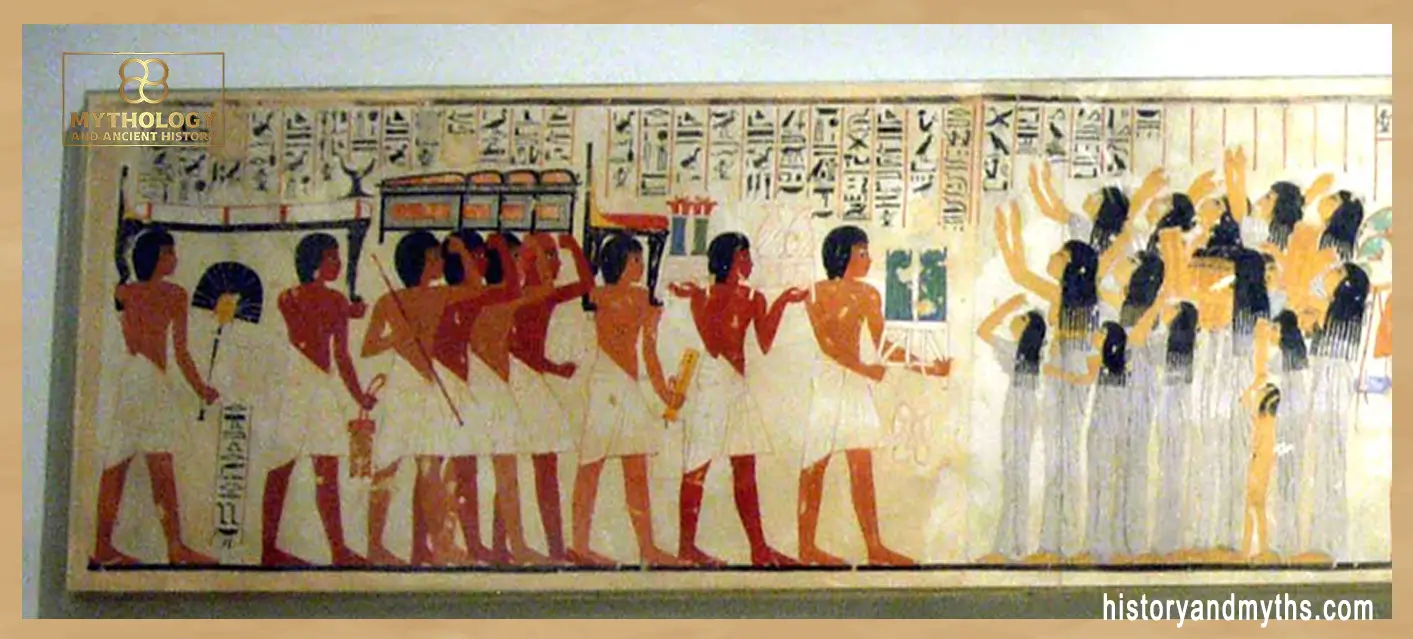
Mourning in ancient Egypt did not start at the tomb. It started inside the house, where grief became visible and socially legible. The first expressions of sorrow were not only personal emotion; they were part of how a household announced loss to the community. A death that was not mourned openly could appear suspicious, cold, or socially incorrect. The house therefore became the first stage where grief was performed, witnessed, and recognized as real.
This indoor mourning also had a practical function. It gathered people and stabilized the situation. The presence of mourners made death a shared event, not an isolated breakdown. In that shared space, the household could begin the transition from shock to structure. Grief did not disappear, but it became organized around expectations: who should be present, how mourning should look, and how the deceased should be treated until transfer.
Most importantly, mourning inside the home shaped memory before any ritual words were spoken at a grave. The last time the dead person belonged to ordinary social life was still within the household. That is where identity was still human and familiar. The move from home to embalming space marked the point where the person became “the deceased” in a technical sense. But inside the house, mourning began while the person was still felt as a presence in daily life, making the domestic moment emotionally and socially decisive.
From Home to Embalming: Preparing the Departure
The shift from death at home to formal treatment was not automatic. It had to be arranged, and that arrangement was itself a critical stage. The household needed to move from mourning and stabilization into preparation for departure, because the dead could not remain in the home indefinitely. The transfer marked the point where family responsibility began to intersect with specialized spaces and procedures, including purification and embalming.
This is where elite and ordinary households diverged most sharply. A well-resourced family could manage the transition with more control, more coordination, and a clearer chain of action. They could secure transport, assign roles, and maintain a calm appearance even under stress. An ordinary household faced the same necessity but with fewer resources, which meant the transition could be faster, simpler, and more exposed. The difference was not in grief. It was in capacity.
Historically, this departure matters because it defines the boundary of the “home stage.” Once the body left the household, the process entered a different world of spaces, specialists, and ritual technologies. But the success of that later process depended on what happened first: how the household managed the initial hours, how it protected dignity, and how it created order. Death at home was not a passive waiting period. It was the moment the funeral process was launched.
Death at home was the domestic start of the funerary process in ancient Egypt. Families secured the body, began mourning indoors, and organized the departure to purification and embalming spaces. The home stage was about control, dignity, and social order—before technical embalming and tomb rituals took over.
Ordinary Homes vs. Elite Houses: Two Levels of Death Management
Death at home did not look the same in every Egyptian household because household power was uneven. In ordinary homes, the response to death had to be efficient. Space was limited, privacy was harder to maintain, and the family’s ability to slow down daily life was constrained by necessity. The dead could not remain at home for long without disrupting food, work, and household stability. Mourning still happened, but it was carried inside a system that could not afford delay.
Elite houses could treat death at home as a managed event. They had more rooms, more people available to carry duties, and more control over how the household presented itself to visitors. That allowed for stronger separation between mourning, organization, and preparation for transfer. Elite families also had greater ability to coordinate the next step: moving the body into purification and embalming spaces with less improvisation and more authority. The household response could be staged as dignified rather than simply urgent.
This difference matters because it shapes what the evidence can represent. Much of what survives visually and ritually tends to reflect elite norms, not the reality of the poorest majority. For many Egyptians, the domestic stage was a struggle to maintain order under pressure. For the elite, it was a controlled transition toward a planned funeral identity.
- Burial Practices in Ancient Egypt: Afterlife Beliefs and Tomb Traditions
- Ancient Egypt’s Afterlife Trial: Will Your Soul Pass the Test?
- Rewards in the Afterlife: Eternal Life in Ancient Egypt
- The Lake of Fire Explained — Judgment and the Egyptian Afterlife
- Aaru (Iaru) — The Field of Reeds in Ancient Egyptian Afterlife
Why Death at Home Mattered: Memory, Dignity, and Social Order
Death at home mattered because it was the last moment the dead person existed inside ordinary social life. Before embalming, before ritual texts, before the tomb became the center of attention, the household held the first version of the ending. That domestic moment shaped memory in a way later ceremony could not fully replace. It determined whether the death felt controlled or chaotic, honored or neglected, and whether the family appeared capable of handling loss with dignity.
This stage also mattered because Egyptian society treated order as a moral principle, not just a practical need. A household that managed death well demonstrated discipline and stability. A household that fell into disorder risked damaging its reputation. The home was therefore a social stage as much as an emotional one. The way grief was expressed, the way the dead were handled, and the way the transition was managed all reflected back on the living.
Most of all, death at home was where the funeral process truly began. The later stages depended on the household’s first response: securing the body, gathering the community, and preparing for departure. In that sense, the home was not outside funerary culture. It was its starting point. The dead left the house for purification and burial, but the household created the first bridge between life and that new state. That bridge—built under pressure—was a core part of how ancient Egyptians protected dignity and maintained social order.
Conclusion
Death at home was the domestic beginning of the Egyptian funerary process, where families secured the body and transformed shock into control. Mourning started indoors, and the household prepared the dead for the transition into purification and embalming spaces. Long before the tomb, the home shaped memory, dignity, and the public face of loss.
- Death at home was the first stage of funerary order, before embalming and burial.
- The household secured the body and stabilized the home in the first hours after death.
- Mourning began indoors and turned grief into a socially recognized event.
- Elite houses could manage death more visibly and with greater control than ordinary homes.
- The home stage focused on dignity and coordination, not technical embalming procedures.
FAQ
Did funerary rituals start at home in ancient Egypt?
Yes. The household stage began immediately after death, when families secured the body, began mourning, and prepared for transfer to purification and embalming spaces.
How long did the dead remain at home before embalming?
It likely varied by household resources and context. What matters is that there was often a domestic interval between death and formal embalming.
Who managed the body inside the house?
Household authority figures and close relatives coordinated the response, while the wider community could also be involved through mourning and support.
Did ordinary people handle death differently from the elite?
Yes. Ordinary homes needed faster, simpler responses, while elite houses had more space, manpower, and coordination capacity to manage the transition.
Was embalming performed inside the home?
Full embalming was tied to specialized spaces and procedures. The home stage focused on securing dignity and organizing departure rather than technical preservation.
Why was mourning important inside the household?
Because it made loss socially recognized, stabilized the household, and shaped memory before the burial process moved into formal stages.
Why is “death at home” historically significant?
It shows where funerary control truly began: in the domestic space where order, dignity, and reputation were managed under pressure.
Sources & Rights
- Assmann, Jan. Death and Salvation in Ancient Egypt. Ithaca, NY: Cornell University Press, 2005.
- Baines, John, and Jaromír Málek. Atlas of Ancient Egypt. New York: Facts On File, 1980.
- Ikram, Salima. Death and Burial in Ancient Egypt. Cairo: American University in Cairo Press, 2003.
- O’Connor, David, and David P. Silverman, eds. Ancient Egyptian Kingship. Leiden: Brill, 1995.
- Pinch, Geraldine. Egyptian Mythology: A Guide to the Gods, Goddesses, and Traditions of Ancient Egypt. Oxford: Oxford University Press, 2004.
- Taylor, John H. Death and the Afterlife in Ancient Egypt. Chicago: University of Chicago Press, 2001.
- Teeter, Emily. Religion and Ritual in Ancient Egypt. Cambridge: Cambridge University Press, 2011.
- Wilkinson, Richard H. The Complete Gods and Goddesses of Ancient Egypt. London: Thames & Hudson, 2003.