What If Akhenaten’s Religion Survived? Ancient Egypt Reimagined
If Akhenaten’s religion had survived his death and become Egypt’s permanent faith, the country would have faced far more than a change of gods. The real challenge would have been turning Atenism from a royal revolution centered on one pharaoh into a religious system capable of surviving new kings, political crises, and generations of Egyptians who were deeply attached to older traditions.
That would require major compromises. The power of Amun’s priesthood would have to be permanently reduced or absorbed into a new structure, while Atenism itself would need priests, rituals, temples, and a clearer place for ordinary worshippers. It would also have to answer questions Akhenaten’s system handled poorly—especially what happened after death and what role remained for Osiris and the traditional funerary beliefs.
Egypt might therefore have moved toward a more centralized state religion, with the pharaoh holding even greater religious authority. Akhetaten could have remained an important sacred center, and the artistic and political culture of the Amarna period might have lasted much longer. But it is far less certain that every older god would simply disappear or that Egypt would become a strictly monotheistic society in the modern sense.
The most plausible long-term outcome is a transformed Atenism rather than an unchanged continuation of Akhenaten’s original program. To become permanent, his religion would have needed to outgrow the man who created it—and in doing so, it might have become very different from the faith Akhenaten intended.
The Historical Turning Point
Akhenaten’s religious revolution did not outlive him in anything close to its original form.
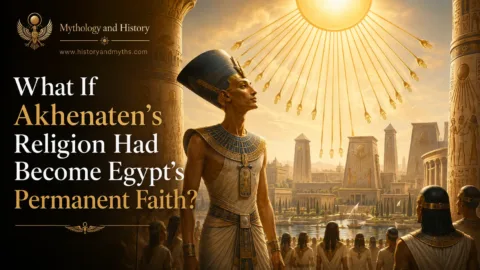
During his reign, Aten was elevated above the traditional gods, Akhetaten became the new royal capital, and the king placed himself at the center of a religious system that weakened older cults—especially that of Amun. Temples, royal names, and official imagery were reshaped around the new order.
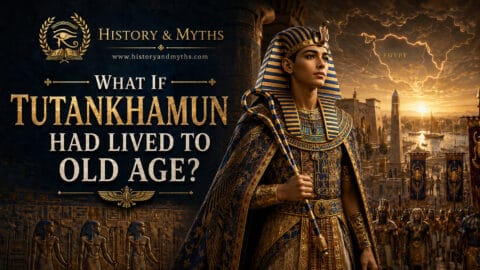
After Akhenaten’s death, however, the system proved fragile. His successors moved away from Akhetaten, restored the traditional gods, and reversed much of the Amarna program. Tutankhaten became Tutankhamun, signaling the return of Amun to royal favor, while later rulers worked to erase much of Akhenaten’s religious legacy.
That collapse reveals the key weakness in Atenism: it depended heavily on Akhenaten himself.
For this alternate history to work, the crucial change is not simply that Aten worship continues for a few more years. Akhenaten’s successor must preserve the new religion, keep its institutions functioning, and prevent the political restoration of the old priesthoods.
Only then could Atenism begin the far harder transition from a pharaoh’s revolution into a faith capable of surviving without its founder.
The Scenario Used in This Article
This is a hypothetical alternate-history scenario, not a claim about what actually happened in ancient Egypt.
It assumes that Akhenaten dies around the historical time of his death, but the religious reversal that followed never takes place. His successor continues to support Aten as the central state deity, keeps the new religious institutions intact, and prevents the full restoration of Amun and the older temple establishment.
The scenario does not assume that every traditional Egyptian belief disappears overnight. Local cults, household worship, funerary customs, and older gods would still survive among much of the population, especially outside the royal court.
The key change is political and institutional: Atenism survives its founder and becomes the official religion of the Egyptian state for generations.
From that point, the question is no longer whether Akhenaten’s experiment lasts a few extra years, but whether it could evolve into a stable faith capable of surviving new pharaohs, public resistance, and the religious needs of ordinary Egyptians.
Could Atenism Actually Survive Akhenaten?
Atenism could survive Akhenaten, but only if it became less dependent on him.
Its greatest weakness was that the king stood at the center of the relationship between Aten, the royal family, and the wider population. After his death, the religion would need institutions strong enough to function without his personal authority.
That meant creating a durable priesthood, temples with regular rituals, and a clear way to transfer religious authority from one pharaoh to the next.
Succession would be decisive. If several rulers continued funding Aten temples and prevented the old priesthoods from regaining political power, the religion could gradually outlive its founder.
Its survival was possible—but only if Atenism became an institution rather than remaining Akhenaten’s personal religious revolution.
What Would Happen to Amun and the Traditional Priesthoods?
A permanent Atenist state would have to deal with Amun’s priesthood as a political institution, not just as a religious rival.
The temples of Amun controlled land, wealth, personnel, and local influence built up over generations. Simply suppressing the god’s name would not remove that network. Akhenaten’s successors would need either to confiscate much of its property, place its resources under royal control, or absorb parts of the old priesthood into the new Atenist system.
The same problem would extend beyond Amun. Egypt’s traditional temples supported local economies and tied communities to particular gods and festivals. Destroying that structure across the country would risk resistance and administrative disruption.
A more durable solution would probably be selective survival. Aten could remain the official state deity while some older cults continued under tighter royal supervision, especially at the local level.
That would make permanent Atenism less radical than Akhenaten’s original program, but far more capable of lasting. The religion would survive not by eliminating every rival, but by preventing the old temple institutions from becoming powerful enough to overturn the new order.
Would Egypt Become a Truly Monotheistic State?
Not necessarily.
Atenism placed Aten at the center of royal religion, but that does not mean a permanent Atenist Egypt would automatically become monotheistic in the modern sense. Older gods, local cults, household practices, and funerary traditions were too deeply rooted to disappear simply because the court promoted one supreme deity.
The most realistic long-term development would be a strongly centralized state religion in which Aten held unmatched official status while other forms of worship survived at the margins or under tighter control.
Over time, that balance could shift in either direction. Later rulers might push Atenism toward stricter exclusivity, or they might restore selected traditional gods without surrendering Aten’s supremacy.
So Egypt could become far more religiously centralized than before Akhenaten, but a completely uniform monotheistic society would be much harder to sustain across the entire country.
How Would Atenism Change Without Akhenaten?
For Atenism to survive for generations, it would almost certainly have to become less dependent on Akhenaten himself.
The religion as he shaped it placed the king and royal family at the center of access to Aten. That structure worked while Akhenaten controlled the system, but it would become fragile under weaker or less charismatic successors.
Later rulers would need to broaden participation. Priests would require clearer authority, temples would need regular public functions, and ordinary Egyptians would need ways to worship Aten without relying so heavily on the presence of the royal family.
The religion would also have to develop stronger answers to everyday religious needs—birth, illness, protection, death, and burial—areas where traditional Egyptian religion already had deep roots.
That means permanent Atenism would probably become more institutional, more practical, and less personally tied to Akhenaten’s theology.
The irony is that the version most likely to survive would probably be less radical than the one Akhenaten created.
What Happens to Osiris and the Egyptian Afterlife?
This would be one of the hardest problems for a permanent Atenist religion to solve.
Under Akhenaten, Osiris largely disappeared from official funerary religion, and elite tombs at Amarna emphasized continued existence through the light of Aten rather than the older journey into the Osirian afterlife. Yet traditional beliefs did not simply vanish. Archaeological evidence from Amarna still shows older funerary ideas surviving among ordinary Egyptians, and even Akhenaten continued to use some traditional burial objects.
If Atenism lasted for generations, it would need a much fuller theology of death. Egyptians expected religion to explain burial, rebirth, protection of the dead, and continued existence after life—roles that Osiris and the wider funerary tradition had filled for centuries.
The most realistic outcome would probably be adaptation rather than complete elimination. Atenist theology could absorb parts of older funerary practice, reinterpret rebirth through the daily return of sunlight, or allow some Osirian beliefs to survive beneath the official state religion.
That compromise would make permanent Atenism less radical, but also far more usable for ordinary Egyptians. A religion that could explain how to worship the sun yet offered no convincing answer to death would struggle to replace the traditions it was trying to suppress.
Would Akhetaten Remain Egypt’s Capital?
Akhetaten would probably remain important, but it would not necessarily stay Egypt’s only political center forever.
Akhenaten built the city as the physical heart of Aten worship, so abandoning it would weaken the message that the new religion was permanent. Successors committed to Atenism would have strong reasons to preserve its temples, royal compounds, and sacred landscape.
But Egypt was too large and administratively complex to depend on one ideologically created city. Memphis remained better placed for government, the army, and communication with the north, while Thebes still carried enormous economic and religious weight.
The most practical outcome would be a divided system. Akhetaten could survive as the principal sacred city of Aten, while administrative power gradually shifted back toward more established centers.
That would actually make Atenism more durable. Instead of tying the entire religion to one capital built for one reign, later rulers could preserve Akhetaten’s religious status while reconnecting the state to Egypt’s older political geography.
Would the Pharaoh Become Even More Powerful?
Probably, at least at first.
A permanent Atenist system would strengthen the religious position of the pharaoh because the king stood at the center of the relationship between Aten and the state. If older priesthoods remained weakened, fewer institutions would be able to challenge royal authority with independent wealth, land, and religious influence.
That could make the monarchy more centralized than it had been before Akhenaten. Control of major temples, religious appointments, and sacred ideology would sit more directly with the crown.
But the system would also become more vulnerable to weak rulers. A child king, succession dispute, or unpopular pharaoh could damage both political authority and the religion built around it.
For Atenism to last, later kings would therefore need to share some religious functions with permanent institutions rather than keeping everything tied personally to the throne.
The pharaoh might become more powerful, but a religion that depended too heavily on one ruler would remain dangerously fragile.
How Would Ordinary Egyptians Respond?
Official acceptance would not mean immediate popular conversion.
Most Egyptians experienced religion through local temples, household rituals, protective gods, festivals, burial customs, and family traditions. Those practices were woven into daily life long before Akhenaten, and many would likely continue even if Aten remained the state’s official deity.
The strongest resistance would probably come where Atenism tried to replace practices people depended on personally—especially funerary beliefs, protective deities, and local cults. Suppressing those traditions too aggressively could make the new religion politically expensive to maintain.
A lasting Atenist state would therefore need compromise. Local customs might survive privately, some older gods could return in reduced roles, and Aten worship would have to become more accessible outside the royal court.
Over several generations, that could produce a genuinely new religious culture: officially centered on Aten, but still carrying many older Egyptian beliefs beneath the surface.
Would Egyptian Art Remain in the Amarna Style?
Some features of Amarna art would probably survive, but the style would not remain frozen in the form created under Akhenaten.
The elongated bodies, intimate royal scenes, and unusual proportions of the Amarna period were closely tied to Akhenaten’s court and religious message. Later rulers who kept Atenism could preserve parts of that visual language while gradually making it less extreme.
The strongest continuity would likely appear in religious imagery. Aten’s rays, open-air worship, and the prominence of the royal family could remain central to temple decoration and official monuments.
Portraiture and royal sculpture, however, would probably move toward a more conventional Egyptian appearance over time. New pharaohs would want their own visual identity, and artists would adapt rather than copy Akhenaten indefinitely.
A permanent Atenist Egypt could therefore develop a lasting artistic tradition inspired by Amarna without preserving every feature of Akhenaten’s original style.
Would Egypt’s Foreign Policy Actually Change?
Probably less than the religion itself.
Egypt would still need to defend its interests in Nubia, protect trade routes, manage diplomacy with Near Eastern powers, and respond to threats in Syria and the Levant. Atenism would not remove those strategic pressures.
The larger difference would be political. A stronger royal ideology could make foreign policy even more closely tied to the pharaoh, especially if the old temple institutions had lost influence at court.
But there is no reason to assume that a permanent Atenist Egypt would automatically become peaceful, isolationist, or militarily weak. Later rulers could easily combine devotion to Aten with aggressive diplomacy and warfare when state interests required it.
The most realistic change would therefore be in how Egyptian power was justified, not in whether Egypt continued to act like a major regional state.
Could Atenism Survive for Centuries?
Yes, but only if it stopped functioning as a fragile court religion and became a durable institution.
For Atenism to survive for centuries, several successive pharaohs would need to support it, train a stable priesthood, fund temples across Egypt, and create rituals that remained meaningful when the reigning king changed. The religion would also need to survive periods of weak rule, dynastic conflict, and economic strain.
Its long-term survival would depend on flexibility. A rigid attempt to erase every traditional god would make rebellion and restoration more likely, while limited tolerance of local practices could reduce resistance without giving the old priesthoods enough power to recover control.
After several generations, the decisive factor would no longer be Akhenaten’s authority. People born into an Atenist Egypt would know the religion as the established order rather than as a revolution.
If that transition happened, Atenism could last for centuries. But the faith that survived would almost certainly be broader, more institutional, and less radical than the system Akhenaten originally imposed.
Read Also
Would Atenism Influence Later Religions?
A permanent Atenist Egypt could have influenced later religious thought, but the scale of that influence is impossible to predict with confidence.
If Atenism survived for centuries, Egypt would preserve a powerful state tradition centered on one supreme solar deity long before Christianity or Islam emerged. That would make Atenist ideas more visible to neighboring cultures through diplomacy, trade, migration, and political contact.
Even so, direct influence should not be assumed. Similar ideas about a supreme god, creation, light, or divine unity can develop independently, and the surviving evidence does not justify treating Atenism as the source of later monotheistic religions.
The safer conclusion is that a long-lived Atenist tradition would have changed the religious environment of the eastern Mediterranean and Near East. Later belief systems might encounter Egyptian theology in a very different form, but exactly how they would respond remains speculative.
What Would Probably Not Change
Even a permanent Atenist religion would not remake every part of Egyptian civilization.
The Nile would still govern agriculture, taxation, transport, and the rhythm of economic life. Egypt would still rely on monarchy, provincial administration, military power, and trade with neighboring regions.
The greatest changes would occur in religion and royal ideology, not in the basic structures that held the state together.
Atenism could transform how divine authority was expressed without turning Egypt into an entirely different civilization.
Most Likely
The most likely outcome is a moderated Atenist system rather than Akhenaten’s original revolution preserved unchanged.
Aten would remain the supreme state deity, while limited local worship and older funerary practices survived beneath the official religion. Amun’s priesthood would remain politically weakened, and Akhetaten could continue as a major sacred center without necessarily remaining Egypt’s sole capital.
After several generations, Atenism could become part of the established order—but in a more flexible form than Akhenaten created.
Plausible but Uncertain
Atenism might eventually develop into a broader theology in which selected traditional gods returned in subordinate roles beneath Aten.
Akhetaten could also remain Egypt’s principal religious center while administration shifted elsewhere, separating sacred authority from day-to-day government.
A longer-lived Atenist Egypt might influence neighboring cultures through trade and diplomacy, but how far that influence would spread cannot be predicted from the surviving evidence.
Highly Unlikely
It is highly unlikely that Atenism could remain unchanged for centuries while permanently eliminating Egypt’s older gods, local cults, and funerary traditions.
It is equally unlikely that its survival would automatically turn Egypt into a modern-style monotheistic society or make Atenism the direct source of later monotheistic religions.
A permanent Atenist state is plausible only if the religion changes with the society around it.
Final Verdict: Atenism Could Survive Only by Becoming Something Akhenaten Never Created
Akhenaten’s religion could plausibly survive for generations, but not in its original form.
To become permanent, Atenism would need stronger institutions, broader religious participation, and room for beliefs that Egyptians were unlikely to abandon completely. Aten could remain supreme while the religion itself became less dependent on one king and one revolutionary moment.
That is the central irony of the scenario: the more successful Atenism became, the less it would resemble the religion Akhenaten originally created.
Frequently Asked Questions
Could Atenism really have survived after Akhenaten?
Yes, but probably only if later pharaohs continued supporting it and turned it into a stable institution with priests, temples, rituals, and a system that did not depend entirely on Akhenaten himself.
Would Egypt have become fully monotheistic?
Not necessarily. Aten could have remained the supreme state deity while local gods, household worship, and older funerary traditions continued in reduced or private forms.
What would have happened to Amun?
Amun’s priesthood would likely have remained politically weakened. Its temples and wealth might have been absorbed, restricted, or placed under tighter royal control rather than restored to their former power.
Would Osiris and traditional beliefs about the afterlife disappear?
Probably not completely. A lasting Atenist religion would need to address burial, rebirth, protection of the dead, and the afterlife, making some adaptation of older Egyptian funerary beliefs highly likely.
Would Akhetaten remain Egypt’s capital?
It could remain a major sacred center of Aten worship, but political administration might eventually shift back toward established cities such as Memphis while Akhetaten retained its religious importance.
Could Atenism have influenced later religions?
A long-lived Atenist tradition could have changed the religious environment of the eastern Mediterranean and Near East, but there is no solid basis for claiming that it would directly create or replace later monotheistic religions.
Sources and Further Reading
Ancient Texts and Archaeological Evidence
1. The Great Hymn to the Aten.
One of the most important surviving texts for understanding Akhenaten’s theology and the presentation of Aten as creator and sustainer of life.
UCL Digital Egypt — Amarna Belief and the Great Hymn to the Aten
2. The Boundary Stelae of Akhenaten.
Primary inscriptions recording the foundation, sacred boundaries, and dedication of Akhetaten to Aten.
UCL Digital Egypt — Boundary Stelae of Akhenaten
3. The Restoration Stela of Tutankhamun.
An important document for the official restoration of traditional Egyptian cults and temples following the Amarna religious revolution.
Digital Karnak — University of California
4. Akhenaten and the archaeological record.
An overview of Akhenaten, Akhetaten, Aten worship, the suppression of Amun, and evidence from monuments and inscriptions.
UCL Digital Egypt — Akhenaten
Modern Egyptological Scholarship
5. James K. Hoffmeier — Akhenaten and the Origins of Monotheism.
A detailed scholarly study of Akhenaten’s religious reforms, Aten theology, Akhetaten, Amun, monotheism, and the possible wider influence of Atenism.
Oxford University Press
6. James K. Hoffmeier — “Is Atenism Monotheism?”
A focused examination of the debate over whether Akhenaten’s religious system should be described as monotheistic.
Oxford Academic
7. James K. Hoffmeier — “The Influence of Atenism in Egypt and the Bible?”
Examines claims of connections between Atenism and later religious traditions and the limits of the available evidence.
Oxford Academic
8. Emily Teeter — “The Amarna Period: Practical Aspects of ‘Monotheism.’”
A major Egyptological discussion of how Akhenaten’s religious changes affected Egyptian belief and religious practice, and why the system proved difficult to sustain.
Cambridge University Press
9. “Ancient Egyptian Religion.”
Academic overview of Egyptian temples, kingship, priesthood, funerary belief, Osiris, personal religion, and the exceptional disruption created by the Amarna Revolution.
Oxford Research Encyclopedia of Religion
10. “The Archaeology of Amarna.”
An archaeological study of Akhetaten as a royal capital and a source for understanding urbanism, domestic life, and society during Akhenaten’s reign.
Oxford Handbooks Online
11. Marsha Hill — “Art, Architecture, and the City in the Reign of Amenhotep IV / Akhenaten.”
Examines the relationship between Aten worship, the foundation of Amarna, temple architecture, royal imagery, and the distinctive artistic changes of the reign.
The Metropolitan Museum of Art
12. Anna Stevens — “Death and the City: The Cemeteries of Amarna in Their Urban Context.”
Archaeological research on death, burial, non-elite cemeteries, and the lived religious environment of Akhetaten.
Cambridge Archaeological Journal
13. Head of the God Amun — Post-Amarna Period.
Museum evidence associated with Tutankhamun’s restoration of Amun’s monuments after the religious changes of Akhenaten’s reign.
The Metropolitan Museum of Art
© Copyright Notice
Copyright Notice: This article is an original alternate-history analysis published by Mythology and History. It draws on ancient Egyptian inscriptions, archaeological evidence, museum collections, and modern Egyptological scholarship to examine a hypothetical historical scenario.
The alternate outcomes discussed in this article are interpretive and should not be treated as historical events. The documented history of Akhenaten, Atenism, Akhetaten, and the post-Amarna restoration is distinguished from the hypothetical developments explored in the scenario.
Copying, republishing, translating, adapting, or substantially reproducing this content, in whole or in part, without prior written permission is prohibited.
Written by H. Moses
All rights reserved © Mythology and History