Greek Colonization of Asia Minor: Ionian Cities and Trade Power
Greek colonization of Asia Minor was not a secondary expansion—it was one of the earliest and most decisive shifts in Greek history. Along the western coast of Anatolia, Greek settlers established cities that were not isolated outposts, but fully developed poleis embedded in a region already rich in resources, trade routes, and established cultures.
Why did this region matter so much? Because it offered something mainland Greece could not: direct access to eastern trade networks and contact with powerful states. Cities like Miletus and Ephesus quickly became more than settlements—they became economic and cultural centers linking the Greek world to Anatolia and beyond.
This was not expansion into empty land. Greek cities in Asia Minor developed through interaction, competition, and adaptation within an already complex environment. That made them different from western colonies and far more influential in shaping trade, politics, and early intellectual life.
This article explains how Greek colonization in Asia Minor worked in practice: why it began, how these cities developed, and why this region became a core zone of Greek expansion rather than just another frontier.
What Made Asia Minor Different from Other Greek Colonies?
Greek settlements in Asia Minor did not develop under the same conditions as colonies in the western Mediterranean. The difference begins with the environment. Asia Minor was not an open frontier. It was already a structured region with established populations, trade systems, and political powers.
This changed the nature of colonization.
In the west, Greek settlers often created new cities in relatively underdeveloped areas, where expansion meant building from the ground up. In Asia Minor, they had to position themselves within an existing landscape. Cities were founded along the coast, where maritime access gave them an advantage, but their growth depended on interaction with inland societies.
That interaction was not uniform. It included trade, cooperation, and at times conflict. Greek cities adapted to local conditions rather than imposing a fully isolated model. This produced a different kind of polis—one shaped as much by its surroundings as by its Greek origins.
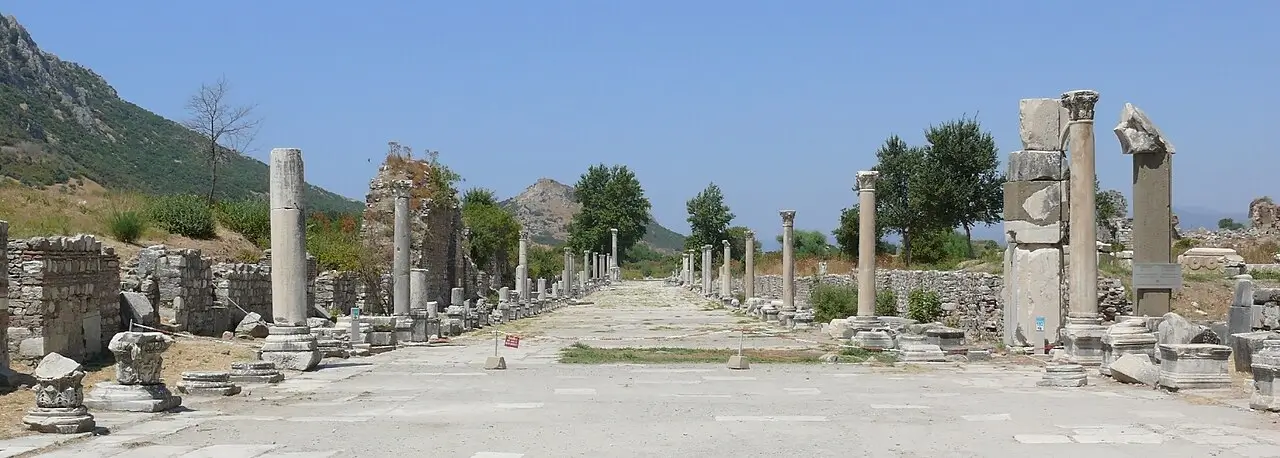
Geography reinforced this pattern. The coastline of Asia Minor offered natural harbors and direct access to Aegean routes, making these settlements ideal as commercial centers. At the same time, proximity to inland routes connected them to resources and markets beyond the Greek world. This dual position—between sea and land—gave these cities a strategic advantage.
The result was a form of colonization that was less about expansion into new space and more about integration into an existing system. Greek cities in Asia Minor became intermediaries: linking the Aegean world with Anatolia and, eventually, larger eastern networks.
This is what sets them apart. They were not peripheral colonies—they were embedded, connected, and positioned at the intersection of multiple economic and political spheres.
| Aspect | Asia Minor Colonization | Western Colonization |
|---|---|---|
| Environment | Established societies and trade systems | Less structured frontier regions |
| Primary Function | Trade integration and regional connection | Land expansion and settlement |
| Political Context | Interaction with major powers | Greater autonomy |
| Economic Role | Trade hubs linking East and West | Agricultural and local economies |
| Cultural Impact | High exchange and adaptation | More direct cultural replication |
| Strategic Value | Gateway between regions | Regional expansion zones |
Who Were the Ionians, Aeolians, and Dorians?
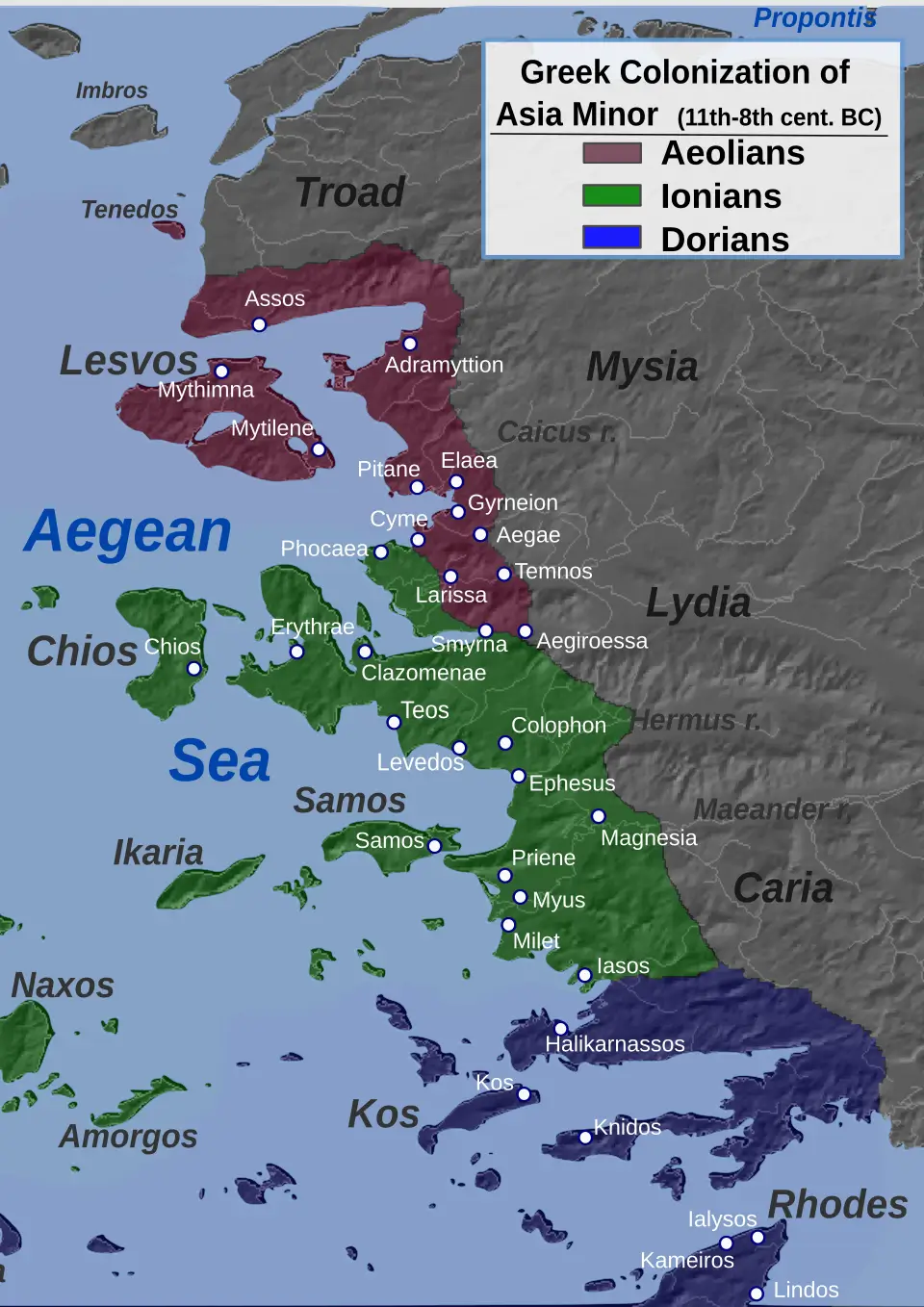
Greek colonization of Asia Minor was not a single movement. It involved distinct groups—Ionian, Aeolian, and Dorian—each settling in different coastal zones and shaping the character of their cities in different ways.
The Ionians occupied the central western coast. Their cities, including Miletus and Ephesus, developed in areas with strong access to maritime routes and nearby inland connections. This positioning helped them become major commercial centers. Over time, Ionian cities were closely associated with trade, cultural exchange, and early intellectual activity.
To the north, the Aeolians settled along a less densely connected stretch of coastline. Their cities were generally smaller and less commercially dominant, but still integrated into regional networks. Aeolian settlements maintained a more limited reach compared to Ionian cities, partly due to geography and partly due to their position within existing trade flows.
Further south, the Dorians established themselves in a narrower coastal zone and nearby islands. Their settlements were fewer and more concentrated. While they shared the broader Greek framework, their development was shaped by different local conditions and connections.
What matters is not just who these groups were, but how their distribution affected the system. Colonization in Asia Minor was not uniform—it produced regional variation within a shared structure. Each group operated within the same general model of the polis, but their location determined their role, scale, and influence.
This distribution also shaped interaction with surrounding powers. Ionian cities, in particular, became deeply involved in wider political and economic dynamics due to their position. That exposure would later define their historical trajectory, especially under external pressure from regional empires.
Why Asia Minor Became the Center of Greek Expansion
Asia Minor became central to Greek expansion because it combined three factors that rarely existed together elsewhere: strategic geography, access to wealth, and direct integration into existing trade systems.
The coastline alone explains part of the story. Western Asia Minor offered a chain of natural harbors facing the Aegean, making it ideal for maritime movement. Greek settlers could maintain constant contact with the mainland while operating beyond its limits. This reduced risk compared to more distant colonies and allowed continuous exchange of goods, people, and information.
More important was access to inland networks. Unlike western colonies, which often depended primarily on sea routes, cities in Asia Minor were connected to established overland trade systems. Through these routes, Greek settlements gained access to resources, markets, and economic flows extending deep into Anatolia and beyond. This turned coastal cities into gateways between two worlds.
Wealth followed that position. Trade was not limited to basic exchange; it involved high-value goods moving between regions. Cities like Miletus leveraged their location to become major commercial hubs, coordinating movement rather than simply participating in it. Economic activity concentrated in these nodes, increasing their influence.
Political context also played a role. Asia Minor was not fragmented in the same way as mainland Greece. Larger regional powers, such as Lydia and later Persia, created a different environment—one where Greek cities had to operate within broader systems of control or negotiation. This pressure forced them to develop stronger economic and administrative structures.
The result was a shift in function. These cities were not peripheral settlements—they were central connectors. They linked the Greek world to eastern economies, concentrated trade, and operated within a more complex political landscape.
That combination made Asia Minor more than a region of colonization. It became the core zone where Greek expansion turned into sustained economic and cultural influence.
Key Cities and Their Roles
Greek cities in Asia Minor did not develop in the same way or serve the same purpose. Their importance came from what they did within the system—how they connected routes, controlled access, or concentrated activity.
Miletus functioned as a primary expansion hub. Its location near key maritime and inland routes allowed it to project influence outward, particularly toward the Black Sea. It was not just a participant in trade—it helped extend the network by founding new settlements and maintaining long-distance connections.
Ephesus developed as a combined commercial and religious center. Its position gave it access to both coastal trade and inland movement, while major religious institutions reinforced its regional importance. This dual role increased stability and attracted continuous activity.
Smyrna occupied a strategic port location that supported regional circulation. Its value was tied to positioning—facilitating movement rather than dominating expansion. Cities like this acted as connectors within the system, ensuring flow between larger hubs.
What distinguishes these cities is specialization. Not every settlement needed to perform the same function. Some drove expansion, others stabilized trade, and others maintained regional links. Together, they formed a distributed structure where influence was not centralized in a single location.
This distribution made the system more resilient. If one city declined or faced external pressure, others could continue to operate. The network adapted because its functions were spread across multiple centers rather than concentrated in one.
The result was not a hierarchy of cities, but a coordinated set of roles—each contributing to the broader operation of Greek presence in Asia Minor.
- Early Greek expansion into a structured and resource-rich region
- Coastal cities connected maritime and inland trade routes
- Ionian, Aeolian, and Dorian groups shaped regional variation
- Integration with powers like Lydia and Persia influenced development
- Trade concentration created early economic centers
- Interaction with the East drove cultural and intellectual growth
Trade, Wealth, and Early Economic Power
The economic strength of Greek cities in Asia Minor did not come from size alone—it came from position and function. These cities sat at the junction of maritime and overland routes, allowing them to control how goods moved between the Aegean and the interior of Anatolia.
Trade here was not incidental; it was structured. Coastal cities received goods arriving by sea—metals, textiles, crafted products—and redistributed them inland. At the same time, they channeled resources coming from the interior—agricultural output, raw materials—back toward the Aegean and wider Mediterranean markets. This two-way movement concentrated economic activity at specific points.
Cities like Miletus leveraged this position to coordinate trade rather than simply participate in it. Their role extended beyond exchange; they organized routes, stabilized supply, and connected distant regions into a functioning system. That control translated into wealth.
Ports were the critical infrastructure behind this process. A well-positioned harbor allowed predictable movement of goods and reduced the risks of long-distance trade. Over time, these ports attracted merchants, craftsmen, and secondary markets, reinforcing the city’s economic base.
The result was early concentration of economic power. Unlike mainland cities, where production and trade were more limited, Asia Minor settlements operated as intermediaries within larger networks. Their influence depended on maintaining flow—keeping routes open, managing access, and adapting to shifting demand.
This is what set them apart. Wealth was not just generated locally; it was accumulated through control of movement. Cities that managed that flow effectively became central to the economic structure of the Greek world.
Interaction with Eastern Powers
Greek cities in Asia Minor did not operate in isolation. From an early stage, they existed alongside—and eventually under—the influence of larger regional powers. This shaped how they governed themselves, how they managed trade, and how stable they could remain.
The first major external influence came from Lydia. As a regional power controlling much of western Anatolia, Lydia brought Greek cities into a system that required negotiation rather than independence. Some cities retained a degree of autonomy, but their position depended on maintaining workable relations with Lydian authority.
This dynamic changed when the Persian Empire absorbed Lydia. Greek cities were then incorporated into a much larger political structure. They were no longer dealing with a regional kingdom, but with an imperial system that operated through appointed officials and defined administrative zones.
Control was not always direct in a local sense, but it was consistent at a higher level. Greek cities were expected to function within the framework of Persian governance—providing tribute, maintaining order, and aligning with broader imperial priorities. This limited their political flexibility, even if local structures remained in place.
At the same time, integration into a larger empire had economic effects. Being part of a stable imperial system could facilitate trade by reducing conflict across regions and securing major routes. Cities that adapted to this environment could continue to function as commercial centers.
The relationship was therefore mixed. External powers imposed constraints, but also created conditions that could support economic activity. Greek cities had to balance these pressures—maintaining local identity while operating within systems they did not control.
This tension defines their position. They were not fully independent, but not fully absorbed either. Their role depended on adaptation, negotiation, and the ability to function within shifting political structures.
The Ionian Revolt and Its Consequences
The stability of Greek cities in Asia Minor depended on their ability to operate within larger power structures. The Ionian Revolt exposed the limits of that balance.
The revolt began as a response to Persian control, but its causes were deeper. Greek cities—especially the Ionian ones—had grown economically and culturally, yet remained politically constrained within an imperial system. Local rulers were often tied to Persian authority, creating tension between internal expectations and external control.
When resistance emerged, it was not coordinated across all cities, nor was it supported by a unified Greek strategy. Some cities participated actively, others remained cautious. This lack of cohesion weakened the overall effort from the start.
Early actions showed potential. Rebel forces managed to challenge Persian positions and even launch offensive operations. But without sustained coordination, logistical depth, or consistent external support, those gains could not be maintained.
The Persian response was systematic. Over time, imperial forces reasserted control, isolating and suppressing individual centers of resistance. By the end of the conflict, the revolt had been contained, and the participating cities faced consequences that reinforced imperial authority.
The outcome matters more than the events themselves. The revolt demonstrated that economic strength did not automatically translate into political independence. Greek cities could operate effectively within a larger system, but breaking away from it required a level of coordination and power they did not possess at that stage.
At the same time, the revolt had broader implications. It marked a turning point in relations between the Greek world and the Persian Empire, setting the stage for larger conflicts that would follow. What began as a regional uprising became part of a wider historical shift.
The key point is this: the Ionian Revolt revealed both the reach and the limits of Greek expansion in Asia Minor. It showed how far these cities had developed—and how constrained they remained within the structures surrounding them.
Cultural and Intellectual Impact
Greek cities in Asia Minor did not just accumulate wealth—they generated new ways of thinking. Their position between the Aegean world and the cultures of Anatolia created an environment where ideas could move as easily as goods.
This mattered for a simple reason: exposure.
In mainland Greece, intellectual life developed within a more contained setting. In Asia Minor, cities were in constant contact with different traditions, systems, and forms of knowledge. That contact encouraged explanation, comparison, and adaptation rather than simple preservation of inherited ideas.
The clearest example is Miletus. Its thinkers began to approach natural phenomena in systematic terms, moving away from purely mythological explanations. What changed was not just the answers, but the method—seeking consistent principles behind observable patterns.
This shift was tied to the environment. A city engaged in trade, negotiation, and coordination across regions requires practical reasoning. Measuring, predicting, and organizing become necessary skills, not abstract pursuits. Intellectual activity followed the same logic: it became more structured, more analytical, and more outward-looking.
Cultural influence spread alongside this process. Language, artistic forms, and religious practices circulated through the same networks that carried goods. At the same time, local elements were absorbed and reinterpreted, producing variation within a shared framework.
What emerged was not a single intellectual center, but a set of cities contributing to a broader transformation. Asia Minor became a space where Greek identity expanded not just geographically, but conceptually—shaped by interaction, not isolation.
- Asia Minor was one of the earliest and most influential zones of Greek expansion
- Colonization here focused on integration, not simple settlement
- Coastal cities became trade hubs linking the Greek world to the East
- Political pressure from Lydia and Persia shaped local development
- Economic power came from controlling trade routes, not just production
- The region played a major role in early Greek intellectual and cultural growth
Frequently Asked Questions
What was Greek colonization of Asia Minor?
It was the early expansion of Greek settlements along the western coast of Anatolia, forming independent cities.
Why was Asia Minor important to Greek expansion?
It provided access to trade routes, resources, and connections to eastern economies.
Who were the Ionians in Asia Minor?
They were Greek settlers who established major coastal cities and became central to trade and culture.
Were Greek cities in Asia Minor independent?
They were politically independent but often operated under the influence of regional powers.
What role did trade play in these cities?
Trade was central, with cities acting as hubs linking maritime and inland routes.
How did Persia affect Greek cities in Asia Minor?
Persian control imposed political limits but also provided stability for trade networks.
What was the Ionian Revolt?
It was a rebellion of Greek cities against Persian rule, revealing the limits of their independence.
Sources & Rights
- Boardman, John. The Greeks Overseas. Thames & Hudson.
- Osborne, Robin. Greece in the Making 1200–479 BC. Routledge.
- Graham, A.J. Colony and Mother City in Ancient Greece. Manchester University Press.
- Hall, Jonathan. A History of the Archaic Greek World. Wiley-Blackwell.
- Snodgrass, Anthony. Archaic Greece. University of California Press.
- Malkin, Irad. Religion and Colonization in Ancient Greece. Brill.
- Malkin, Irad. A Small Greek World. Oxford University Press.
- Hansen, Mogens Herman. Polis: An Introduction. Oxford University Press.
- Cartledge, Paul. Ancient Greece: A Very Short Introduction. Oxford.
- Hornblower, Simon. The Greek World 479–323 BC. Routledge.
- Herodotus. Histories.
- Thucydides. History of the Peloponnesian War.
- Diodorus Siculus. Library of History.
- Strabo. Geography.
- Finley, M.I. The Ancient Economy. University of California Press.
- Van Wees, Hans. Greek Warfare: Myths and Realities. Duckworth.
- Shipley, Graham. The Greek World After Alexander. Routledge.
- Burkert, Walter. Greek Religion. Harvard University Press.
- Whitley, James. The Archaeology of Ancient Greece. Cambridge.
- de Polignac, François. Cults, Territory, and the Origins of the Greek City-State. Chicago.
Written by H. Moses — All rights reserved © Mythology and History