Greek Mercenaries: How Ancient Soldiers Fought for Pay Across Empires
Greek mercenaries were not just soldiers for hire—they were the product of a broken system. After the Peloponnesian War, thousands of trained fighters found themselves with no land, no income, and no role inside their own cities. Instead of laying down their weapons, they sold them.
What started as a survival strategy quickly became a transnational military market. Greek soldiers began fighting in foreign armies—from Persian satraps to Egyptian rulers—turning warfare into a profession detached from loyalty to any single polis. This shift didn’t just change how wars were fought; it changed who controlled them.
The result was a new kind of power structure: armies that moved for money, not citizenship, and commanders who answered to paymasters, not city-states. The story of the Anabasis—where thousands of Greek mercenaries were stranded deep in enemy territory—exposes the strengths and risks of this system at its peak.
This article breaks down Greek mercenaries as a system: why they emerged, how they operated, and how they quietly undermined the very political order that created them.
What Were Greek Mercenaries? (Beyond the Simple Definition)
Greek mercenaries were not simply “soldiers who fought for money.” They represented a structural shift in how warfare functioned in the Greek world. Traditionally, armies were composed of citizens—men who fought to defend their own polis, then returned to civilian life. Service was temporary, tied to land ownership and political identity.
Mercenaries broke that model.
They were professional fighters who operated outside the civic framework. They did not fight because they were Athenians or Spartans; they fought because they were paid. This distinction matters. Once military service is detached from citizenship, the army stops being an extension of the state and becomes a tool that can be bought, moved, and redirected.
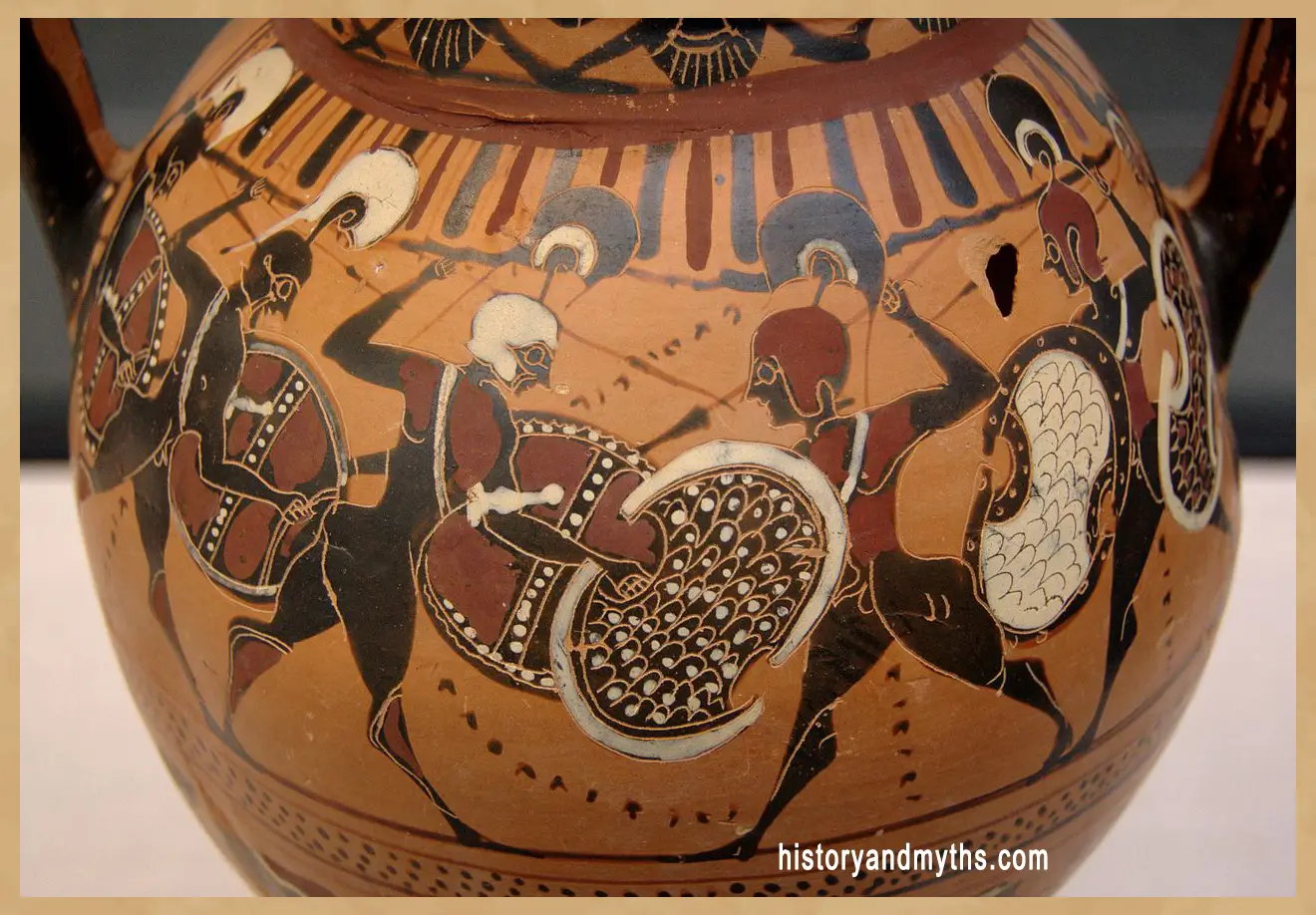
Most Greek mercenaries were experienced hoplites—heavily armed infantry trained in disciplined formation warfare. What made them valuable was not just skill, but consistency. Unlike citizen soldiers, who fought seasonally, mercenaries could campaign year-round, operate far from home, and adapt to different commanders and theaters of war.
This created something new in the ancient world: a mobile, reliable military workforce. Greek mercenaries could be hired by Persian satraps, Egyptian rulers, or rival Greek factions with minimal friction. Loyalty was contractual, not political. If payment stopped, so did allegiance.
The key point is this: Greek mercenaries were not a side phenomenon within Greek warfare—they were the beginning of its professionalization. They turned war from a civic duty into a transferable skill, and in doing so, they weakened the traditional link between the soldier and the state.
| Aspect | Citizen-Soldier System | Mercenary System |
|---|---|---|
| Basis of Service | Citizenship and duty | Payment and contract |
| Loyalty | To the polis | To the employer |
| Duration | Seasonal / temporary | Continuous / long-term |
| Mobility | Limited | High across regions |
| Command Structure | Civic leadership | Contract-based hierarchy |
| Economic Role | Secondary to civilian life | Primary profession |
Why Did Greeks Become Mercenaries?
The rise of Greek mercenaries was not driven by ambition—it was driven by structural pressure. After the Peloponnesian War, the Greek world produced a surplus of trained soldiers with no stable place to go.
War had trained them. Peace had no use for them.
The first factor was economic. Prolonged conflict disrupted agriculture, destroyed local economies, and concentrated wealth in fewer hands. Many citizen-soldiers—especially those without strong landholdings—lost the ability to sustain themselves. Returning home did not mean returning to stability; it meant unemployment.
The second factor was skill specialization. Years of continuous warfare had turned ordinary citizens into experienced fighters. This created a labor mismatch: the economy needed farmers and craftsmen, but it had produced soldiers. Fighting became the one skill that still had value—and outside Greece, that value was high.
The third factor was opportunity beyond the polis. Foreign powers, particularly in the eastern Mediterranean, had both the resources and the need for reliable infantry. Greek hoplites had a reputation for discipline and battlefield effectiveness, making them a preferred asset. For many, leaving the polis was not exile—it was access to a functioning market for their only viable skill.
There was also a political dimension. Internal instability in many city-states—shifts between democracy, oligarchy, and tyranny—created uncertainty and reduced long-term security for citizens. Mercenary service offered something local politics could not: consistent pay, clear hierarchy, and a defined role.
Put together, these forces created a pipeline. War produced skilled fighters; economic collapse removed local options; external demand provided a market. Becoming a mercenary was not a deviation from the system—it was the system adapting to its own consequences.
Where Did Greek Mercenaries Fight?
Greek mercenaries did not operate on the margins of the Greek world—they operated beyond it. Their movement traces where demand for organized, disciplined infantry was highest, and that demand came primarily from states that lacked a comparable military structure.
The most consistent employer was the Persian Empire. Regional governors (satraps) needed reliable forces to maintain control, suppress rebellions, and compete with rival officials. Greek hoplites filled that gap. They were inserted into Persian campaigns not as auxiliaries, but often as the core fighting unit. The campaign described in the Anabasis—where Greek mercenaries marched deep into Persian territory—shows how far and how centrally they could be deployed.
Egypt was another major destination, particularly during periods when local rulers sought independence from Persian control. Greek mercenaries were used to reinforce armies, guard strategic positions, and stabilize regimes that lacked a strong native military base. Their role was less about numbers and more about reliability in decisive engagements.
In Asia Minor, mercenaries were part of a constant cycle of local conflicts. Competing cities, Persian authorities, and regional powers all drew from the same pool of Greek fighters. This created a fluid environment where the same soldiers could shift sides across campaigns, depending on contracts rather than allegiance.
They were also used within the Greek world itself. City-states increasingly hired external forces to avoid relying entirely on their own citizens. This reduced internal strain but introduced a new risk: military power that was no longer tied to the political body of the polis.
What matters here is not just where they fought, but how they moved. Greek mercenaries formed a mobile military network across the eastern Mediterranean. They could be recruited, transported, and deployed across long distances with relative speed. Warfare, in this context, stopped being local. It became regional, interconnected, and increasingly dependent on hired force rather than civic obligation.
The Business of War: How Mercenary Contracts Worked
Greek mercenary service operated on a clear principle: payment defined loyalty. But behind that simplicity was a structured system that allowed armies to be assembled, managed, and redeployed with surprising efficiency.
Recruitment rarely happened at the individual level. Employers—whether Persian satraps, local rulers, or Greek factions—contracted with commanders, not scattered soldiers. These commanders acted as intermediaries. They gathered experienced fighters, organized them into units, and negotiated terms on their behalf. Authority flowed from the contract: the employer paid the commander, and the commander controlled the men.
Payment was typically in coin, which mattered. Unlike land or delayed rewards, cash allowed mobility. A mercenary could leave one employer and move to another without long-term ties. In some cases, additional incentives were offered—shares of plunder, bonuses for successful campaigns, or promises of settlement—but regular pay was the core of the system. If wages were delayed or reduced, discipline weakened immediately.
Command structure was hybrid. Greek mercenaries often retained their own officers and internal organization, even when serving foreign powers. This preserved cohesion and battlefield effectiveness. At the same time, they operated within a broader army under a non-Greek authority. This dual structure worked as long as objectives aligned. When they didn’t, conflict between command layers became a real risk.
Loyalty, therefore, was conditional. Mercenaries were not inherently unreliable—but their commitment had limits. They would fight effectively under clear terms, but they would not absorb losses or continue campaigns indefinitely without compensation. If leadership collapsed or payment stopped, the army could fragment or act independently.
The episode of the Anabasis illustrates this pressure point. When their employer was removed and the chain of command broke, the mercenaries did not dissolve—they reorganized under new leadership and acted in their own interest. The system held, but only because the soldiers themselves replaced the missing structure.
The key takeaway is that Greek mercenary warfare was not chaotic. It was transactional, organized, and scalable. It turned military force into something that could be contracted, priced, and redirected—provided the flow of payment and leadership remained intact.
- War created a surplus of trained soldiers after the Peloponnesian War
- Economic instability pushed citizens into military labor markets
- Commanders acted as intermediaries between employers and soldiers
- Payment in coin enabled mobility and contract-based loyalty
- Greek hoplite discipline made them a preferred force across the eastern Mediterranean
- Military power became transferable, not tied to the polis
Why Were Greek Mercenaries So Effective?
Greek mercenaries were not just available—they were consistently effective. Their advantage came from a combination of structure, training, and battlefield method that most armies they faced did not match.
The core factor was the hoplite system. Greek mercenaries fought in tightly organized formations built on discipline, not individual combat. The phalanx required coordination, timing, and mutual reliance between soldiers. This created a level of cohesion that irregular or lightly organized forces struggled to break. It was not about individual strength; it was about collective pressure applied in a controlled way.
Experience reinforced that structure. Many mercenaries were veterans of prolonged conflicts inside Greece. They had already fought in large-scale, organized battles before entering foreign service. This meant they did not need to be trained from scratch. They arrived as a ready-made fighting force with internal hierarchy, shared tactics, and battlefield familiarity.
Consistency was another advantage. Unlike citizen armies that mobilized seasonally, mercenaries operated continuously. They could campaign longer, move farther, and maintain readiness across multiple engagements. This made them more predictable from a command perspective and more stable under pressure.
They also benefited from relative standardization. Greek equipment, formations, and command practices were broadly similar across different groups. This allowed mercenaries from different regions to integrate quickly under a single commander. It reduced friction at the unit level and increased overall efficiency.
Finally, they filled a structural gap in the armies that hired them. Many of their employers lacked heavy infantry capable of holding a line in close combat. Greek mercenaries provided exactly that function. They were not just additional troops—they were often the decisive element in battle, anchoring formations and absorbing direct engagement.
The result was a force that could be deployed with confidence. Not because it was loyal in a civic sense, but because its internal discipline, experience, and organization made its performance relatively reliable—as long as the system around it held.
The Dark Side: Mercenaries and the Collapse of the Polis System
The rise of mercenaries solved a short-term problem—military demand—but it weakened the foundation that Greek warfare originally depended on: the citizen-soldier model.
In the traditional system, those who fought were the same people who held political rights. Military service was tied to citizenship, land ownership, and participation in the polis. This created alignment. The army defended the state because it was the state.
Mercenaries broke that alignment.
Once city-states began relying on hired forces, military power became externalized. Armies could be assembled without mobilizing citizens, which reduced immediate pressure on the population. But it also reduced their role. Over time, this created a gap between political authority and military force. Decisions about war were no longer directly tied to those who would fight it.
This shift had internal consequences. Citizens became less central to defense, which weakened their leverage inside the political system. At the same time, rulers—especially in oligarchic or unstable regimes—gained access to forces that were not bound by local loyalties. Mercenaries could enforce decisions without the same social constraints that applied to citizen armies.
There was also a loyalty problem at the systemic level. Mercenaries were effective under contract, but they had no inherent stake in the survival of a specific polis. If conditions changed—missed payments, shifting alliances, or leadership collapse—their commitment could dissolve. Military stability became conditional, not structural.
In some cases, this dependence created a feedback loop. The more a city relied on mercenaries, the less it invested in its own citizen force. The weaker the citizen force became, the more necessary mercenaries appeared. Over time, this eroded the original model entirely.
The broader effect was a redefinition of warfare. It moved from a civic obligation to a managed resource. That made armies more flexible and scalable—but it also disconnected military power from the social and political base that had once stabilized it.
From Citizen Soldiers to Military Professionals
Greek mercenaries were not an isolated development—they marked a transition. What began as a response to crisis gradually redefined how armies were built and controlled.
The older model depended on citizens who fought when required and returned to civilian life. It worked as long as wars were limited in scope and duration. But once conflicts became longer, more frequent, and geographically extended, that model started to fail. It could not sustain continuous warfare.
Mercenaries filled that gap, but in doing so, they changed expectations. Armies no longer needed to be temporary or locally bound. They could be maintained, deployed, and reused. Warfare became something that could be managed over time, not just mobilized in moments of need.
This shift laid the groundwork for more centralized military systems. The clearest example appears under Alexander the Great, where the army functioned as a permanent, professional force operating far beyond the limits of any single city-state. While not purely mercenary, it relied on the same principles: continuous service, structured command, and separation from traditional civic frameworks.
The key difference is scale and control. Earlier mercenary forces operated through contracts and intermediaries. Later systems absorbed that model into a more unified command structure, reducing fragmentation and increasing strategic coherence. The soldier was no longer tied to a city—or even a contract—but to an ongoing military institution.
What began with displaced Greek fighters selling their skills evolved into a broader transformation: the emergence of professional armies as a standard feature of large-scale states. The connection between warfare and citizenship did not disappear entirely, but it was no longer the defining structure.
In that sense, Greek mercenaries were not just participants in history—they were a transition point. They represent the moment when war stopped being a civic duty and became a specialized profession, with all the flexibility and instability that comes with it.
- Greek mercenaries emerged from economic and political disruption, not choice
- They transformed warfare from civic duty into a paid profession
- Their effectiveness came from discipline, experience, and formation warfare
- They operated across Persia, Egypt, and the Greek world as a mobile military force
- Reliance on mercenaries weakened the traditional polis-based army system
- This shift laid the foundation for fully professional armies in later empires
Frequently Asked Questions
What were Greek mercenaries?
They were professional soldiers who fought for payment rather than for their own city-state.
Why did Greek mercenaries become common?
Economic collapse and prolonged warfare created a surplus of trained soldiers with limited local opportunities.
Where did Greek mercenaries serve?
They served in Persia, Egypt, Asia Minor, and even in conflicts between Greek city-states.
What made Greek mercenaries effective?
Their disciplined formations, combat experience, and consistent training gave them an advantage in battle.
How were mercenaries paid?
They were typically paid in coin, sometimes supplemented by loot or bonuses.
Did mercenaries weaken Greek city-states?
Yes, reliance on hired forces reduced the role of citizen armies and weakened the polis system.
What is the significance of the Ten Thousand?
They demonstrate how mercenary armies could operate independently when leadership and contracts failed.
Sources & Rights
- Anderson, J.K. Military Theory and Practice in the Age of Xenophon. Berkeley: University of California Press.
- Parke, H.W. Greek Mercenary Soldiers. Oxford: Clarendon Press.
- Trundle, Matthew. Greek Mercenaries: From the Late Archaic Period to Alexander. Routledge.
- Xenophon. Anabasis.
- Diodorus Siculus. Library of History.
- Herodotus. Histories.
- Thucydides. History of the Peloponnesian War.
- Cartledge, Paul. Ancient Greece: A Very Short Introduction. Oxford.
- Hanson, Victor Davis. The Western Way of War. University of California Press.
- Gabriel, Richard A. Philip II of Macedonia. Potomac Books.
- Sekunda, Nicholas. The Ancient Greeks at War. Osprey Publishing.
- Van Wees, Hans. Greek Warfare: Myths and Realities. Duckworth.
- Spence, I.G. The Cavalry of Classical Greece. Oxford.
- Lendon, J.E. Soldiers and Ghosts. Yale University Press.
- Rop, Jeffrey. Greek Military Service in the Ancient World. Cambridge.
- Hornblower, Simon. The Greek World 479–323 BC. Routledge.
- Waterfield, Robin. Dividing the Spoils. Oxford.
- Green, Peter. Alexander of Macedon. University of California Press.
- Billows, Richard. Kings and Colonists. Brill.
- Kuhrt, Amélie. The Persian Empire. Routledge.
Written by H. Moses — All rights reserved © Mythology and History