Marriage and Divorce in Ancient Greece: Power, Dowry, Family Control
Marriage in ancient Greece was not about love or personal choice—it was a controlled arrangement designed to secure inheritance, produce legitimate heirs, and connect families through stable alliances. The decision was typically made by the male head of the household, not the couple themselves, and it served the long-term interests of the family rather than individual preference.
A Greek marriage transferred a woman from her father’s oikos into her husband’s, where her role was clearly defined: manage the household and ensure the continuation of the family line. Dowry, legitimacy of children, and social status were central to the process, making marriage both a legal and economic mechanism.
To understand how Greek society functioned, you have to see marriage as part of a larger system. It was the point where family, property, and social order intersected—and it shaped all three.
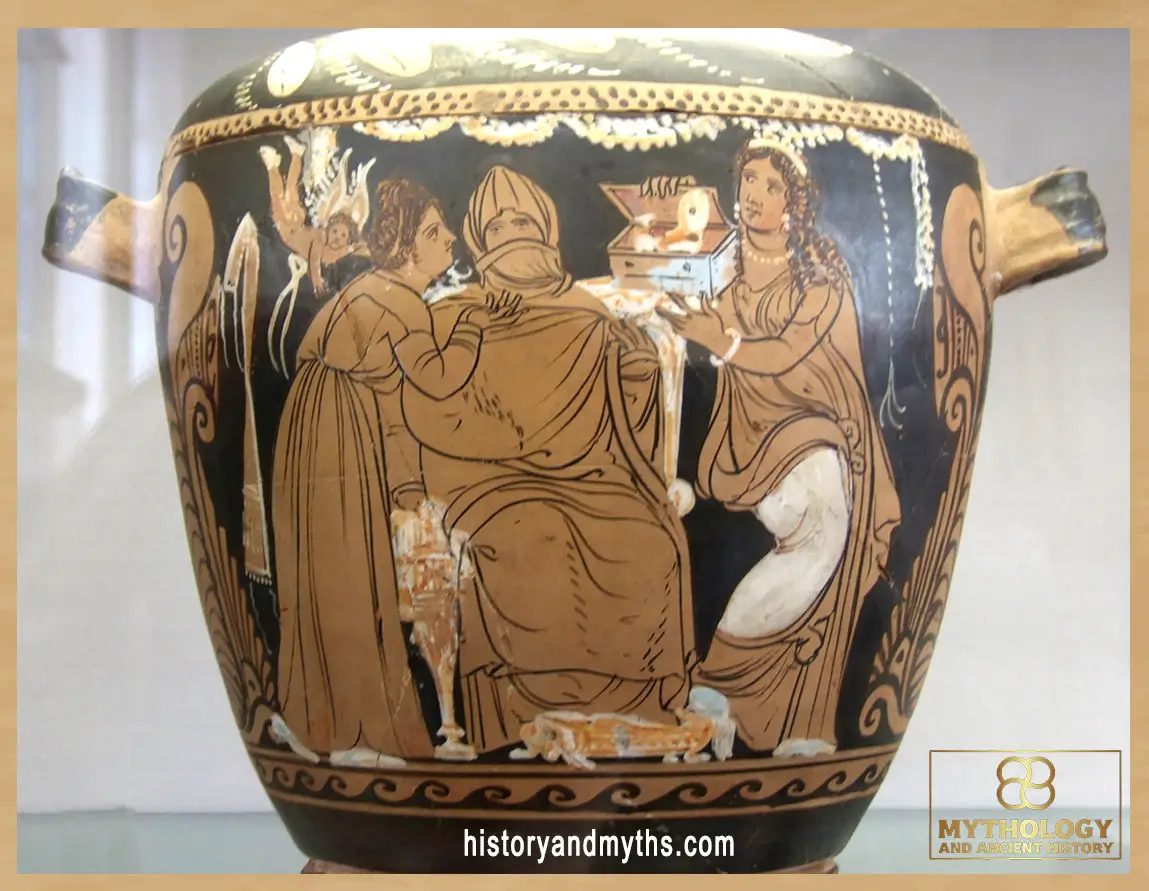
The Core System: Marriage Inside the Oikos
Greek marriage only makes sense when you place it inside the oikos. It was not an independent relationship; it was a mechanism that allowed the household to extend itself—by adding labor, securing alliances, and producing heirs who could inherit without dispute.
The transaction moved a woman from her father’s household into her husband’s, but the goal was continuity on both sides. For the receiving oikos, marriage supplied a legitimate mother for future heirs and a manager for internal operations. For the giving oikos, it created a durable link to another family and redistributed property through the dowry. Nothing about this process is casual. Each element is designed to stabilize assets and clarify lineage.
Control sits with the household, not the couple. The terms of the marriage—timing, partner, and conditions—are set to fit existing priorities: property already held, alliances worth securing, and heirs that must be produced. Personal preference does not drive the arrangement; risk management does. Ambiguity around inheritance is costly, so the system removes it in advance by defining who belongs where and under what terms.
The structure of the house supports this transfer. Entry points, reception spaces, and deeper domestic areas allow the new member to be integrated without exposing the entire household to external contact. The shift is immediate: the woman’s role aligns with the needs of the new oikos, and her visibility and movement follow its internal rules. The marriage is complete when the household can operate without friction.
Across different settings, including Athens and Olynthus, the same pattern appears in both legal references and material layouts: marriage is the point where family structure, property, and daily function lock together.
| Element | Purpose | System Role |
|---|---|---|
| Male Head | Controls decisions | Maintains property and alliances |
| Bride | Joins new household | Ensures heirs and internal stability |
| Dowry | Transfers assets | Binds families economically |
| Marriage Agreement | Formalizes union | Reduces inheritance disputes |
| Children | Continue family line | Secure long-term continuity |
Who Controlled Marriage Decisions?
This control starts before any agreement is visible. Discussions take place between households, not individuals. Terms are assessed, risks are weighed, and only then is the arrangement formalized. The woman’s consent is not the deciding factor; her position in the family structure defines the outcome.
Authority continues after the agreement. The husband becomes the controlling figure within the new oikos, while the original household retains an interest through the dowry and the legitimacy of future children. The arrangement links two families, but it does not distribute control equally between them.
In cities like Athens, where inheritance and citizenship carried legal weight, this centralized decision-making was reinforced by law. The structure reduces uncertainty by ensuring that marriages serve the stability of the household first.
The pattern is consistent across evidence, including domestic contexts in Olynthus: marriage is directed from above, not formed from below.
The Role of Women in Marriage
Marriage repositions a woman within the system rather than redefining it. She moves from her father’s oikos into her husband’s and takes on a function that is already established: manage the internal household and produce legitimate heirs.
Her authority operates inside the house. She organizes daily work, oversees food preparation and textile production, and coordinates the labor that keeps the household running. This role is not symbolic. It is necessary for the stability of the oikos, especially where internal production reduces reliance on the market.
At the same time, the limits are clear. She does not control property in the same way as the male head, nor does she represent the household in public or legal contexts. Her position is defined by responsibility within a structure she does not direct.
Marriage fixes these terms from the start. The transfer into a new household is immediate, and her role aligns with its priorities without negotiation. What matters is not personal adjustment but functional integration—whether the household continues to operate without disruption.
Across different contexts, including Athens and Olynthus, the pattern remains consistent: women are central to the operation of the household, but not to its control.
The system depends on their role. It does not shift authority because of it.
Dowry: The Financial Engine of Marriage
The dowry was not a ceremonial addition to marriage—it was the mechanism that made the arrangement stable. Without it, the transfer between households would remain socially recognized but economically exposed. With it, the marriage becomes anchored in property.
The dowry moved assets from the woman’s original oikos into her husband’s household, but it did not disappear into it. It remained tied to her status and could be reclaimed if the marriage ended. This created a controlled balance. The husband gained resources that supported the household, but he also carried an obligation tied to them. Mismanagement or dissolution of the marriage had financial consequences.
This structure serves two purposes at once. It supports the receiving household by adding material strength—land, money, or goods—while also protecting the interests of the family that provided the bride. The link does not end at the wedding; it continues through the value attached to the dowry.
The presence of a dowry also raises the cost of instability. Divorce, neglect, or failure to maintain the marriage is not just a social issue—it becomes an economic one. That pressure encourages continuity and reduces arbitrary decisions. The system uses property to reinforce behavior.
In places like Athens, this arrangement was clearly embedded in legal practice. Contracts, expectations, and disputes around dowry were structured to ensure that both households remained accountable. Evidence from domestic organization in Olynthus reflects the same priority: resources are tracked, stored, and integrated into the household’s function.
The dowry does not symbolize the marriage. It regulates it.
Without it, the system loses one of its main controls over continuity.
Age and Timing: Why Girls Married Early
Marriage did not happen at a random point in life. It was timed to fit the priorities of the household, and that timing favored early marriage for women. The reason is not cultural preference alone—it is structural.
The system depends on producing legitimate heirs quickly and reliably. Delaying marriage increases uncertainty: fewer years of fertility, higher risk of complications, and a longer period in which property remains without a clear line of succession. Early marriage reduces that risk. It aligns biological capacity with the needs of the oikos.
Control is another factor. A younger bride enters the new household before forming independent ties or expectations that might conflict with its structure. Integration is easier when roles are adopted early rather than negotiated later. The transition from one oikos to another becomes more predictable.
For men, timing is different. Marriage tends to occur later, after the male head has established control over property or secured his position within the household. This creates a gap in age, but that gap reflects function: one side enters to be integrated, the other enters to maintain and direct.
In cities like Athens, where inheritance and citizenship required clear legitimacy, this timing supports legal stability. The earlier the structure is set, the sooner the next generation can be secured. Across different contexts, including evidence from Olynthus, the pattern remains consistent.
Marriage in ancient Greece was not a personal relationship but a structured system designed to control inheritance, secure alliances, and produce legitimate heirs. Every part of the process—from arrangement to dowry—served long-term family stability.
© historyandmyths.com — Educational use
Legitimacy and Heirs: The Core Objective
Everything in Greek marriage points toward one outcome: producing heirs whose status cannot be questioned. Without that certainty, property becomes vulnerable, succession becomes unstable, and the oikos risks fragmentation.
Legitimacy is not a moral label; it is a legal and social condition that determines who can inherit. A child must be recognized as belonging to the household under accepted rules, otherwise claims to property can be challenged. The structure of marriage—who arranges it, how it is formalized, and how roles are enforced—exists to remove that ambiguity before it appears.
This is why the boundaries around the household are tightly managed. Visibility, interaction, and movement are all structured to reduce the possibility of doubt. The goal is not isolation for its own sake, but clarity. When the time comes to transfer property, there should be no competing claims.
If that clarity is threatened, the system does not leave it unresolved. It introduces mechanisms to preserve continuity. In some cases, inheritance could be secured through arrangements that ensured property remained tied to a recognized line, even when direct male heirs were absent. The priority is always the same: keep the household intact across generations.
In places like Athens, where citizenship and inheritance were legally defined, legitimacy had direct consequences. Rights, status, and access to property depended on it. Evidence from Olynthus reflects the same concern in the organization of domestic space and resources.
Marriage, in this context, is not complete when it is formed. It is complete when it produces heirs who can carry the system forward without dispute.
Daily Married Life: Reality vs Expectation
Daily life inside a Greek marriage followed the same structure set at the moment of arrangement. There was no shift from formal agreement to informal relationship. The roles defined at the start remained in place and shaped routine without needing to be renegotiated.
The husband’s position stayed tied to external control—property, legal matters, and interaction beyond the house. His presence inside the household did not redefine internal management; it reinforced the structure already in place. The wife operated within that structure, directing daily work, organizing resources, and maintaining the rhythm of the household.
Interaction between them was not based on equal participation in the same space. It followed the separation built into the house and the system. Each role functioned in its own domain, and overlap was limited to what the household required. The marriage does not produce a shared sphere of activity; it coordinates separate ones.
Expectations are consistent across contexts such as Athens and Olynthus. The details of daily routine may vary with scale and resources, but the pattern holds: work is organized, movement is structured, and behavior aligns with defined roles.
What appears as routine is the system operating as intended. There is no need for constant adjustment because the structure anticipates how each part should function.
Marriage does not create a new pattern of life. It activates one that is already defined.
Divorce and Its Limits
Divorce existed in ancient Greece, but it operated within the same system that shaped marriage. It was not a personal reset. It was a controlled process with financial and social consequences that limited how often and why it occurred.
A husband could end a marriage by dismissing his wife, but that action triggered obligations. The dowry had to be returned, and failure to do so could lead to legal pressure. This requirement placed a cost on separation and discouraged arbitrary decisions. Ending the marriage did not dissolve responsibility; it shifted it back to the original household.
A wife had a narrower path. Separation was possible, but it typically required formal steps and the involvement of male guardians or public authorities. The process reflects the same imbalance present at the start of the marriage: control remains centralized, and access to it is not equal.
What matters is how divorce interacts with the larger system. It does not remove the importance of legitimacy, inheritance, or property. Those concerns continue after the separation. Any children remain tied to questions of status and succession, and the movement of property through the dowry must be resolved clearly.
In places like Athens, these rules were embedded in legal practice. Divorce was recognized, but it was structured to protect property and maintain order rather than to maximize individual choice. Evidence from domestic organization in Olynthus aligns with this pattern, showing households designed for stability rather than frequent disruption.
Divorce is allowed, but it is constrained. The system permits it without letting it undermine the continuity it was built to protect.
Social and Political Impact of Marriage
Marriage in ancient Greece did not stop at the household. It extended into the wider structure of society, shaping how power, status, and alliances were distributed. What looks like a private arrangement function as a building block of the political and social order.
Each marriage links two oikoi, but the effect goes beyond that connection. Over time, these links form networks between families, reinforcing positions and stabilizing relationships that matter in public life. Influence is not created only through institutions; it is reinforced through controlled family ties.
In a city like Athens, where citizenship, inheritance, and participation in civic life were closely connected, marriage played a direct role in maintaining the boundaries of the community. Legitimate birth determined who could belong, and marriage ensured that this status could be passed forward without dispute. The stability of the political body depends on the clarity of these lines.
This also explains why the system resists randomness. Unregulated relationships would introduce uncertainty into inheritance and status. By controlling marriage, the society controls who can claim property, who can inherit roles, and who is recognized as part of the community. The household becomes the filter through which membership is defined.
Archaeological and social patterns from places such as Olynthus support this connection. The organization of domestic space, the management of resources, and the consistency of household structures all point to a system designed for continuity at both the private and public levels.
Marriage, then, is not separate from politics. It is one of the ways politics is sustained—quietly, but consistently.
Marriage as a System of Continuity
Marriage in ancient Greece was not a personal milestone. It was a structured process designed to secure heirs, stabilize property, and connect households in a controlled way. Every element—from who arranged the match to how the dowry functioned—served that purpose.
What holds the system together is consistency. The same logic appears in the household, in inheritance, and in daily life. Roles are defined in advance, and behavior follows those definitions. The marriage does not create a new structure; it activates one that already exists.
This is why it matters. Without marriage, the oikos cannot maintain itself across generations. With it, continuity becomes predictable.
- Marriage was arranged to protect property and secure alliances.
- The male head of household controlled all key decisions.
- Women entered marriage to manage the home and produce heirs.
- Dowry acted as a financial system linking two families.
- Legitimate children were the primary goal of marriage.
- Marriage reinforced social order and political stability.
Frequently Asked Questions
What was the purpose of marriage in ancient Greece?
Marriage was designed to produce legitimate heirs, protect property, and connect families through stable alliances.
Who arranged marriages in ancient Greece?
Marriages were arranged by the male head of the household, not by the couple themselves.
What was a dowry in ancient Greek marriage?
A dowry was a transfer of property from the bride’s family to the husband’s household, ensuring financial stability and accountability.
Did love play a role in Greek marriage?
Marriage was primarily a social and economic arrangement rather than a romantic relationship.
Could couples divorce in ancient Greece?
Yes, divorce was possible but controlled and often required returning the dowry.
Why was legitimacy important in Greek marriage?
Legitimacy ensured clear inheritance and prevented disputes over property and status.
Sources & Rights
- Pomeroy, Sarah B. Goddesses, Whores, Wives, and Slaves. New York: Schocken Books, 1975.
- Just, Roger. Women in Athenian Law and Life. London: Routledge, 1989.
- Foxhall, Lin. “Household, Gender and Property in Classical Athens.” The Classical Quarterly, 1989.
- MacDowell, Douglas. The Law in Classical Athens. Cornell University Press, 1978.
- Hansen, Mogens Herman. The Athenian Democracy in the Age of Demosthenes. Oxford: Blackwell, 1991.
- Golden, Mark. Children and Childhood in Classical Athens. Johns Hopkins University Press, 1990.
- Humphreys, Sally C. The Family, Women and Death. London: Routledge, 1983.
- Cohen, David. Law, Violence and Community in Classical Athens. Cambridge University Press, 1995.
- Osborne, Robin. Greece in the Making. London: Routledge, 1996.
- Cartledge, Paul. Ancient Greece: A History in Eleven Cities. Oxford University Press, 2009.
- Finley, Moses I. The Ancient Economy. University of California Press, 1999.
- Garland, Robert. Daily Life of the Ancient Greeks. Greenwood Press, 1998.
- Nevett, Lisa C. House and Society in the Ancient Greek World. Cambridge University Press, 1999.
- Cahill, Nicholas. Household and City Organization at Olynthus. Yale University Press, 2002.
- Allison, Penelope M. The Archaeology of Household Activities. Routledge, 1999.
- Ault, Bradley A. The Houses at Halieis. Indiana University Press, 2005.
- Morris, Ian. Archaeology as Cultural History. Blackwell, 2000.
- Whitley, James. The Archaeology of Ancient Greece. Cambridge University Press, 2001.
- Sealey, Raphael. A History of the Greek City States. University of California Press, 1976.
- Fisher, Nick. “Hybris and Dishonour.” Greece & Rome, 1976.
Written by H. Moses — All rights reserved © Mythology and History