Ancient Greek Houses: Structure, Daily Life, and Family Roles
Ancient Greek houses were not designed for comfort or display—they were built to control privacy, social roles, and daily behavior. Most homes followed an inward-facing layout centered on a private courtyard, limiting outside visibility and organizing movement inside the household. This design was not accidental; it reflected deeper priorities around family structure, gender separation, and social order.
From the outside, these houses looked plain—often little more than blank walls facing the street. But inside, the space was carefully structured. Certain rooms were reserved for men and public interaction, while others were restricted to women and domestic work. Movement was controlled, visibility was managed, and every part of the house had a defined function tied to status, gender, and authority.
To understand daily life in ancient Greece, you cannot start with politics or philosophy—you start with the house. It was the smallest unit of the system, but also the most controlled one. Everything from social hierarchy to economic activity passed through it, making the Greek home less of a shelter and more of a mechanism that shaped how people lived, interacted, and maintained order.
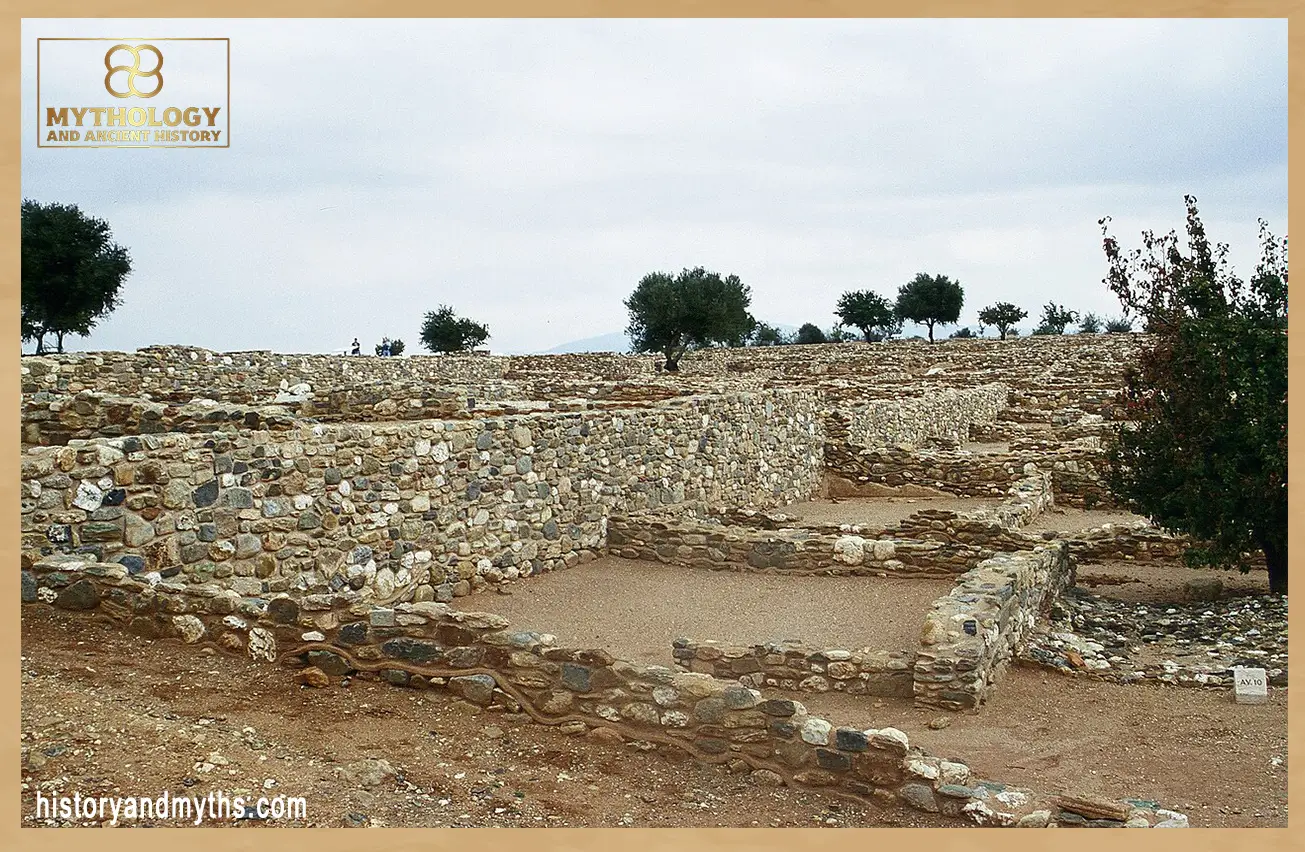
The Core System: Why Greek Houses Were Built Inward
At first glance, the inward-facing design of ancient Greek houses looks like a practical response to climate—shade, ventilation, protection from heat. That explanation is incomplete. The real logic is social, not environmental.
Greek houses were built inward because control mattered more than openness.
Unlike later Roman homes or modern houses, Greek domestic architecture avoided exposure to the street. External walls were typically blank, with few or no windows at ground level. The street was not an extension of domestic life; it was a boundary. What happened inside the house was meant to stay inside, both physically and socially.
This inward focus revolved around a central courtyard—the structural and functional core of the house. Every major room opened toward this internal space, not outward. The effect was deliberate: movement, visibility, and interaction could all be monitored and limited. Anyone entering the house passed through controlled points, and once inside, their access to different areas was not equal.
This design reflects a deeper concern with who is allowed to see and be seen.
In a society where reputation, family honor, and social hierarchy carried real consequences, visibility was a risk. The architecture responds to that risk. By closing the house to the outside and organizing life around an internal core, Greek households created a controlled environment where exposure could be minimized and roles could be enforced without interference.
There is also a security dimension, but not in the modern sense of theft prevention. The concern was less about material loss and more about social intrusion—unwanted presence, inappropriate contact, or violations of expected boundaries. The house acts as a filter. It does not just keep people out; it regulates how far in they can go.
Archaeological evidence from sites like Olynthus supports this pattern consistently. Houses follow similar inward-oriented layouts regardless of size, suggesting that the model was not a luxury choice but a standard expectation. Even in urban environments like Athens, where space was constrained, the principle remains: prioritize internal organization over external connection.
What this creates is not just a physical structure, but a system of controlled interaction. The house becomes a space where:
- outsiders are limited,
- insiders are organized,
- and daily life operates within clear, enforced boundaries.
This is the foundation for everything that happens next inside the Greek home—gender separation, economic activity, social hierarchy. None of it works without this first principle:
the house must control visibility before it can control behavior.
| Space | Function | Social Role |
|---|---|---|
| Entrance | Controlled access point | Filters outsiders |
| Andron | Guest reception and symposium | Male authority and public interaction |
| Courtyard | Central working and living area | Controlled shared space |
| Inner Rooms | Work, storage, family life | Restricted and less visible |
| Storage Areas | Food and goods preservation | Economic control and independence |
Layout as Power: Who Controls Space?
The internal layout of a Greek house was not a neutral arrangement of rooms—it was a hierarchy made physical. Space was assigned, restricted, and used to signal who held authority and who did not. You can read the power structure of the household directly from the floor plan.
The most revealing example is the andron, the room reserved for male gatherings. This was not just another interior space; it was the only part of the house designed to receive outsiders on a regular basis. Positioned near the entrance but still within controlled access, the andron allowed the male head of the household to host guests without exposing the rest of the family. Its layout—often with space for couches arranged along the walls—was built for the symposium, where politics, alliances, and social reputation were negotiated.
What matters is not the furniture but the logic:
public interaction is allowed, but only in a controlled, male-dominated zone.
Beyond that threshold, access narrows. The deeper areas of the house were not meant for outsiders. These interior spaces—commonly associated with women, children, and domestic work—were less visible and more restricted. The term “gynaikonitis” is often used to describe this zone, though in practice the separation was not always architectural in a strict sense. What remained consistent was the principle: certain parts of the house were socially off-limits.
This creates a layered structure:
- Entrance → Controlled access point
- Andron → Semi-public, male-controlled space
- Inner rooms → Restricted, domestic, and largely invisible
Movement through these layers was not random. It was regulated by status and purpose. A guest could enter, but not roam. A servant could move, but not host. A woman of the household operated within a different spatial logic entirely—present in the house, but not equally visible within it.
The central courtyard ties these layers together, but it does not equalize them. It acts as a hub, yet even here, presence is structured. Who uses the courtyard, when, and for what purpose is shaped by the same underlying rules of hierarchy and separation.
Archaeological layouts from Olynthus show this pattern repeatedly. Houses differ in size, but the spatial logic remains consistent: a front area that can absorb controlled social interaction, and deeper zones that withdraw from it. In urban settings like Athens, the compression of space does not remove this hierarchy—it intensifies it.
What emerges is a system where architecture enforces behavior without constant supervision. You do not need rules written on walls; the walls themselves guide movement. Where you are allowed to stand, sit, or enter is already defined by the structure.
Gender Control: The House as a Tool of Separation
The separation between men and women inside the Greek house was not just a cultural idea—it was enforced through space. The layout did not simply reflect gender roles; it helped produce and maintain them on a daily basis.
Women were not absent from the house. They were central to its function. But their presence was managed through limited visibility and controlled movement. The deeper sections of the house, away from the entrance and the andron, were where most of their activity took place. These areas were associated with domestic work, child-rearing, and the internal economy of the household. What matters is not the label of these spaces, but their position: they were physically harder to access and socially off-limits to outsiders.
This arrangement was tied to a broader concern with reputation and legitimacy. In a society where family honor depended heavily on the perceived conduct of women, exposure was treated as a risk. The architecture reduces that risk by minimizing contact. A visitor could enter the house, but the structure itself made it unlikely that he would encounter the women of the household. Separation did not require constant enforcement because the layout already limited interaction.
The result is a form of control that operates quietly. It does not rely on visible restriction at every moment, but on a built environment that narrows possibilities. Women’s movement was not necessarily confined to a single room, but it was shaped by where they could be seen and by whom. Visibility, not just location, was the key variable.
This also explains why the distinction between male and female space was not always rigid in architectural terms, but remained consistent in practice. The same room could serve different functions depending on time, context, and who was present. What stayed stable was the underlying rule: certain interactions were acceptable, others were not, and the house was designed to make that difference easier to maintain.
Literary and archaeological evidence from places like Athens and Olynthus supports this pattern. Houses vary in size and detail, but they repeatedly show a concern with depth, layering, and restricted access. These are not accidental features; they are structural solutions to a social problem.
What the Greek house achieves is not total isolation, but controlled separation. Women remain essential to the household’s operation while being selectively removed from its public-facing side. The architecture makes that balance possible without constant oversight.
In this sense, the house does more than contain family life. It organizes it according to a set of expectations that are built into the space itself.
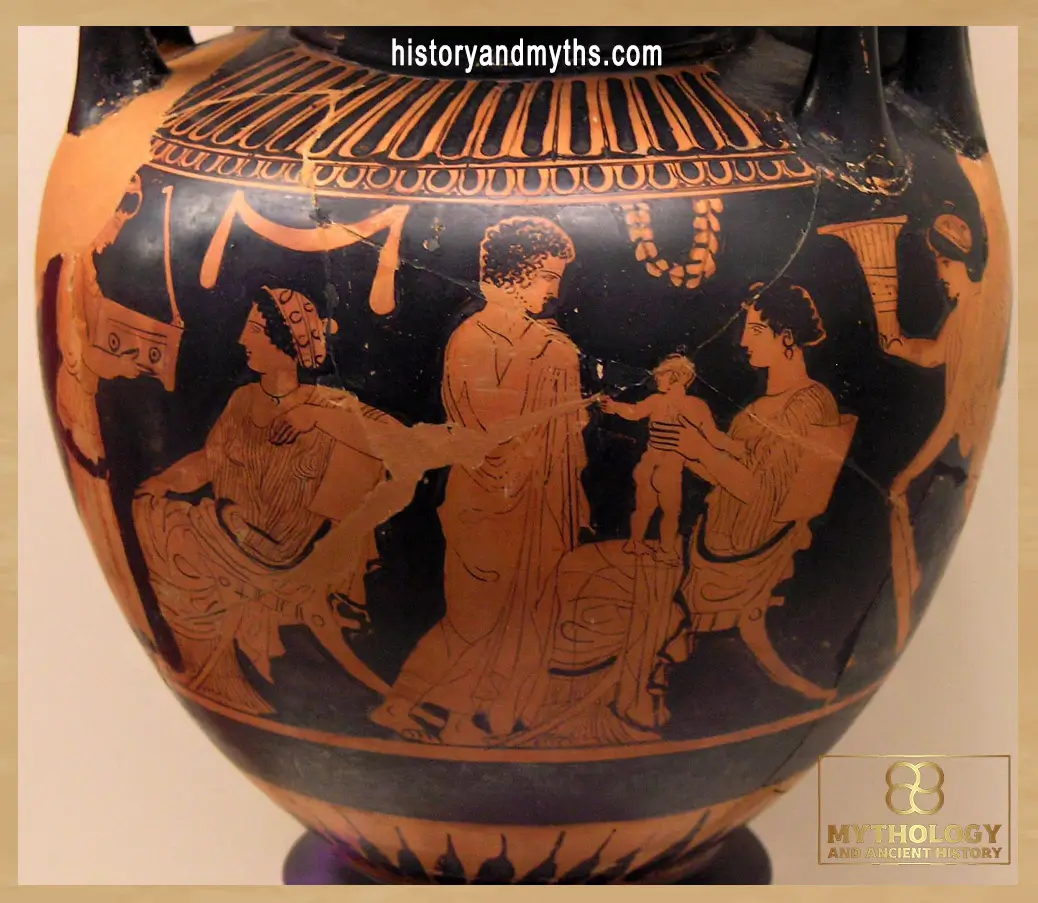
Economy Inside the House: Production, Not Just Living
If you read the Greek house only as a place where people lived, you miss how it actually functioned. It was a working unit. Daily survival did not depend on markets alone but on what the household could produce, store, and manage within its own walls.
Much of that activity was concentrated around the courtyard and the inner rooms. These were not passive spaces. They were used for grinding grain, preparing food, weaving textiles, and storing supplies. The rhythm of the day was shaped by repetitive tasks that turned raw materials into usable goods. What looks like “domestic life” is, in practice, a small-scale economic system operating continuously.
Textile production is the clearest example. Spinning and weaving were not occasional chores; they were essential forms of output. Cloth had value, and producing it inside the house reduced dependence on external exchange. The work required time, coordination, and space—looms, tools, storage—and it tied directly into the structure of the household. Women, servants, and enslaved individuals were all part of this process, not as a side role but as the core workforce sustaining the house.
Storage also matters. Many Greek houses included areas for keeping grain, oil, and other essentials. This was not just about convenience; it was about control. A household that could store enough resources could withstand shortages, avoid immediate reliance on the market, and maintain a degree of independence. The architecture supports this by allocating space not only for living but for holding and protecting what the household produced.
Labor inside the house was organized rather than random. Tasks were distributed according to status and role, and movement through space followed that logic. Work did not spill into every area equally. It remained concentrated in parts of the house that were already less visible from the entrance, reinforcing the separation between the public-facing side of the household and its productive core.
Archaeological findings from Olynthus show houses equipped with tools and installations linked to these activities—grinding stones, storage vessels, and work areas integrated into the layout. Similar patterns appear in Athens, even where space was more limited. The consistency suggests that production was not an exception but a standard expectation of domestic life.
What this creates is a system where the house reduces its exposure to external dependency. It does not eliminate trade or markets, but it delays the need for them. The household becomes a buffer, absorbing part of the economic pressure through its own labor.
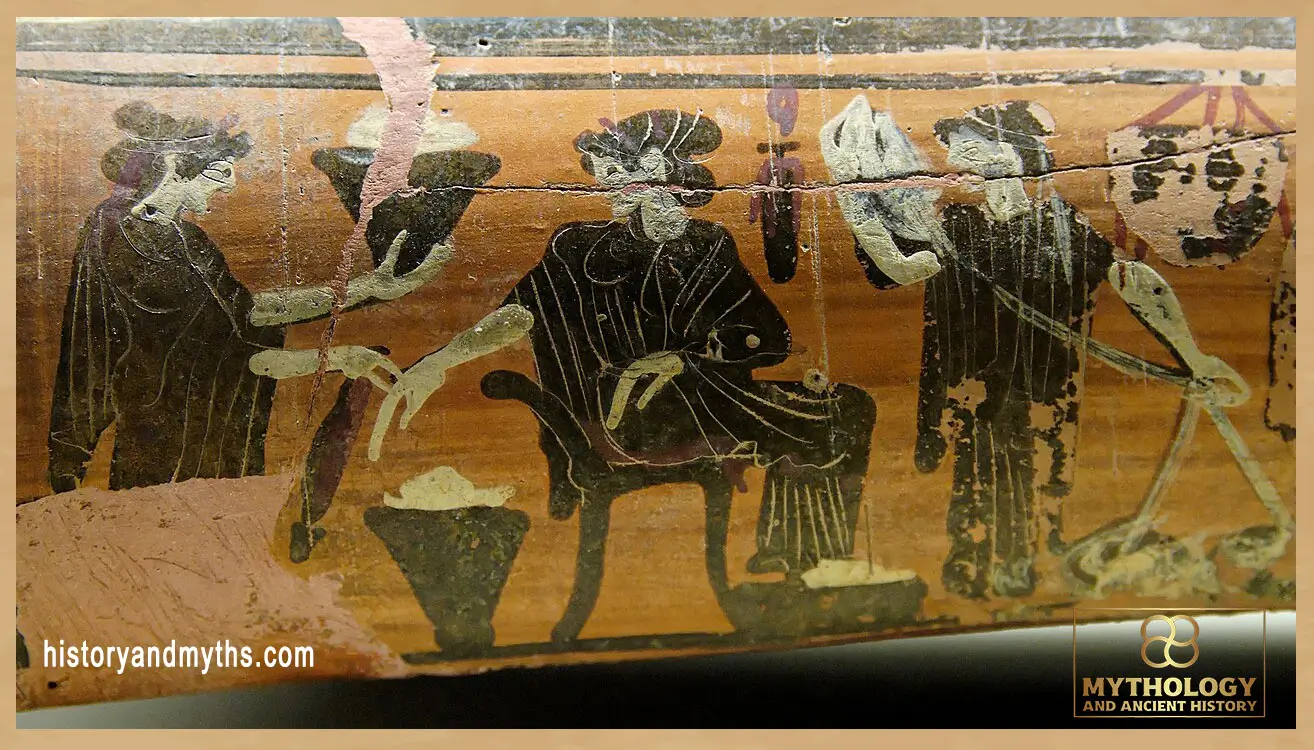
Ancient Greek houses were not designed for comfort or aesthetics. They were structured to control visibility, regulate movement, and enforce social roles. Every part of the layout—walls, rooms, and access points—worked together to limit exposure, organize labor, and maintain hierarchy inside the household.
© historyandmyths.com — Educational use
Privacy vs Public Life: Greek vs Modern Thinking
If you approach the Greek house with a modern idea of privacy, the structure starts to look contradictory. It is closed to the outside, yet internally it does not operate on the same concept of individual privacy that exists today. The difference is not in how much privacy existed, but in how it was defined.
Modern privacy is individual. It assumes that each person has a right to personal space, separation, and autonomy within the home. The Greek house works on a different principle. Privacy is collective and selective. It belongs to the household as a unit, not to individuals within it.
This is why the exterior is sealed. The house protects itself from the outside world as a whole. What happens inside is not meant to be visible to outsiders, but once inside, visibility is redistributed rather than eliminated. Members of the household share space, work, and routines in ways that do not prioritize personal isolation. What matters is not whether someone is alone, but whether they are seen by the right people.
This creates a system of controlled visibility rather than complete privacy. A guest entering the house is allowed to see certain things and not others. A woman of the household may move within the house, but her visibility is limited depending on who is present. A servant may pass through multiple spaces, but without access to authority. The structure does not give equal access to all observers; it filters who sees what.
The distinction becomes clearer when you compare internal and external boundaries. The strongest line is drawn between the house and the street. Once that boundary is crossed, the divisions become more flexible, but still structured. The goal is not to isolate individuals completely, but to manage exposure according to role and context.
In cities like Athens, where houses were packed closely together, this inward focus becomes even more pronounced. There is little interest in engaging with the street visually. The outside remains a space of movement and uncertainty, while the inside is ordered and predictable. At sites such as Olynthus, the same pattern appears in more regular layouts, reinforcing the idea that this is not a local adaptation but a broader cultural model.
What emerges is a different way of thinking about private life. It is not about withdrawing from others entirely, but about controlling the terms under which interaction happens. The house does not remove social structure; it concentrates it.
The result is a form of privacy that is less about the individual and more about protecting the integrity of the household as a whole.
Rich vs Poor Houses: Same System, Different Scale
The difference between rich and poor houses in ancient Greece was not in design logic, but in how fully that logic could be applied. The same structural idea appears in both: inward orientation, controlled access, and organized movement. What changes is scale and precision.
Larger houses had the space to separate functions clearly. A distinct andron could be maintained near the entrance, while deeper areas remained less accessible and more insulated. Work, storage, and daily routines could be distributed across multiple rooms, making control easier to enforce. The layout does not just exist—it operates efficiently.
Smaller houses follow the same pattern, but under tighter constraints. Separation becomes less rigid, and spaces serve multiple roles depending on time and need. A single room may shift between work, storage, and social use. This reduces the clarity of boundaries, but it does not remove them. Access is still managed, even if it relies more on practice than on architecture.
Archaeological evidence from Olynthus shows consistent layouts across different house sizes, reinforcing that the model itself was standard. In denser urban settings like Athens, the same principles appear in more compressed forms. Limited space does not eliminate the system; it forces it to adapt.
What wealth provides is not a different type of house, but a stronger version of the same one. More space allows for clearer divisions, better control of movement, and more stable separation between functions. Less space weakens those divisions but does not replace them.
Archaeology Reality Check: What the Evidence Actually Shows
Most reconstructions of Greek domestic life rely on a limited but consistent archaeological record. The key point is not that every house looks the same, but that the same logic appears across different sites, materials, and conditions. The pattern holds even when details change.
At Olynthus, one of the best-preserved examples of classical housing, entire neighborhoods reveal repeated layouts: rooms arranged around a central courtyard, with a controlled entrance and a gradual shift from accessible to restricted space. The consistency is difficult to dismiss as coincidence. These are not isolated designs; they reflect a shared model.
In Athens, the evidence is less complete due to continuous occupation and later construction, but the same structural principles appear where remains survive. Houses adapt to tighter plots and irregular streets, yet still prioritize inward orientation and layered access. Even when the plan becomes less symmetrical, the underlying organization remains intact.
There are variations, and they matter. Some houses include specialized rooms that others lack. Some show clearer separation between functions, while others rely on more flexible use of space. But these differences operate within a stable framework. They do not replace the system; they adjust it.
It is also important to recognize the limits of the evidence. Archaeology provides walls, floors, and objects, but not behavior directly. Interpretation depends on how these elements are read together. A room identified as an andron, for example, is based on layout, artifacts, and comparison with other sites. The conclusion is strong, but not absolute.
What strengthens the overall picture is repetition across contexts. When similar layouts, access patterns, and functional zones appear in multiple locations, the argument shifts from possibility to probability. The Greek house was not a random collection of rooms shaped by individual preference. It followed a recognizable structure that can be traced across the material record.
Daily Life Flow: How the House Actually Functioned
The structure of the Greek house only makes sense when you follow movement through it over the course of a day. The layout is not static; it directs who goes where, at what time, and for what purpose.
At the start of the day, activity concentrates in the inner parts of the house. Work begins early, especially tasks tied to food preparation and textile production. These are not scattered actions but repeated routines anchored in specific areas—spaces that remain out of direct view from the entrance. The courtyard becomes active, not as an open social space, but as a controlled center where necessary work happens.
As the day progresses, movement remains structured. Members of the household do not circulate freely across all areas. Their paths are shaped by role. Some remain tied to the internal zones where production and maintenance take place. Others move closer to the front of the house, especially if interaction with the outside becomes necessary. This shift is limited and purposeful, not continuous.
When guests are received, the system becomes more visible. Entry is controlled, and movement is directed toward the andron. The rest of the house does not open with it. The layout allows social interaction to occur without exposing the internal structure of the household. What the visitor experiences is a partial view, shaped by the architecture itself.
Later in the day, the same spaces adjust again. Rooms that served one function earlier may take on another role as activity changes. This flexibility does not erase structure; it operates within it. The boundaries remain understood even when the use of space shifts.
Across all of this, one pattern stays consistent: movement is never neutral. It is guided, limited, and aligned with the roles embedded in the household. The house does not need constant instruction to enforce this. Its design already sets the terms.
- Greek houses were inward-facing to control privacy and exposure.
- Space inside the house reflected power, gender, and social hierarchy.
- Women’s visibility and movement were structurally managed.
- The household functioned as a small economic production unit.
- Wealth affected scale, not the underlying system.
- Architecture guided behavior without constant supervision.
Frequently Asked Questions
What did a typical ancient Greek house look like?
Most houses were built around a central courtyard with rooms opening inward, creating a closed and controlled internal space.
Did Greek houses have separate areas for men and women?
Yes, space was organized to limit interaction, with certain areas more accessible to men and others associated with women and domestic work.
Why were Greek houses built inward instead of outward?
The inward design helped control visibility, protect family privacy, and reduce exposure to outsiders.
Were Greek houses used for economic activity?
Yes, households produced goods such as textiles and managed storage, functioning as small economic units.
Did all Greek houses follow the same design?
The core layout was consistent, but size and level of separation varied depending on wealth and location.
How do archaeologists know how Greek houses worked?
Evidence comes from excavated sites, preserved layouts, and artifacts that reveal how spaces were used.
Sources & Rights
- Jameson, Michael H. “Private Space and the Greek City.” In The Greek City from Homer to Alexander, edited by Oswyn Murray and Simon Price. Oxford: Oxford University Press, 1990.
- Nevett, Lisa C. House and Society in the Ancient Greek World. Cambridge: Cambridge University Press, 1999.
- Cahill, Nicholas. Household and City Organization at Olynthus. New Haven: Yale University Press, 2002.
- Walker, Susan. “Women and Housing in Classical Greece.” The Classical Quarterly 38, no. 1 (1988): 81–91.
- Pomeroy, Sarah B. Goddesses, Whores, Wives, and Slaves. New York: Schocken Books, 1975.
- Foxhall, Lin. “Household, Gender and Property in Classical Athens.” The Classical Quarterly 39, no. 1 (1989): 22–44.
- Ault, Bradley A. The Excavations at Ancient Halieis, Volume 2: The Houses. Bloomington: Indiana University Press, 2005.
- Goldberg, Sander M. Constructing Literature in the Roman Republic. Cambridge: Cambridge University Press, 2005.
- Morgan, Janet. “Domestic Space and Social Identity in Classical Greece.” American Journal of Archaeology 105, no. 2 (2001): 231–259.
- Allison, Penelope M. The Archaeology of Household Activities. London: Routledge, 1999.
- Bradley, Mark. Classical Art: From Greece to Rome. Oxford: Oxford University Press, 2009.
- Boardman, John. The Greeks Overseas. London: Thames & Hudson, 1999.
- Whitley, James. The Archaeology of Ancient Greece. Cambridge: Cambridge University Press, 2001.
- Snodgrass, Anthony. An Archaeology of Greece: The Present State and Future Scope of a Discipline. Berkeley: University of California Press, 1987.
- Morris, Ian. Archaeology as Cultural History: Words and Things in Iron Age Greece. Oxford: Blackwell, 2000.
- Osborne, Robin. Greece in the Making 1200–479 BC. London: Routledge, 1996.
- Cartledge, Paul. Ancient Greece: A History in Eleven Cities. Oxford: Oxford University Press, 2009.
- Garland, Robert. Daily Life of the Ancient Greeks. Westport: Greenwood Press, 1998.
- Hansen, Mogens Herman. The Athenian Democracy in the Age of Demosthenes. Oxford: Blackwell, 1991.
- Fisher, Nick. “Hybris and Dishonour: I.” Greece & Rome 23, no. 2 (1976): 177–193.
Written by H. Moses — All rights reserved © Mythology and History