Port Cities in Ancient Greece and Their Maritime Power
Port cities in Ancient Greece developed around harbors, maritime movement, and coastal exchange systems that connected Greek urban centers to the wider Mediterranean world. Cities such as Piraeus, Corinth, Rhodes, and Syracuse became heavily shaped by shipping activity, naval movement, imported goods, and the constant flow of merchants, sailors, and travelers through their ports.
These cities depended on more than trade alone. Harbors influenced urban growth, political priorities, population movement, and economic organization by turning the coastline into the operational center of daily life. Port infrastructure, maritime logistics, and naval connectivity transformed certain Greek cities into highly outward-looking communities closely tied to the rhythms of the sea and long-distance exchange networks.
What Made a Greek City a Port City?
Greek port cities developed around harbors that supported continuous maritime movement, coastal exchange, and naval connectivity across the Mediterranean world. These cities depended heavily on shipping access because ports connected urban life to trade networks, imported goods, military movement, and regional communication.
Harbors also shaped the organization of the city itself. Markets, storage areas, ship facilities, and waterfront activity often became central parts of daily economic life in coastal urban centers closely tied to maritime systems.
Unlike inland communities focused primarily on agriculture or regional land routes, port cities evolved around the operational demands of the sea. Their prosperity and influence depended on maintaining stable access to maritime traffic and external exchange networks.
Port Cities in Ancient Greece
| Port City Feature | Impact on Urban Development |
|---|---|
| Natural Harbors | Supported maritime exchange and naval access |
| Port Infrastructure | Connected shipping, storage, and coastal logistics |
| Maritime Movement | Increased population flow and economic circulation |
| External Connectivity | Linked cities to wider Mediterranean networks |
| Harbor-Based Economy | Made maritime activity central to urban life |
Harbors as the Economic Heart of the City
In many Greek port cities, the harbor functioned as the main center of economic activity because maritime traffic controlled the movement of goods, labor, and commercial exchange. Ships arriving from different regions brought imported products, merchants, sailors, and resources that supported urban markets and coastal industries.
Economic life near the harbor often operated continuously around loading, unloading, storage, transport, and ship preparation. Waterfront districts became closely connected to warehouses, marketplaces, workshops, and commercial services tied directly to maritime activity.
This concentration of economic movement made ports more than transportation points alone. Harbors shaped the daily rhythm of urban life and linked the prosperity of the city to the stability of maritime exchange networks across the Mediterranean world.
Piraeus and the Rise of Maritime Athens
Piraeus became essential to the growth of Athens because it connected the city directly to maritime trade, naval movement, and imported resources moving across the Aegean and Mediterranean worlds. The harbor system transformed Athens from a powerful regional polis into a major maritime center closely tied to seaborne exchange and naval logistics.
The relationship between Athens and Piraeus also demonstrated how port infrastructure could reshape the priorities of an inland political center. Grain imports, merchant traffic, ship activity, and naval operations increasingly depended on maintaining secure maritime access through the harbor.
As maritime activity expanded, Piraeus developed into a highly active urban-commercial environment linked to both economic exchange and military power. The harbor became central not only to Athenian trade, but also to the broader functioning of the city itself.
Naval Movement and Urban Growth
Maritime movement accelerated urban growth in Greek port cities by increasing population flow, commercial activity, and dependence on coastal infrastructure connected to the sea. Sailors, merchants, laborers, and foreign visitors continuously moved through these urban centers, creating environments shaped by constant interaction and economic circulation.
Imported goods arriving through ports also supported population expansion by supplying resources that local production alone could not always provide. Coastal cities closely tied to maritime exchange often became denser, more economically active, and more connected to external regions than many inland communities.
This growth strengthened the importance of the harbor within urban life. As maritime traffic expanded, port districts increasingly influenced the economic structure, labor systems, and daily organization of the city itself.
Harbors Became the Center of Coastal Greek Cities
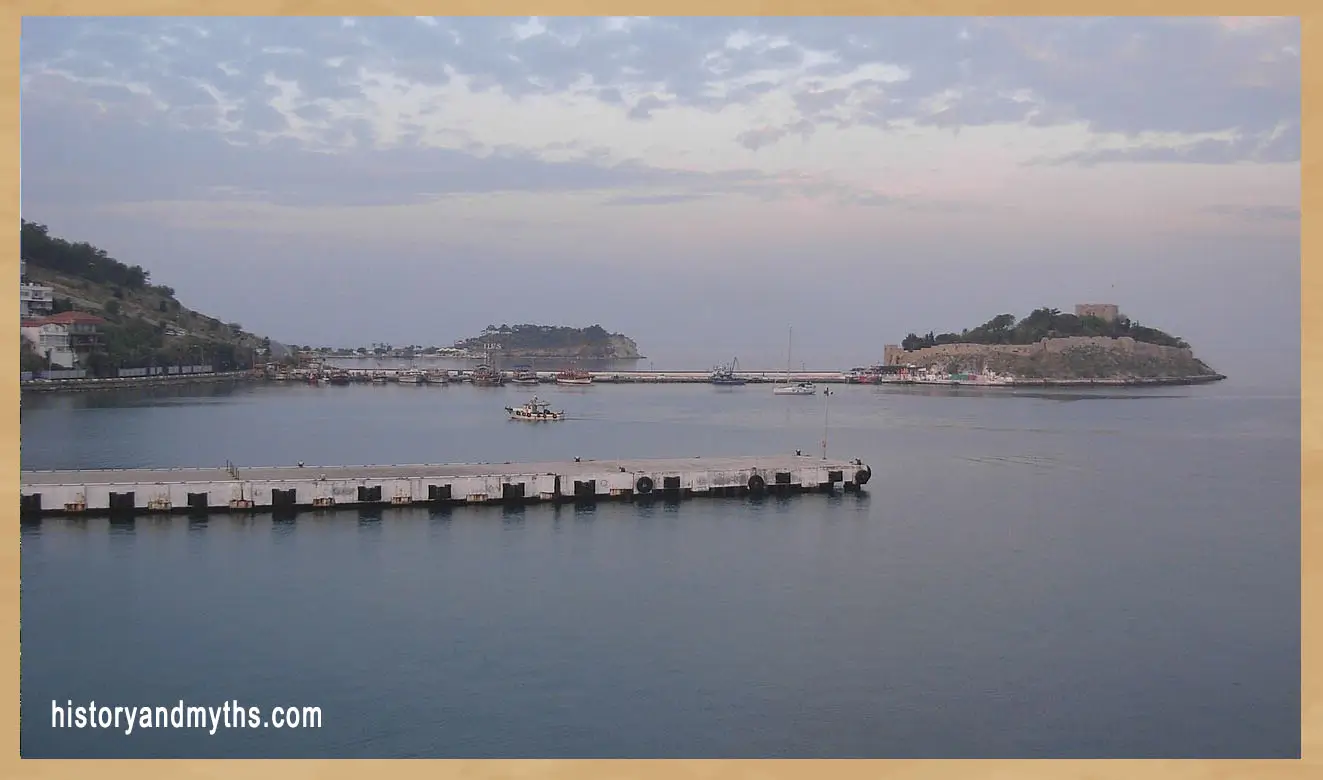
Port cities in Ancient Greece developed around harbors that connected coastal communities to maritime trade, naval movement, imported resources, and Mediterranean exchange networks. In many cities, the harbor became the operational and economic heart of urban life.
© historyandmyths.com — Educational use
Port Infrastructure and Maritime Logistics
Greek port cities required complex infrastructure capable of supporting continuous maritime coordination between ships, cargo, storage, and coastal movement. Docks, anchorage zones, repair areas, and waterfront facilities allowed ports to manage large volumes of commercial and naval activity arriving from different regions.
Maritime logistics also depended on efficient handling systems that connected incoming cargo to markets, warehouses, and distribution networks inside the city. Port operations therefore became closely tied to urban organization and the practical management of coastal economic life.
As shipping activity increased, port infrastructure grew more important to the stability of the city itself. Harbors capable of supporting large-scale maritime movement strengthened the strategic and economic position of major coastal centers across the Greek world.
Why Port Cities Became More Connected to the Outside World
Port cities became more connected to external regions because maritime exchange brought continuous contact with foreign merchants, travelers, sailors, and political delegations moving across Mediterranean sea routes. Coastal access exposed these cities to wider networks of information, commerce, and cultural interaction beyond their immediate territory.
This external connectivity influenced urban life in ways less common in isolated inland communities. Imported goods, foreign languages, diplomatic contact, and maritime communication increased the cosmopolitan character of many major port centers.
Dependence on external exchange also shaped political and economic priorities. Port cities often paid closer attention to naval security, maritime alliances, and regional stability because disruptions at sea could directly affect urban life and commercial continuity.
Risks Faced by Port Cities
Port cities faced constant vulnerability because their prosperity depended heavily on secure maritime access and uninterrupted shipping activity. Naval blockades, piracy, storms, and regional warfare could rapidly disrupt supply systems connected to food imports, trade movement, and coastal communication.
Dependence on the sea also exposed these cities to sudden economic instability when maritime routes became unsafe or politically contested. Harbors closely tied to external exchange networks often experienced immediate pressure during periods of conflict affecting Mediterranean navigation.
Coastal location created additional military risks as well. Major ports frequently became strategic targets because controlling harbors meant controlling commercial access, naval movement, and critical urban resources connected to maritime power.
How Ports Shaped Urban Identity
Ports shaped the identity of many Greek cities by making maritime activity central to daily life, economic organization, and political outlook. Coastal communities dependent on harbors often developed stronger connections to external trade, naval movement, and Mediterranean communication than inland cities focused primarily on regional agriculture or land-based systems.
This maritime orientation influenced public priorities and urban culture. Port cities relied heavily on sailors, merchants, shipbuilders, and harbor labor connected to continuous coastal movement, creating social environments shaped by exchange and mobility.
Over time, some Greek cities became defined as maritime centers whose influence depended on maintaining strong harbor systems and active participation in wider sea-based networks linking the Greek world to surrounding regions.
Key Takeaways
- Greek port cities developed around harbors and maritime exchange systems.
- Harbors became the economic center of many coastal urban communities.
- Piraeus transformed Athens into a major maritime power.
- Port infrastructure supported shipping, storage, and naval logistics.
- Maritime movement accelerated urban growth and population flow.
- Port cities became highly connected to external Mediterranean networks.
- Dependence on maritime access created economic and military vulnerabilities.
Frequently Asked Questions
What were port cities in Ancient Greece?
Port cities were Greek coastal urban centers built around harbors, maritime movement, naval activity, and Mediterranean exchange networks.
Why were harbors important in Greek cities?
Harbors connected cities to shipping routes, imported goods, naval operations, and economic exchange across the Mediterranean world.
How did Piraeus influence Athens?
Piraeus gave Athens direct maritime access that strengthened trade, naval power, grain imports, and wider Mediterranean connections.
What role did port infrastructure play?
Docks, warehouses, repair areas, and loading systems supported the movement of ships, cargo, and maritime logistics.
Why did port cities grow rapidly?
Continuous maritime traffic increased population movement, commercial activity, imported resources, and coastal urban expansion.
How were port cities connected to foreign regions?
Maritime exchange brought merchants, sailors, travelers, and information from different parts of the Mediterranean world.
What risks did Greek port cities face?
Port cities were vulnerable to piracy, naval blockades, storms, warfare, and disruptions to maritime trade routes.
How did ports shape urban identity?
Harbors made maritime activity central to daily life, economic organization, and political priorities in many coastal Greek cities.
Sources & Rights
- Casson, Lionel. Ships and Seamanship in the Ancient World. Johns Hopkins University Press, 1995.
- Blackman, David. Ancient Harbours in the Mediterranean. British School at Athens, 1982.
- Bresson, Alain. The Making of the Ancient Greek Economy. Princeton University Press, 2016.
- Finley, Moses I. The Ancient Economy. University of California Press, 1999.
- Malkin, Irad. A Small Greek World: Networks in the Ancient Mediterranean. Oxford University Press, 2011.
- Cartledge, Paul. Ancient Greece: A History in Eleven Cities. Oxford University Press, 2009.
- Hansen, Mogens Herman. An Inventory of Archaic and Classical Poleis. Oxford University Press, 2004.
- Hornblower, Simon. The Greek World: 479–323 BC. Routledge, 2011.
- Meiggs, Russell. The Athenian Empire. Oxford University Press, 1972.
- Osborne, Robin. Greece in the Making: 1200–479 BC. Routledge, 2009.
- Murray, Oswyn. Early Greece. Harvard University Press, 1993.
- Boardman, John. The Greeks Overseas. Thames & Hudson, 1999.
- Burford, Alison. Land and Labor in the Greek World. Johns Hopkins University Press, 1993.
- de Souza, Philip. Piracy in the Graeco-Roman World. Cambridge University Press, 1999.
- Rhodes, P. J. The Greek City States: A Source Book. Cambridge University Press, 2007.
- Ober, Josiah. The Rise and Fall of Classical Greece. Princeton University Press, 2015.
- Foxhall, Lin. Money, Labour and Land: Approaches to the Economies of Ancient Greece. Routledge, 2002.
- Thucydides. History of the Peloponnesian War. Academic translated editions.
- Strabo. Geographica. Academic translated editions.
- Pausanias. Description of Greece. Academic translated editions.
Written by H. Moses — All rights reserved © Mythology and History