Greek Philosophy: How Socrates, Plato, and Aristotle Changed Thinking
Greek philosophy is not a collection of abstract ideas. It is a method for thinking—one that focuses on asking precise questions, testing assumptions, and organizing knowledge into clear structures. What makes it distinct is not what it concludes, but how it approaches problems.
Instead of accepting tradition or authority as final, Greek thinkers treated knowledge as something that could be examined and improved. They broke complex questions into smaller parts, looked for consistent patterns, and built arguments that could be followed step by step. This created a form of thinking that is structured, repeatable, and open to challenge.
This approach changed how people understood the world. Questions about reality, knowledge, and human behavior were no longer answered through myth or custom alone. They became subjects of analysis. Once this shift happens, thinking itself becomes a process that can be refined.
To understand Greek philosophy, the focus should not be on memorizing doctrines or names. The key is to see how this method works—how questions are formed, how ideas are tested, and how conclusions are built. That system is what continues to matter.
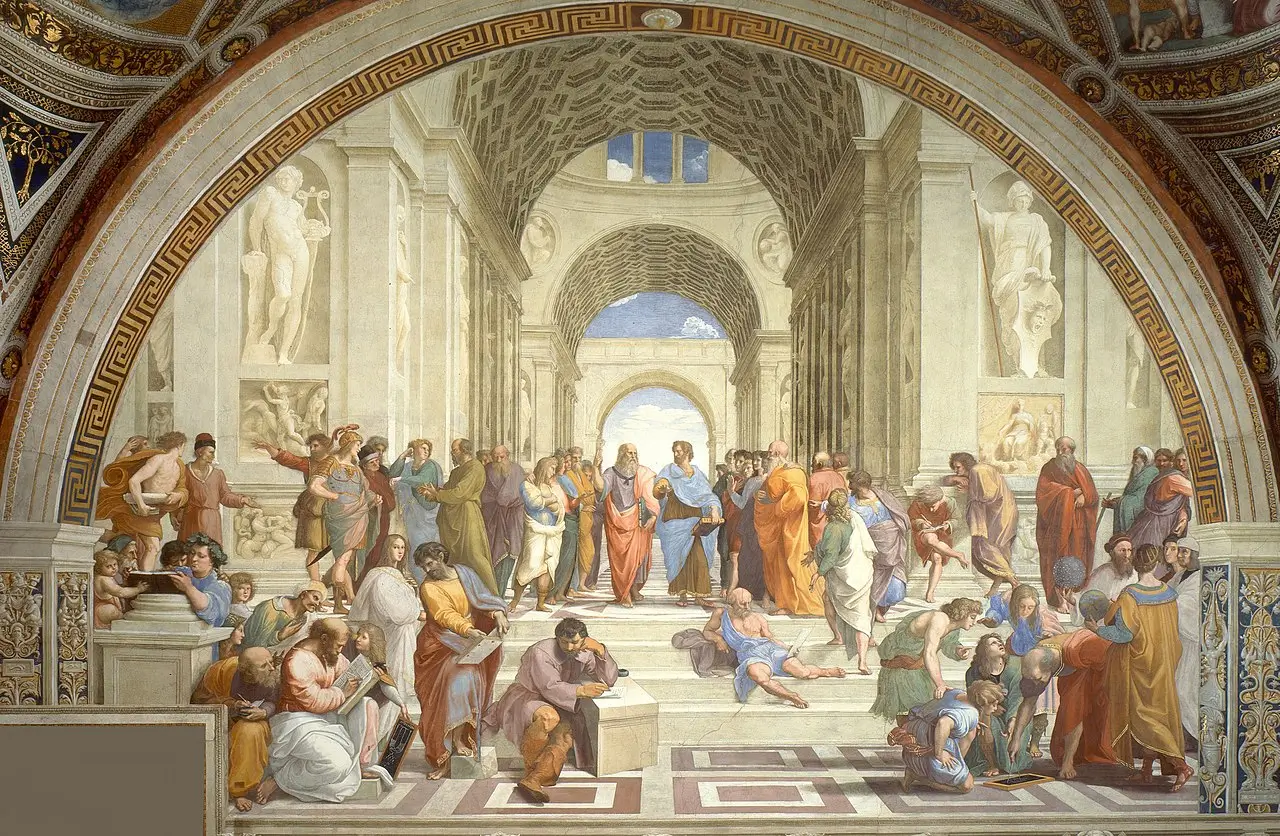
What Is Greek Philosophy?
Greek philosophy is a structured method of thinking that uses questioning, logical reasoning, and clear definitions to examine reality, knowledge, and human behavior. It is not defined by specific answers, but by how problems are approached and analyzed.
At its core, it operates through three steps. First, assumptions are questioned rather than accepted. Second, arguments are built through logical connections, where each idea follows from the previous one. Third, concepts are clarified to remove ambiguity, ensuring that terms are used consistently.
This process turns thinking into a controlled system. Instead of relying on opinion or tradition, ideas are tested for coherence and internal consistency. If an argument fails under examination, it is revised or rejected.
What defines Greek philosophy is this method. It provides a way to move from uncertainty to structured understanding, where conclusions are not final truths, but results that can be examined and improved.
| Component | Role in Thinking | Effect |
|---|---|---|
| Questioning | Challenges assumptions | Reveals contradictions |
| Logic | Builds structured arguments | Ensures consistency |
| Definition | Clarifies meaning | Removes ambiguity |
| Modeling | Organizes abstract ideas | Simplifies complexity |
| Classification | Structures knowledge | Creates systems |
Why Philosophy Emerged in Greece
Greek philosophy did not appear in isolation. It developed within a setting where ideas could be discussed, challenged, and compared openly. The structure of the Greek city-state created conditions that encouraged this kind of thinking.
Public life required argument. Decisions about law, politics, and social order were debated rather than imposed without question. This made reasoning a practical skill, not just an abstract activity. To persuade others, ideas had to be clear, structured, and defensible.
At the same time, there was no single authority controlling knowledge. Without a centralized system defining truth, explanations of the world could vary. This created space for alternative views, where different explanations could be tested against each other.
Traditional explanations based on myth were still present, but they were no longer sufficient for every question. As new problems emerged—about nature, knowledge, and human behavior—there was a need for more systematic answers. Philosophy developed as a response to that need.
What made Greece distinct was not that people asked questions, but that questioning became organized. Ideas were not only expressed, but examined through structured reasoning. This turned thinking into a process that could be applied consistently across different problems.
The System of Greek Thinking
Greek philosophy works through a repeatable structure that turns thinking into a controlled process rather than a series of opinions. The goal is to move from a question to a clear conclusion through defined steps.
The process begins with questioning. Assumptions are not accepted as given; they are examined to determine whether they hold under scrutiny. This step exposes gaps, contradictions, or unclear ideas that need refinement.
Once the question is defined, reasoning is applied. Arguments are built step by step, where each claim depends on a previous one. If a link in this chain fails, the entire argument must be reconsidered. This enforces consistency and prevents unsupported conclusions.
Clarity is essential throughout the process. Terms are defined precisely to avoid confusion. Without clear definitions, reasoning breaks down because the same idea can be interpreted in different ways.
The system functions by combining these elements. Questioning identifies the problem, reasoning structures the answer, and clarity ensures that the result can be understood and tested. This approach allows thinking to be applied systematically across different subjects, rather than relying on intuition or authority.
Greek Philosophy — Core Insight
Greek philosophy is not a set of ideas, but a method for thinking. It operates through questioning, logical reasoning, and clear definitions to transform uncertainty into structured understanding.
What makes this system effective is its repeatability. The same process can be applied to different problems, allowing knowledge to be examined, refined, and organized over time.
© historyandmyths.com — Educational use
Socrates, Plato, and Aristotle — Three Approaches to Thinking
Greek philosophy becomes clear when viewed through three distinct approaches rather than a list of ideas. Each thinker develops a different way of organizing thought.
Socrates focuses on questioning. His method breaks down assumptions by asking direct, structured questions that expose contradictions. Instead of providing answers, he forces the problem to become clearer. The goal is not to conclude quickly, but to remove false certainty.
Plato builds models. He moves from questioning to constructing abstract frameworks that explain how things should be understood. These models simplify complex reality into organized concepts, making ideas easier to analyze and compare.
Aristotle organizes knowledge. He takes observation and arranges it into categories, systems, and logical structures. His approach focuses on classification and clear reasoning, turning scattered information into ordered knowledge.
These approaches are not separate stages but different methods. Questioning exposes problems, models provide structure, and classification organizes results. Together, they form a complete system for thinking, where each method supports the others.
How Greek Philosophy Changed Thinking
Greek philosophy changed thinking by turning it into a structured process rather than a passive acceptance of ideas. Before this shift, explanations were often received from tradition or authority. After it, ideas had to be examined, justified, and connected logically.
This change introduced a new standard. An idea was no longer accepted because it was familiar or widely believed. It had to be consistent, clearly defined, and able to withstand questioning. This made reasoning central to understanding, not optional.
It also separated thinking into distinct areas. Questions about nature, ethics, and knowledge began to be treated differently, each requiring its own method of analysis. This organization allowed complex problems to be studied more precisely instead of being handled as a single, undefined whole.
Most importantly, it made thinking transferable. The same process—questioning, reasoning, and clarification—could be applied across different subjects. This created a framework that could be reused, refined, and extended beyond its original context.
What changed was not only the answers people reached, but how they reached them. Thinking became something that could be structured, tested, and improved over time.
Greek Philosophy vs Modern Thinking
Greek philosophy relies on direct reasoning and structured questioning without external support. The process depends on clarity, logical consistency, and the ability to test ideas through argument alone.
Modern thinking operates within more specialized systems. Knowledge is divided into fields, supported by data, experiments, and technical methods. Reasoning is still present, but it is often combined with tools that extend beyond pure logic.
This difference changes how problems are approached. Greek philosophy begins with broad questions and reduces them into clear concepts. Modern thinking often starts with defined problems and builds outward using data and analysis.
Despite this, the core method remains connected. Modern systems still depend on clear definitions, logical structure, and the ability to test ideas. What Greek philosophy established is not replaced, but expanded.
Continue Reading
Why Greek Philosophy Still Matters
Greek philosophy remains relevant because it established a method for thinking that still underlies how problems are approached today. It shows how to move from a question to a structured answer using clear reasoning and defined concepts.
This method is not tied to a specific subject. It can be applied to any field where ideas need to be examined and organized. The ability to question assumptions, build logical arguments, and clarify meaning is still essential for understanding complex issues.
What endures is not the content of the ideas, but the process behind them. Greek philosophy turned thinking into something that can be controlled, tested, and improved, and that approach continues to shape how knowledge is developed.
Key Takeaways
- Greek philosophy is a method of thinking, not just ideas
- It relies on questioning, logic, and clear definitions
- Socrates, Plato, and Aristotle represent different approaches
- Thinking becomes structured and repeatable
- The system can be applied across different fields
- It shifted knowledge from belief to analysis
- Its method still influences modern reasoning
Frequently Asked Questions
What is Greek philosophy?
Greek philosophy is a structured method of thinking based on questioning, logic, and clear definitions.
Who are the main Greek philosophers?
Socrates, Plato, and Aristotle are the most influential figures.
Why is Greek philosophy important?
It introduced systematic reasoning and changed how knowledge is examined and organized.
What is the Socratic method?
It is a questioning technique used to test ideas and reveal contradictions.
How did Greek philosophy influence modern thinking?
It established logical reasoning and structured analysis used in modern disciplines.
What is the focus of Plato’s philosophy?
He developed abstract models to explain reality and knowledge.
What is Aristotle known for?
He created systems of classification and formal logic.
Sources & Rights
- Russell, Bertrand. A History of Western Philosophy.
- Copleston, Frederick. A History of Philosophy.
- Guthrie, W.K.C. A History of Greek Philosophy.
- Burnet, John. Early Greek Philosophy.
- Vlastos, Gregory. Socrates: Ironist and Moral Philosopher.
- Plato. The Republic.
- Plato. Apology.
- Aristotle. Nicomachean Ethics.
- Aristotle. Metaphysics.
- Aristotle. Organon.
- Annas, Julia. An Introduction to Plato’s Republic.
- Kraut, Richard. The Cambridge Companion to Plato.
- Barnes, Jonathan. Aristotle: A Very Short Introduction.
- Irwin, Terence. Classical Thought.
- Hadot, Pierre. What is Ancient Philosophy?.
- Fine, Gail. The Oxford Handbook of Plato.
- Shields, Christopher. Aristotle.
- McKirahan, Richard. Philosophy Before Socrates.
- Long, A.A. Hellenistic Philosophy.
- Waterfield, Robin. The First Philosophers.
Written by H. Moses — All rights reserved © Mythology and History