Ancient Greek Children: Education, Discipline, and the Making of Heirs
Children in ancient Greece were not raised for personal development—they were shaped to serve the needs of the household and the state. From birth, a child’s value depended on acceptance into the family, future role, and ability to continue the family line. Not every child was guaranteed a place; the father’s decision determined whether the child would be raised or rejected.
Upbringing followed a clear purpose. Boys were prepared to become citizens, manage property, and represent the family in public life. Girls were raised to enter another household through marriage, where they would manage domestic work and produce legitimate heirs. Education, discipline, and daily routine were all directed toward these outcomes, not toward individual choice.
To understand childhood in ancient Greece, you have to look beyond daily life. Children were part of a system that controlled identity, inheritance, and social order from the beginning.
The Core System: Children Inside the Oikos
Children were not an independent category in Greek society. They were part of the oikos from the moment they were accepted into it, and their position was defined by what the household needed from them over time. The family did not adjust itself to the child; the child was shaped to fit the structure already in place.
Their role begins with continuity. Every accepted child represents a future claim to the family line, but that claim is not automatic. It has to align with inheritance, property, and status. This is why upbringing is directed from the start. Behavior, discipline, and training are not left open—they are guided toward a specific outcome.
The house itself supports this process. Daily routines are structured, spaces are organized, and interaction follows established patterns. A child grows within an environment where roles are visible and repeated. Authority is clear, labor is distributed, and expectations are stable. Over time, the child learns not by instruction alone, but by operating inside this system.
This is also why flexibility is limited. A household that depends on continuity cannot allow roles to shift unpredictably. Each member, including children, is expected to move toward a defined function. The process is gradual, but the direction is fixed.
Evidence from places like Athens and Olynthus shows consistent domestic organization that supports this model. The arrangement of space, work, and authority does not change to accommodate childhood as a separate phase. It integrates children into the same structure that governs the rest of the household.
| Stage | Process | System Role |
|---|---|---|
| Birth | Acceptance or rejection | Determines inclusion in the oikos |
| Early Childhood | Discipline and conditioning | Shapes behavior and obedience |
| Education | Role-based training | Prepares for future function |
| Work Integration | Gradual participation | Supports household economy |
| Adulthood | Full role activation | Maintains continuity of the family |
Birth and Acceptance: Who Was Allowed to Stay
Acceptance created identity. Once recognized, the child became part of the household’s line, with a defined position in inheritance and family continuity. Without that recognition, there was no claim—no role to grow into and no place in the structure that organized property and status.
This decision was tied to practical limits. Households managed resources—space, labor, and long-term obligations. Admitting a child meant committing to years of support and a future share in property. Refusal avoided that commitment. The logic is not abstract; it is built around managing risk and maintaining stability.
The process also clarifies legitimacy. A recognized child is not just present; they are positioned to inherit without dispute. That clarity protects the household later, when property must pass forward. Ambiguity at birth becomes conflict at succession, so the system removes it early.
Early Childhood: Control and Conditioning
Once a child was accepted into the oikos, upbringing began immediately with a clear direction. Early childhood was not treated as a free or unstructured stage. It was a period of controlled development where behavior, habits, and expectations were shaped to fit the household’s needs.
Discipline started early. Children learned where they could move, how they should behave, and how to respond to authority. This was not taught through abstract instruction but through repetition and environment. The structure of the house—who gives orders, who works, who has access—was visible every day, and children adapted to it over time.
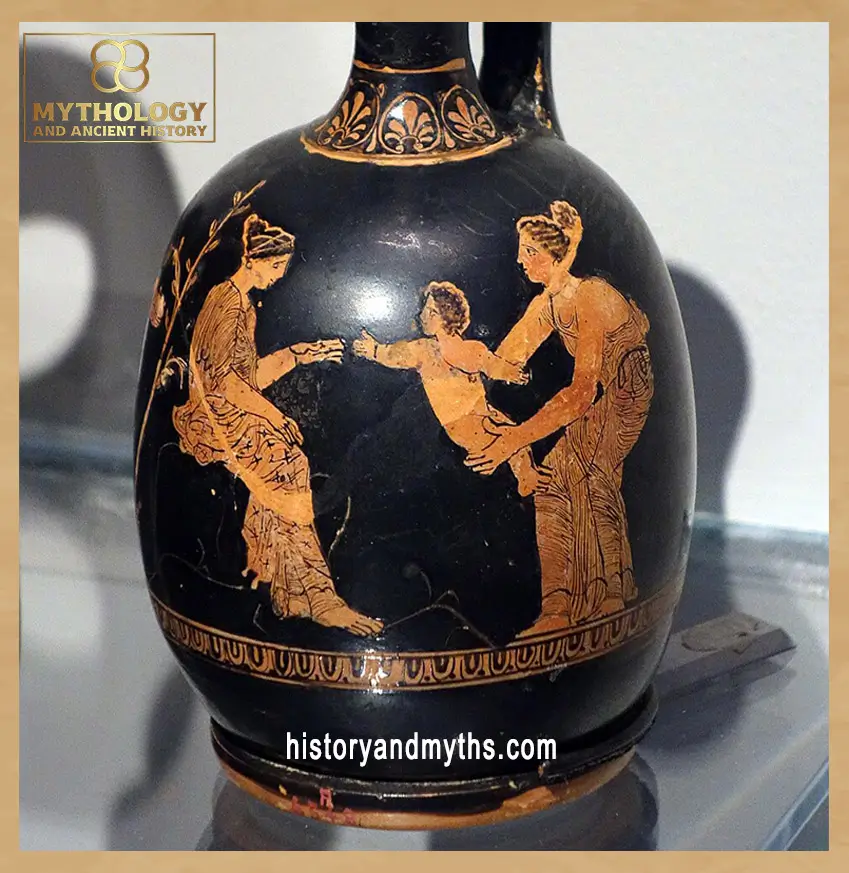
Care during this stage was often handled within the household, sometimes by nurses or enslaved individuals, but always under the direction of the family. The goal was not independence. It was reliability. A child needed to become predictable in behavior before taking on larger roles.
This period also set boundaries. Interaction, speech, and conduct were shaped to match social expectations that extended beyond the house. What was learned early would later define how the individual functioned in wider society. The household acted as the first layer of training.
In places like Athens, where social identity had legal consequences, this early conditioning carried weight. It prepared the child to operate within a system that required clarity and discipline.
Education: Training for Roles, Not Knowledge
Education in ancient Greece was not designed to expand knowledge for its own sake. It was structured to prepare children for the roles they were expected to take within the household and the wider society. What a child learned depended on what they were meant to become.
For boys, education moved outward. It focused on skills that supported public life—literacy, basic numeracy, physical training, and the ability to participate in civic and social settings. The aim was not intellectual exploration but competence. A boy had to be capable of managing property, representing the oikos, and operating within the expectations of the community.
For girls, education remained within the household. It centered on domestic management—organizing work, handling resources, and maintaining the internal function of the family. Instruction was practical and continuous, shaped by daily tasks rather than formal schooling. The objective was stability, not variation.
This division is consistent across contexts such as Athens and Olynthus. The form may vary—some households could support more structured teaching, others relied entirely on practice—but the direction remains the same. Education aligns with function.
What this creates is a system where learning is not open-ended. It is targeted. Each child is trained to fit a defined role, and the content of education reflects that purpose.
Boys vs Girls: Two Different Paths
From early on, the paths for boys and girls separated and did not converge again. The difference was not gradual; it was built into expectations and reinforced through daily practice. Each path led to a distinct function within the system.
For boys, development moved toward public visibility. As they grew, their responsibilities expanded beyond the house—first through education, then through participation in social and civic life. The goal was clear: to become a recognized member of the community, capable of managing property, representing the household, and continuing the male line.
For girls, the path remained inward. Their training prepared them to move into another household through marriage, where they would take on internal management and produce legitimate heirs. Visibility was limited, and interaction with the outside world was structured. The transition was not from private to public, but from one controlled environment to another.
This division shaped behavior long before adulthood. What each child learned, where they spent time, and how they were expected to act all followed this split. It did not rely on later correction because it was established early and reinforced consistently.
In contexts such as Athens, this difference carried legal and social consequences. Citizenship, inheritance, and public participation were tied to one path and not the other. Evidence from Olynthus reflects the same separation in domestic organization and use of space.
Childhood in ancient Greece was not a separate phase of freedom. It was a structured process designed to prepare individuals for fixed roles within the household and society, ensuring continuity, stability, and control across generations.
© historyandmyths.com — Educational use
Play and Toys: Practice Before Responsibility
Play in ancient Greece was not separate from training. It operated as a controlled space where children repeated the behaviors they would later be expected to perform. The activity looks informal, but its direction is not.
Objects associated with play—balls, dolls, miniature tools—mirror adult roles. The point is not realism; it is familiarity. Repetition builds habit. A child learns how to handle objects, follow patterns, and accept limits without formal instruction. The house supplies both the materials and the context.
Use of time follows the same logic. Play is allowed within boundaries set by the household. It does not replace work or discipline; it sits alongside them. As children grow, the balance shifts. Time given to play decreases, and time tied to defined tasks increases. The transition is gradual, but the direction is fixed.
The difference between boys and girls remains visible here as well. Activities align with the roles they are moving toward. The content varies, but the principle holds: early actions anticipate later responsibilities.
Finds from places like Athens and Olynthus include toys and small objects associated with childhood, but their presence supports this reading rather than contradicting it. They appear within households organized for work and control, not apart from them.
Children and the Household Economy
Children did not remain outside the economic life of the oikos. As they grew, they were gradually drawn into the work that sustained the household. This was not a separate phase introduced later; it was a transition built into upbringing from the beginning.
Participation started with simple tasks—observing, assisting, and repeating small actions tied to daily routines. Over time, these tasks expanded. The goal was not productivity at first, but familiarity with how work was organized. A child needed to understand how resources were used, how labor was coordinated, and where their role would fit.
The type of work followed the same division already in place. Boys moved toward activities connected to external management and physical labor, while girls remained within the internal economy—food preparation, textile work, and storage management. The distinction was not occasional; it was consistent.
This integration served the household directly. The more effectively children could take on defined tasks, the more stable the oikos became. Dependence on external labor could be reduced, and continuity of skills was ensured across generations.
Evidence from sites such as Olynthus shows domestic spaces organized for coordinated activity—tools, storage areas, and work zones integrated into the house. In Athens, similar patterns appear within more compact environments. These settings do not separate childhood from work; they bring children into it gradually.
Coming of Age: When a Child Becomes a Social Unit
The shift from childhood to adulthood in ancient Greece was not gradual or open-ended. It was marked by a clear transition where the individual moved from being shaped by the system to actively serving it. At this point, the household no longer invests in preparation—it expects function.
For boys, this transition leads outward. They begin to take on roles connected to the public sphere—managing aspects of property, participating in civic life, and representing the oikos beyond the house. In some contexts, this stage is formalized through training that prepares them for collective responsibilities. The change is visible: authority is still above them, but their range of action expands.
For girls, the transition takes a different form. It is defined by marriage. Instead of expanding outward, they move into a new oikos, where their role shifts from preparation to execution. The structure remains familiar, but the position changes. They are no longer being trained; they are now responsible for maintaining internal order and producing heirs.
This moment is less about age and more about readiness within the system. The timing depends on when the household determines that the individual can fulfill the required role. Once that threshold is crossed, expectations change immediately.
Mortality and Reality: Limits of Childhood
Childhood in ancient Greece existed under constant risk. High infant and child mortality shaped how families planned, invested, and made decisions. This was not a background detail; it influenced the structure of the oikos at every level.
Not every child survived to adulthood. Illness, limited medical knowledge, and environmental conditions made early life uncertain. As a result, families did not build their expectations around a single heir. The system assumes loss and compensates for it by ensuring that more than one child could carry the line if needed.
This reality affects behavior. Investment in children is structured but cautious. The household commits to upbringing and training, but always within a framework that prioritizes continuity over individual outcome. The focus remains on maintaining the line, not on guaranteeing the future of any one child.
It also reinforces earlier decisions. Acceptance at birth, timing of marriage, and emphasis on legitimacy all become more critical when survival is uncertain. Each step reduces the risk that the oikos will fail to continue.
In contexts such as Athens, where inheritance and status depend on clear succession, this uncertainty increases the importance of structure. Evidence from Olynthus reflects households organized to manage resources carefully under these conditions.
Childhood as Preparation, Not Freedom
Childhood in ancient Greece was not treated as a separate, protected phase of life. It was the first stage of integration into a system that prioritized continuity, property, and social order. From acceptance at birth to education and daily work, every step moved the child toward a defined role.
What gives this structure its strength is consistency. The same logic appears in the household, in family roles, and in the transition to adulthood. Children are not raised to choose their path; they are shaped to fit one that already exists.
This is why childhood matters in the Greek context. It is not about growth for its own sake. It is about preparing individuals to sustain the system that precedes them.
- Children were raised to serve the needs of the oikos, not personal freedom.
- Acceptance at birth determined identity and future role.
- Education focused on preparing boys and girls for different functions.
- Play and daily activity acted as early training for adult responsibilities.
- Children gradually entered the household economy as they grew.
- Childhood ended when individuals became functional members of the system.
Frequently Asked Questions
What was childhood like in ancient Greece?
Childhood was structured and focused on preparing individuals for their future roles within the family and society.
Did all children survive in ancient Greece?
No, infant and child mortality rates were high, which influenced family structure and planning.
How were boys and girls raised differently?
Boys were prepared for public roles and citizenship, while girls were trained for marriage and household management.
Did children receive education in ancient Greece?
Yes, but education focused on practical skills and social roles rather than abstract knowledge.
Were children involved in work?
Yes, children gradually took part in household tasks and economic activities as they grew.
What was the purpose of raising children in ancient Greece?
The main purpose was to ensure the continuity of the family line and maintain social stability.
Sources & Rights
- Golden, Mark. Children and Childhood in Classical Athens. Johns Hopkins University Press, 1990.
- Pomeroy, Sarah B. Goddesses, Whores, Wives, and Slaves. Schocken Books, 1975.
- Nevett, Lisa C. House and Society in the Ancient Greek World. Cambridge University Press, 1999.
- Garland, Robert. Daily Life of the Ancient Greeks. Greenwood Press, 1998.
- Foxhall, Lin. “Household, Gender and Property in Classical Athens.” The Classical Quarterly, 1989.
- Humphreys, Sally C. The Family, Women and Death. Routledge, 1983.
- Hansen, Mogens Herman. The Athenian Democracy. Blackwell, 1991.
- Cartledge, Paul. Ancient Greece: A History in Eleven Cities. Oxford University Press, 2009.
- Osborne, Robin. Greece in the Making. Routledge, 1996.
- Finley, Moses I. The Ancient Economy. University of California Press, 1999.
- Whitley, James. The Archaeology of Ancient Greece. Cambridge University Press, 2001.
- Morris, Ian. Archaeology as Cultural History. Blackwell, 2000.
- Ault, Bradley A. The Houses at Halieis. Indiana University Press, 2005.
- Allison, Penelope M. The Archaeology of Household Activities. Routledge, 1999.
- Sealey, Raphael. A History of the Greek City States. University of California Press, 1976.
- Just, Roger. Women in Athenian Law and Life. Routledge, 1989.
- MacDowell, Douglas. The Law in Classical Athens. Cornell University Press, 1978.
- Cohen, David. Law, Violence and Community in Classical Athens. Cambridge University Press, 1995.
- Snodgrass, Anthony. An Archaeology of Greece. University of California Press, 1987.
- Boardman, John. The Greeks Overseas. Thames & Hudson, 1999.
Written by H. Moses — All rights reserved © Mythology and History