Ancient Greek Colonization: Colonies and Mediterranean Expansion
Greek colonization was not driven by empire-building in the modern sense, but by necessity and opportunity. From the eighth century BCE onward, many Greek city-states faced a structural problem: limited farmland and growing populations. To relieve this pressure, they established new settlements across the Mediterranean and the Black Sea, securing access to fertile land, trade routes, and essential resources such as grain.
These colonies were not distant outposts controlled like later empires. In most cases, they were independent city-states founded by settlers who maintained cultural and economic ties to their place of origin. This explains a key question often overlooked: Greek colonization expanded influence without creating a centralized empire.
Understanding Greek colonization requires focusing on three elements: why it began, how colonies were established, and what they achieved. It was a system that redistributed population, secured resources, and extended trade networks across the Mediterranean—reshaping the Greek world without unifying it politically.
Why the Greeks Began Colonization
Greek colonization began as a response to structural pressures inside the city-states. The most immediate was limited agricultural land. Much of mainland Greece could not support growing populations, especially as communities expanded during the eighth century BCE. Establishing new settlements provided access to fertile territory that was unavailable at home.
Population growth intensified this pressure. As families expanded, land became increasingly fragmented and difficult to distribute. Colonization offered a direct solution: relocating groups of settlers to new regions where land was more abundant. This reduced internal strain without requiring major changes to existing social structures.
Economic motives reinforced these factors. Greek cities depended on external resources, particularly grain, metals, and timber. Establishing colonies near resource-rich areas ensured more stable access to these supplies. In many cases, colonization followed existing trade interests, turning temporary exchange into permanent presence.
Political tensions also played a role. Internal conflicts, including disputes over land and power, sometimes led groups to leave and found new communities elsewhere. Colonization therefore functioned as both an economic strategy and a mechanism for managing social pressure. It allowed Greek city-states to expand outward while maintaining stability at home.
| Region | Purpose of Colonization | Strategic Impact |
|---|---|---|
| Black Sea | Grain production | Secured food supply for major cities |
| Southern Italy & Sicily | Agriculture and trade | Expanded economic activity and markets |
| Asia Minor | Access to trade routes and resources | Connected Greek world to eastern economies |
| North Africa & Western Mediterranean | Trade expansion | Extended network reach and influence |
How Greek Colonies Were Established
Greek colonies were founded through organized expeditions rather than spontaneous migration. A city-state would select a leader, often called the oikist, who was responsible for guiding settlers and establishing the new community. This process was deliberate: the choice of location, timing, and participants was planned to ensure long-term viability.
Site selection followed clear criteria. Colonies were typically founded in coastal areas with access to harbors, fertile land, and nearby resources. Strategic position mattered as much as agricultural potential. A well-placed settlement could function both as a farming center and as a node within existing trade routes, linking it to the wider Greek world.
Once established, the colony developed its own political structure. Although settlers maintained cultural and religious ties to their original city, the new settlement operated as an independent polis. It minted its own coins, managed its own land, and conducted its own external relations. This independence distinguishes Greek colonization from later imperial systems based on direct control.
Despite this autonomy, connections remained active. Trade, shared customs, and mutual interests linked colonies to their founding cities. These ties ensured that colonization strengthened the broader Greek network without creating a centralized political structure.
Major Regions of Greek Colonization
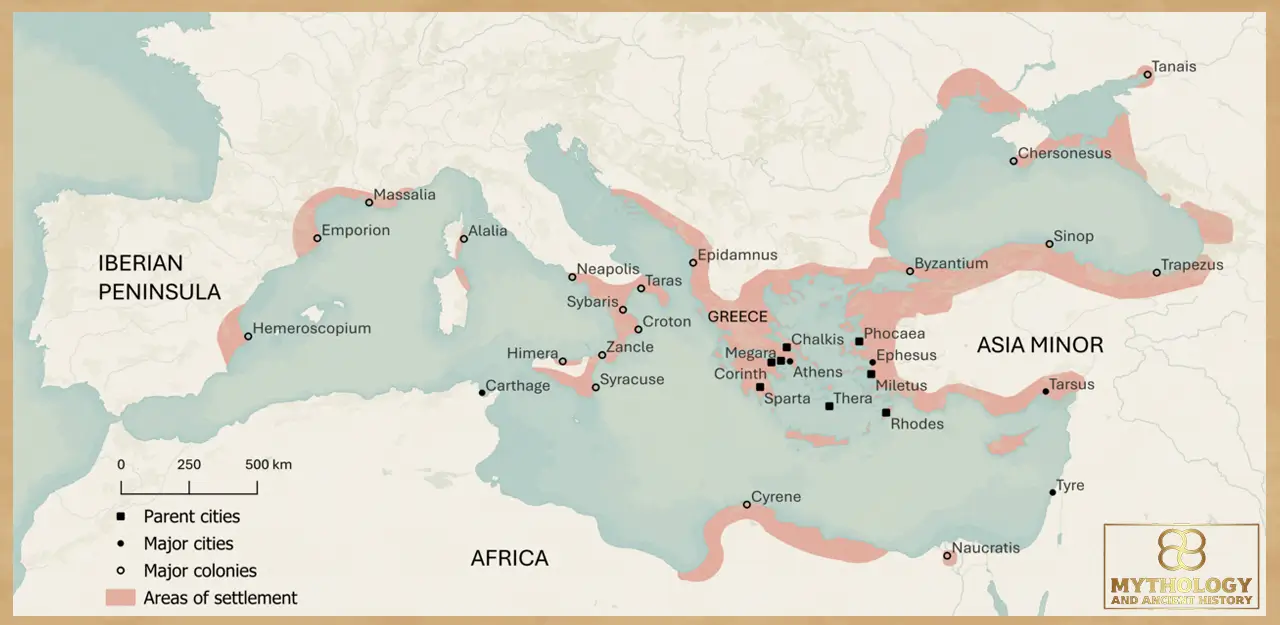
Greek colonization followed clear geographic patterns, concentrating in regions that offered strategic and economic advantages. The most significant expansion occurred around the Black Sea, where fertile land made large-scale grain production possible. Colonies established along its coasts became key suppliers of food to mainland cities that lacked sufficient agricultural capacity. This region was not peripheral—it was central to the stability of major Greek populations.
A second major zone was southern Italy and Sicily, often referred to as Magna Graecia. These areas provided both fertile land and access to western trade routes. Greek settlements there developed into prosperous cities that combined agricultural production with commercial activity, linking eastern and western Mediterranean markets.
Colonization also extended along the coast of Asia Minor (Anatolia). This region offered proximity to established trade networks and access to valuable resources. Cities founded here became important connectors between the Greek world and the economies of the Near East, reinforcing the role of trade in colonization strategy.
Additional settlements appeared in North Africa and the western Mediterranean, including areas near modern Libya and southern France. These colonies often functioned as intermediate points within longer trade routes, supporting movement between distant regions. Together, these zones formed a distributed system of settlements that extended Greek presence far beyond the Aegean while remaining tied to its economic network.
How Greek Colonization Worked
- Colonization responded to land shortages and population growth.
- Settlements were established in strategic coastal locations.
- Colonies operated as independent city-states.
- They secured resources and expanded trade networks.
- Colonization extended influence without creating a centralized empire.
Colonies and Economic Expansion
Greek colonization expanded the economy by turning distant regions into reliable sources of supply and exchange, rather than occasional trading partners. Instead of depending on fluctuating external markets, city-states could secure access to grain, metals, and other resources through settlements integrated into their economic network. This reduced uncertainty and stabilized long-distance trade.
Colonies also functioned as commercial extensions of the Greek world. They created new markets for exported goods such as olive oil, wine, and pottery, while simultaneously increasing the volume of imports entering the network. This dual role—supplier and consumer—allowed trade to operate on a larger and more consistent scale.
Over time, these settlements reduced the distance between production and consumption. Instead of transporting goods across unfamiliar or hostile regions, Greek merchants could rely on a chain of connected communities that shared language, customs, and commercial practices. This lowered transaction risk and improved the efficiency of exchange across the Mediterranean.
In this sense, colonization did not simply add new territory—it reorganized the economic landscape. By embedding production and trade within a wider network of settlements, the Greek world moved from isolated local economies toward a more integrated system of sustained exchange.
Independence and Identity of Colonies
Greek colonies were not governed as extensions of their founding cities. Once established, they operated as independent poleis, with their own political institutions, laws, and economic policies. This autonomy was a defining feature of Greek colonization and distinguishes it from later imperial systems based on direct administrative control.
Despite this independence, colonies maintained a strong cultural connection to their origins. Shared language, religious practices, and civic traditions created continuity between the new settlement and the mother city (metropolis). Ritual ties, such as honoring the same deities or maintaining founding myths, reinforced this identity without limiting political autonomy.
Economic relationships also remained active. Trade between colonies and their founding cities was common, but it was not exclusive or enforced. Colonies participated in broader networks, interacting with multiple regions rather than serving a single center. This flexibility allowed them to function as independent actors within the Mediterranean system.
The result was a dual structure: political independence combined with cultural and economic linkage. This balance allowed Greek colonization to expand influence across large distances without creating a centralized state, preserving the decentralized character of the Greek world.
Continue Reading
Colonization and Political Power
Greek colonization reshaped political influence by extending the reach of individual city-states beyond their immediate territory. Although colonies were independent, their existence increased the strategic depth of the Greek world. Cities that founded or maintained strong connections with colonies gained indirect influence over key regions, especially those tied to resources or trade routes.
Control did not come through direct administration but through position and access. A city linked to colonies in resource-rich areas could secure more stable supplies and strengthen its economic base. This, in turn, translated into greater political and military capacity. Athens, for example, depended on external grain sources, and its ability to maintain access to these regions became a central element of its power.
Colonization also affected competition between city-states. Establishing settlements in strategic locations—near trade routes, fertile land, or coastal passages—allowed cities to position themselves advantageously within the wider Mediterranean system. These choices influenced long-term rivalries, as access to resources and routes often determined economic strength and political leverage.
In this context, colonization functioned as a form of distributed power. Rather than creating centralized empires, Greek city-states extended their influence through networks of settlements that enhanced their position within a competitive and interconnected world.
Long-Term Impact of Greek Colonization
Greek colonization produced lasting structural changes in the Mediterranean world. By establishing settlements across distant regions, it transformed isolated local economies into interconnected systems of exchange. Goods, people, and practices moved more regularly between regions, creating stable patterns of interaction that persisted beyond individual city-states.
It also extended Greek cultural influence without political unification. Language, religious practices, and urban institutions spread through these colonies, shaping local societies while adapting to regional conditions. This process laid the groundwork for what would later become the Hellenistic world, where Greek culture operated across a wide geographic area.
Economically, colonization secured long-term access to critical resources. Regions such as the Black Sea became consistent suppliers of grain, while western settlements supported agricultural production and trade. These connections reduced vulnerability to shortages and allowed major cities to sustain larger populations and more complex economies.
The broader outcome was integration rather than centralization. Greek colonization did not create a unified empire, but it produced a network of connected communities that shared economic and cultural frameworks. This system defined the Greek presence in the Mediterranean and influenced the structure of regional interaction for centuries.
Key Takeaways
- Greek colonization was driven by economic and demographic pressures.
- Colonies were independent but remained culturally connected.
- Key regions included the Black Sea, Sicily, and Asia Minor.
- Colonization supported trade networks and resource access.
- It expanded influence without forming a unified empire.
Frequently Asked Questions
Why did the Greeks establish colonies?
Greek colonization was driven by land shortages, population growth, and the need for resources such as grain and raw materials.
Were Greek colonies controlled by their mother cities?
No. Greek colonies were independent city-states, although they maintained cultural and economic ties with their origins.
Where did the Greeks establish colonies?
Major regions included the Black Sea, southern Italy and Sicily, Asia Minor, and parts of North Africa and the western Mediterranean.
How did colonization affect trade?
Colonies secured access to resources and expanded trade networks, making long-distance exchange more stable and efficient.
What was the long-term impact of Greek colonization?
It spread Greek culture and created interconnected economic systems across the Mediterranean without forming a centralized empire.
Sources & Rights
- Cartledge, Paul. Ancient Greece: A Very Short Introduction. Oxford University Press.
- Hansen, Mogens Herman. An Inventory of Archaic and Classical Poleis. Oxford University Press.
- Bresson, Alain. The Making of the Ancient Greek Economy. Princeton University Press.
- Encyclopaedia Britannica. Ancient Greek Civilization: Colonization.
- EH.net. The Economy of Ancient Greece.
Written by H. Moses — All rights reserved © Mythology and History