Ancient Greek Fire Signals: How Beacon Communication Worked
Ancient Greeks used fire signals and light beacons to send messages across long distances in a matter of minutes, long before written dispatches could arrive. By placing signal stations on high points and relaying visible flames from one to another, they created a chain that could carry information rapidly over terrain that would otherwise take days to cross. Early systems could only transmit simple, prearranged messages, but later methods—especially those described by Polybius—allowed more detailed communication using coded signals.
What Were Fire Signals in Ancient Greece?
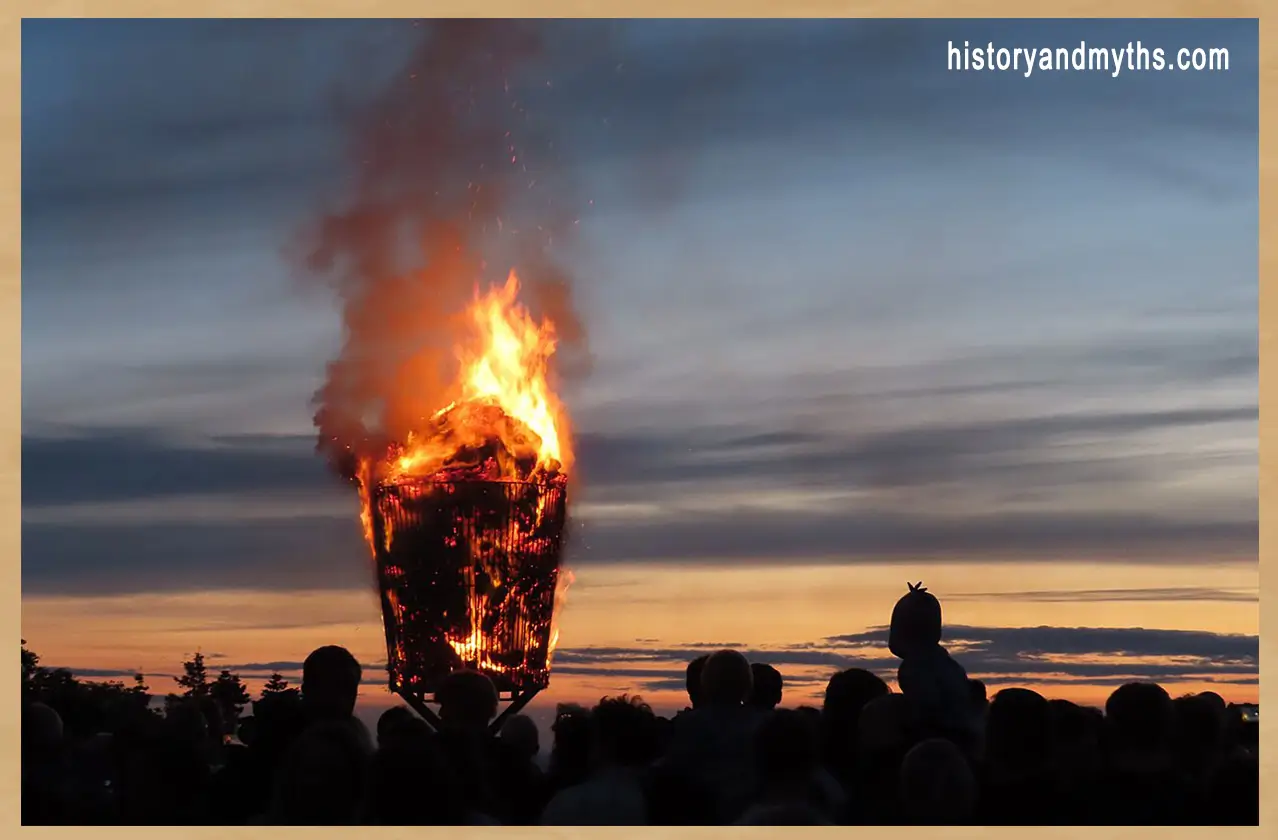
Fire signals were a line-of-sight signaling system that used visible light—flames at night and smoke by day—to transmit messages across distance. The method depended on elevation and visibility. Stations were placed on hills or towers so that each point could clearly see the next, turning geography into a communication network rather than an obstacle.
In its basic form, a signal was not a sentence but a prearranged meaning. A single flame, multiple flames, or a timed display could indicate a specific event already agreed upon in advance—such as an approaching enemy or a call to mobilize. This kept the system fast and reliable. There was no decoding delay because both sender and receiver already knew what each signal represented.
What made the system effective was its simplicity. It required no written medium, no physical transport, and no intermediary once the chain was active. As long as visibility held, a message could move from one station to the next almost instantly, crossing distances that would otherwise take hours or days by messenger.
The limitation was built into the design. Because signals had to be recognized at a glance, they could only carry a small set of meanings. Complex information—names, locations, detailed instructions—could not be transmitted in this early form. That constraint shaped how the system was used: for alerts, confirmations, and rapid coordination rather than detailed communication.
In practical terms, fire signaling worked as an early warning and relay system. It was fast, low-cost, and effective under the right conditions, but it traded detail for speed. That trade-off defines the entire system and explains both its value and its limits.
| System | How It Worked | Strength | Limitation |
|---|---|---|---|
| Beacon Fires | Flames relayed across line-of-sight stations | Very fast transmission | Only simple prearranged signals |
| Hydraulic Telegraph | Synchronized water clocks with marked messages | More message options | Requires precise timing |
| Polybius System | Torch signals encoding letters via grid | Can transmit detailed messages | Slower and error-prone |
| Relay Chains | Sequential signal repetition across stations | Covers long distances quickly | Breaks if visibility fails |
How Beacon Chains Worked Across Distance
The system worked as a relay. Signal stations were positioned on high ground so that each could see the next, forming a continuous visual path across distance. When a message was triggered at the origin point, the first station lit a fire or raised a torch signal. As soon as the next station observed it, it repeated the same signal, and the process continued down the line.
Because each station only needed to watch one direction and mirror what it saw, transmission was extremely fast. The delay at each point was minimal—just the time required to confirm the signal and reproduce it. Over long distances, this created a cascading effect where information moved in stages but without the slow accumulation of travel time that affects messengers.
Placement determined effectiveness. Stations had to be close enough to maintain clear visibility but far enough apart to cover meaningful distance. Terrain played a central role. Mountain ridges, coastal high points, and constructed towers were used to secure uninterrupted lines of sight. Any break in visibility—fog, heavy rain, or terrain obstruction—would interrupt the chain entirely.
The system did not require centralized control once established. Each station operated with a simple rule: observe and repeat. This made the network resilient. Even if part of the chain failed, other segments could still function independently.
In practical use, beacon chains were suited for urgent transmission rather than detailed communication. They could alert distant locations quickly, but only within the limits of predefined signals. Speed came from repetition; reliability came from simplicity.
Why Early Fire Signals Were Limited
Early fire signaling was fast because it simplified the message. A signal had to be recognized instantly at a distance, often in poor conditions, so it could only represent prearranged meanings. In practice, this reduced communication to a small set of agreed signals—an alert, a confirmation, a call to act. Anything that required detail fell outside the system’s capacity.
The limitation came from visibility. At long range, you cannot distinguish fine differences in a flame. Small variations in size, position, or timing become hard to read, especially when weather or terrain interferes. To avoid misinterpretation, signals had to be clear and few. Complexity increased the risk of error, and error in this context meant acting on the wrong information.
Synchronization was another constraint. For a signal to be understood, both ends had to share the same code in advance. If one station interpreted a pattern differently, the message would break down as it moved through the chain. This made the system reliable only within tightly coordinated networks where meanings were fixed beforehand.
There was also no built-in way to verify or correct a message. Once a signal was sent and repeated, it propagated forward without feedback. Unlike a messenger who could clarify or adjust, the beacon system offered no correction layer. A mistake at one point could be carried across the entire chain.
These limits explain how the system was actually used. Fire signals were effective for urgent, binary communication—situations where speed mattered more than detail and where the possible messages were known in advance. They were not designed to carry information broadly; they were designed to trigger action quickly under clear conditions.
The Hydraulic Telegraph of Aeneas Tacticus
A more controlled method appears in the 4th century BCE with Aeneas Tacticus. Instead of relying on a few fixed signals, his system used synchronized water clocks to transmit one of several predefined messages with better precision.
Each station had the same setup: a container filled with water and a vertical rod marked with specific messages at fixed intervals. When the sender wanted to transmit a message, both stations started draining their containers at the same moment—typically triggered by a simple visual cue like raising a torch. As the water level dropped, the rod descended. When the desired message mark reached the top, the sender signaled again, and both sides stopped the flow. The receiver then read the message indicated at the top of the rod.
The advantage is clear. Instead of a single “on/off” signal, the system could select from a list of distinct messages—for example, “enemy advancing,” “reinforcements needed,” or “attack at dawn.” It did not transmit open-ended text, but it significantly expanded what could be communicated compared to basic beacon fires.
The system’s reliability depended on synchronization. Both stations had to begin and stop at the same time, and the containers had to drain at identical rates. Any mismatch—uneven flow, delayed response, or poor visibility—would shift the reading and produce the wrong message. This made the method more precise than simple fire signals, but also more sensitive to error.
In practical terms, the hydraulic telegraph traded some of the raw speed of beacon chains for greater informational control. It worked best over shorter, well-coordinated links where timing could be managed carefully. It represents a clear step toward structured communication, where messages were selected and transmitted intentionally rather than implied through simple signals.
Ancient Greek fire signaling relied on visibility, elevation, and repetition. Signals were transmitted across chains of stations using flames or torches, allowing messages to move rapidly over long distances. Early systems carried only simple alerts, while later methods—like the Polybius code—introduced structured encoding, turning visual signals into readable messages.
© historyandmyths.com — Educational use
The Polybius System: From Signals to Messages
A true expansion of signaling capacity appears with Polybius in the 2nd century BCE. Instead of sending one of a few fixed meanings, his method turns fire signals into a coded alphabet, allowing operators to transmit specific words.
The system uses a 5×5 grid that maps letters to pairs of numbers. Each number is then represented by a count of torches. In practice, the sender raises a set of torches to indicate the row, pauses, and then raises another set to indicate the column. The receiver reads the pair, converts it back into a letter, and repeats the process until the message is complete. What matters here is not the exact grid layout but the logic: visible counts become coordinates, and coordinates become letters.
This changes the role of signaling. Instead of recognizing a prearranged meaning, the receiver reconstructs a message step by step. That makes it possible to send names, places, and instructions—information that earlier systems could not handle.
The trade-off is speed and discipline. Each letter requires two signals, so transmission takes longer than a single beacon alert. Accuracy now depends on careful counting, clear pauses between signals, and consistent timing across stations. Any mistake in counting or sequencing corrupts the message.
Even with these constraints, the Polybius method marks a shift from signaling to communication in the modern sense. It introduces encoding, decoding, and message construction—turning a visual relay into a system that can carry language, not just alerts.
Speed vs Accuracy: The Core Trade-Off
Greek signaling systems always balanced two competing goals: how fast a message could move and how much information it could carry without error. The simplest beacon chains moved fastest because they minimized interpretation. A flame appeared, the next station repeated it, and the signal advanced almost immediately. Over long distances, this could outpace any runner or rider.
That speed came at the cost of detail. When a signal must be recognized at a glance, it cannot encode much information. Expanding the message set—whether through timed displays, water clocks, or counted torches—adds interpretation at each station. Interpretation takes time and introduces the possibility of mistakes.
The more advanced systems shifted the balance. Methods like the hydraulic telegraph and the Polybius code increased what could be said, but they slowed transmission and demanded stricter coordination. Operators had to synchronize starts and stops, count accurately, and maintain consistent pauses. Small deviations accumulated across a chain, especially in poor visibility.
Environmental conditions amplified the trade-off. Clear nights favored speed and reliability; fog, rain, or haze reduced visibility and forced operators to wait, repeat, or risk misreading. Terrain mattered as well: longer gaps between stations increased uncertainty, while shorter gaps improved clarity but required more infrastructure.
In practice, the choice of method depended on the situation. For urgent alerts, cities used the fastest, simplest signals. For messages that required content, they accepted slower transmission in exchange for clarity. The system did not try to optimize both at once; it selected the balance that matched the task.
Where Fire Signals Were Used
Fire signaling was used where speed of awareness mattered more than detail. Its primary role was early warning. Frontier posts and elevated positions along key routes used beacon lines to alert nearby cities of approaching forces or sudden changes in the situation. The goal was not to describe the threat but to trigger a response before it arrived.
Coastal zones relied on the same logic. Watchpoints overlooking sea lanes could relay signals inland as soon as ships were sighted, giving authorities time to prepare defenses or mobilize crews. Because the system depended on clear lines of sight, these stations were placed to cover predictable approaches—straits, capes, and open horizons—rather than every possible direction.
The network also supported rapid coordination between nearby communities. In regions with established lines of stations, a message could move from one settlement to another in minutes, which was enough to synchronize basic actions such as assembling forces or closing access points. When more detail was required, a messenger would follow, but the initial signal ensured that the receiving side was already prepared.
What unified these uses was constraint. Fire signals were chosen for situations where a simple, immediate cue—act now, stand ready, confirm receipt—was more valuable than a full explanation. The system was not designed to replace other forms of communication; it was designed to buy time.
Why Fire Signaling Worked (And Its Limits)
Fire signaling worked because it matched the constraints of its environment. It required minimal infrastructure, could be deployed quickly on high ground, and used a medium—light—that travels instantly once visible. For urgent situations, this produced a clear advantage: information moved faster than any physical messenger.
The system’s strength was its simplicity. Each station followed a single rule—observe and repeat or decode according to a shared method—so training and coordination demands were low for basic signals. When conditions were favorable, the network behaved predictably, delivering alerts across long distances with little delay.
Those same constraints defined its limits. Visibility controlled everything. Weather, darkness transitions, and terrain could interrupt transmission entirely or degrade clarity enough to cause errors. More advanced methods that carried detailed messages reduced ambiguity but introduced dependence on precise timing and counting, which increased the chance of mistakes across multiple stations.
There was also no inherent correction mechanism. Once a signal was misread and repeated, the error propagated forward. Unlike written communication or a returning messenger, the system could not verify or amend a message mid-transmission.
In practice, fire signaling succeeded because it was used where its strengths mattered most: fast, simple, and actionable communication. It was not a universal solution, but within its limits, it provided a reliable way to move critical information across distance faster than any alternative available at the time.
- Greek fire signals enabled rapid long-distance communication using light.
- Beacon chains worked through relay stations placed on high ground.
- Early systems transmitted only simple, prearranged messages.
- The hydraulic telegraph allowed more controlled message selection.
- The Polybius system introduced encoding for detailed communication.
- Speed and accuracy were always in trade-off in Greek signaling systems.
- Visibility and weather conditions directly affected reliability.
Frequently Asked Questions
How did ancient Greeks communicate over long distances?
They used fire signals, beacon chains, and later coded torch systems to transmit messages quickly.
What were Greek beacon fires used for?
They were used to send urgent alerts such as enemy movements or warnings across distances.
Who invented advanced Greek signaling systems?
Figures like Polybius developed methods to encode detailed messages using signals.
What is the Polybius signaling system?
A method that uses torch signals to represent letters through a grid-based code.
What were the limitations of fire signals?
They depended on visibility and could only transmit limited information in early forms.
Were Greek fire signals accurate?
They were reliable for simple alerts but could become error-prone when transmitting complex messages.
Sources & Rights
- Polybius. The Histories. (Book X – Fire Signaling System).
- Aeneas Tacticus. How to Survive Under Siege.
- Hanson, Victor Davis. Warfare in the Classical World. University of California Press.
- Campbell, Duncan B. Greek and Roman Siege Machinery. Osprey Publishing.
- Shelton, Jo-Ann. As the Romans Did. Oxford University Press.
- Lewis, M. J. T. Surveying Instruments of Greece and Rome. Cambridge University Press.
- Keyser, Paul T. Ancient Greek Science. Routledge.
- Evans, James. The History and Practice of Ancient Astronomy. Oxford University Press.
- Landels, John G. Engineering in the Ancient World. University of California Press.
- Headrick, Daniel R. When Information Came of Age. Oxford University Press.
- Rihll, Tracey. The Catapult: A History. Westholme Publishing.
- Hornblower, Simon. The Oxford Classical Dictionary. Oxford University Press.
- Anderson, J. K. Military Theory and Practice in the Age of Xenophon.
- Sabin, Philip. The Cambridge History of Greek and Roman Warfare.
Written by H. Moses — All rights reserved © Mythology and History