Hospitality in Ancient Egypt: Guest Traditions, Banquets
Ancient Egyptian hospitality was a social system, not a casual habit. Welcoming a guest meant protecting family reputation, showing respect, and proving that a household could offer comfort without shame or disorder. Whether the visit was informal or elite, hosting followed expectations about greetings, seating, food, and behavior.
In practice, hospitality shaped daily relationships: who you trusted, how your home was judged, and how status was quietly displayed. To understand Egyptian guest traditions, you have to look at what happened at the door, what was served, what was considered polite, and how class changed the entire experience.
What Hospitality Meant in Ancient Egypt (Beyond “Being Generous”)
Hospitality in ancient Egypt wasn’t measured by how much food you could place on a table. It was measured by whether your home could receive another person without damaging honor, comfort, or social balance. The “success” of hosting was social: the guest leaves respected, the household looks capable, and the relationship becomes stronger instead of tense.
At the core, hospitality worked like a contract. The host offered safety, order, and basic care. The guest accepted that care without turning it into humiliation or exploitation. This is why hospitality mattered so much in daily life—it gave people a reliable way to interact even when power, wealth, and personal motives were unequal.
Hospitality was reputation management
A household’s reputation didn’t depend only on wealth. It depended on control: clean space, calm behavior, and proper treatment of a visitor. Even a modest home could “host well” if it followed expectations. But a wealthy home could still fail if the event felt chaotic, disrespectful, or socially careless. Hosting was judged as competence.
It also created social bonds that mattered later
Egyptian society ran on relationships—family ties, neighbors, work connections, and mutual support. Hospitality helped maintain those bonds. A visit was not always entertainment; sometimes it was diplomacy, social maintenance, or negotiation. Hosting made future cooperation easier because it proved you understood social rules.
The host’s duty was comfort without weakness
Good hospitality had a balance: you give enough to show respect, but you don’t lose authority inside your own space. That balance shaped everything—how you greeted someone, where you seated them, what you served, and how long the visit lasted. Too little looked shameful. Too much could invite disrespect or dependence.
The guest’s role mattered just as much
A guest was expected to behave in a way that protected the host’s dignity. Politeness wasn’t optional. The guest had to respect boundaries, accept what was offered properly, and leave the household’s reputation intact. A visitor who caused disorder wasn’t just rude—he threatened the host socially.
So when we talk about “hospitality” in ancient Egypt, we’re really talking about daily social architecture: a set of behaviors that made homes safe places for relationships, status, and trust.
| Hospitality Element | What It Looked Like | Why It Mattered | Social Meaning |
|---|---|---|---|
| Greeting | Warm welcome, controlled tone | Sets respect and safety | Protects dignity on both sides |
| Seating | Guest placed appropriately | Avoids accidental insult | Maps rank without conflict |
| Water / refreshment | Early relief gesture | Shows real welcome fast | “You are safe here” |
| Food & drink | Staples or banquet-level variety | Proves respect visibly | Reputation and status signal |
| Guest behavior | Restraint, respect, boundaries | Protects host honor | Makes hospitality succeed |
| Class differences | Ordinary “practical” vs elite “display” | Changes expectations | Surplus becomes social power |
The Guest Arrival: What Happened First?
In ancient Egypt, the first moments of a visit mattered more than the meal. Hospitality began at the door, because the doorway was the boundary between private life and public judgment. A good host did not treat arrival as casual. He treated it as a controlled transition: bringing the guest inside safely and respectfully, without allowing the home to feel exposed or disordered.
1) Greeting: respect before comfort
The host’s first job was to establish tone. A proper greeting communicated two things at once: “you are welcome” and “this house is stable.” Even in ordinary homes, greeting was not a throwaway moment. It was where social rank, familiarity, and intent became visible. The host had to read the visitor correctly: friend, relative, neighbor, superior, or someone unknown.
2) Seating: the social map of the room
Where a guest sat was never random. Seating organized hierarchy without argument. A respected guest would be placed more comfortably and more centrally, while other visitors might be placed closer to the edge of activity. This wasn’t cruelty—it was how households maintained social order. A home that seated guests badly could create insult without meaning to.
3) Immediate relief: water and basic refreshment
Before heavy food, hospitality usually begins with something simple: relief. Water is the obvious example. Refreshment signals safety and care, and it tells the guest: “you can relax here.” The host who offers nothing at the start risks looking cold, stingy, or socially incompetent. Even modest households understood that a small gesture early is stronger than a large gesture later.
4) The hidden goal: comfort without chaos
The host was managing a tension. Too much attention can feel performative, but too little can feel insulting. The goal was smoothness. The guest should feel welcomed, but the home should still feel controlled. This is why early hospitality is often about small, structured actions: greeting, seating, water—then the rest follows naturally.
In short, arrival wasn’t simply entering a house. It was a social ritual that protected both sides: the guest’s dignity and the host’s reputation.
Food, Drink, and the “Proof” of Respect
In ancient Egypt, serving food and drink was the most visible evidence that hospitality was real. Words of welcome were important, but a table—even a simple one—proved respect. The host wasn’t judged only by generosity. He was judged by whether he could offer something appropriate without creating embarrassment for the guest or disorder in the household.
Food wasn’t about luxury first—it was about correctness
A common mistake is to imagine hospitality as an elite banquet every time. In most daily visits, the point was not excess. The point was to serve what fit the situation: enough to honor the guest, but not so much that it looked like the host was begging for approval. Good hosting felt natural, not desperate.
Bread and beer: the social baseline
In Egyptian daily life, bread and beer were foundational staples. That matters for hospitality because it means a household could offer a “real” welcome without needing rare ingredients. Even modest homes could host decently by serving staples well. For higher-status visits, the variety could expand—but the logic stays the same: hospitality is measured by whether what you offer matches the guest’s standing and the occasion’s seriousness.
Presentation was part of the message
How the food was offered mattered. A well-run household could serve in a way that looked calm and competent. A chaotic or visibly strained service could damage reputation even if the food itself was good. Hospitality was a performance of stability: “we have enough” and “we are in control.”
Drink shaped the mood of the visit
Drink didn’t only satisfy thirst—it regulated the social atmosphere. A host who served drink appropriately made conversation easier and lowered tension. But over-serving could also create risk: the home could lose control, or the guest could behave badly. So drink was part of hospitality, but it was managed, not reckless.
The real point: food turned a visit into a relationship
Sharing food and drink created a bond that words alone couldn’t. It marked the visit as meaningful rather than transactional. That’s why hospitality is a serious social tool: it turns contact into obligation, trust, and future cooperation—without needing a contract.
If you want to understand Egyptian guest traditions, don’t start with “what did they eat?” Start with what serving meant: respect made visible.
Hosting Rules: What the Host Had to Do (and Avoid)
In ancient Egypt, hospitality wasn’t just “offer something.” It was a set of social rules that protected the host’s reputation. A host could lose status by being cheap, but also by being careless. The best hosting looked effortless because it followed expectations so smoothly that nothing felt forced.
1) Offer comfort early, not late
The first minutes of a visit mattered. A host who delays hospitality looks reluctant, even if he eventually serves food. The correct approach was to give the guest quick signs of safety—seating, refreshment, and a calm welcome—so the guest doesn’t feel like a burden.
2) Match the hospitality to the guest’s rank
Hospitality was always adjusted. A close friend might be treated casually. A respected elder or superior demanded a more formal welcome. A host who treats an important guest like an ordinary visitor risks insult. But a host who over-serves a minor visit can also look insecure or socially confused. The goal was proportion.
3) Protect the guest from embarrassment
Good hosting avoids making the guest feel watched or judged. The guest should not feel like every bite is being measured. Even if the household is modest, the host must present the offering with dignity, not apology. A guest should feel honored, not pitied.
4) Keep the home controlled
Hospitality was a test of household order. Too much noise, arguments, interruptions, or obvious stress could turn the visit into a failure. The host’s job was to keep the environment stable: smooth service, calm tone, and boundaries that stop the home from feeling exposed.
5) Avoid showing stinginess—or showing desperation
Two extremes ruin hospitality:
- Stinginess makes the guest feel unwanted.
- Desperation makes the host look weak, as if he is buying approval.
The best host sits in the middle: generous enough to show respect, controlled enough to keep authority.
6) End the visit cleanly
A host also manages the exit. Ending a visit properly matters because the final moments define what the guest remembers. If the ending feels abrupt or awkward, everything before it loses value. A clean farewell protects reputation and keeps the relationship positive for the next meeting.
In short, hospitality wasn’t only kindness—it was competence. The host had to deliver comfort, respect, and social control at the same time.
Guest Rules: What Was Considered Polite Behavior?
Hospitality in ancient Egypt only worked when the guest understood his role. The host carried the visible responsibility—food, seating, order—but the guest carried the responsibility of not turning generosity into humiliation. A guest who behaved badly didn’t just offend a person. He damaged a household’s reputation and could create conflict that lasted long after the visit ended.
1) Accept what is offered without testing the host
A polite guest does not negotiate hospitality like a market deal. Refusing what is offered too aggressively can insult the host, because it implies the host’s effort is worthless. At the same time, accepting everything greedily can also insult the host, because it turns the visit into exploitation. The expected behavior is balance: accept with respect, not with hunger.
2) Don’t overstay
Time is part of hospitality. A guest who stays too long turns welcome into burden. Ancient households ran on tight routines—work, food preparation, storage, family obligations. A guest who ignores that reality forces the host to keep performing longer than necessary. Overstaying breaks the social contract.
3) Respect the household’s boundaries
A guest is not free to treat the house like his own. Moving too freely, intruding into private spaces, or questioning household matters crosses an invisible line. Politeness means staying within the social frame: you are welcomed, but the host remains in control.
4) Control speech and conflict
Words could damage hospitality faster than hunger. A guest who criticizes the home, compares it to other households, raises sensitive topics, or turns the visit into argument creates social risk. A polite guest keeps conversation stable and avoids turning private life into public judgment.
5) Leave the host’s honor intact
This is the deepest rule: the guest must protect the host’s dignity. That doesn’t mean flattery—it means behaving in a way that allows the host to look competent. The guest should not expose weakness, create disorder, or force the host into embarrassment. Even when hospitality is modest, the guest’s respect makes it socially “enough.”
So while ancient hospitality is often described as generosity, the truth is sharper: it was cooperation. The host provided care; the guest provided restraint. Without both, hospitality failed.
Class Differences: Elite Banquets vs Ordinary Homes
Hospitality in ancient Egypt didn’t follow one “standard version.” It changed with class because class changed what a household could afford—and what it was expected to display. A working family could host properly with simplicity. An elite household was expected to host with performance.
Ordinary homes: practical hospitality, not spectacle
In most homes, hospitality was designed to be sustainable. The host offered what the household could reasonably spare without threatening its own stability. The goal was respect, not luxury. A modest welcome could still succeed if it was calm, clean, and socially correct. The visit felt personal, controlled, and rooted in community relationships.
This form of hospitality also depended on restraint from both sides. The guest understood the limits of the household, and the host understood the limits of the situation. It was hospitality as daily social glue.
Elite homes: hospitality as display and social theater
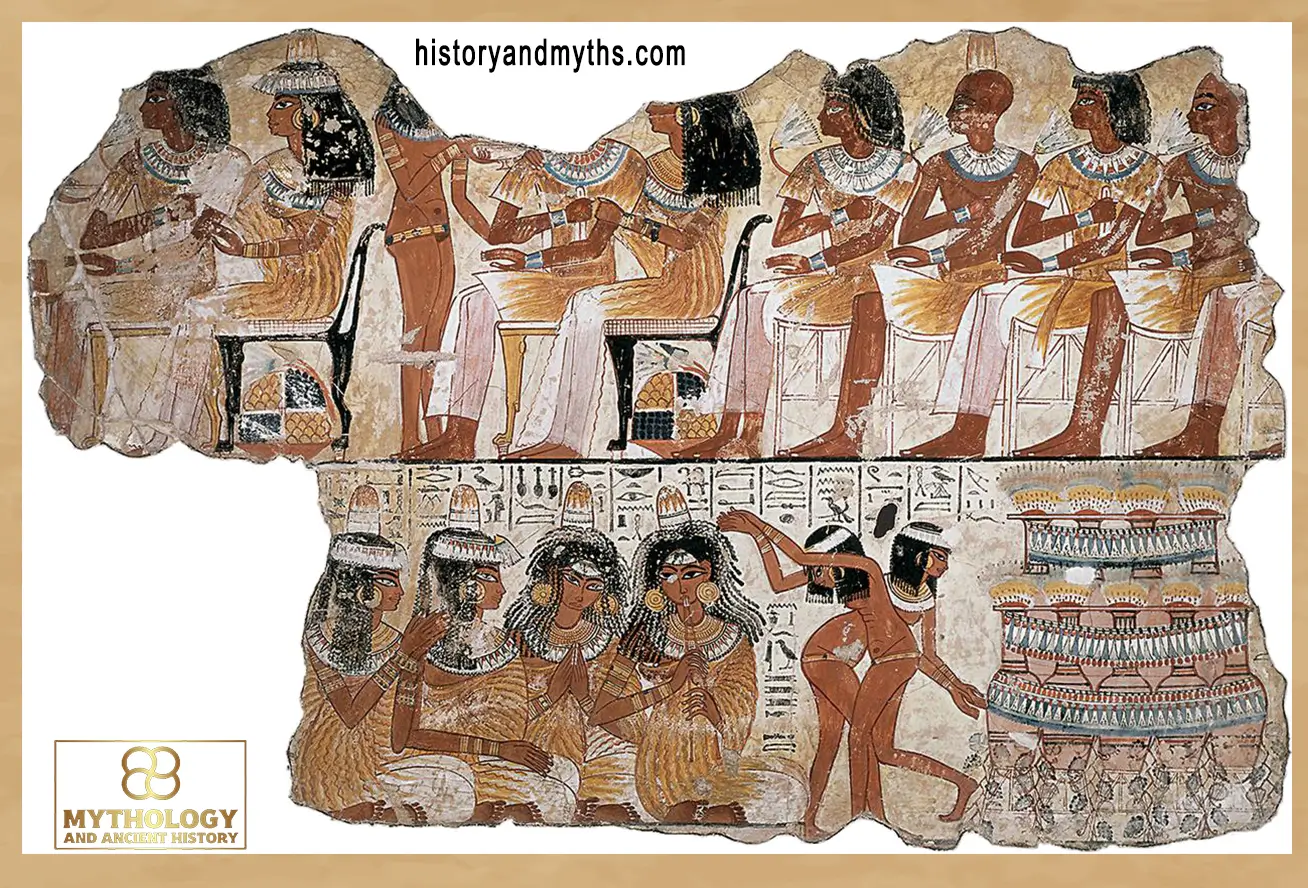
Elite hosting wasn’t only about feeding a guest—it was about showing capacity. Wealth created expectations: more variety, more organization, and sometimes professional-style service. In elite settings, hospitality could become a public statement about status, access, and refinement. The house didn’t simply receive a guest; it staged an event.
That difference matters because it changes the meaning of “generosity.” In an ordinary home, generosity is sacrifice or effort. In an elite home, generosity can be branding: a controlled demonstration that resources are abundant and the household is socially dominant.
The real comparison
Ordinary hospitality proves dignity through correctness. Elite hospitality proves power through surplus. Both serve the same function—building relationships and protecting reputation—but they do it at different scales.
Quick Infographic: Ancient Egyptian Hospitality in 6 Rules
- Welcome first — hospitality begins at the door.
- Seat with care — placement avoids insult.
- Offer relief early — water and calm tone matter.
- Serve what fits — “correct” matters more than luxury.
- Guests must show restraint — respect keeps honor intact.
- Hosting builds power — reputation turns into social security.
Hospitality and Reputation: Why Hosting Was Social Power
In ancient Egypt, hospitality was never neutral. It shaped reputation in a way that could follow a household for years. Hosting was one of the few social tools that turned private space into public value: people saw how you welcomed others, and they judged what kind of person you were.
Hosting created trust and obligation
A guest who has been treated well becomes tied to the host through expectation. Even without formal promises, hospitality builds invisible debt: respect returned later, help during need, support in disputes, or alliance in social networks. This is why hospitality is more than politeness—it’s investment.
Hosting protected honor
A household that hosted badly could be labeled weak, careless, or socially unreliable. That kind of reputation is dangerous in a society where relationships often determine safety. Good hospitality protected honor because it demonstrated control: the home is stable, the people are disciplined, the household can manage visitors without disorder.
What we can (and can’t) know
We can confidently describe hospitality as a social system because the same logic appears repeatedly: greeting, controlled seating, refreshment, and behavior expectations that protect both host and guest. We can also explain class differences because wealth changes hosting pressure.
What we should avoid is pretending every visit looked identical. Egypt was large, and traditions shifted by region, period, and household type. But the core principle holds: hospitality was social power, because it turned daily visits into reputation, bonds, and long-term security.
Key Takeaways
- Hospitality in ancient Egypt was a social system, not casual kindness.
- The visit began with greeting, seating, and early refreshment.
- Food and drink served as visible proof of respect.
- Good hosting meant comfort without chaos and control without stinginess.
- Guests were expected to show restraint, boundaries, and respect.
- Elite hospitality became status display, while ordinary homes focused on correctness.
Continue Reading
- Food and Drink in Ancient Egypt — staples, banquets, and what “serving” meant socially.
- Housing and Domestic Life in Ancient Egypt — privacy, home order, and household boundaries.
- Social Classes in Ancient Egypt — why hospitality looked different by rank.
- Family Life in Ancient Egypt — honor, reputation, and social expectations.
- Daily Life of Ordinary People in Ancient Egypt — survival routines and community rules.
FAQ: Hospitality and Guest Traditions in Ancient Egypt
How did ancient Egyptians welcome guests?
Guests were welcomed with a respectful greeting, proper seating, and early refreshment before food and longer conversation.
What was considered good hospitality in ancient Egypt?
Good hospitality meant offering comfort and respect without chaos, while keeping the household calm, clean, and socially controlled.
What food did Egyptians serve to guests?
Most visits relied on basic staples like bread and beer, while elite households could offer greater variety as a form of status display.
Did hospitality depend on social class?
Yes. Ordinary households focused on practical hosting, while elite hospitality often became a staged display of surplus and refinement.
What rules did guests have to follow?
Guests were expected to accept what was offered respectfully, avoid overstay, respect boundaries, and protect the host’s dignity.
Why was hospitality important in Egyptian society?
Hospitality built trust, created obligation, protected honor, and strengthened social bonds that mattered for long-term security.
Was hospitality only for friends and relatives?
No. Visits could also function as social maintenance, negotiation, and reputation management beyond close family ties.
What is the biggest mistake people make about Egyptian hospitality?
The biggest mistake is assuming hospitality always meant luxury banquets. In daily life, it was about correct behavior and dignity.
Sources & Rights
- Kemp, Barry J. Ancient Egypt: Anatomy of a Civilization. 2nd ed. London: Routledge, 2006.
- Shaw, Ian, ed. The Oxford History of Ancient Egypt. Oxford: Oxford University Press, 2000.
- Brewer, Douglas J., and Emily Teeter. Egypt and the Egyptians. 2nd ed. Cambridge: Cambridge University Press, 2007.
- Grajetzki, Wolfram. The People of the Pyramids: Everyday Life in Ancient Egypt. London: Duckworth, 2006.
- Meskell, Lynn. Private Life in New Kingdom Egypt. Princeton: Princeton University Press, 2002.
- Tyldesley, Joyce. Daily Life in Ancient Egypt: Recreating Lahun. London: Weidenfeld & Nicolson, 2003.
- David, Rosalie. Handbook to Life in Ancient Egypt. New York: Facts On File, 1998.
- Trigger, Bruce G., Barry J. Kemp, David O’Connor, and Alan B. Lloyd. Ancient Egypt: A Social History. Cambridge: Cambridge University Press, 1983.
Written by H. Moses — All rights reserved © Mythology and History