Oaths and Witnesses in Ancient Egypt: How Courts Proved the Truth
Oaths, witnesses, and legal proof in Ancient Egypt were the tools that turned a claim into a verdict—long before modern forensic evidence existed. Courts built “truth” through credible testimony, sworn statements, written records, and consistency under questioning. The system wasn’t naive, but it was vulnerable: whoever controlled witnesses and oaths could shape the outcome of justice.
What “Legal Proof” Meant in Ancient Egypt
Legal proof in Ancient Egypt was not a single object like a fingerprint or a lab report. It was a package of credibility—the kind of evidence that could convince officials that one version of events was more reliable than another. Courts were trying to produce a decision that could be enforced, recorded, and accepted by the community, even when absolute certainty was impossible.
That is why Egyptian proof relied on three foundations. First, witness testimony: who saw what, and whether multiple voices agreed. Second, oaths: a sworn statement that raised the cost of lying by attaching it to divine and social punishment. Third, records: written documentation from an administrative culture that tracked work, goods, duties, and obligations.
The key idea is that Egyptian justice created what we can call legal truth. A claim became “true” when it survived questioning, matched other testimonies, fit known records, and could be written down as a defensible outcome. Proof was not only about facts—it was about whether a story could stand inside the court’s logic without collapsing.
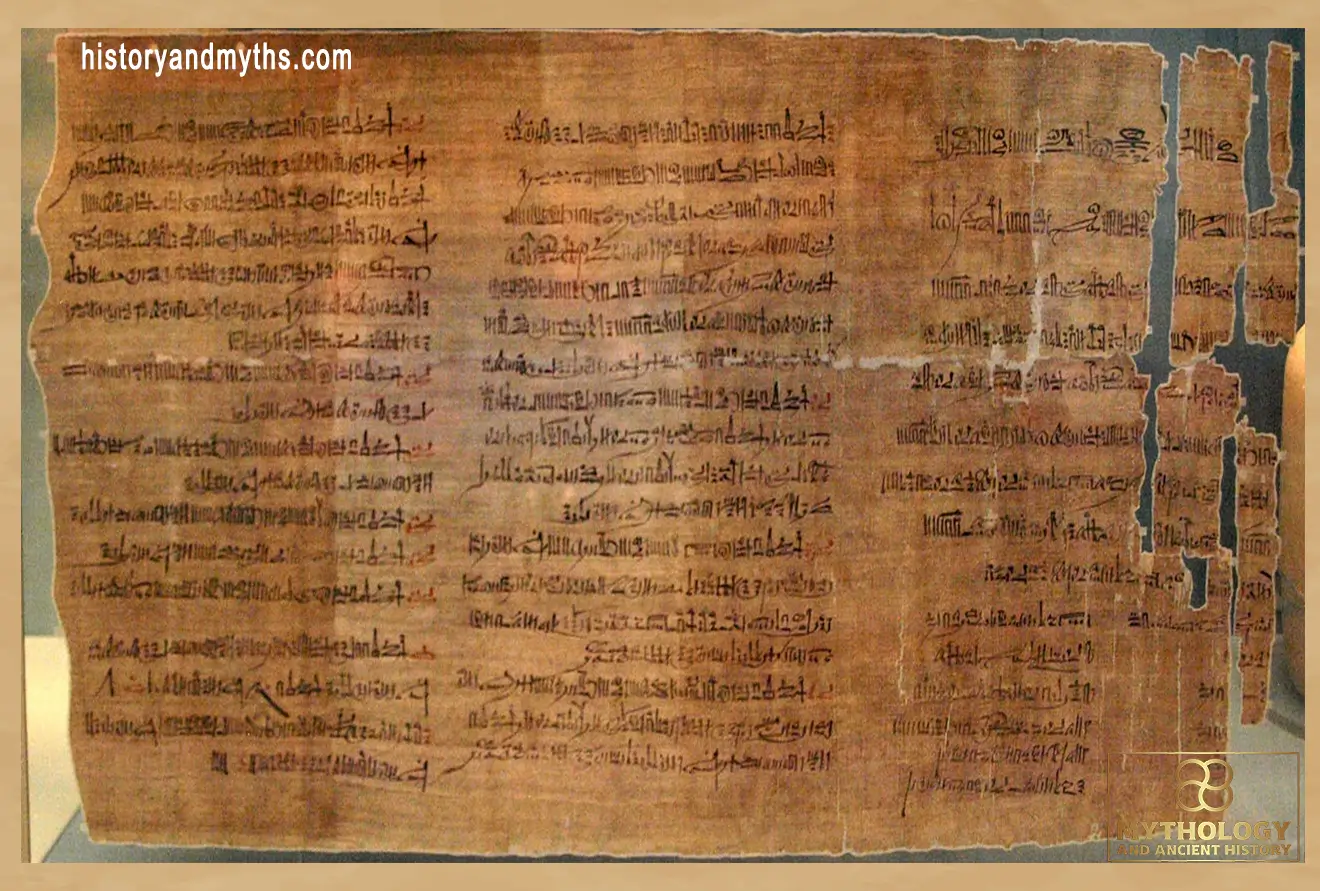
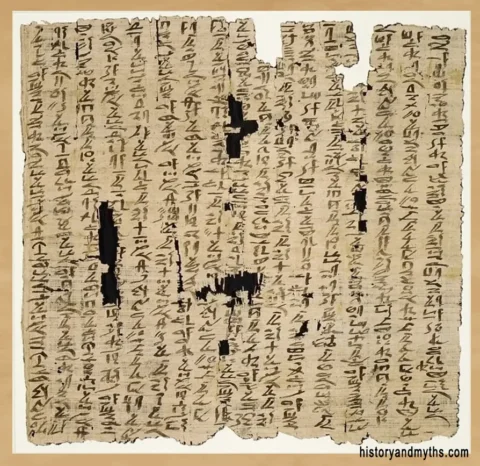
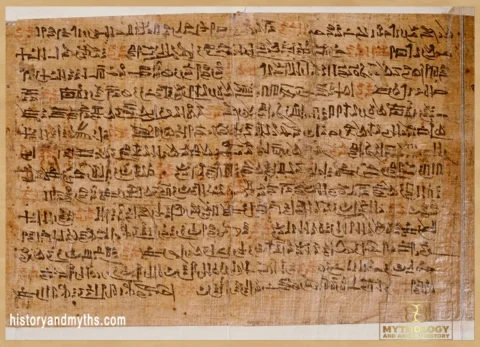
The Abbott Papyrus (EA 10221), official inspection record of royal tombs under Ramesses IX (c. 1110 BCE) — Source: Wikimedia Commons (CC BY-SA 3.0), photo by Captmondo (19 August 2008)
| Tool of Proof | What It Does | Best Used When | Main Weak Point |
|---|---|---|---|
| Written records | Creates fixed reference points | Wages, deliveries, duties, property claims | Missing or incomplete paperwork |
| Multiple witnesses | Supports credibility through agreement | Events witnessed publicly or locally | Bias, coordinated testimony |
| Single witness | Provides direct account | Minor disputes, personal transactions | Easy to challenge |
| Oaths | Forces commitment under pressure | Evidence is incomplete but verdict needed | Relies on social and religious cost |
| Credibility testing | Stress-tests stories for consistency | Contradictory claims and unclear facts | Depends on skilled questioning |
| Legal truth | Creates enforceable court decisions | Any dispute requiring closure | Not always the same as full reality |
The Proof Hierarchy: Which Evidence Was Strongest?
Egyptian courts did not treat all evidence equally. Some proof carried more weight because it was harder to fake, harder to deny, and easier to enforce. If you want to understand how cases were decided, the fastest way is to think in levels: what the court trusted first, what it used when stronger proof was missing, and what it treated as weak by default.
At the top were written documents and administrative records. A receipt, an assignment list, a delivery record, or an official note could lock a dispute into something concrete. A document did not automatically win a case, but it gave the court a fixed reference point that testimony had to explain.
Next came multiple independent witnesses. One person can lie. A coordinated group can also lie, but it is harder to maintain the same story across time and questioning. Courts could compare witness statements for consistency, and agreement across separate voices increased credibility.
After that came oaths, which often appeared when the court lacked a clean document or enough witnesses. An oath was not “evidence” in the modern sense, but it was a credibility amplifier. It forced a person to publicly stake their safety and honor on their statement. That pressure could break weak stories and discourage casual deception.
Near the bottom was a lone accusation without support. A single claim, unsupported by records, witnesses, or a strong oath, was vulnerable. It could trigger a trial, but it was the easiest type of “proof” to challenge. In a system built on credibility, the strongest evidence was the evidence that could survive repetition, comparison, and writing.
Witnesses: Who Was Believed, and Why
A witness in Ancient Egypt was not just someone who spoke. A witness was someone whose words could carry legal weight. Courts needed witnesses because most disputes happened in everyday life, where the only “evidence” was who saw an act, who heard an agreement, or who could confirm a transaction.
The strength of a witness depended on three factors. The first was independence. A person with no obvious benefit from the outcome was harder to dismiss. A witness who gained property, status, or protection from one side was automatically suspicious, even if they sounded confident.
The second factor was clarity and consistency. Egyptian courts were not hunting for dramatic speeches; they were testing whether a story stayed stable under questioning. A witness who changed details or avoided specifics looked unreliable. Consistency mattered because it made testimony usable as a written record.
The third factor was social credibility. Reputation functioned like legal capital. In a tightly connected community, officials knew who had a history of conflict, dishonesty, or instability. That background shaped how testimony was received, especially when stronger proof was missing.
So witnesses were not treated as equal voices. They were evaluated as sources. The court’s goal was not to collect opinions, but to filter testimony into something dependable enough to support a decision.
Oaths: When the Court Forced a Decision Without Perfect Evidence
Oaths mattered because they solved a problem Egyptian courts faced constantly: many disputes could not be proven with documents or enough witnesses. When the evidence was incomplete, the court still had to reach a decision that could be enforced. The oath was a tool for closing that gap.
An oath was not just a religious phrase. It was a legal mechanism that raised the cost of lying. The person swearing was effectively saying: my statement is true, and I accept the consequences if it is not. Those consequences were not only legal. They included loss of honor, social exclusion, and the fear of divine punishment. That combination made the oath a pressure test for credibility.
Oaths also worked as a way to stop endless disputes. If two sides kept accusing each other with no solid proof, the court could push the conflict into a decisive moment. A person who refused to swear looked guilty or uncertain. A person who swore falsely risked consequences that extended beyond the courtroom.
This is why oaths were powerful in Egyptian legal thinking. They created enforceable truth when hard evidence was missing. They did not replace proof, but they replaced paralysis. In a system built to preserve order, the oath was one of the cleanest ways to turn uncertainty into a verdict.
Written Records: When Administration Became Evidence
Ancient Egypt produced paperwork at a scale most ancient societies could not match. That administrative habit mattered legally because it created something courts always prefer: fixed references that do not change when people change their stories.
Written records were strongest in disputes tied to work and property. If a case involved deliveries, wages, assignments, storage, or temple goods, officials could compare claims against lists, notes, and receipts. A document did not need to be “perfect” to matter. Even a partial record could expose a lie by showing that a timeline or transaction could not have happened the way someone described it.
Records also reduced the power of pure accusation. A person might claim “I paid,” “I was ordered,” or “I delivered,” but a court could ask: where is the written trace? In many situations, the absence of documentation was itself suspicious, especially when a transaction should normally leave a record.
This is one of the most important facts about Egyptian legal proof: administration was not separate from justice. Bureaucracy created evidence. The more the state recorded, the harder it became to win a case through storytelling alone.
How Courts Tested Credibility (The Hidden “Method” Behind Verdicts)
Even without modern forensic tools, Egyptian courts were not passive. They did not simply accept a claim and choose a side. They used practical methods to test whether a story could survive pressure.
The first method was repetition. A person who tells the truth can usually repeat the same account with stable details. A person inventing a story often slips. Courts could ask the same question in different forms, at different times, to see whether the narrative stayed coherent.
The second method was comparison. Officials listened to multiple statements and checked whether they matched on core facts: the object, the time, the place, the sequence of events. Small differences might be normal, but major contradictions were a credibility alarm.
The third method was anchoring to records. If a claim involved duties, goods, or formal obligations, the court could test it against administrative reality. A story that conflicts with recorded work patterns or documented transactions is easier to reject.
The final method was forcing a commitment, often through an oath. When evidence was incomplete, the court could push a person into a high-risk statement that exposed whether they were confident or bluffing. In short, Egyptian courts produced verdicts by stress-testing stories until one version looked enforceable.
- Legal proof in Ancient Egypt was built from credibility, not forensic science.
- Written records were the strongest evidence because they fixed facts beyond storytelling.
- Witnesses mattered, but their value depended on independence, clarity, and reputation.
- Oaths were a decision tool when evidence was incomplete and the court needed closure.
- Courts tested credibility by repetition, comparison, and anchoring claims to records.
Did Egyptian courts require multiple witnesses?
Multiple witnesses strengthened a claim, especially when they were independent and consistent, but courts could still rule using records or oaths when witness support was limited.
Were oaths used only in legal cases?
No. Oaths also supported administrative promises, loyalty, and obligations, but they became legally powerful when proof was incomplete.
Could a written document override a witness?
Often yes, because records fixed details beyond memory, forcing testimony to explain the document rather than replace it.
How did courts deal with contradictions in testimony?
Officials repeated questions, compared statements, and tested which story stayed stable under pressure and matched known facts.
Was “truth” the same as “legal truth”?
Not always. Courts aimed to produce enforceable decisions based on credible proof, even when full certainty was impossible.
Could people refuse to swear an oath?
Refusal could damage credibility and suggest weakness, especially when the court treated an oath as the cleanest way to end dispute.
Why was witness credibility so important?
Because most everyday disputes had no physical proof, so justice depended on whether testimony could be trusted and recorded.
Sources
- Allam, Schafik. Recht und Rechtspflege im Alten Ägypten. Munich: C.H. Beck, 1991.
- Assmann, Jan. Ma’at: Gerechtigkeit und Unsterblichkeit im Alten Ägypten. Munich: C.H. Beck, 1990.
- Baines, John, and Jaromír Málek. Atlas of Ancient Egypt. Oxford: Phaidon, 1980.
- Černý, Jaroslav. A Community of Workmen at Thebes in the Ramesside Period. Cairo: Institut Français d’Archéologie Orientale, 1973.
- Davies, W. V. “The Law in Ancient Egypt.” In The Oxford Encyclopedia of Ancient Egypt. Oxford University Press, 2001.
- Gardiner, Alan H. Egypt of the Pharaohs. Oxford University Press, 1961.
- Haring, Ben J. J. Divine Households: Administrative and Economic Aspects of the New Kingdom Royal Memorial Temples in Western Thebes. Leiden, 1997.
- Johnson, Janet H. Thus Wrote ’Onchsheshonqy: An Introductory Grammar of Demotic. Oriental Institute, University of Chicago, 2000.
- Kemp, Barry J. Ancient Egypt: Anatomy of a Civilization. 2nd ed. Routledge, 2006.
- Lippert, Sandra. “Law Courts.” UCLA Encyclopedia of Egyptology. University of California, Los Angeles, 2012.
- Menu, Bernadette. Recherches sur l’histoire juridique, économique et sociale de l’Égypte ancienne. Institut Français d’Archéologie Orientale, 1998.
- Meskell, Lynn. Private Life in New Kingdom Egypt. Princeton University Press, 2002.
- Peet, T. Eric. The Great Tomb-Robberies of the Twentieth Egyptian Dynasty. Clarendon Press, 1930.
- Shaw, Ian, ed. The Oxford History of Ancient Egypt. Oxford University Press, 2000.
- Teeter, Emily. Religion and Ritual in Ancient Egypt. Cambridge University Press, 2011.
- VerSteeg, Russ. “Law in Ancient Egypt.” Arizona Journal of International and Comparative Law.
- VerSteeg, Russ. “Legal Procedure and the Law of Evidence in Ancient Egypt.” Tulane Journal of International and Comparative Law 10, no. 1 (2001): 1–32.
- Westbrook, Raymond, ed. A History of Ancient Near Eastern Law. Brill, 2003.
- Wilkinson, Toby. The Rise and Fall of Ancient Egypt. Random House, 2010.
- Redford, Donald B., ed. The Oxford Encyclopedia of Ancient Egypt. Oxford University Press, 2001.
- Allen, James P. Middle Egyptian: An Introduction to the Language and Culture of Hieroglyphs. Cambridge University Press, 2014.
- The British Museum. Abbott Papyrus (EA 10221).
- The British Museum. Judicial Papyri Collection.
- The Griffith Institute. Ancient Egyptian Legal Papyri.
- UCLA Encyclopedia of Egyptology. “Law Courts.”
- UCLA Encyclopedia of Egyptology. “Administration.”
- UCLA Encyclopedia of Egyptology. “Deir el-Medina.”
- University of Chicago – Oriental Institute. Ancient Egyptian Legal Texts.
- The Metropolitan Museum of Art. Egyptian Administrative Documents.
- Encyclopaedia Britannica. “Ancient Egyptian Law.”